Sabtu, 23 Juli 2016

Magearna is Reason and Eve


Many Japanese animated movies are meditations on the problem of science and the West, and attempt to present solutions as to how the Japanese - as represented by Satoshi, the boy with an "electric rat" and a woman's voice - can save the world. The latest movie (Pokémon the Movie XY&Z: Volcanion and the Mechanical Magearna) from the Pokémon franchise, written by Atsuhiro Tomioka the same writer as the last, replaces Hooper and mini Hooper with Volcanion and Magearna. Volcanion, like Hooper, has a hoop, and is a bit too strong for his and his surroundings good. Magearna is the first robotic pocket monster built by the those blue eyed, blonde, science fanatics based upon Pokémon. She has a metal body, crucifixes for pupils, and a scientific cog-bonnet. Apart from having her own shell-like monster ball, into which she retreats when she is afraid, and the ability to produce bunches of flowers from her hands that put others (other than Volcanion) in a romantic mood, she does not do much, but she has great power. The reason for this is related to her removal "soul hear" which seems to be the very core of science. This heart soul is also said, in the catch copy for the movie, in contradistinction to almost all other Pokémon, to have a voice. For my money, Magearna is the linguistic Other who whispers in the hearts of Western "men". Sometimes as listener she is called Reason, by Jefferson and Dawkins, and shown the greatest respect. "Fix reason firmly in her seat, and call on her tribunal for every fact, every opinion (Jefferson see Dawkins, 2008, p64) But her first name was I think Eve, the first in a long line of Western "robotic" pocket monsters. She is robotic in so far as she is linguistic. She doesn't just bond, and sit on the shoulder of her trainers and friends but alas, whispers to them, in romantic voice of her soul heart. As such she is extremely dangerous, the Sibyl that Heraclitus writes of. This Pokémon movie reached the conclusion that Volcanion should sacrifice himself to save her, and that she should be taken from the land of the blonde blue eyed men and returned to the wild. I thought Jarvis, the lead scientist and baddie (who is nonetheless forgiven as Japanese baddies always are) a little similar to David Bowie. http://flic.kr/p/KpjTEv

Kamis, 21 Juli 2016

Trump happened because conservatism failed


Tyler Cowen (now a Bloomberg View colleague of mine) took a crack at this question back in February, and I've been thinking about it ever since. Here's my unified theory of why a guy like Trump managed to take over the Republican party this year, when nothing similar had ever happened before in living memory.

First of all, a note about causality. Most events are the result of a chain of causes - if one link in the chain falls apart, the event doesn't happen. This is not the way human intuition naturally thinks about causality - we instinctively imagine each event as the sum of causal factors, and attribute some percent of responsibility to each factor. But with a causal chain, each link is responsible for 100% of the causality. Just like the marginal value of a right shoe and the marginal value of a left shoe are both equal to 100% of the total value of a pair of shoes.

So I think that Trump is a special human being. He's a reality star, a possibly-faux-billionaire celebrity who's really good at overselling himself, and has essentially no scruples. There aren't many of those in the United States who want the job of president. In fact, there is probably only one. If Trump had been killed in a car accident in 2014, we might be looking at a much more typical Republican candidate, with the Republican establishment retaining a shaky but intact grasp on the party.

But that's just one link in the chain - one precondition for the Trump Takeover. I think there are two other main links here: 1. The dramatic weakness of the Republican establishment, and 2. The existence of a Trump-friendly voter bloc in the first place.

In the past, the Republican presidential candidate was usually a gray, bland figure, a stalwart conservative but not a fire-breathing one, a man who had worked his way up the ranks. Romney, McCain, Bush II, Dole, and Bush I all fit this description - Reagan was the only possible exception within my lifetime, and even he didn't deviate too far from this model. As a conservative, the Republican nominee would support tax cuts, a business-friendly attitude, a tough-guy attitude toward America's enemies and rivals, and traditional family values based on Christianity. That's what conservatism was.

But in the past fifteen years, the three pillars of conservatism - economic, foreign-policy, and social conservatism - have all had huge, dramatic failures.

Economic conservatism had two big failures. The first failure was when the Bush tax cuts failed to reverse income stagnation:


The second failure was when a lax regulatory climate appeared to give rise to a financial crisis that devastated the job market. That second shock was so huge that it has all kinds of people questioning neoliberalism itself - big, comprehensive alternative policy paradigms like protectionism, socialism, and industrialism are now being openly considered. Those alternatives may or may not gain traction. But certainly, the formula of "cut taxes and let businesses do as they see fit" is now pretty discredited. Some older intellectuals continue to fight doggedly for this economic program, but nowadays they are rightfully ignored.

Simple truth: Economic conservatism failed in the 2000s and 2010s.

Next, foreign policy conservatism. This failed during the George W. Bush administration, when Bush turned bellicose rhetoric into bellicose reality with the disastrous Iraq War. The Iraq War was a disaster because despite winning the war pretty handily and taking low casualties, we received no gains. We spent massive amounts of money and thousands of lives, and temporarily wrecked our international prestige, only to turn Iraq from an unthreatening petty dictatorship into a failed state and a breeding ground for ISIS. It was a failure of the modern conservative approach to war itself.

A more minor failure was the seeming emptiness of Bush's bellicose rhetoric when it came to actual threats. Under Bush's watch, Putin's power grew inexorably, and North Korea got nukes, while Bush barked impotently. This wasn't nearly the kind of disaster that Iraq was, but it probably unsettled some Americans, and it certainly unsettled the foreign-policy establishment.

So foreign-policy conservatism failed in the 2000s.

Finally, social conservatism. This was the biggest failure of all. Social conservatism promised to restore family values by promoting Christianity and resisting things like gay marriage. But as Charles Murray and many others have documented, working-class white America professes more traditional values, but doesn't practice them. On the whole, working-class whites are no longer going to church, are no longer getting married (or staying married), and are having kids out of wedlock - in other words, traditional family values are dying among the very people who were most receptive to social conservatives' message. Here's a graph from the Washington Post:


Social conservatism also failed to make its case to young Americans. Secularism is rising rapidly. Gay marriage enjoys wide support, especially among the young. Americans have resoundingly rejected the values pushed on them by Christian conservatives in the 80s, 90s, and 00s. Here's a graph from Pew:


So social conservatism also failed in the 2000s and 2010s.

Add all this up, and what do you get? A massive, total failure of all three pillars of modern conservatism within a 15-year period. It's little wonder, therefore, that Trump voters were unwilling to vote for Republicans who offered them only more of the same - the same economic policies that seemed to cost them their jobs and businesses and wages, the same foreign policies that embarrassed their country, the same social policies that had done nothing to save their families. Even when the conservative ideology was offered with maximum fire and vitriol, in the person of Ted Cruz, they weren't willing to bite. So they looked around for something else, and Trump was there.

So that leaves us with the final link in the chain: the question of why Trumpism filled the void that conservatism created with its rapid collapse. Why are Trumpians Trumpians in the first place? That's a question I don't think I know how to answer. It's probably something having to do with race, religion, tribalism, xenophobia, etc. It very well might have something to do with globalization and import competition from China. Or it might just be a faction that was there all along, and supported conservatism for a while out of convenience. Or all three. Or something else. I don't know.

But whatever the reason for Trump's support, a necessary piece of the Trump takeover equation was the collapse of the conservative ideology. That epochal event should be a lesson to us all - it's what inevitably happens to an ideology when it succumbs to overreach, dogmatism, and an echo chamber.

I hope I don't ever have to watch the same thing happen to the American left.

Rabu, 20 Juli 2016

The Chinese and The Japanese

The Chinese and The Japanese
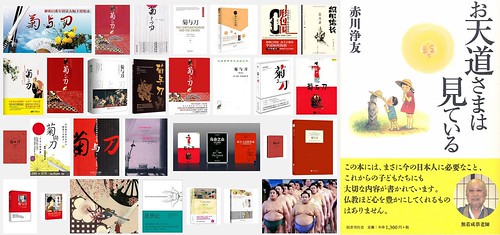
Ruth Benedic's (1946) classic "Chrysanthemum and the Sword" has been popular in China (translated as 菊与刀) selling 70,000 copies in 2005 alone, since it would provide an explanation how the Japanese managed to kill so many Chinese and yet exhibit a level of remorse that the Chinese feel to be very inappropriate. Ruth Benedict's answer is that the Japanese lack a conscience, caring only what other's think about them. A great deal of Japanese believe this theory, which itself originates in a disgruntled Japanese called Robert Hashimoto (Lummis).

More contemporary Japanese detractors of Benedict's theory do not rarely argue that the Japanese do in fact have conscience, under the conventional meaning of that term, but rather that "conscience" in the sense of internal, self-directed, self-reproval simply does not exist. The main reason for this is that they are aware that they judge themselves visio-aesthetically, and this is not something that one can do from inside ones own head. The Japanese forget that the mind is not inside the head -- it is easy to do, I have -- but rather the other way around.

The Japanese are therefore in large part blissfully ignorant of the origin of their own morality, which is, the same as that of the Chinese. Both believe that in addition to the censure of other people, heaven is also judging.

In Japanese parlance the kind old sun is watching (otentou sama ga mite iru. お天道さまがみている。See e.g. Akagawa, 2015) and they'd feel her displeasure should they do anything bad.

This does not explain why the Japanese were able to kill so many Chinese, nor why they do not feel more remorse. In order to understand that one would have to read other books, mainly of a more historical nature.

I hope that the Chinese realise that in fact the Japanese do have a conscience before The Chinese and The Japanese come to blows again.

The images above left are the result of an image search for "”菊与刀” 销量" meaning "sales of 'Chrysanthemum and the Sword'" in Chinese, and the cover of a non-academic book entitled "The Kind Old Sun is Watching" (Akagawa, 2015)

Akagawa, J. 赤川浄友. (2015). お天道さまは見ている. 国書刊行会.
Benedict, R. (1946). The chrysanthemum and the sword; patterns of Japanese culture.

Selasa, 19 Juli 2016

Criticisms of NGDP futures targeting


Zak David, a quant trader, recently wrote a post criticizing Scott Sumner's idea of NGDP futures market targeting. Sumner fired back with a defense of the idea, and Zak responded with an update to his post.

I want to see if I can explain Zak's ideas in a little greater detail. Basically, he's right.

To recap, the original NGDP futures targeting idea goes something like this:

1. The Fed sets an NGDP target (say, 5%).

2. The Fed then offers to enter into any number of NGDP futures contract with anyone who wants, at a price equal to the target. So if I take a $1000 long position in these futures, and NGDP comes in at 10% (double the target), I get $2000 back. If I take a $1000 short position, and NGDP comes in at 2.5% (half the target), I get $2000 back. And so on. The Fed is always on the other side of the deal, and I can make as many of these deals as I want (assuming I can post sufficient margin).

3. The Fed then makes monetary policy automatically in response to people entering into these contracts with it. If a person takes a long position in NGDP futures, the Fed tightens a bit to make sure NGDP doesn't actually come in above target.

Zak had three main criticisms of this idea:
A) Informed traders will not trade in this market,
B) Manipulators will trade in the market, and
C) Data revisions will introduce noise into monetary policy.

I'll ignore (C) and try to explain (A) and (B). Keep in mind that I'm not saying anything new in this post; just restating Zak's argument in my own words.

First, let's talk about why informed traders - the people we want to trade these contracts - won't even show up. Suppose I have some knowledge that the Fed doesn't, about macroeconomic forces. For example, suppose I see a big inflationary shock coming that, if the Fed doesn't counteract it, will raise NGDP to 10%. Will I take a long position in an NGDP futures contract in the market described above, thus revealing my private information to the Fed and helping it make better policy?

It depends. IF the Fed hits its NGDP target on average, then I will not. Because in that case, on average, I would lose money betting on the Fed not hitting its target. Why the heck would I bet good money on 10% - or 2%, or 6%, or 5.001% -- when the probability distribution of NGDP is distributed symmetrically around 5%? A negative expected return with positive risk? No thanks!

If the Fed DOESN'T hit its target on average, then I might be able to make some money entering into this futures contract. But if the NGDP futures targeting mechanism doesn't lead to the Fed hitting its target on average, why the heck would we want to use that mechanism to make monetary policy in the first place??

So IF the mechanism works, no informed traders would use it. Hence, whatever information they have about macroeconomic shocks will NOT reach the Fed.

That is criticism (A).

OK, so who definitely would trade in that futures market? Manipulators.

Suppose I'm just some deep-pocketed jerk with zero knowledge of the macroeconomy, and I want to make some free money at the expense of the country and the bond markets. Here's what I do. First, I sell TIPS and buy Treasuries - in other words, I bet against inflation. Then I take a huge amount of long positions in NGDP futures. The Fed tightens monetary policy. My TIPS go down relative to my Treasuries, and I pocket the spread. Then I take a bunch of short positions in NGDP futures -- at the exact same price as before -- to net out my previous long position.

I have manipulated the TIPS and Treasury bond markets. I have caused monetary policy to change. And I have made arbitrage profits.

This is bad, because it introduces noise into monetary policy, and it also causes the bond markets to be less efficient.

That is criticism (B).

Both of these criticisms are valid. In other words, an NGDP futures targeting policy as stated above would introduce zero information to the making of monetary policy, while introducing a nonzero amount of noise. You'd be better off setting monetary policy according to  a random number generator, because at least then you wouldn't be letting crooks rig the bond markets.

So Zak David is correct. The idea is not sound. If you want to use NGDP futures targeting to set monetary policy, you're going to have to think of a much better system than the one described above.

(Fun bonus point: Why doesn't criticism (A) apply to all financial markets? That's probably the biggest question in the field of market microstructure. Check out the Glosten-Milgrom model and the Kyle model for two classic answers to that question.)


Updates

1. Everybody is asking me to link to these old posts (post 1, post 2) by Mike Sankowski criticizing Sumner's idea. Check them out if you're interested in this debate (and if you're not, why have you read this far?).

2. As expected, Scott Sumner fires back. He accuses Zak and me of disbelieving the EMH. Well, does anyone think the EMH holds when the government pegs the price of assets? If the government offered to buy and sell infinite amounts of Tesla stock futures at the price of $200 a share, would that market be efficient? No, it would not. Would $200 be the best estimate of Tesla's future earnings? No, it would not. Scott, just because you call something a "market" doesn't mean it's efficient.

Sumner seems to have thought very little about how markets actually become efficient. Scott, you need price discovery. Which means you need informed traders to trade. Informed traders' trades are the mechanism by which information gets from the world into the price. If informed traders don't trade, the price is based on some combination of A) noise, and B) manipulation. Informed traders only show up if they can profit by trading on their information. For informed traders to profit, someone else must lose money. In most models of market microstructure, the money is lost by liquidity traders (sometimes called "noise traders", though that term is now usually used to mean fools who trade overconfidently on false information).

In Sumner's "market", the only liquidity trader is the Fed itself. If the Fed sets policy such that A) informed traders can make money trading against the Fed, and B) the Fed offers infinite liquidity, that means that informed traders can make infinite money at the Fed's expense. But the Fed controls policy. It can make very, very, very sure it does NOT lose infinite money to informed traders. If the Fed provides infinite liquidity, the only way for the Fed to make sure that it doesn't lose infinite money to informed traders is for the Fed to make sure it doesn't lose any money to informed traders. (Note that this would most likely involve setting monetary policy to overreact to any trade.)

Hence, an informed trader would have to be dumb to trade in Scott's market, because trading in Scott's market means fighting the Fed and losing. Hence, no informed traders will show up. So the only traders who do show up will be A) liquidity/noise traders, B) fools, and C) manipulators. Hence, if the Fed sets monetary policy in reaction to trades in Sumner's market, it will set monetary policy purely in reaction to noise and/or manipulation.

"I am, Because you are"

"I am, because you are"
The sign reads "I am, because you are" or "You are, so I am," which is the philosophy of interdependence (Markus & Kitayama, 1981), or ubuntu, in a nutshell.

Note however that this Japanese interdependence is in the world of speech. The second line reads, "Lets hail each other, and thereby, together do our best." This the above is a slogan encouraging greetings such as "good morning" and "g'day" which the Japanese favour even more than Crocodile Dundee. In the world of language, the Japanese subject, their "I" is "you for you" (Mori, 1999, p.163 complete quote again below).

The interdependence of the Japanese visual self is a little more nuanced. The visual self-encourages and requires an awareness of the social nature of self, and interdependence due to the scopic necessity of focusing upon a surface. This ostensible 'externality' convinces even the Japanese that they are out and out collectivists.

But in the Japanese case, they also believe that the 'the kind old sun is always watching' (See e.g. Akagawa, 2015). Their belief gives them a good measure of independence, and Morality with a capital M. Even if 'everyone else is doing it', the Japanese avoid doing things that look bad because the kind old sun can see them, and they'd feel her displeasure should they do ugly things.

Akagawa, J. 赤川浄友. (2015). お天道さまは見ている. 国書刊行会.
Mori, A. 森有正. (1999). 森有正エッセー集成〈5〉. 筑摩書房.
扨(さ)て私は、「日本人」において「経験」は複数を、更に端的に二人の人間(あるいはその関係)を定義する、と言った。それは一体何を意味しているのであろうか。二人の人間を定義するということは、我々(日本人)の経験と呼ぶものが、自分一個の経験にまで分析されていない、ということである。換言すれば、凡ての経験において、それをもつ主体がどうしても「自己」というものを定義しない、ということである。肉体的に見る限り、一人一人の人間は離れている。常識的にはそこに一人の主題、すなわち自己というものを考えようとする思惑を感ずるが、事態はそのように簡単ではない。それは我々において、「汝」との関係がどれほど深刻であるかを考えてみればある程度納得が行くであろう。もちろん「汝」ということは、日本人のみならず、凡ゆる人間にとって問題となる。要はその問題のなり方である。本質的な点だけに限っていうと、「日本人」においては、「汝」に対立するのは「我」ではないということ、対立するものもまた相手にとっての「汝」なのだ、ということである。私はけして言葉の綾をもてあそんでいるのではない。それは本質的なことなのである。「我と汝」ということが自明のことのように、ある場合には凡ての前提となる合言葉のおうに言われるが、それはこの場合当て嵌まらない。親子の場合をとってみると、親を「汝」として取ると、子が「我」であるのは自明のことのように主和得る。しかしそれはそうではない。子は自分の中に存在の根拠をもつ「我」でなく、当面「汝」である親の「汝」として自分を経験しているのである。Mori, 1999. p.163

Minggu, 17 Juli 2016

The Light that Watches and Protects

The Light that Watches and Protects
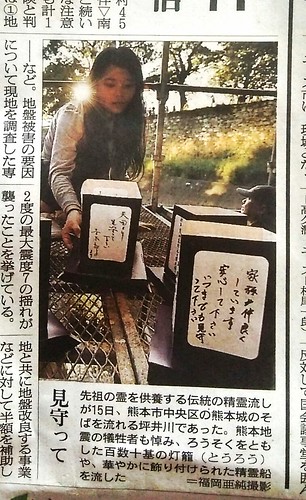
The Japanese represent their ancestors by floating lanterns, that watch over and protect the living. The message, "don't worry, we are getting along together really well. Please watch over and protect us forever," is written on the lantern on the right. The " please watch over us" on the young lady's lantern is prefaced by "Kind old Sun*" since the Japanese traditionally believe that ancestors merge with the Sun(goddess), who is always watching and protecting. The visual aspect of the Japanese Other, watching and protecting as it must an 'external' appearance, convinces most that the Japanese are more collectivist and conformist, but the whispering that Westerners do, though it seems solitary, is no less social. We will realise this eventually.

That it seems as if Tiger Woods' head is appearing from a lantern bottom right is a mere coincidence.

*The literal translation is more like "Mister/Madam Sun". The Japanese salutation "sama" is genderless. "Kind old Sun" is a term of respect and endearment for the sun, like the Japanese original, from Wilfred Owen's poem, Futility.

Central image by Azumi Fukuoka. (2016/7/16). Asahi Newspaper. p1.

お取り下げご希望の場合、下記のコメント欄か、nihonbunka.comのメールリンクまで御一筆いただければありがたいです。

Sabtu, 16 Juli 2016

Secretary and the Beast by Yuu Takahashi

Secretary and the Beast by Yuu Takahashi

This post is of an adult, sexual nature.

At the end of the manga, the "beast" of a company boss has very graphically represented relations every which way with his secretary (aslo) male, in the company shower rooms.

The strange thing is that this is part of a genre of comics (bishounen ai or perhasp in this case close to Yaoi) read predominantly by young Japanese girls, perhaps in their late teens. The reason for this, I believe is, that traditionally in Japan it is only female sexuality and desire which is considered taboo, so as long as their are only blokes, then, while smutty and embarassing, there is nothing really bad about it.

Each society hides the harsh reality of the sexual desire that is at its foundation.

Japanese society is based upon rearing children so wombs, whiles and reality of women's desire is hidden. Women appear only as pretty young men.

Western society is based upon horizontal adult to adult "love." (Childrearing is a bit of a "curse.") The above sort of pornography is a mirrored in that which uses lesbians to titillate Western men. In extremis, the male organ and male desire is hidden or completely absent. Men only appear as vorascious lesbians.

Each to each, the ultimate horror, is unhorrible. At the end of the day, this does not bode well for Japanese Western international relations.

おとりさげごきぼうのばあいはnihonbunka.comのめーるりんくまで