Rabu, 31 Desember 2014

What can be done about the gender problem in economics?


A little while ago, I wrote a Bloomberg View article highlighting some research showing that the economics profession is more biased against women than are the natural sciences or the other social sciences. Following that article, I received quite a number of emails agreeing with what I wrote, and offering opinions about what can be done.

By far the most common suggestion was just to raise awareness of the problem. The modal comment was something along the lines of "I never realized there was a gender problem in econ, but recently I've started noticing it more and more." That is very encouraging. The more economists realize that something is fishy, the more they will act to counter it in their daily lives.

Raising awareness can be done at the individual level and at the official level. Regarding individual-level awareness, Frances Woolley has a great blog post on the subject:
"Sexism" is not the result of some high level conspiracy. It is the product of millions of every day actions by thousands of ordinary people...  
[A] scholars's reputation and impact is determined by the decisions of others: who they choose to acknowledge, who they choose to network with. Every single active academic can, through the citation and other decisions they make every day, influence other academics' reputations - and thus the probability that they will receive tenure or get promoted.   
Who do you cite? If you're like most people, you're more likely to cite the seminal work of some well-known male academic than the work of a female scholar... 
Do you give women credit for their ideas? Just about every woman has had the experience of sitting in a committee, saying something, and having her contribution ignored. A man will then restate her point, and he is listened to, and receives credit for the idea... 
How do you word your letters of reference? Do you use the same adjectives to describe women and men? Or are women delightful, pleasant, conscientious and hard-working while men are strong, original, insightful and persistent? 
Who do you invite to present at conferences or departmental seminars? If a man, do you turn down invitations to participate in conferences with all-male line-ups (see the gendered conference campaign)? Do you make it easy for female colleagues to come for a drink in the bar after a seminar by corralling them into the bar-going group?  
The economics profession is far from perfect...and the power to change it lies within every one of us.
Well said.

Woolley also points out some potential problems with Ginther and Kahn's research (which inspired my post). But that doesn't diminish the case for raising individual awareness in the way Woolley describes.

As for official awareness, things get trickier. As Woolley points out, it's the natural instinct of organizations like the AEA, universities, and journals to try to fight discrimination by giving women more responsibility. But in academia, responsibilities - like department chairs and committee memberships - are often detrimental to a professor's career rather than helpful.

A better way, in my opinion, is to strengthen and increase support for organizations designed to investigate and highlight the gender problem. The main such organization is the Committee for the Status of Women in the Economics Profession, an AEA committee. The AEA might, in the future, increase the committee's size and funding, or perhaps the number of paper sessions allocated to the committee. It also might promote the committee more prominently on its website and in the events at the annual meeting.

As for universities, more might follow the lead of Harvard, whose Task Force on Women Faculty put out an interesting report in 2005 (the link is courtesy of Anke Kessler, head of the Canadian Women Economists Network).

How can journals help? Well, they can invite some publications by top researchers on the subject of gender discrimination in econ. As Frances Woolley points out, Ginther and Kahn's paper leaves some stones un-turned. The more research there is on the topic, the more we will know about exactly where the problem lies.

A final player is the media at large. The media can help highlight the increasing contributions of female economists, instead of ignoring them.

The overall hope here is that gender discrimination in economics is like the Phillips Curve - that the more we believe in it, the more it goes away in reality. Ideally, everyone should do their part.


Update: Here is a piece in Quartz by Miles Kimball and an anonymous co-author, giving first-hand accounts of the culture of sexism in econ.

Minggu, 28 Desember 2014

Scott Sumner on taxes


Scott Sumner has a reply to a BV piece of mine in which I suggested that the labor disincentive effect of income taxation is relatively modest right now in the U.S.

Scott:
The required number of hours worked is itself endogenous.  In Europe, required yearly hours are less than in the US, due to higher taxes. 
This assertion might be true. If Scott has evidence to back up this claim, he does not present it in this post.

Scott:
Second, when you tax people, they are poorer, and they need to work more to maintain their standard of living. 
This is a common misconception that I see all the time.  There is no first order effect of taxes on national income, as the tax money gets recycled into the economy.  Now it’s true that the government might waste the tax money, leaving a country poorer, but in that case it would be more accurate to say that government waste causes people to work harder.  In modern economies most extra spending at the margin goes back in transfer programs.  Since national income doesn’t fall from the direct impact of taxes, there is only a substitution effect on labor supply, not an income effect.
Well, this would be a good point if taxes left income unchanged - in other words, if tax revenue was redistributed lump-sum to the people from whom it was extracted, as is the case in many economic models. However, if taxes represent income redistribution - as they often do in the U.S. - this is not the case, and we do need to think about income effects. In particular, our tax system is highly progressive - rich people pay most of the taxes, poor people get most of the services. Thus, if we want to think about whether taxes make the rich work less, we do need to think about income effects, contra Scott.

Scott:
You don’t want to use time series data, as there is a long-term downward trend in hours worked due to increasing affluence. 
Of course, but this does give you some general idea of how much we might increase labor supply (or fail to increase it) by cutting marginal tax rates. The long-term trend really seems to dominate. Of course, this by itself is not dispositive, but that's why I mentioned it.

Scott:
Lower income people face a much higher implicit MTR than in the 1950s and 1960s.
This is a good point, and I probably should have mentioned something about this in my article (I was focused on the idea of taxing the rich). Casey Mulligan has argued that implicit taxes (from benefit phase-outs) are high. Paul Krugman has also made this argument. I'd like to see more research on it, but it's a very important point, and one that is totally left out of the discussion in most U.S./Europe comparisons.

For a rundown of the relevant research on taxation and labor supply, see these fun slides. (hat tip to Claudia Sahm)

Sabtu, 27 Desember 2014

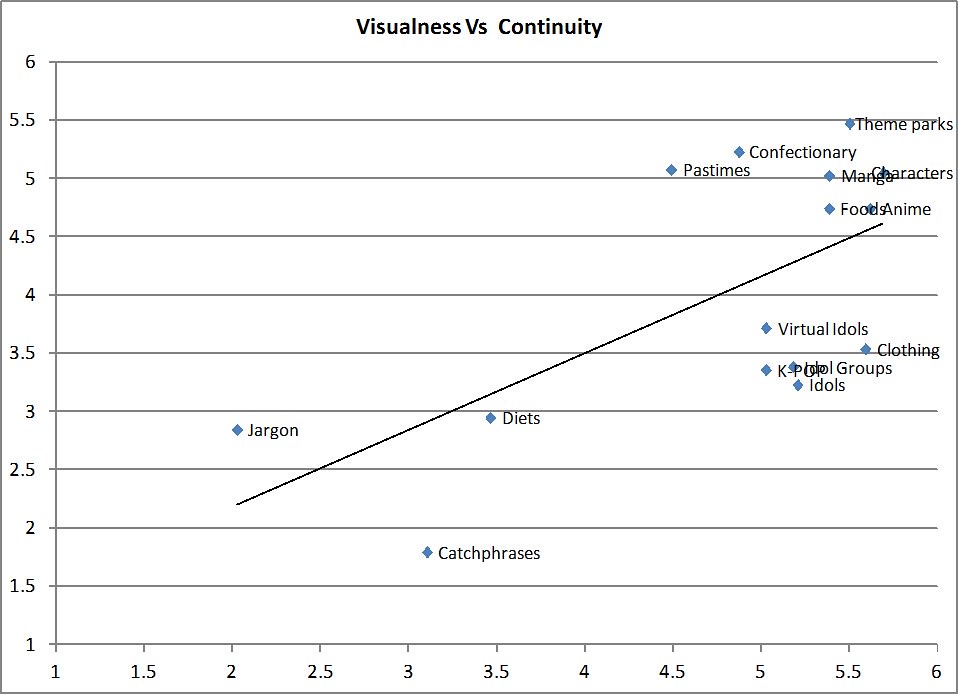
Visualness Vs. Continuity


The late great Donald Ritchie wrote an incisive but somewhat disparaging book about Japan in which he claimed that Japan is an "Image Factory," forever churning out fads and fashions. It seemed to that part of this is true. Japan is very good at manufacturing images, in the form of Anime, manga, characters (such as Kumamon or Kitty), architecture, and all the manufactured things from cars to cameras that Japan prides itself in. But on the other hand, I do not believe that they are in the slightest bit faddy or merely a fashion. Since Aristotle Westerners have argued that the voice, narration, ideas are the vector of identity and the soul whereas images are mere images, the stuff of fads and fashions. This is a Western prejudice.

In Japan continuity, identity and soul resides in the visual and my seminar student, Masaki Abe (2014) appears to have proved it. In an initial experiment we asked for social phenomenon that have longevity and continuity and those that do not, those that are faddish. In a second experiment, subject were required to rate these phenomenon according to the extent to which they were visual and had continuity. It was found as predicted that there is a strong positive correlation (r=0.64) between visuality and continuity in Japan.

Jargon included also "modes of speech" such as speaking like a posh person, and was considered, along with diets, and the catch phrases of comedians to be the most faddish phenomenon there are. Maruyama Masao claimed that this faddishness extended to theories too. Perhaps my theory will have its day.

Hello Kitty, a recognisable face and little more, is 40 years old this year.

http://flic.kr/p/qy7fMk

Jumat, 26 Desember 2014

Omonenashi: Like the Graceful Swan Flapping its Legs Under Water


In his excellent book "Recommending Hospitality Studies" (2008) Professor Katsuhito Hattori, head of the Japanese Association of Hospitality Management provides a great many interesting distinctions between hospitality, service and Japanese hospitality (omotenashi). However his assertion that the biggest difference between Western hospitality and Japanese omotenashi is that the former is active while the latter is passive, is not a conclusion that I can agree with. Certainly omotenashi has a reserved grace and modesty. Sushi chefs form sushi with an expression of calm. The (female) heads of Japanese traditional hotels welcome their guests with and un-ruffled grace. Banquet hall staff provide Japanese meals silently in such a way as to avoid drawing attention to themselves. These service providers may seem therefore to be more "passive" than the garrulous one-upmanship provided by Western hosts, but this is merely an appearance. Even while obeying the silver rule - one should not treat others in ways that one would not like to be treated - omotenashi professionals are always attempting to put themselves in the position of their guests, use their creative imagination, and empathise. As the famous phrase from the Manga "Star of the Giants" puts it, "the gracefully swimming swan is paddling her legs fiercely beneath the surface of the water". Similarly Japanese hospitality/omotenashi professionals are expected to be equally ardent in their attempts to provide psychological services to their guests while maintaining that typical Japanese grace and poise. 日本ホスピタリティ・マネジメント学会の会長である服部勝人先生は、その良書『ホスピタリティー学のおすすめ』で、ホスピタリティー・サービスやおもてなしについての、そしてそれらの違いについてかずかずの示唆を与えてくれている。しかし、欧米のホスピタリティと日本のおもてなしは最大の違いを、前者が能動的で後者が受動的だとしている。これにはどうしても賛成できない。たしかにおもてなしには、閑雅で奥ゆかしいところがある。板前は動揺のない顔で寿司を握る。旅館のお上は、優雅で騒ぎのない態度でお客を招き入れる。会場の中井はお客に気にさわる話や動作をされずたんたんと静かに会席料理のしたくをする。このように日本のおもてなし専門家は、積極的な話しかけをしたり+αを提供しようとする欧米のホストと比べて、受納的に見えるが実はそうではない。自分がほしくないことを相手にしないというだけでも、もてなす側は常にお客に思いやり、気遣い、《察し》を行っている。漫画『巨人の星』の名セリフ「優雅に泳ぐ白鳥も水面下では激しく足を動かしている」のように、優雅にもてなそうとする側も、思いやり・気遣い・察しのような精神的な奉仕を行っているというのが少なくともおもてなしの理想であると思われる。 Images 板前的野村裕二師傅 by 黑欣爺, on Flickr かわじま白鳥飛来地 2014 #3 by kobaken++, on Flickr http://flic.kr/p/qgzbfw

Nothing Less Than Perfection: The Dedication of Japan’s Master Craftsmen

Tekumi Manabu Ikeda can take years to finish one of his renowned detailed paintings. Via.

The work is done, but just one small detail seems off. If no one notices, is it worth fixing?

In Japan, the answers to questions like these are what separate an ordinary artisan from takumi – masters of their craft.

Takumi are artists who have honed and perfected their skills over years, perhaps a lifetime, of training. They can be craftsmen, potters, and textile makers, among many other professions, and are a major part of Japanese tradition. Though their numbers have dwindled, there are still many active takumi who remain dedicated to their craft. In contemporary Japan, the term has acquired a more generic adjectival meaning, implying a person with an especially sophisticated skill in any field of creation, including food and fashion.

These masters are known for dedication to their philosophies and methods of art-making, and the artists featured in Japan Society’s Garden of Unearthly Delights are no exception. Each artist possesses traits common to all takumi: perfectionism, diligence, and most importantly, discipline.

Manabu Ikeda exemplifies this with his incredibly detailed drawing style that is extremely time-consuming to achieve; one large-scale work can take him two or more years to complete. Using a fine-point pen, Ikeda creates monumental landscapes that can overwhelm the viewer at first glance.

Hisashi Tenmyouya is a different kind of takumi who skillfully blends tradition with modern themes. His works juxtapose traditional symbols and imagery with a brash, contemporary style that he calls Neo Nihonga―a renewed, revitalized version of Japanese-style painting.

TeamLab is a collective of hundreds of takumi working in various areas of art, design and technology. Via

Like Tenmyouya, teamLab blends the old and the new, but follows a more technology-oriented path. As an expansive collective of creators from varying specialties (it now has over 300 members), it’s a far cry from the traditional solitary image of takumi, but when looking at the amazingly high-tech work the members have created, it’s hard to deny that they’re just as deserving of the title.

Discussing takumi in the catalog for Garden of Unearthly Delights,  exhibition co-curator Laura J. Mueller said the works "are imbued with an undeniable spirituality or religiosity that adds great weight to their effectiveness and meaning."

Japan Society has presented many exhibitions featuring takumi in recent years. Contemporary Clay: Japanese Ceramics for the New Century (2006) exhibited some of Japan’s finest potters and celebrated the rich history of Japanese ceramics and those who have made lasting contributions to the art form over the past half century.

The Genius of Japanese Lacquer: Masterworks by Shibata Zeshin (2008) showcased Japan’s greatest lacquer artist, recognized worldwide for his exquisitely detailed lacquered boxes, panels, sword mounts, and other objects, as well as scrolls painted in both ink and lacquer.

And New Bamboo: Contemporary Japanese Masters (2009) was devoted exclusively to Japanese bamboo as a sculptural medium, which featured 90 works from 23 innovators who demonstrate awesome technique, meticulous attention to detail, and extraordinary creativity.

As takumi tend to be innovators, each of them have wildly different and recognizable styles, such as Ikeda’s; once you’ve been mesmerized by one of his massive drawings, you’re not likely to forget it.

However, there’s one thing they all share: an obsession with perfection, the results of which we’ll be able to appreciate for years to come.

--Mark Gallucci

Tenmyouya at work. Via.

Kamis, 25 Desember 2014

Spectre Watch's Bicultural Hero


Yo-kai Watch (妖怪ワォッチ) is big in Japan, with the game, subsequent anime, and recent movie breaking records and making millions of dollars and billions of yen for their respective creators, originally Level 5, to whom the copyright for the above image belongs. (お取り下げご希望でありましたら、コメント欄かnihonbunka.comのメールリンクまでご連絡ください)

The title (like many elements of the oeuvre) is a pun meaning (1) "spectre summoning wrist watch." This device is used by next generation Satoshi, to summon not Pokemon but Youkai - ghouls or spectres - and is not dissimilar to all the transformatory watches and belts used by Masked Riders and Power Rangers. Youkai Watch also means (2) the ability to see the same ghouls or spectres. It may also have the sense of "Neighbourhood Watch" in that Keita looks out for ghouls and spectres haunting his environs, based on the town of Tsukuba, in which I have lived. Importantly Keita Amano "watches" in both senses of the word/neologism: he sees and he plays with time.

I have argued that the dual nature of Japanese super heroes -- either they are possessed by something outside of them, or accompanied by a super friend --- reflects the way in which the Japanese self is visual, autoscopic (日人hito) rather than narrative (人間 ningen, "homonarans").

The Japanese super heroes' suit does not hide his mumbling 'secret identity," in which the Western super hero spends some of the time, but rather the Japanese super hero is spatially separate but often almost equivalent to the suit (Masked Riders, Evangelion, Gundam) and suiting up is done in public sometimes with great aplomb (Mitokoumon, Shinkenja). Traditionally, Words, names and symbols only have importance, as do images Lacanian theory, as transformatory 'stages' or catalysts. These medals, coins, cards with bar codes, etc. transform or summon the super visual form. The Japanese only need names to convince themselves that they are the sum total of their images (henshin! gattai!), their mask, or persona (Watsuji), as we only need images as a covering(Baudrillard), to convince ourselves that we are the hero of this narrative, behind that mask.

But Youkai Watch's Keita Amano is a little different. He is possessed or accompanied by two imaginary friends. The second, Jibanyan, a twin tailed cat, is strikingly similar to all the other cute but strong, round characters that accompany Japanese boys (from Doraemon to Pikachuu). The first friend above right, however, who provided the titular wrist watch, is more rare. This friend, "Whisper," is in name, constant attention to a encyclopaedic spectral i-Pad, very linguistic, garrulous. He is also fairly weak. In these respects he is pre-dated by Masked Rider Double, Philip, another weak, autodidactic wordy possessed or possessing familiar often seen walking around a spectral library or "Gaia Memory." I did not notice at that time, but I think that at least, after about 70 years of trying, the Japanese have succeed inviting the word to become flesh and dwell amongst them. Since originally in Shinto, words were things that one jumped in to rivers to wash out, this may be a bit of a shame.

But to today's bi-cultural Japanese children, raised in a mix of traditional Japanese and Western culture, to be concerned not only about how things look but how things narrate, Keita Amano and his two imaginary friends is a runaway cultural mega-phenomenon. Even more than Satoshi (who is accompanied, but off-stage, by a narrating professor) of Pokemen, Keita with his twin friends in Jibannyan and Whisper, should be successful in uniting children all over the globe.

I went to see the recent movie "Yo-Kai Watch the Movie: The Secret is Created, Nyan!" with my children. It featured the origins of the watch (previously appearing to be a present from Whisper, and at the same time random) in the promise of Keita's grandfather to his unborn grandson. It also featured a trinity of evil, industrial, villains that were always turning time backwards with horrific effect. In order to defeat these devils it was required that Jibanyan and Whisper merge. Bearing in mind that Derrida argues that the Western self is "deferred" in time (as opposed to displaced, seen from the outside) - we are always receiving spoken messages sent to ourselves, by ourselves from the past, the news is not all good. Keita Amano appeared to me to be a sort of Jappo-Western (和魂洋魂?) hybrid to beat nasty, industrial, watch-making Western culture.

Selasa, 23 Desember 2014

Time for gaijin to take a second look at Abe's Womenomics


If you follow Japan news, you know about Shinzo Abe's "Womenomics" program/meme. You also know that much of the Western press - especially the Japan-based Western ("gaijin") press - is startlingly vitriolic about the program.

Why? It's not that gaijin want to keep Japanese women in the kitchen - far from it. In fact, Westerners have been writing editorials about how Japan needs to be less sexist for many many years. So why are they so hostile now that Abe is actually trying to do what they've been urging Japanese leaders to do since forever?

Well, first some background. Shinzo Abe is a conservative - and not just a conservative, but a nationalist conservative, one of an outspoken minority of Japanese politicians who want Japan to stop obsessing about World War 2 and go back to being a strong military power. To some gaijin, this implicitly associates Abe with the pre-1945 fascist regime, and also with Japan's xenophobic feudal government back in the 1800s. They instinctively see Abe as part of a long Japanese tradition of anti-Westernism. Their greatest fear is that Abe is the leading edge of a wholesale revival of that tradition. They see Japan as a pendulum that swings back and forth between openness and xenophobia, and Abe's popularity seems like a sign that the pendulum is swinging back. If that happens, their very livelihoods are in trouble, and they could face social and/or official discrimination.

So if Abenomics succeeds, the thinking goes, Abe might be able to push Japan in a xenophobic direction. But that doesn't explain the particular venom many gaijin writers have toward the Womenomics part of the program. I have a hypothesis to explain this: Abe stole their issue.

You see this all the time in politics. Democrats gave Bush little to no credit for the Medicare expansion. Republicans gave Clinton little to no credit for scaling back welfare. And so on. When a leader of the Enemy Party does something you've long been calling for, the instinctual response is to A) discount it as tokenism, and then B) deride the Enemy Leader for engaging in tokenism.

A lot of Westerners went to Japan in the 1990s and 2000s, lured mostly by the explosion of Japanese pop culture. They have been banging the drum for women's equality for years and years, and seen Japanese feminists stonewalled by a seemingly impenetrable wall of conservative LDP politicians. Now along comes one of the most conservative LDP politicians of all, and suddenly he's talking up feminism? It must be a trick! And a dirty, cruel trick at that, designed to subvert the gender equality movement and give it false hope, etc. etc.

I see this kind of thinking a fair amount.

But here's the thing: gaijin/Westerners are not a unified bloc. Many disagree totally with the kind of thinking I've described. And these dissenters, who generally bear no particular love but also no particular animus toward the LDP, have started to realize that Womenomics, no matter what concrete policy changes come out of it, has fundamentally changed the game in Japan.

For example, here's Anthony Fensom in The Diplomat, quoting the excellent Devin Stewart:
Abe has announced a series of reforms to boost Womenomics, including ensuring sufficient childcare centers for 300,000 children by March 2020; requiring listed companies to disclose the number of female executives by March 2015; and reviewing the tax and social security system to ensure its neutrality toward women workers. 
“Together with other measures to facilitate women-friendly work places such as disseminating good practices and promoting disclosure of company information on female participation, the government aims to raise the employment rate of women (aged 25-44) from 68 percent (in 2012) to 73 percent in 2020 and to increase women occupying leading positions to 30 percent in 2020,” the government said in its growth strategy prepared for November’s G20 summit in Brisbane, Australia. 
The strategy also announced plans for the next Diet session to introduce “a new working hour system to break the link between wages and the length of time spent at work, while protecting workers’ health and achieving a better work-life balance,” as well as reviewing international best practice concerning labor disputes... 
[S]igns of progress have been seen in the corporate sector, with brokerage Nomura appointing this year its first woman trust bank head since 1945, and female directors now on the boards of the nation’s three megabanks. Women delivery drivers and construction workers are no longer a rare sight as Japan utilizes its formerly neglected labor resource, in preference to broad-scale immigration. 
Importantly, the government has flagged plans to abolish the current spousal tax deduction system, which offers tax deductions providing the low-income spouse’s salary does not exceed around 1 million yen a year. The system has been blamed for encouraging married women to stay out of the workforce, but according to the Yomiuri Shimbun, the reform will offer tax deductions to the spouse with the higher annual income, with no upper limit placed on their spouse’s income... 
Devin Stewart, Senior Fellow, Carnegie Council, told The Diplomat after a recent Japan visit that progress was apparent, including proposed moves by business lobby Keidanren pushing companies to publish action plans on women employment, immigration policies allowing more nannies, the deregulation of part-time workers beyond the three-year limit, and an increase in childcare leave benefits from 50 percent to 67 percent of initial salaries for both parents. 
“More women are working in the bureaucracy, and they are bringing about reform to the way Kasumigaseki [Japan’s government district] operates. A group of women who were selected to be trained for management training have created a network for change in Tokyo’s central government. In their spare time (often in pre-dawn hours), these women have put together a proposal for change titled, ‘Towards Sustainable Work Style: Proposals from Female Officials Working in the Japanese Central Government.’ Each ministry is now considering how to adopt their suggestions, such as reducing work hours and allowing workers to telecommute,” he said. 
“In the courts, there has been some progress for the protection of women workers. This fall, the Japanese Supreme Court overturned a Hiroshima court ruling about maternity harassment (also known as pregnancy discrimination) in violation of the equal employment act. The Supreme Court has ordered a re-trial– a victory for the plaintiff. It means Japan may start enforcing laws that protect women’s rights like this one, which has been in place since 1986.” 
Despite concerns over the planned female executive target – one analyst described it as potentially creating a small elite of “platinum kimonos” due to the lack of trained talent – Stewart said attitudes were changing. 
“We are witnessing a gradual, nascent feminization of the workplace in Japan, and this is a good change. It is coming from the necessity of a globalized market, a shrinking population, and via the innovations of entrepreneurs and other change-makers. Abe’s rhetoric in the past two years has helped to give this change some momentum,” he said... 
While critics suggest Womenomics will end with Abe’s departure, Stewart said a generational change by 2020 would ensure women’s empowerment “becomes the norm rather than a political buzzword.”
Even if Abe is a lone feminist figure in a party of sexist conservative old men, his rhetoric and his policies have changed something. For the first time, the Japanese establishment - the bureaucracy, big business, and the media - are on the side of women in the struggle for gender equality.

So the gaijin and Western writers who still see Womenomics as tokenism should wake up and realize that Something Is Different In Japan. And like it or not, it is different because of Shinzo Abe.

Senin, 22 Desember 2014

Commie commie commie commie commie K-Keynesian

Commies. Awesome printing on t-shirt. Credits to whoever made this..

Boy, do people like arguing over whether "Keyneisanism" is right or wrong.

I suspect that much of the motivation for John Cochrane to write this latest blast comes from his ongoing personal feud with Paul Krugman, generally acclaimed as the champion of "Keynesianism". Of course, the Wall Street Journal eats it up, since to most WSJ readers, "Keynesian" is a code-word for "commie" (thanks, Friedrich Hayek). The result of these two forces is an article which has a few good points buried deep inside it, but which is mostly wrong. 

No government is remotely likely to spend trillions of dollars or euros in the name of “stimulus,” financed by blowout borrowing.
Sure, but that's always true. Then when the crash comes, "everyone's a Keynesian in a foxhole," as Robert Lucas said. A few weeks later and everyone is back on the austerity bandwagon. This is a time-stationary process, dude. Fiscal stimulus ain't dead, it's pinin' for the fjords.
Keynesians told us that once interest rates got stuck at or near zero, economies would fall into a deflationary spiral. Deflation would lower demand, causing more deflation, and so on.
Well, that's a good point! Where IS the deflation? When you have to patch up a theory after every contrary fact, you get a degenerating research program. See also: Every other macroecnomics research program.
Our first big stimulus fell flat, leaving Keynesians to argue that the recession would have been worse otherwise. George Washington’s doctors probably argued that if they hadn’t bled him, he would have died faster.
By what measure did the stimulus "fall flat"? Arguing about macro counterfactuals may be a mug's game, but a Booth Business School survey of economists found that 92% thought the ARRA lowered the jobless rate. Check out the list. That's an awful lot of well-respected doctors saying bleeding worked. Maybe they're all wrong! I wouldn't be surprised, given how little we really understand macro.
With the 2013 sequester, Keynesians warned that reduced spending and the end of 99-week unemployment benefits would drive the economy back to recession. Instead, unemployment came down faster than expected, and growth returned, albeit modestly. The story is similar in the U.K.
But didn't a 3% sales tax hike send Japan spiraling into recession? Oh, the competing anecdotes! WHO DO I BELIEVE??
Keynesians forecast depression with the end of World War II spending. The U.S. got a boom.
Well, you know, except for that 12.7% fall in GDP in 1945.
The Phillips curve failed to understand inflation in the 1970s and its quick end in the 1980s, and disappeared in our recession as unemployment soared with steady inflation.
We'll always have Paris.
Hurricanes are good, rising oil prices are good, and ATMs are bad, we were advised: Destroying capital, lower productivity and costly oil will raise inflation and occasion government spending, which will stimulate output. Though Japan’s tsunami and oil shock gave it neither inflation nor stimulus, worriers are warning that the current oil price decline, a boon in the past, will kick off the dreaded deflationary spiral this time.
This is a good point! Liquidity trap models with all those paradoxes are hard to square with reality. though Japan's growth did certainly rise after the 2011 tsunami and has been rising faster than America's since, and they've switched from deflation to inflation, so that might not have been the best example. Generally natural disasters lead to a growth boom due to rebuilding, though you don't need a liquidity trap model to get that.
I suspect policy makers heard this, and said to themselves “That’s how you think the world works? Really?” And stopped listening to such policy advice.
Well I suspect policymakers would be caught dead in bed with Siamese twins before they'd open up a New Keynesian DSGE paper and try to work out its implications, but hey.
Keynesians tell us not to worry about huge debts
Except in, say, Krugman's paper with Eggertsson, which is all about how debt is baaaad. I guess Cochrane means government debt. But I have heard self-identified Keynesians say that government debt isn't as bad as private debt after a recession, and that governments should run deficits in busts and then do austerity in booms. Is that crazy?
Stimulus advocates: Can you bring yourselves to say that the Keystone XL pipeline, LNG export terminals, nuclear power plants and dams are infrastructure?
I bet they could...
Can you bring yourselves to mention that the Environmental Protection Agency makes it nearly impossible to build anything in the U.S.?
This is not necessarily a good point, but it is closely related to a very good point, which is that infrastructure costs are weirdly high in the U.S., and environmental review is part of that (but it's local NIMBY landowners, not the EPA).

...Wait, what did this have to do with Keynesians? Oh, yeah, I forgot. Commies, etc.
Now you like roads and bridges. Where were you during decades of opposition to every new road on grounds that they only encouraged suburban “sprawl”? If you repeat in your textbooks how defense spending saved the economy in World War II, why do you support defense cutbacks today? Why is “infrastructure” spending abstract or anecdotal, not a plan for actual, valuable, concrete projects that someone might object to?
COMMIES
Keynesians tell us that “sticky wages” are the big underlying economic problem. But why do they just repeat this story to justify inflation and stimulus? Why do they not advocate policies to undo minimum wages, labor laws, occupational licenses and other regulations that make wages stickier?
If I recall correctly, Keynesians think getting rid of sticky wages in the middle of a recession is bad. Also if I recall correctly, if you take sticky wages out of a New Keynesian model, you still get a recession when a bad demand shock hits, the recession just reduces people's hours instead of sending them into involuntary unemployment.
Inequality was fashionable this year. But no government in the foreseeable future is going to enact punitive wealth taxes.
Wait, how is this related to stabilization policy? Besides COMMIES, I mean.

So here is my assessment of Cochrane's column:

  1. New Keynesian models do indeed have lots of big holes in them. But most of the things Cochrane characterizes as "Keynesian" (now say that 10 times fast!) seem like things he read Krugman write in a blog post.
  2. I'm sure Cochrane does really, honestly believe that self-identified Keynesians are a bunch of, essentially, commies. Which means that when he says "Keynesians", he's not thinking of Bob Hall, Emi Nakamura, Jordi Gali, or Roger Farmer. But maybe he should.
  3. Cochrane really really really doesn't like Krugman. Krugman's name is never mentioned, but it's clear who this article is aimed at. The feud is getting out of hand!
  4. The WSJ editorial page readership seem mentally stuck in the 1970s. Or at least, some of them do. We live in a Malmendier & Nagel world.

For a more reasonable Cochrane discussion of fiscal stimulus, I recommend this 2012 blog post, and of course, Cochrane's paper on New Keynesian models.

Also: COMMIES!!!

Also: I stole the title of this blog post from @cellsatwork on Twitter, and I'm not sorry.

Sabtu, 20 Desember 2014

In my Day it was a Tick: Japanese positivity in the face of Opium War III

In my Day it was a Tick

There is not enough positivity in Japan, we are told. About ten years ago cultural psychologists toyed with the idea that Japanese people replace high-self evaluation with high other evaluation. But when asked to evaulate their peers it is found that Japanese subjects do not evaluate others as highly as North Americans.

North Americans will tell you that they are great, and that their family members are great too. Japanese will only say that they are average and their mothers are a bit better than average (Endo, Heine, Lehman, 2000). So interpretations of Japanese culture moved away from positivity to social embededness. Japanese do not praise themselves, nor each other, as much as Americans, but they feel a part of the socius. The Japanese live, we are told, to help the hive.

This might be enough. Christian even. The Japanese traverse this vale of tears helping each other, finding meaning in their social contributions rather than their personal positivity, their happiness.

But Westerners have gone on the attack. Chillingly similar to perhaps the greatest holocaust in history -- the Opium Wars-- the sale or pushing of drugs to East Asians to make a buck, Western pharmaceutical companies have succeeded in persuading Japanese that they need to be able tell themselves that they are happy. And if they can not then they need to take Western anti-depression drugs. And sales of anti-depression drugs have increased massively. During the same period Japanese suicide levels have increased by 50%. It is sickening.

My take is always the same. I am not sure if it is true. But to me, above all, Japan is beautiful. Positivity abounds in Japan. It is just that Japanese positivity does not take place in words.

The above image is my son's homework having been 'marked' by his teacher. Personally I don't think that my son has done his homework all that well. But the teacher who is quiet, dour and as thin as a Japanese primary school student in this 40's, has drawn a sort of flower by way of evaluation and encouragement. No ticks or linguistic praise for Japanese students, who work like cattle, only red flowers that explode like suns! Japan is harsh linguistically, but when you look at her, Japan is beautiful.

Endo, Y., Heine, S. J., & Lehman, D. R. (2000). Culture and positive illusions in close relationships: How my relationships are better than yours. Personality and Social Psychology Bulletin, 26, 1571-1586. http://www.psych.ubc.ca/%7Eheine/docs/2000rsb.pdf

Should theories be testable?


Lots of interesting philosophy-of-science arguments around the web these days.

In physics, there's an editorial in Nature complaining about string theory - and especially the "string theory landscape" - isn't falsifiable. (Personally I think the word "falsifiability" is a little silly, since it's just testability + strongish priors against your own hypothesis.) Brian Greene, a string theorist, has a response in Smithsonian magazine. On Twitter, Sean Carroll complains about the "falsifiability police". Personally, I think Chad Orzel has the best take on the whole thing. 

I don't see why we should insist that any theory be testable. After all, most of the things people are doing in math departments aren't testable, and no one complains about those, do they? I don't see why it should matter if people are doing math in a math department, a physics department, or an econ department. 

I think testability starts to matter when you start thinking about applying theories to the real world. This is why I get annoyed when people ignore the evidence in business cycle theory, but not when they do it in pure theory. 

Suppose you're studying the properties of repeated games. Who cares if those games represent anything that really exists today? They might represent something we might implement with algorithms somewhere in the future. Or even if not, it's fun (i.e. valuable) to just know a bunch of cool stuff about how concepts fit together (i.e. math). The same is true about the kind of abstract "math of value functions" stuff that Miles Kimball taught me in grad school.

But when you start making models that claim to be about some specific real thing (e.g. monetary policy), you're implying that you think those models should be applied. And then, it seems important to me to have some connection to real data, to tell if the theory is a good one to use, or a crappy one to use. That's testability.

Anyway, this sort of seems very college-freshman-dorm-discussion-level when I write it out like this, but I think there are a surprising number of people who don't seem to agree with it...

Elsewhere, Kevin Bryan has a post up about "minimal model explanations" in economics, which basically echoes Friedman's "methodology of positive economics". Brad DeLong links to an Itzhak Gilboa paper about economic models as analogies. Moises Macias Bustos informs me that the Stanford Encyclopedia of Philosophy has updated its entry on "scientific explanation". And Robert Waldmann reminds me of this interesting post, in which he argues that Friedman's ideas and Lucas' ideas about economic methodology are mutually contradictory.


Update: I think it's worth pointing out once again that purely mathematical theories, which don't describe any pre-existing phenomenon (and hence are not "testable"), can be useful.

A good example is the Stable Matching Theory developed by Al Roth and Lloyd Shapley. When this theory was developed, it didn't describe anything that existed in the world. So you couldn't go out and test it. It was obvious that it "worked", in the sense that you could program computers that implemented it. That was trivial. You could know that just from working out the math. So this theory, when it was made, wasn't a "testable" theory like General Relativity. But then, eventually, people came up with a way to use Stable Matching Theory for assigning organ transplants. And it worked really well. So it turned out to be useful.

Now look at a lot of the stuff people are doing in math departments. How much of that stuff will eventually be useful? The answer is "We don't know, and we can't know." In 1896, in a letter discussing the new theory of vectors, Lord Kelvin - one of history's greatest physicists - said "'[V]ector' is a useless survival...and has never been of the slightest use to any creature." To put it mildly, he was extremely wrong.

So abstract, mathematical "theories" that can't be tested like science theories can still be useful. And we can't know which of them will be useful in the future. And it's cheap and harmless to have people sit around and work on those things. And I can't see how it matters whether those people are in math departments, or physics departments, or econ departments, or computer science departments, or statistics departments, or applied math departments, etc.

But as soon as people start saying - or even implying - that their theories describe real phenomena, then the ball game changes.

Selasa, 16 Desember 2014

Cultural liberalism is about personal responsibility


"We have the best patients in the world because of jail."
     - Raul, Venezuelan diplomat, "Parks and Recreation"


More culture-blogging. Sorry, econo-nerds.

A couple posts back, I talked about the Liberal Marriage Hypothesis, which says that liberal values - gender equality, cooperative parenting, etc. - are actually strengthening traditional marriage instead of weakening it.

Now we have some evidence for the Liberal Drug Hypothesis:
[S]urvey results released today [find[ that the use of cigarettes, alcohol, and prescription painkillers among teens have all declined in the past year, consistent with an overall downward trend for the past few years... 
The majority of high school seniors currently do not think occasional marijuana smoking is harmful, with only 16.4 percent saying occasional use puts the user at "great risk," compared to 27.4 percent five years ago. Eighty-one percent of high school seniors told researchers this year that marijuana is easy for them to get. 
In other words, pot is readily available, in some cases legal to have, and kids don't think it's harmful. Yet they aren't using more of it. 
Which leads us to a law of teenagers that has held constant across all generations: Things are only cool as long as they're dangerous and forbidden.
This is the old idea that alcohol abuse is less common if kids are allowed to drink as soon as they're "old enough to see over the bar," as in Europe and Japan.

Derek Thompson, who wrote the above article, thinks that this is about the peculiar psychology of teenagers - that that which is forbidden is cool. But it might be something more general. It might be about two ways of getting people to do the right thing - personal responsibility vs. social censure.

Under a social censure model, punishment is communally imposed to get people to avoid unhealthy behaviors, such as drugs and broken families.

Under a personal responsibility model, people are educated about the risks and dangers, and told that it is incumbent upon them to avoid doing the bad stuff.

It seems to me that social conservatives endorse the former approach - using shame, monetary penalties, jail, and other punishments to enforce healthy behavior. In contrast, liberals (and some libertarians) endorse the latter approach - using education to teach people about the consequences of unhealthy behavior, but avoiding the use of external punishment, and then leaving people to decide how best to live their own lives.

Of course, this is a huge generalization, but I think you see this dynamic at work in the case of marriage and the case of drugs. The "secret traditionalism" of upper-class liberals is no secret. It is simply the outcome of the repeated quiet exercise of personal responsibility. It is what happens when you frame family choices as individual choices instead of communal imperatives - people do the healthy thing, but they don't preach it.

Social conservatives, in my experience, often tend to argue that the lower classes of society are not smart enough to handle personal responsibility. They seem to argue, in effect, that lower-class people are stuck at Piaget's "concrete operational stage" - thinking in terms of rigid rules - while upper-class people are able to move on to the more abstract "formal operational" stage. In other words, they don't trust the masses to do the right thing if given freedom from punishment.

Now, if that sounds like a straw man, well, good, because I am not a big fan of that idea, and I hope it's more rare than it seems. But I suspect you'll find at least hints and threads of this idea throughout the arguments of many social conservatives.

So that leaves the question: If personal responsibility works better than social censure, why? Does the universality of censure free people from feelings of guilt and shame over their secret violations? Do people think "it isn't cheating if you don't get caught"? Does punishment trick people into forgetting about natural consequences by making them focus only on externally imposed consequences?

This seems like a question for psychologists. So if any psychologists want to show up and point me to the relevant research, please do.

In the meantime, at the aggregate level we now have a bit of circumstantial evidence favoring the liberal, health-and-responsibility-based approach over the conservative, punishment-and-censure-based approach on both marriage and drug use.


Update: Commenter TWY points me to this interesting experiment.

Update 2: Also, this.

Sabtu, 13 Desember 2014

The Interdependence of the Visual Self

The Interdependence of the Visual Self

I often make out that the Japanese are just as independent as Westerners it is just that they percieve themselves from the point of view of an eye rather than an ear, a visual rather than linguistic intra-psychic Other (super-addressee, super-addressee, super-ego, impartial spectator, generalised other, cranial comforter, Eve).

Having a visual self makes possible very close-knit, "inderdepended," inter human bonds as these Japanese comics illustrate.

The above is a very Japanese two page spread from "Emblem Take 2" (Kiuchi & Watanabe, 1991, pp 22-23) where a group of three Japanese mafiosi (yakuza) reaffirm their unity, and intention to seek revenge for one of their number who has been shot. The comic is read from the top right and I first translate the words, but the very Japanese bit occurs in the frames where nothing is said.

On the top of the right page, one of the two underlings -- who both look older and tougher than their boss -- says "Though we were born seperately we can die at the same time time. That is the oath of "wine bowl" isn't it?

To which the boss replies mid left "Ha...What "Oat"? You have been watching too many Yakuza movies!"

The underlings then reply, shocked "Big brother!" (how can you be so cold, cynical?).

The remaining frames are almost silent, except for a little laughter, and the three mafiosi leave the hospital as one, in a vendetta kind of mood, we presume.

What is going on? First of all it should be explained that the plege of alliegence to the yakuza gang is performed via an oath where one accepts a bowl (sakazuki) of rice wine from the mafia boss. The recipient keeps the bowl, generally close to their heart, as well as the wine and becomes as one with the boss, the group, and at least one of the family - hence the exclamations of "big brother," by the underlings even though they are not conventionally related.

It is my view that in a sense they are married, and that the ritual of the rice bowl is the same as that shared by Japanese couples when they marry under with the two sips and a gulp rice bowl ritual (san san ku dou 三々九度), where the bride ang groom share a similar bowl of rice wine.

From having performed the ritual, the shape of the bowls, the fact that a diety drinks a reflection in the Kojiki Myth, and my uderstanding of the Japanese visio-imaginary self, I think that both the Sakazuki oath performed by yakuza, and the sansankudou oath performed by marrying couples, represent the drinking of other's reflection, in recognition of the fact that each will exist, interdependently, as seen an imagined in the mirror of each other's heart. But that is all talk.

The actual bonding takes place in the remaining frames where the yakuza look at each other, sweat, laugh, and leave together. If you live in the light then you need and have your companions since, to a large extent, without them you would not have a face.

But at the same time to an extent, the Japanese have a god, an imaginary friend (in two ways), their very own view of themselves, and to that extent their autoscopy, and our, Western, "hearing ourselves speak," facilitates an independent self of sorts. But, they way in which the self facilitates bonding and provides for an illusory independence are two sides of the same coin. The self is social. That Yahew made Eve - the original comforter - out of a piece of our chest results in our cleaving to others and institution of marriage (as illustrated in the next image).

Image page 22 and 23 of Kazumasa Kiuchi (story), Jun Watanabe (Artwork) (1991) "代紋TAKE2." ("Emblem Take 2") Koudansha. www.amazon.co.jp/%e4%bb%a3%e7%b4%8bTAKE2-5-%e3%83%a4%e3%8....

Kamis, 11 Desember 2014

Admonishing Japan Style


Japan is the empire of mirror neurons. Mirror neurons are brain cells that have become quite the vogue in brain cell research in the 21st century. Mirror neurons can do various things. In the extreme they allow humans to see themselves from external perspectives. Generally speaking, according to the examples given in the book I have read, they allow people to understand other people's behaviour visually, because they create in oneself the feeling that one is doing that which one is seeing. Before mirror neurons were discovered, Lacan pointed out that children cry when other children are hurt.

Mirror neuron specialists have shown that we activate the muscles, if only slightly, of the actions that we see other's make. Further, the more we are adept and the movements we see the more this reaction is activated. Pianists jiggle their fingers when they see other pianists playing. Go to a jazz club with a musician to see. Mirror neurons allow us to identify with visual representations of bodies. Experiments demonstrate that subjects feel prosthetic limbs to be their own if they watch a prosthetic limb being poked at the same time as have a poke on their own limb. Indeed, perhaps it is only a matter of tradition or culture that we identify with our own bodily visual representation. My face may be my face by virtue of convention. It is not as if our consciousness, our being, has a face. On another planet or another culture, the faces of our family members could be just as much, or more even, "our own".

The 'centre of gravity' of the human psyche is malleable. At the very least it can be the hero of ones self narrative, or ones face, and very possibly the "I" or face of another. Returning to mirror neurons, and Japanese culture there is a saying in Japan that one should, or that one does, look at the behaviour of others and in so doing see oneself. or that one can see oneself by looking at the behaviour of others (人のふり見て我が身を振り返る). This is general Japanese advice.

It is also a method of admonishing others. If you see a friend or colleague doing something that you do not approve of, then you can tell that person so. Another, Japanese, method of changing someone's behaviour is to impersonate If, for example, your colleague puts his feet on a the canteen table and you do not approve, then, assuming that your colleague has mirror neurons, then all you need to do is mimic your colleague's behaviour. It works. Your colleague will suddenly become Japanese and see their own behaviour, modelled by yours, as their own. http://flic.kr/p/q6en8v

Addendum
Firstly, this "Japanese method of admonishing" is essentially the same as holding up a mirror to the offender, so that the increase in objective self awareness cause a pro-social modification of behaviour. It is probably only necessary to admonish children and foreigners like me, since most Japanese have a mirror in their heads. But this gives me an idea. If it is true that Japanese do not have a generalised linguistic other in their heads, then perhaps they can be provided with one if an interlocutor repeats their linguistic responses back to them. "So, we should hide this air bag defect".

Seconding, what is happening here? It is less that the subject is being provided with a generalised other/impartial spectator but more that the subject is simply being separated from their actions/utterances by the mimicry of another. The "generalised other" comes naturally when one is represented with ones actions and utterances in the person of someone else. In a strange sense then it is the break causes the evaluation, and if it is true that I evaluate myself linguistically and Japanese visually, then that would suggest contradictorily, that there is a break between me and my voice, and a break between the Japanese and their self-images. If my voice were just me then it would be like my breath and I would ignore it. It is because my voice is *another me* that hear, evaluate, and care about it. Presumably it is because their face is not me but "another me" that the Japanese pay attention to, evaluate, and care about it.

Omotenashi may be Unwelcome and Unwelcoming


The Japanese are proud of their Omotenashi, "service of the heart", where the server not only provides what the customer asks for but provides what the server judges the customer needs may not be as bad as a kick in the teeth, and will often be an interesting cultural experience, but it may not be felt to be entirely welcoming, or welcome to Westerners. Westerners like to fool themselves that they are young, independent, and capable. So when people offer them help without their asking, it is like becing told that they are incabable and they find this to be stressfu than receiving help only when they ask for it (left hand two bars). More grateful, realistic East Asians on the other hand are aware that they need help, and that others will often know when to help them before they know it themselves. They also do not want to be a burned upon others so, they do not like asking for things. Hence East Asians tend to find it less stressful to be helped without having to ask for help (right hand two bars in the above graph). In other words, while East Asians may find "Omotenashi," service of the heart, welcoming, it may be unwelcome to Westerners. Image from p92 of Mojaverian, T., & Kim, H. S. (2013). Interpreting a Helping Hand Cultural Variation in the Effectiveness of Solicited and Unsolicited Social Support. Personality and Social Psychology Bulletin, 39(1), 88–99. doi:10.1177/0146167212465319 http://flic.kr/p/qnvNqe

Rabu, 10 Desember 2014

21 Century Fumie


A station in Japan has come up with a way of preventing cyclists from parking their bicycles in the wrong places. They have affixed cute drawings by children on the ground next to the rail that people were using to lock their bicycles to. 0 timtak The Japanese feeling highly identified with the visual world and visual representations of themselves and others. While they can say "I'm stupid," and not take a hit to their self esteem, since they have not internalised a linguistic "generalised other," The Japanese really do not like looking bad, in auto photography, while playing sport, in self-representing Manga. And they do not like visually denigrating things that they like and admire, such as, famously, "stepping stones" (or fumie) used to test whether Japanese were Christians or not during the period of suppresion of Christianity. The Edo period authorities new that if they just asked the Japanese "Are you a Christian" they would prevaricate "No, I have given up on that (and will take it up again tomorrow)," "No (but I am still trying to become one)." But if they were forced to stamp on an effigy of the Holy Virgin, then if they were Christian, they would not be able to do it. A recent researcher has used this method to test Japanese self esttem by getting them to put crosses on words for self and other. Crossing out is the paper and pen version of stamping. And so back to the images above, they may prove effective in preventing cyclists from parking their bicycles next to the railings but they may also prevent passers by from standing on them, causing as much, or more, conjestion that the illegally parked bicycles that they prevent. Image from Japan Today and originally from Rocket News. Mori, K., Uchida, A., & Imada, R. (2008). A paper-format group performance test for measuring the implicit association of target concepts. Behavior research methods, 40(2), 546-555. Mori, K. (2003). The development of the FUMIE Test for measuring the implicit association of target words to negative emotions. In Proceedings of the 44th Annual Convention of the Japanese Society for Social Psychology (pp. 104–105). Retrieved from http://ift.tt/1wARiLF http://flic.kr/p/pqHbRn

Noh Kata And the Eye Apart


Writing in the 15th century Noh expert Zeami wrote that through his practice of Noh forms, such as that shown above (where a man is playing woman) the Noh practioner is able to gain an eye apart, a sight of himself from a position away from himself (riken no ken 離見の見) as if from the position of his audience. In the 21 first century Kyari Pamyu Pamyu performed a formulaic dance before spewing eyebals that encircle her in the video for Pon Pon Pon. Image: school festival and others 038 by Olivia Blackburn @ Flickr http://flic.kr/p/q5TDoD

Noh Kata And the Eye Apart


Writing in the 15th century Noh expert Zeami wrote that through his practice of Noh forms, such as that shown above (where a man is playing woman) the Noh practioner is able to gain an eye apart, a sight of himself from a position away from himself (riken no ken 離見の見) as if from the position of his audience. In the 21 first century Kyari Pamyu Pamyu performed a formulaic dance before spewing eyeballs that encircle her in the video for Pon Pon Pon. Image: school festival and others 038 by Olivia Blackburn @ Flickr http://flic.kr/p/q5TDoD

Selasa, 09 Desember 2014

Smashing in Pink: Japan's Artful, Rebellious Film Genre

Actress Kaori Okamoto bares (almost) all in Top Stripper. © 1982 Nikkatsu Corporation.

Adult film is a genre often avoided by film critics, and for obvious reasons: stories tend to be nonexistent, plots are often anemic and loaded with clichés, and the acting is more happenstance than skillful.

But there are some films that don’t quite line up with the traditional types of adult film often seen in the West, such as Japan's unique mid-20th century soft-core pinku eiga, or Pink Film,  a genre all to itself.

As John Zorn, curator of Japan Society's ongoing Dark Side of the Sun series of outré films told the New York Times, the genre has “no relation at all to erotica in the rest of the world… They are fully realized films, often done with great artistry and a fabulous imagination. They proved to be testing grounds of many young visionary directors who later went on to more mainstream projects.” (The series continues Dec. 11 with the "comic-erotic coming-of-age story" Top Stripper.)

Scholar Joel Neville Anderson, who curated Japan Society's 2014 JAPAN CUTS festival says Pink Film is "a parallel industry which became a fertile creative training ground for young, politically-minded filmmakers of the 1970s following the collapse of the studio system. The genre sustained generations of filmmakers that often broke into the mainstream, as well as a filmgoing public attending devoted Pink theaters. Critical reception of the films always negotiates the political potential of this counterpublic, and their portrayal of misogynistic, conventional sexual violence."

Pink Films can belong to almost any standard genre, but do have some fundamental elements, according to Donald Richie in The Pink Book: The Japanese Eroduction and its Contexts:
Since each [film] is intended to be shown with two others, the ideal length decided upon is 6,500 feet, or 70 minutes… In theory, directors are instructed to aim at some kind of sex scene every five minutes; in practice, however, it has proved almost impossible to construct a story-line which allows this, with the results that sex scenes are sometimes fewer but longer.
Those required sex scenes are markedly different from what one might expect of an adult film. In accordance with Japanese law, filmmakers can't show pubic hair, let alone genitalia. This leads to some strategic placement of props, blurring, or even just leaving the act out of the frame entirely.

Other defining characteristics of Pink Films include the 35mm film typically used to record them, as well as their low budgets, as Richie explains: “Actresses receive about $60 a day, actors as low as $30. The cost for such a film can be as low as $2,000, though many cost more, particularly those in part-color.”

As for the intercourse itself, it’s entirely simulated; actors use pads called maebari to cover their genitals, which can’t be shown anyway. Without the potential to show the scenes uncensored, an innovative, often artistic approach becomes necessary. It is the ability to appeal to the curiosity of the viewer that made Pink Films so successful.

It all started in 1962 with Flesh Market, which caused controversy in Japan upon its release due to six sexually violent scenes that were deemed by police to be “indecent”, as described by Roland Domenig in The Pink Book. A mere two days after the film’s release, the police had stopped all showings of the film and confiscated all of the prints and negatives. When the film was re-released with the objectionable scenes removed, it proved immensely profitable – while it was only made for 8 million yen, it ended up bringing in 100 million.

Flesh Market was only the beginning. Because producers of these films only cared that their guidelines, much like the ones listed above, were met, directors had incredible freedom to pursue their own creative interests. This meant that Pink Films and their directors were very independent; they stood in stark contrast to the failing, mainstream studios of the time, luring audiences in with a product that had never been available before.

One of these independent directors was Koji Wakamatsu. Known as “the most genuinely controversial figure of the period” of Pink Film, Wakamatsu founded his studio, Wakamatsu Productions, in 1965. He was known for his political, often sexually violent films, such as Go, Go Second Time Virgin, The Embryo Hunts in Secret, and Violated Angels, which was based on the 1966 Richard Speck murders.

According to Japanese-culture author Patrick Macias in his 2001 book TokyoScope: The Japanese Cult Film Companion, "No one had up to that point, or since, filmed porn with as overtly politically radical and aesthetically avant-garde an agenda as Wakamatsu had."

In an interview with American actor Christian Storms, Wakamatsu said, “the people who make things, who create in this world, have to remain on the outside, have to look at the world sometimes from a different perspective, saying: ‘Hold on!’ Somebody taking a different view.”

It was this perspective that allowed Wakamatsu to make such shocking films - films that received not only attention, but critical acclaim. Wakamatsu was able to see both the rise and fall of the Pink Film, going on to direct over 40 films throughout his lifetime before his passing in 2012.

Japan Society commemorated Wakamatsu’s work with a screening of Atsushi Yamatoya’s Inflatable Sex Doll of the Wastelands, which launched the Dark Side of the Sun film series. Yamatoya was one of Wakamatsu’s close collaborators and worked for Wakamatsu Productions as an anonymous writer. The film is about a hitman who is hired to rescue a wealthy real-estate agent’s girlfriend from a gang of men who are holding her hostage, though the film’s idiosyncratic, hallucinatory nature makes it a bit more complex than that.

Today there may not be many chances left to see Pink Films the way they were intended to be shown–in theaters. Even in Japan, Pink Films have all but vanished, with only a few theaters still standing. While Pink Films enjoyed impressive popularity in the 60s and 70s, by 1980, adult videos began to capture the Pink Film market, and by the end of the decade, adult video had far surpassed Pink film in popularity.

While many other Pink Film directors might lament this loss of popularity, Wakamatsu, as was often the case, had a different perspective.

“Movies can't really be called ‘Pink’ if they are being accepted by the general public. They've always got to be guerilla. Pink Films are about putting it out there in the public’s face and smashing people’s minds.”

--Mark Gallucci

Interation in Space


Interation in Space by Timtak @ Flickr


In "Bodies that Matter" Judith Butler argues that the repeated creation of bodily forms aids in the identification with a material self since the principal, defining characteristic of signification is iterability (after Derrida, 1978): the possibility, or guarantee, of exact repetition, sameness, at a later time. In order to be or become a "body that matters", that signifies, that has meaning, bodies must also be repeatable "iterable" in time, she argues.

I believe that Japanese achieve identification with their bodies through the awareness of their bodies iterability in space. Forms (kata) are practised by rows of practitioners in emulation of an instructor, and or in front of mirrors, as is the case in Kyuudou (Japanese archery). The practioner is multiplied, iterated, and the form (kata) is felt to be authenticopied in space. The Japanese do not hear themselves in the future, but see themselves from outside. The Japanese Other is not deferred but displaced.

Butler, J. (2013). "Bodies That Matter"
Derrida, J. (1978). Writing and difference. University of Chicago Press.

Misery Matters Less in Japan: Or its okay to say "I am sad"

Misery is Okay in Japan

Despite attempts by pharmaceuticals companies to persuade the Japanese that when they feel sad they have a "cold of the heart," and should take antidepressants, there is still less of a link between negative effect (feeling sad) and both physical and mental well-being. In Japan it is okay to feel sad, and there is even an aesthetic of enjoying sadness in the form of loneliness and the fleeting nature of things-human.

The above graph shows the relationship between those that report negative affect and those that report negative physical conditions (the first two sets of data) and positive psychological conditions. As one can see, there is less of a positive direct correlation between feeling sad and being ill, and less of a negative inverse correlation between feeling sad and having low self-esteem or psychological well being.

It should also be noted that the whole research paradigm is based upon self reports and may not have a lot of meaning in reality. That people say they are happy, or have psychological well being only proves that they say they are happy, and say that they have psychological well being. In Japan it is okay to say that one is sad, blue or upset.

Image, reproduced without permission, from p3 of Curhan, K. B., Sims, T., Markus, H. R., Kitayama, S., Karasawa, M., Kawakami, N., ... & Ryff, C. D. (2014). Just How Bad Negative Affect Is for Your Health Depends on Culture. Psychological science, 0956797614543802. http://ift.tt/1vI7zML http://flic.kr/p/q4QUZk

Senin, 08 Desember 2014

May’s Pink Mirror as Goshintai


This is the god shelf (kamidana) in our beach house. I have yet to purchase a tablet bearing the name of a deity, as a Goshintai (ご神体)the an object of worship housed in a Shinto shrine which is believed to contain the spirit of a deity. Instead I am using a small round pink mirror. If you pray in words, you will come to believe that someone is always listening. If you pray to a mirror using bodily movements then you will come to believe that someone is always watching. Shinto prayer is bodily movement, two bows, two claps, one bow. It is the primal form or kata that allows Japanese to transform into beings of light in the tradition of Ultraman, Mirrorman, and generations and generations of Power Rangers and Masked Riders. http://flic.kr/p/q4CYRy

Jumat, 05 Desember 2014

Bases Covered: MLB Player's Long-Term Support of Japan Earthquake Recovery

Presenters at the Nov. 15 MLB press conference to spotlight earthquake recovery.

It’s the Japan All-Star Series, an annual goodwill competition between America’s and Japan’s best baseball players, and the Americans are down 2-0. Game 3 at the Tokyo Dome is a must-win for the MLB All-Stars, who will need to win three in a row to emerge victorious in the best-of-five series.

Yet on November 15, the day of the game, twelve of the MLB players were not on the field warming up, but packed into a small room with representatives from Japan Society and the Major League Baseball Players Trust. Among the players present were Royals pitcher Jeremy Guthrie, Rays third baseman Evan Longoria, and Astros outfielder Dexter Fowler.

Also present were the people they were there to meet: representatives from organizations that the Players Trust supports through Japan Society’s Japan Earthquake Recovery Fund (JERF), created to aid victims of the Great East Japan Earthquake, which devastated Japan’s Tohoku region on March 11, 2011.

The Players Trust, which allocated $1 million in support following the earthquake, began a multi-year partnership with Japan Society in 2012, working with JERF on five recovery projects.

"We as players are very fortunate, and always very excited, to use the help of the Players Trust to make an impact on the world," Guthrie said at the press conference. "The slogan that we have is, 'Care. Act. Inspire.' Working with Japan Society has allowed us to be able to do this on an international level."

Chris Capuano and his wife enjoy a meal at Organ Dou. Via

Prior to the event, Guthrie, Pirates pitcher Mark Melancon, and free agent Chris Capuano, who is considering a move to Japan, visited Fukushima Organ Dou, a store set up by the Fukushima Organic Agriculture Network, to enjoy some of the farmers’ produce. Thanks to the support they received through JERF, the farmers were able to afford machines that thoroughly test their produce for significant levels of radiation, ensuring their customers that their food is safe to eat. Capuano said:
We're here today because as players, we're very happy to be able to support Fukushima. The area was hard hit by a tsunami back on March 11 of 2011, and there’s still a great need of recovery. A lot of these farmers in Fukushima need our help today. They need our support in showing that they've come a long way. The produce is safe and delicious to eat, and we're happy to be able to still support them.
As of September 3, 2014, JERF has received $13.89 million from over 23,600 individuals, companies and foundations from all 50 states and nearly 60 countries around the world. To date, it has distributed $13.6 million to 43 organizations in support of 64 projects

In addition to the Fukushima Organic Agriculture Network, the Players Trust through JERF also supports Ashoka Japan’s Tohoku Youth Venture program, which grants seed money to high-school and college students who devise viable creative and innovative ideas for revitalizing the Tohoku region; two mental-health care projects with the Japanese Medical Society that provide services and training in Fukushima and Iwate Prefectures; and a leadership development project led by Japan Society and ETIC that promotes entrepreneurship towards self-sustaining economic and community revitalization in Tohoku.

These and all  projects supported by JERF give a much-needed boost to Japan’s recovery in the wake of the earthquake, tsunami and nuclear disasters, which, according to the National Police Agency of Japan, left nearly 16,000 dead, more than 6,000 injured, and thousands still considered missing.  It also took a massive toll on buildings, with more than 120,000 totally destroyed. Today, nearly four years after the tragic events, more than 93,000 people are living in temporary housing, with construction plans facing delays.

The immediate concern has shifted from cleanup to reconstruction, as reviving the economies of the small towns hit hardest by the earthquake is a major priority. Since farming is a major part of Japan’s small-town economies, that means bringing in soil from other areas to cover ground rendered infertile by seawater– a process costing upwards of $90 million.

Though debris has been cleared, seawalls are being constructed, and in many highly populated areas a sense of normalcy has returned, the recovery process is far from over. In an interview with Reuters , Japan Society president Motoatsu Sakurai said, "it is very, very evident in Japan this recovery process will continue for more than 10 years."

And because it’s such a lengthy process, it needs all the attention it can get, as Players Trust director Melissa Persaud alluded to at the press conference.

"The players take a long-term approach to their disaster-relief support," Persaud said. "They have learned that too often, after the initial media spotlight fades on a region or people devastated by a disaster, the support fades as well. Yet the needs remain for quite some time."

--Mark Gallucci

Top photo courtesy of MLB. First Row (left to right): Akihiro Asami, Fukushima Organic Agriculture Network; Yoshiaki Ishikawa, ETIC; Shinichi Niwa, Kokoro no Care, Nagomi; Hiroshi Yamanaka, Kokorogake; Akiko Ito, Kokorogake; Toshikazu Abe; Mina Sato, Tohoku Youth Venturer; Nana Watanabe, Ashoka Japan. Second Row: Drew Butera, LA Dodgers; Jeremy Gutherie, KC Royals; Rob Wooten, Brewers; Chris Capuano, NY Yankees; Dexter Fowler, Houston Astros; Hisashi Iwakuma, Seattle Mariners; Salvador Perez, KC Royals; Evan Longoria, Tampa Bay Rays; Mark Melancon, Pittsburgh Pirates; Tsuyoshi Wada, Chicago Cubs; Jerry Blevins, Washington Nationals; Jeff Beliveau, Tampa Bay Rays; Shoko Takamatsu, Fukushima Organic Agriculture Network; Koji Yamauchi, ETIC.

Rabu, 19 November 2014

Three String Theory: Japan's Shamisen Threads Culture and History

Shamisen building circa 1909. Via

The warmth of a calming resonance slowly spreads to each corner of the room. A shrill tapping quickens and that warmth turns to fire – a frenzied, wailing blaze, starting and stopping of its own accord. In an instant, as if all the oxygen in the room suddenly ran out, it is extinguished, though the reverberance remains. Reduced to cinders, the soothing warmth returns.

Such is the burning power of the shamisen, a three-stringed instrument that has played an integral role in Japan’s historic entertainment culture.


The shamisen (literally “three strings”) originated from a Chinese instrument called the sanxian, which was exported to Okinawa in the late 14th century. It eventually became the Okinawan sanshin, which entered mainland Japan in the 16th century, when Japanese biwa players began using it for short songs. As the sanshin grew more popular, it was adapted to suit various Japanese performing arts and eventually became the shamisen we know today.

Those unfamiliar with the shamisen by name have likely heard its distinctive sound at some point. In the States, it normally accompanies popular American ideas of Japanese culture—think of samurai, geisha or cherry blossoms and you will probably hear the shamisen (perhaps with the koto or shakuhachi running counterpoint). While it may sound similar to a banjo, and is sometimes even called "Japan's banjo", it has fewer strings and a deep twang that differentiates it from the American instrument.

The shamisen has been used in performance arts such as kabuki theater, bunraku puppet theater, and salon music concerts for hundreds of years, and there are many different shamisen styles to accompany them. Nagauta (literally “long song”) typically accompanies kabuki, featuring singers and shamisen players performing behind dancers. Gidayu, named after its creator, Takemoto Gidayu, includes chanting alongside shamisen playing and is used in both kabuki and bunrakuJiuta is a style that was popular among blind musicians of the Edo period. It is a pure instrumental form of music that is relatively separate from the world of performing arts. In jiuta, the performer chants while playing the shamisen.

These three styles are featured as part of Japan Society’s Shamisen Series Vol. 3: A Salute to Tradition on November 20. Eight of Japan’s most respected traditional artists will appear, including Takemoto Komanosuke, one of Japan’s Living National Treasures – a group of people deemed by the Japanese government to be preservers of important cultural properties. Komanosuke, a gidayu chanter, makes her North American debut t alongside musicians such as Tsuruzawa Yumi (aka Yumiko Tanaka), an avant-garde shamisen expert who also performed in Volume 2 of the series.

With only three strings, the shamisen may seem simple – a relic of Japan’s past. But it’s still very much alive. Nowadays, it’s used in a wide variety of musical genres by contemporary artists such as Hiromitsu Agatsuma, who incorporates aspects of jazz, funk, and electro music into his songs. There’s also the electric shamisen and instruments such as the shaminome, a cross between a shamisen and Monome controller, invented in part by Yumiko Tanaka.

From its origins to its modern remodeling, the shamisen hasn’t merely survived – it’s undergone a rebirth.

--Mark Gallucci

World renowned contemporary shamisen-ist Agatsuma. Image courtesy of the artist.