Jumat, 30 Januari 2015

Nuclear will die. Solar will live.


In a recent article, I suggestedthat batteries might replace oil for many of our transportation needs within two decades. Batteries store energy, and we need a way to produce that energy in the form of electricity. Currently we produce most of our electricity from natural gas and coal. And while our use of natural gas and coal doesn’t feed the coffers of unsavory regimes like Russia and Saudi Arabia the way our use of oil does, it’s still the case that these energy sources are limited. They run out.  What will replace them?
                
The leading candidate is solar power. Cost is droppinglike a rock, including “balance of system” costs that include things like installation and land. For an update on the status of solar power, see this excellent article from The Economist. Of course, improvements in battery storage are very helpful for solar, since you need to store some energy for nighttime.
                
But there is still a strong contingent out there who is dead-set against the solar revolution – not because they want to keep using fossil fuels, but because they are convinced that only nuclear power can solve our energy crunch.
                
One example of this faction is the Breakthrough Institute, which regularly releases articlescomparing nuclear and solar, invariably supporting the former over the latter. Of course, solar costs continue to perform much, much better than they predict, but they continue to insist that nuclear – and only nuclear – must be the energy source of the future.
                
I’m always a bit puzzled by the anti-solar antipathy of the pro-nuclear crowd. Energy is energy, after all. Perhaps nuclear looks muscular and futuristic – an emblem of national greatness – while solar looks like wimpy hippie stuff.
                
But regardless of people’s feelings, the fact is that conventional nuclear power – by which I mean uranium fission, the kind of thing Mr. Burns produces on The Simpsons – is on the way out. This is not a cry of triumph on my part, but a lament. Nuclear power is cool. It’s just not the future.
                
For the most convincing evidence that uranium fission is on the way out, I again point you to The Economist. Their 2012 special report, called “The Dream That Failed,” shows how nuclear usage is flat, and expected to decline in rich countries.
                
There are three basic reasons conventional nuclear is dead: cost, safety risk, and obsolescence risk. These factors all interact.
                
First, cost. Unlike solar, which can be installed in small or large batches, a nuclear plant requires an absolutely huge investment. A single nuclear plant can cost on the order of $10 billion U.S. That is a big chunk of change to plunk down on one plant. Only very large companies, like General Electric or Hitachi, can afford to make that kind of investment, and it often relies on huge loans from governments or from giant megabanks. Where solar is being installed by nimble, gritty entrepreneurs, nuclear is still forced to follow the gigantic corporatist model of the 1950s.
                
Second, safety risk. In 1945, the U.S. military used nuclear weapons to destroy Hiroshima and Nagasaki, but a decade later, these were thriving, bustling cities again. Contrast that with Fukushima, site of the 2011 Japanese nuclear meltdown, where whole towns are still abandoned. Or look at Chernobyl, almost three decades after its meltdown. It will be many decades before anyone lives in those places again. Nuclear accidents are very rare, but they are also very catastrophic – if one happens, you lose an entire geographical region to human habitation.
                
Finally, there is the risk of obsolescence. Uranium fission is a mature technology – its costs are not going to change much in the future. Alternatives, like solar, are young technologies – the continued staggering drops in the cost of solar prove it. So if you plunk down $10 billion to build a nuclear plant, thinking that solar is too expensive to compete, the situation can easily reverse in a couple of years, before you’ve recouped your massive fixed costs.
                
If you want to see these forces at work on the largest possible scale, look at the example of Japan. Japan was a leader in solar when the technology first emerged, but the government bet big on nuclear. Now, with nuclear power suddenly…um…radioactive following Fukushima, Japan is struggling to catch up in solar. Meanwhile, huge losses by the Japanese nuclear industry are going to land in the lap of the government and the too-big-to-fail banks.
                
Oops.

Uranium fission was a great idea, but it hasn’t worked out. If nuclear fission is going to be viable in the future, it’s going to require thorium fuel (which is much safer than uranium) and much smaller, cheaper reactor designs. Those technologies are still in the research stage, not ready for immediate use. Meanwhile, solar power is racing ahead much faster than anyone expected, continuing to beat all the forecasts.

Our government should continue to fund research into next-generation nuclear power. But what next-generation energy source should we be installing, right now? It’s not even a contest. Solar beats nuclear.

Rabu, 28 Januari 2015

Japanese Think with their Fingers


In professor Mitsuyasu Miyazaki's last lecture (Translation as Communication) he performed a translation of a Japanese novel, writing on the blackboard as he did so claiming that his use of the chalk and his hands would extend his powers of comprehension and expression. There is research (Sasaki & Watanabe, 1984) to show that he is right, about Japanese and Chinese at least.

If you observe Japanese in conversation, or even performing some linguistic talks on their own, you may see them making strange movements in the air. They are generally tracing kanji (Sino-Japanese ideograms) in order to clarify a homonym to an interlocutor, or to remember a kanji for themselves. When asked to interpret kanji written in the air, it helps if they write the kanji themselves also in the air.

And in a cross cultural study, twelve English words that are taught at Japanese middle school, with some of their letters missing, were shown to Japanese and non kanji using subjects. It was found that those Japanese that were allowed to write in the air, or think with their fingers, were more successful in interpreting the incomplete words, than those who were forbidden from writing in the air. The reverse effect was found among those from countries that do not use ideographic characters. In other words, the Japanese think visually using their fingers. Furthermore, of relevance to conversations teachers like myself, this research demonstrates that Japanese remember English words morphologically as graphemes. No wonder I have such a tough time teaching them to speak.

Japanese also think with their fingers when performing visual checks such as of bullet trains, as discussed elsewhere. It is found that it is particularly the point of the "finger point and call" tests that decreases reaction times (Shinohara, Morimoto & Kubota, 2009).

Image based upon figure 2 in
佐々木正人, & 渡辺章. (1984). 「空書」 行動の文化的起源. The Japanese Journal of Educational Psychology, 32(3), 182–190. Retrieved from jlc.jst.go.jp/DN/JST.JSTAGE/jjep1953/32.3_182?from=Google
篠原一光, 森本克彦, & 久保田敏裕. (2009). 指差喚呼が視覚的注意の定位に及ぼす影響. 人間工学, 45(1), 54–57. doi:10.5100/jje.45.54

Priors and posteriors


A really wonderful blog post by Stephen Senn, head of the Methodology and Statistics Group at the Competence Center for Methodology and Statistics in Luxembourg, sums up the philosophical problem I've always had with Bayesian inference in scientific studies. Basically, the question is: Where does the prior come from? Senn argues that it can't be your real prior, since you can't quantify your real prior.

Where else could your prior come from? Here's the list I thought of:

1. You could use a "standard" prior that a bunch of other people use because it's "noninformative" in some sense (e.g. a Jeffreys prior). See this Larry Wasserman blog post on some of the potential problems with that approach.

2. You could use some prior that comes from empirical data. This is the foundation of the "empirical Bayes" approach.

3. You could choose a bunch of different priors and see how sensitive the posterior is to the choice of prior. This could be done in a haphazard or a systematic way, and it's not immediately clear if one of those is always better than the other. The drawback of this approach is that it's a bit cumbersome, and hard to interpret.

4. You could choose a prior that is close to the answer you want to get. The less informative your data is, the closer your prior will be to your posterior. This seems a bit scientifically dishonest. But I bet someone out there has tried it.

5. You can choose an "adversarial prior" that is similar to what you think someone who disagrees with your conclusion would say. (Thanks to Sean J. Taylor of Twitter for pointing this out.)

Have I missed any big ones?

Anyway, as always in stats, there's some element of intuition that can't be incorporated into the estimation in a systematic way.

Anyway, Andrew Gelman, one of the high priests of Bayesianism, so to speak, had this to say about Senn's post:
I agree with Senn’s comments on the impossibility of the de Finetti subjective Bayesian approach. As I wrote in 2008, if you could really construct a subjective prior you believe in, why not just look at the data and write down your subjective posterior. The immense practical difficulties with any serious system of inference render it absurd to think that it would be possible to just write down a probability distribution to represent uncertainty. I wish, however, that Senn would recognize “my” Bayesian approach (which is also that of John Carlin, Hal Stern, Don Rubin, and, I believe, others). De Finetti is no longer around, but we are! 
I have to admit that my own Bayesian views and practices have changed. In particular, I resonate with Senn’s point that conventional flat priors miss a lot and that Bayesian inference can work better when real prior information is used. Here I’m not talking about a subjective prior that is meant to express a personal belief but rather a distribution that represents a summary of prior scientific knowledge. Such an expression can only be approximate (as, indeed, assumptions such as logistic regressions, additive treatment effects, and all the rest, are only approximations too), and I agree with Senn that it would be rash to let philosophical foundations be a justification for using Bayesian methods. Rather, my work on the philosophy of statistics is intended to demonstrate how Bayesian inference can fit into a falsificationist philosophy that I am comfortable with on general grounds.
Cool.

Update: Thinking about it a little more, I don't think Senn's point really has any implications for study design. But it does seem to have implications for how a "client" (or reader of a paper) should treat a "Bayesian" researcher's results. Basically, a researcher doing Bayesian inference is not the same as a Bayesian agent in a model. A Bayesian agent in a model always uses her own prior, and thus always uses information optimally. A researcher doing Bayesian inference cannot use his own prior, and so may not be using information optimally. So using Bayesian inference shouldn't be a free ticket to respectability for research results.

Selasa, 27 Januari 2015

Postwar vs. New Gilded Age: How did the middle class do?


Here's another point in the ongoing debate over the fate of the American middle class in recent decades (installment 1 here, installment 2 here).

In his original post, Brad DeLong wrote:
Across most of the income distribution Americans today are little if any better off than their predecessors back in 1979...For 150 years before 1979 Americans had confidently expected that each generation would live roughly twice as well in a material sense as its predecessor, not find itself struggling against the current to stay in the same place.
In my previous posts, I pointed out that median household income had increased. But let's just look at median individual income. Was 1979-2000 really worse than the postwar period, for the average person?

Let's look at the relative performance of the period, not its absolute performance.

I found this cool graph from the Russell Sage Foundation. Using Census data, it shows inflation-adjusted median and mean household and individual income, starting in 1947:


Median individual income in constant 2012 dollars is the green time series. I drew three horizontal lines, corresponding to 1947, 1979, and 2000. 

From 1947 to 1979, real median individual income went from around $16,000 to around $21,000 - a total increase of about 32%. That is a compound annual growth rate of about 0.8%.

From 1979 to 2000, real median individual income went from around $21,000 to around $28,000 - a total increase of about 33%. That is a compound annual growth rate of about 1.38%.

Let's do a comparison that's a little more favorable to DeLong and Thomas' argument, and a little less favorable to mine. Let's use 1972 as the end of the "good" times and 1972-2012 as the "bad" times.

From 1947 to 1972,  real median individual income went from around $16,000 to around $23,000 - a total increase of about 48%. That is a compound annual growth rate of about 1.46%.

From 1972 to 2012,  real median individual income went from around $23,000 to around $27,000 - a total increase of about 17%. That is a compound annual growth rate of about 0.4%.

Finally, From 1979 to 2012,  real median individual income went from around $21,000 to around $27,000 - a total increase of about 28%. That is a compound annual growth rate of about 0.76%.

You can play around with these numbers more, but several conclusions emerge:

Conclusion 1: If you go by personal rather than household income, it is not true, as Brad asserts, that the average American saw his or her material standard of living double in the Postwar period.

Conclusion 2: The period from 1979-2000 - the Late 20th Century Boom - was about as good for the average American's income as the Postwar Boom period from 1947-1972. The Postwar Boom wins, but only slightly, since both booms have fairly high compound growth rates.

Conclusion 3: The Total Postwar period, from 1947 through 1979, is almost exactly the same as the Total New Gilded Age from 1979-2012, although both have fairly low compound growth rates.

Conclusion 4: The Late 20th Century Boom thoroughly thumps the Total Postwar Period (1947-1979) in terms of the growth in the material standard of living of the average American.

Conclusion 5: The 1970s was bad, but was over quickly. The Post-2000 period has also been bad, and is stretching out for longer than the 1970s.

In other words, Brad DeLong's contention that the average American saw a dramatic slowdown or reversal in the rate of growth of his or her material standard of living in 1979 is not supported by this evidence. And his contention that the Postwar rate of growth in material standard of living represented a generational doubling is not correct, if you exclude the effects of technological improvements. It was more like a 33%-50% increase.

And my contention that the period from 1979-2000 was a great time for the average American's material standard of living is correct, if you compare it to the period from 1947 -1979, and even looks pretty good if you compare it only to the best Postwar decades.

Again, this is not accounting for leisure and home production. But observe that the Postwar period, just like the period from 1980-2000, saw a steady increase in the percent of women in the labor force:


Therefore, hours spent on home production were decreasing at about the same rate in the Postwar period as in 1979-2000. In other words, although women's workforce entry contributed more to rising income in 1979-2000 (because women's wages had converged somewhat with men's by then), the rate at which household production hours were sacrificed - the rate at which women exited the home and went into the workforce - was roughly the same in both periods.

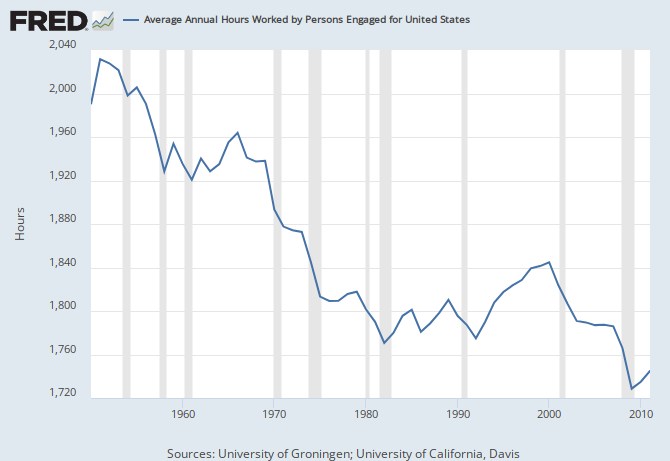
So as I see it, the entire case that 1979-2000 represented a dramatic slowdown in the growth of material living standards relative to the Postwar period rests on the fact that leisure increased during the Postwar but flatlined during 1979-2000:


If you want to make the case that the American economy did dramatically worse for the average American in 1979-2000 than in 1947-1979, this is the most convincing case I can think of. 


(Note: I still think the Postwar period represented a much bigger jump in the welfare of Americans, since marginal utility of consumption is concave. Getting food on the table, warm clothes, and a roof over your head is vastly more important than getting a bigger house, a second car, etc.)

Circada do not Speak to the Japanese: The Japanese don't really speak to each other!

Circada do not Speak to the Japanese: The Japanese don't really speak to each other!
Tadanobu Tsunoda (e.g. 1975) using data on the identification of sounds presented monaurally to both ears, claims that the Japanese, unlike speakers of Indo-European languages process natural sounds such as of insects (e.g. cicada) with the left hemisphere that is usually associated with language processing. He claims that this is due to Japanese attentiveness to nature and the characteristics of the vowels in Japanese and other East Asian/Pacific languages.

His research was dismissed as pseudo-science by some (Dale, 1993), but with the recent boom in research into cognitive styles (e.g. Masuda & Nisbett, 2001), and recent research into culture and the brain (e.g. Kitayama & Uskul, 2011), his research may come under reappraisal.

As noted Tsunoda (1975) found that among Japanese, natural sounds such as those of insects and music were processed more effectively by the left brain which is more generally associated with linguistic processing. He concluded that the Japanese were hearing nature speak to them.

However, other research has suggested that the Japanese thought processes are disrupted, as opposed to enhanced, by phonetic speech (Kim, 2002), that the phonetic word content is less important that vocal tone (Ishii, Reyes, & Kitayama, 2003), the Japanese show an amazing ability to ignore phonetic language (Nakajima, 1997) such as all the announcements, that there is a lack of dialogue in Japanese society in general (Nakajima, ibid), and that Japanese thought may be particularly visual in nature (Takemoto and Brinthaupt, in preparation).

So it may be the case that, rather than that insects are speaking to the Japanese, both cacophony of cicada and phonetic speech are not speaking to the Japanese for whom phonemes are sound and fury signifying very little. On the contrary the Japanese, due to the visual nature of the culture and the use of Sino-Japanese characters which (unlike their Chinese counterparts) are not associated with single phonemes (Wydell, Butterworth, & Patterson, 1995; Perfetti, 2002), may do more of their symbolic processing in the visual, right hemisphere. Or again put another way it is not that insect sounds processing have swapped to the language hemisphere but that a greater degree of symbolic processing may take place in the visual hemisphere - as may also be the case with speakers of sign languages. It certainly appears true that Japanese read Kanji at least partly from their shape (Wydell, Patterson, & Humphreys, 1993). This would also explain why Barthes, who did not believe in meaningful visual signs, felt Japan to be "The Empire of the Signs" (Barthes, 1983) which were yet "empty signs," signifying no-phonemes, with no gloss, but to the Japanese replete with meaning.

This view is supported by the fact that cicada create a brain-numbing cacophony, as suggested by the famous Haiku by Matsuo Basho
静けさや岩に染み入る蝉の声
silence - the screams of cicadas seep into the rocks,
and that traditional Japanese music such as Gagaku and Kagura Uta tends to be less symbolic (compared to Bach at least) more directly emotive or atmospheric nature. As Dale (1993) points out it is rather preposterous to suggest that the Japanese are simply better at deciphering the sounds of nature and music. But it may be the case that nature does not speak to the Japanese, nor in a Western way do the Japanese speak to each other, but that the Japanese hear and understand the tone of nature's -- and each others' -- voices (Ishii, Reyes, & Kitayama, 2003). That is to say, the Japanese cognise their environment in a different way (Masuda & Nisbett, 2001).

Bibliography
Barthes, R. (1983). Empire of Signs. (R. Howard, Trans.). Hill and Wang.
Dale, P. (1993). The Voice of Cicadas: Linguistic Uniqueness, Tsunoda Tananobu’s Theory of the Japanese Brain, and Some Classical Perspectives. Electronic Antiquity: Communicating the Classics, 1(6).
Kim, H. (2002). We talk, therefore we think? A cultural analysis of the effect of talking on thinking. Journal of Personality and Social Psychology.
Kitayama, S., & Uskul, A. K. (2011). Culture, mind, and the brain: Current evidence and future directions. Annual Review of Psychology, 62, 419–449. Retrieved from www.annualreviews.org/doi/abs/10.1146/annurev-psych-12070...
Ishii, K., Reyes, J. A., & Kitayama, S. (2003). Spontaneous Attention to Word Content Versus Emotional Tone. Psychological Science, 39–46. Retrieved from php.scripts.psu.edu/users/n/x/nxy906/COMPS/indivdualisman...
Masuda, T., & Nisbett, R. E. (2001). Attending holistically versus analytically: comparing the context sensitivity of Japanese and Americans. Journal of Personality and Social Psychology, 81(5), 922. Retrieved from psycnet.apa.org/journals/psp/81/5/922/
Nakajima, Y. 中島, 義道. (1997). 「対話」のない社会―思いやりと優しさが圧殺するもの (A society without dialogue: Things wiped out by sympathy gentleness). PHP研究所.
Tsunoda, T. (1975). Functional differences between right-and left-cerebral hemispheres detected by the key-tapping method. Brain and Language, 2, 152–170. Retrieved from www.sciencedirect.com/science/article/pii/S0093934X75800617
Wydell, T. N., Butterworth, B., & Patterson, K. (1995). The inconsistency of consistency effects in reading: The case of Japanese Kanji. Journal of Experimental Psychology: Learning, Memory, and Cognition, 21(5), 1155. Retrieved from http://psycnet.apa.org/psycinfo/1996-13614-001
Wydell, T. N., Patterson, K. E., & Humphreys, G. W. (1993). Phonologically mediated access to meaning for Kanji: Is a rows still a rose in Japanese Kanji? Journal of Experimental Psychology: Learning, Memory, and Cognition, 19(3), 491–514. doi:10.1037/0278-7393.19.3.491

Image copyright
Image Copyright: Circada by Michael Lacey, on Flickr

Senin, 26 Januari 2015

Working women and the middle class


Kenneth Thomas of Angry Bear thinks I made an error when I said that things got better for the middle class in the last two decades of the 20th century:
Noah Smith put up a post Sunday purporting to show that things aren’t so bad for the middle class. Then he immediately shows us a chart of median household income. Stop right there. As I have argued before, this is always going to give you a rosier picture than reality. We need to look at individual data, aggregated weekly (because average hours per week have fallen for non-supervisory workers), to know what’s going on. 
Because the individual real weekly wage is still below 1972 levels, households have had to compensate by having more incomes and going into debt. They have traded time and debt for current consumption. This is not an improvement in the middle class lifestyle. Commenter Richard Serlin points out that we also need to consider risk as well as average incomes, and he is right. The middle class is less secure than it was in 1972.
Well, here's what I have to say to that.

I don't understand the idea that "households have had to" compensate for lower weekly wages (also the choice of weekly over hourly wages continues to mystify me, since long workweeks suck, but OK).

What does "have had to" mean?? They did not have to. They chose to.

If I can choose how much I work, and my wage stays the same, and I work more and my income rises, then I must be better off. Because if I was not better off, then I wouldn't have chosen to work more and earn more income.

So, median real wages in America stayed roughly flat in America in 1980-2000, and people worked more - actually, what happened is that many women stopped being housewives and began working. The obvious conclusion would seem to be that if this choice represented a deterioration in the standard of living, people would not have chosen to do it. In other words, if you can still afford to buy your old bundle back, revealed preference says you like your new bundle more.

Now, of course, there are some counterarguments you could make as to why what looks like a choice was not a choice:

1. The extensive margin - the requirement that women choose between 0 and 40-hour work weeks, with nothing in between - caused an overshoot, where women (and some men) were working more than they'd like, because it was less bad than working less than they'd like.

2. Social preferences - the need to "keep up with the Joneses" - dominate normal preferences, and everyone was running harder just to keep their place in the line.

Neither of these would be persuasive to me, because as regards (1), it seems likely that there is enough leisure/home-production preference heterogeneity that this isn't going to make a huge difference, and as regards (2), who cares, I don't want to make national policy to help people keep up with the Joneses.

But back to the main argument...

Kenneth Thomas is basically saying that the mass entry of American women into the workplace in 1980-2000 represents a real deterioration in the living standards of the average American, despite the fact that it boosted household incomes substantially.

Why did women stampede into the workforce in 1980-2000?

Possibility 1: The decline of discrimination and/or traditional values allowed them to.

Possibility 2: Advances in home production allowed them to.

Possibility 3: Improvements in consumption technology ("toys", as Brad DeLong puts it) motivated women to go earn more money.

Possibility 4: A shift in tastes away from leisure and/or home-produced goods caused them to.

Possibility 5: A global-game-theoretic equilibrium of "keeping up with the Joneses" emerged in which women all went to work because other women did.

Possibility 6: Something, somewhere has been seriously mismeasured.

To me, Possibilities 1-3 sound like good things, real unambiguous improvements. Possibility 4 sounds either good or neutral, but also mysterious and unlikely. Possibility 5 sounds bad (but if that's really what's going on, why are we talking about absolute measures of income in the first place), and Possibility 6 means this whole discussion is a waste.

So I conclude that the mass entry of women into the workforce in 1980-2000, which raised the income of the middle class, was almost certainly a good thing.

Would it have been better if real median hourly wages had risen, even without taking composition effects and technological improvements into consideration? Hell yes, it would have been.

That doesn't mean 1980-2000 was a crappy time for the American middle class.

Results of my unemployment bets with Kurt Mitman


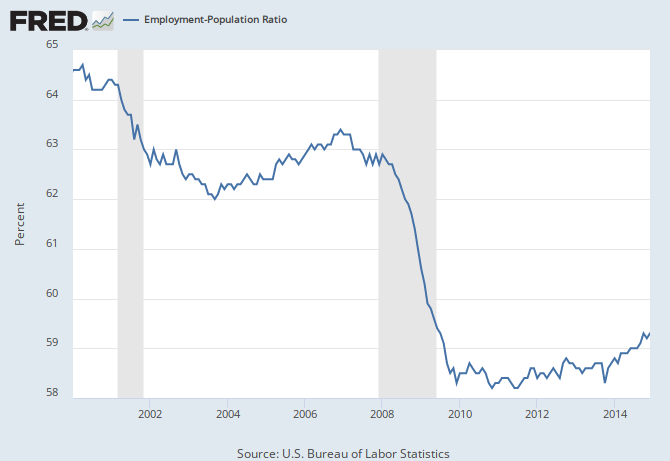
Back in February, I made a bet with Kurt Mitman, who wrote a theoretical paper about unemployment benefits and unemployment. Based solely on my prior that "all macro models are massively misspecified," I bet that both unemployment and the employment-to-population ratio would remain flat from December 2013 through December 2014. Kurt bet on the point estimates of his model. So it was:

Noah's beta:
Unemployment: 6.7%
Employment-to-population ratio: 58.6%

Kurt's bets:
Unemployment: 5.2%
Employment-to-population ratio: 60.6%

Actual figures:
Unemployment: 5.6%
Employment-to-population ratio: 59.2%

Result: We split the bets. My miss on unemployment was 1.1% to Kurt's 0.4%, so Kurt wins that one. My miss on employment-to-population ratio was 0.6% to Kurt's 1.4%, so I win that one.

As per the terms of the bet, Kurt and I will each buy each other a pizza dinner. However, since Kurt now works in Europe, it may be awhile before we can make good!

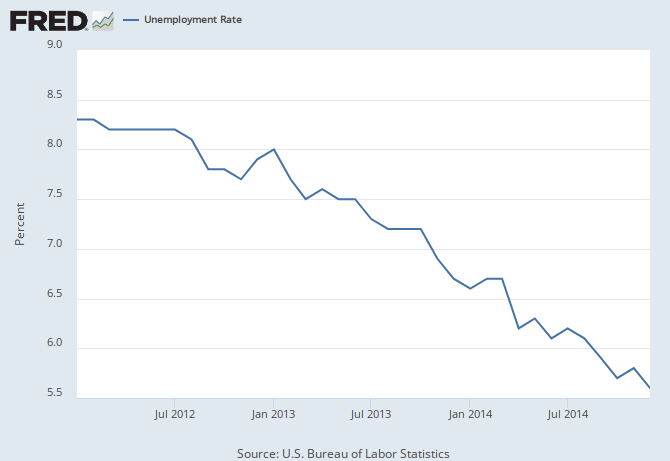
Anyway, in retrospect, it was a little careless of me to bet on "no change" for unemployment, which was clearly trending downward as of January 2014:


And it was probably a little careless of Kurt to bet on employment-to-population ratio when his model didn't model the margin between unemployment and out-of-the-labor-force, or the margin between employment and out-of-the-labor-force.

But anyway, as a follow-up, Kurt is co-author on a new paper that gives an empirical estimate of the effects of the termination of extended unemployment benefits. Looking at differences across state borders (and between neighboring counties in different states), they find that the termination of benefits increased the total number of employed people by 1.2%. That doesn't sound huge, but it's actually 1.8 million jobs. Whether it qualifies as an employment "miracle", as the paper's title claims, is up for debate, but 1.2% is not nothing. (Of course, I'm accepting the paper's result at face value; some other studies have yielded very different results.)

So although unemployment benefits don't seem to have been the main reason for the huge decline in U.S. employment since 2008, and their effect isn't as big as in Kurt's original model, they were indeed a non-trivial factor. There were a substantial number of people out there who were being paid not to work, and are now back working again.


Update:

Mike Konczal has a blog post in which he reviews some evidence regarding UI extensions and unemployment. The other studies that examined this question looked not at states or counties but at individuals. It would take a lot of effort for me to compare the two methodologies in detail, so I won't. The other studies find that UI extensions decreased employment by about 0.1 to 0.5 percentage points, which is much smaller than the estimate of the recent paper on which Mitman is a co-author. (A 2011 paper by Makoto Nakajima, however, finds effects close to those Mitman finds).

But I think the bigger point is this. The employment-to-working-age-population ratio fell by a bit little over 5 percentage points in the Great Recession, and since then has recovered by a little over 3.5 percentage points. Mitman and his co-authors estimate that UI extensions were responsible for about 17% of the drop, or about 26% of the recovery. The other commonly cited paper estimates that UI extensions were responsible for around 5.7% of the drop, and 8.7% of the recovery.

Looking at this range, it's clear that UI extensions do hurt employment, but were not the dominant factor in the recent recession.

The Story of Tokyo Rose

 A multitude of Tokyo Roses in Miwa Yanagi's Zero Hour. (c) Naoshi Hatori 

Commemorating the 70th anniversary of the end of World War II, Japan Society launches its Stories from the War programming series this week with Miwa Yanagi's Zero Hour, a theatrical retelling of the legend of Tokyo Rose. Hayley Valk, a recent intern for Japan Society's Performing Arts Program, reports from Frederick P. Close's seminal book on the subject, Tokyo Rose / An American Patriot: A Dual Biography (Scarecrow, 2010).

Born on the Fourth of July

An immigrant to Los Angeles from Yamanashi Prefecture, Jun Toguri was overjoyed when his daughter Iva was born on Independence Day, 1916. Iva was American through and through – she loved baseball, had no taste for Japanese music but loved Big Band, and her extroverted personality won her many Caucasian friends but clashed with her father’s conservative Japanese style. Her childhood was spent in various cities in Southern California, as her father moved through the import-export business and eventually came to own grocery stores. Iva graduated with a degree in zoology from UCLA, but without many career prospects due to her gender and Japanese heritage.

In June 1941, Iva’s aunt fell ill in Tokyo. Since Iva’s mother Fumi also suffered from failing health, Iva decided to pay a visit in her place and travel to Japan for the first time. She boarded a ship with her friend Chiyeko Ito, not knowing that she wouldn’t return to the U.S. for another seven years.

An American in Tokyo

Six months after arriving in Tokyo, Iva heard the shocking news: Japan had bombed Pearl Harbor. She struggled to book passage on a ship leaving the country but, without the appropriate passport or funds, was stranded. The police regularly came knocking at her door to harass Iva and convince her to renounce her U.S. citizenship, but she refused again and again. Though she lived with her aunt for a time, this unyielding support of the enemy made Iva’s relatives and neighbors uncomfortable and in time resentful, and she ultimately decided to move into a boarding house found with the help of her Japanese language school. Meanwhile, her family back home had been interned.

Realizing that she would have to make her own way in Japan for some time to come, Iva continued learning Japanese, improving on the very little knowledge she possessed before arriving in Japan. She found several small jobs in these years, transcribing English for Domei News Agency, teaching piano to children from wealthy families, and doing office work for the Danish Minister. As Japan struggled in a time of severe rationing, Iva actively traded on the black market and smuggled goods to POWs, saving Allied lives. Finally, she began part-time work as a typist at Radio Tokyo.

Zero Hour

Early in Japan’s propaganda effort, three English-speaking POWs with broadcasting experience were brought to Radio Tokyo to develop programming. Charles Cousens, Ted Ince, and Norman Reyes were forced by the Japanese government to oversee an hour-long radio show called Zero Hour, containing music, skits, censored news, and POW messages. They searched for a female broadcaster to introduce the jazz music segments and deliver short scripted announcements, and came across typist Iva Toguri; fluent in English and with a raspy, unalluring voice, she was exactly what the program needed. Facing government threats, she was given little choice but to accept the position.

As the primary of multiple women broadcasting for Zero Hour, Iva became established under the identity “Orphan Ann.” She could sympathize with the stranded GIs as she greeted them, “my fellow orphans in the Pacific.” Though these comments ostensibly served the Japanese government’s objective of weakening the Allied forces’ morale, the POWs carefully scripted the show to subvert the negativity in favor of cleverly-worded encouragement. The preserved records of Iva’s Zero Hour broadcasts reveal that, in fact, she did little more than entertain GI listeners and announce the upcoming music selections.

Will the Real Tokyo Rose Please Stand Up?

Meanwhile, from very early in the war talk was flying about a radio personality known only as “Tokyo Rose.” According to GIs in the Pacific, Tokyo Rose was famous for demoralizing comments, rumors of unfaithful girlfriends back home, and leaking military secrets. She was described as a seductress with an English accent. Impossible to pin on any one broadcaster, the name was attributed in rumors to other broadcasters such as Radio Manilla’s Myrtle Lipton or even to Amelia Earhart. The popularity of the Tokyo Rose legend became so widespread that she was even common vocabulary back in the U.S., encouraged by movies, cartoons, and articles.

To this day, no records exist of any broadcaster introducing herself as “Tokyo Rose” on the air. Furthermore, no one woman’s voice or broadcast contents perfectly match all the myriad qualities and statements attributed to her. With the information available at this point, it is safe to say that no single Tokyo Rose ever existed. Rather, she existed as an amalgamation of various broadcasters born to fill a void in the GIs lives left by homesickness, hopelessness, and sexual frustration. A figment of collective imagination, she became all too real when successively propagated by GIs and the media.

Suspect Treason

Given these facts, the next mystery is why Iva Toguri ever claimed to be the “one and original ‘Tokyo Rose’” in the confusion that followed the war. Possibly out of a desire for the money to return home or the promise of fame, or perhaps just out of ignorance, Iva quickly dug herself into a hole she couldn’t escape from. After being promised $2,000 for the first interview as “Tokyo Rose,” Iva agreed to give many more, and signed her name over and over as “Iva Toguri/Tokyo Rose," which would cause her trouble for years to come.

On October 17, 1945, Iva entered Sugamo Prison under suspicion of treason against the U.S. Facing entirely false and fabricated accusations, Iva was treated far worse by her home government than by even the Japanese military government during the war. She was alternately confirmed as a U.S. citizen and therefore capable of treason, and denied the benefits of U.S. citizenship under the false accusation that she had renounced it in favor of the Portuguese citizenship she acquired after marrying Phil d’Aquino in her Radio Tokyo years. After a year in jail full of painful investigations, a lack of substantial evidence led the CIC and FBI to drop the case, and Iva walked out of Sugamo on October 25, 1946.

In response to civilian outrage towards Iva’s release spurred by Walter Winchell’s U.S. radio show, the Truman administration sought to save face and not appear too easy on traitors. The FBI reopened the case with an open call for witnesses. The witness testimonies were censored to make the strongest case against Iva, and she was returned to Sugamo and slated to return to the U.S. for further investigation. Because her case would be under the jurisdiction of the location she first set foot on U.S. soil, her destination was set for San Francisco, where she would be likely to encounter the greatest opposition. In 1948, after seven years abroad, Iva was reunited with her father in her home country.

Iva Toguri's Sugamo mugshot. Via

The United States v. Iva Toguri

Thanks to Jun, Iva was grateful to finally have legal representation from Wayne Collins, yet was still forced to spend almost two years in jail before and during the trial without having been convicted. She was charged with eight overt acts of treason, so vague they proved no anti-U.S. crimes in and of themselves. In desperate prosecution, Thomas DeWolfe and the U.S. government went so far as to bribe and coach witnesses, spend exorbitantly to secure testimonies, sabotage the defense, destroy records, and exclude all minorities from the jury.

The deceitful actions of the U.S. government only worked to confirm the verdict of a trial that was doomed at the core. The question was never, “Did Iva Toguri commit treason?” but instead, “Is Iva Toguri truly Tokyo Rose?”, Tokyo Rose automatically assumed a guilty identity. The eight overt acts of treason were ambiguously worded and lacked concrete evidence on either side. The judge eliminated the possibility of duress and, left merely with speculations of Iva’s intention, the jury found her guilty of one overt act: “speaking into the microphone concerning the loss of ships.” After 12 weeks, 800,000 words of testimony, and $500,000 prosecution (if not five or ten times more), Iva Toguri was sentenced on October 6, 1949 to a $10,000 fine and 10 years in prison.

“Pardon me, Iva”

Iva stayed busy during her next six years in Alderson Federal Reformatory for Women. She learned and worked in coding, medicine, and dentistry, and spent free time reading and making bags and other crafts to sell. She was well-liked for her poise and generosity, and developed strong relationships with her inmates and guards.

During her time in prison, Collins attempted to appeal the court’s decision and applied to President Eisenhower for a pardon, to no avail. The day before Iva was to be released from prison, she was informed that she would be deported and forcibly expatriated for treason. On January 28, 1956 Iva left Alderson, but, rather than join her family in Chicago, had to stay in California for two and half years before the effort to deport her was dropped.

Iva returned to Chicago and lived quietly until 1973, when unexpectedly a Boston pediatrician named Dr. Clifford Uyeda read a dissertation about her trial and resolved to achieve a pardon. He spearheaded an action committee with the support of the Japanese American Citizens League, scholars, and politicians. Journalists took up the subject anew, finally acquiring truthful statements from the witnesses that had been coerced by the prosecution. GIs and the state of California even supported the effort. Finally, on January 19, 1977, Iva Toguri was overjoyed to receive word that Gerald Ford, on the final day of his presidency, had pardoned her for the charges pressed thirty years earlier.

Epilogue

Iva lived the rest of her life in Chicago, grateful to have finally secured her U.S. citizenship. She managed her father’s business until her final years, and spent time visiting friends across the U.S. and supporting the arts. Though memories of the war influenced the rest of her years, Iva was never bitter about what had passed. She died of a stroke at home on September 26, 2006, at age 90. Still, the legends of Orphan Ann and Tokyo Rose live on.

--Hayley Valk

Hayley Valk is a junior at Barnard College majoring in East Asian Cultures with a focus on Japan. She has also worked as Stage Manager/Producer for numerous student theater productions at Columbia University. Hayley interned at Japan Society in the Performing Arts Department from Fall 2013 through Summer 2014. She is currently studying abroad in Kyoto, Japan under the KCJS: Kyoto Consortium for Japanese Studies program housed at Doshisha University and recently volunteered for the Kyoto Experiment International Performing Arts Festival.

Look at this Figure Now!

Look at this Figure Now!
"Look at this figure now!" the image above is one of many mother and child joint attention pictures from the floating world of ukiyoe artists which, according to the famed psychologist Osamu Kitayama, express something important about the Japanese mind. It shows a mother showing her rather terrified child a glove puppet.

Osamu Kitayama is right and further, I think that these express the cosmology of the Japanese.

If one has (or has modelled) a linguistic, listening father figure, "super-ego," or "generalised other" in ones mind then concepts or later "matter;" that dark stuff that has properties, can be thought to be the essence of things and the visuals, "res extensa" a fleeting subjective veneer.

But, if one shares ones heart with a vast and joint attentive seeing mother, then the figure, or face, can be the centre of gravity of the self, and of things also.

Words and their meanings are no less subjective. The deciding factor is the nature of ones generalised other: does s/he hear or see.

I don't think that there can be any deciding who is right about the cosmos, but it is interesting to note that scientists are now experimenting to see whether the universe is two dimensional a two dimensional floating world in which three dimensionality is an "emergent" property.

Jumat, 23 Januari 2015

Memories of Oshogatsu, Japan's New Year's Family Celebration


It’s December 31, and the house is spotless, the food has been prepared, and the celebration is about to begin. Tomorrow is New Year’s Day in America, but in Japan, it’s the beginning of Oshogatsu, Japan’s New Year’s equivalent.

"In the U.S., New Year's is just a single day, but the Japanese New Year’s is celebrated for an extended period of time, usually about three days." says Kazuko Minamoto, Deputy Director of education and family programming at Japan Society. "Most businesses in Japan are even closed for the first three days in January in observance of Oshogatsu"

Oshogatsu focuses on starting from a clean slate, so before the new year begins, everyone makes sure all business and housework from the previous year is completed. More like Christmas in America, Oshogatsu is typically spent with family, who often gather at grandparents’ houses for several nights. Great meals are prepared with each item of food symbolizing something.

"As a child, I enjoyed traditional New Year’s food – ozoni (rice cake in soup) and osechi (various special foods we only eat during Oshogatsu)," says Education Program Officer Yumi Nagasawa. "These days my family eats toshikoshi soba noodle, a meal that represents a wish for a long life."

Even the colors of the food's ingredients are taken into account. Lucky colors such as red and white are prominently featured in Oshogatsu dishes, also known as osechi ryori. The cooking takes days of exhausting work to prepare, so it’s not uncommon for modern Japanese people to buy the food pre-made from a high-end kaiseki restaurant.

Education Program Associate Owen Rojek took part in the full celebration for himself recently. "I spent the last two New Year's in Oita, a rural prefecture on the island of Kyushu, with my friend’s family, and it was a great and touching experience. Her immediate and extended family all gathered at her grandfather’s house and it felt like I was attending a large family reunion. Grandparents held great-grandchildren on their knees, siblings reminisced about their childhood, and everyone enjoyed beautifully prepared osechi ryori and copious amounts of alcohol."

While the adults of the house are busy cooking and cleaning, the children are free to play with their cousins that they may not get to see very often. They also receive otoshidama, money from parents and relatives enclosed in a small envelope.

"As a child, of course, my favorite memory is of otoshidama," says Yumi. "Part of the fun was to visit all my relatives, but it was also exciting to find out how much money I received. I learned how to use or save it wisely."

Learning the value of money is a very important part of receiving otoshidama, notes Kazuko. "I was able to save enough otoshidama that I received from my parents and relatives over many years to buy an audio stereo set when I was a teenager. It gave me a sense of accomplishment and taught me the importance of saving money (and patience that goes with it) when I was a kid."

As for the moment the clock strikes twelve, it’s a bit less climactic than it is in America. Rather than meeting up at, say, Times Square to watch the ball drop, families will head to nearby shrines to pray for success in the new year.

"As the end of the year drew closer, there was no big countdown like in the U.S.," says Owen, "but we all put on our coats and shoes and went to three local shrines to celebrate the New Year in an activity known as sansyamairi. We prayed for a good year and bought slips of paper with our fortunes for the New Year. This last time, I got daikiti, which means 'best luck' and is the best fortune you can get. After returning home, we went to sleep because we would be going to see the first sunrise of the year, another New Year’s tradition in Japan. After watching the sunrise from a nearby mountain, we returned home and ate ozoni, the traditional New Year’s day soup containing rice cakes and vegetables. Dinner was leftover osechi ryori, which was still delicious."

"We enjoyed hearing the sounds of year-end bell, Joya no kane – 108 times, says Yumi. "This is to cleanse the 108 kinds of human egos before welcoming a new year. My family lived close to a famous shrine, and we often went to give prayer on the first day (or very early morning around Midnight) to start the New Year with a good wish and a good new year’s resolution.

Kazuko adds, "On New Year’s Eve, I usually enjoy watching with family members the popular NHK’s Kohaku-uta-gassen, known in English as 'Red & White Year-end Song Festival,' a music program running since 1951 that features hit songs of the year."

Many Oshogatsu traditions have endured through the ages, and several are on display for children to discover and participate in at Japan Society’s annual Oshogatsu Family Festival this Sunday.

Guests can watch taiko drumming, lion dancing, pound their own mochi, write calligraphy, and participate in other fun events.

Having been a part of Japan Society's Oshogatsu event since its inception, Kazuko shared an element of volunteerism that few people may realize occurs:

"One of the most memorable and consistent scenes I have witnessed since we started Oshogatsu is how over fifty high-school student volunteers, including Japanese teens from Keio Academy and American teens from one-to-two local high schools who study the Japanese, work closely together to help children at the game and activity booths. Those students were hardworking, diligent, kind, and thoughtful to our younger guests and our presenters and performers. Keio Academy students looked very proud of their country’s tradition while American students truly enjoyed the festival atmosphere they couldn’t normally experience in their classroom setting. We are grateful for their assistance."

It’s an atmosphere unique to Japan, which makes the event such a unique opportunity for those who wouldn’t otherwise be able to experience it.

"I am still fairly new to Oshogatsu at Japan Society, having only experienced it last year," says Yumi, "but it is a wonderful opportunity especially for young children to experience a Japanese custom and tradition in a fun way. Traditions are acquired through experience, so Oshogatsu is a chance to experience and learn about Japan without being in Japan, and for family to create and share memories."

--Mark Gallucci

Photo by George Hirose.

Japanese Psychotherapy for PTSD


As war continues around the globe more and more veterans suffer from post traumatic stress disorder characterised by aggressiveness, nightmares, flashbacks, and feeling like one is under a spotlight in crowds (e.g. in this collection of testimonies - one can ignore the politics). One veteran characterised PTSD as generally not being able to get over certain painful images which affect ones perception of the present. If so then perhaps Japanese psychotherapeutic methods might be of some help.

Lacan argues that if we can’t express something to ourselves, because we have mixed emotions about it, or it is too shameful or painful, it returns as a symptom. So, he said, symptoms are expressions or signs. Many psychologists including Lacan tend to emphasize language, so his theory becomes “What we can’t think, i.e. say to ourselves, return as symptoms, and if we say the experiences, talk about the experiences, then we stop producing the symptoms. However, there are lots of therapies that are not about talking, and several of them are popular in Japan.

Morita Therapy
Morita therapy is a bit like becoming a hermit for a while. Morita was a psychotherapist who treated Japanese people with “social phobia”. Such people often become hermits. Rather than going against the flow, he confined his patients to their rooms. Then gradually as the patient got bored, he would give them tasks such as cleaning the corridor outside their room, or weeding the garden outside their window, and encouraged the patients to realize that in fact that want to reintegrate with society. With respect of other symptoms as well, rather than going against the flow, Morita encouraged patients to accept their symptoms -- trying to stop them makes them worse – and generally aim towards ‘a whatever will be will be’ (‘ari no mama’ in Japanese) mentality towards them and life in general.

Dohsa (movement) Therapy
Dohsa just means movement in Japanese. This therapy is defined consciously in opposition to talking cures. While many therapies proceed using words as the medium or vector between the client and the therapist, movement therapy uses movement, massage, and other bodily contact. I have a picture of people massaging the backs of people in crouched position, or getting into a sort of T-shape, with intertwined legs. Since this therapy is so non-verbal it is essentially difficult to describe. Books on Dohsa therapy contain little theory, but lists of positions and movements. I think that it may be difficult to get good Dohsa treatment outside of Japan since the therapist would also have had to have had bodily experience.

Tsubo (Pot or Potted) Image Therapy
Seiichi Tashima, a professor from Kyushu University developed this for his clients due to his in ability to use image therapy with them. Image therapy again uses not words but images, asking patients to visualize various images associated with their symptoms. Prof Tashima found that his patients would become too emotional if they did this, or they were too scared of the rush of emotions to do it. His solution was to create a controlled form of image therapy by the most direct of means. He first encouraged his patients to image a large pot with a lid – the lid being the important part. He would then encourage them to image that the pot contained certain positive images. Then the clients would practice experiencing those positive images by opening and closing the lid of the pot that they imagined in their mind. Once they had mastered this use of an imaginary pot to control images, he encouraged them to imagine another pot containing the problematic images. The clients are at first encouraged to open the lid only a little very briefly, just to take a glimpse, and then shut the imaginary lid firmly, and repeat this until they are sure that they can control the flow of images in this way. And then, alternating between positive and negative images, clients are encouraged to increase the amount of time that they can spend with the negative ones until, eventually, they are able to get into the pot with bad images, and just let them flow, like Morita therapy. Rather than a pot one might use anything with a lid or a door.

Sand Play Therapy
This was imported by perhaps the most famous post-war Japanese psychologist, Hayao Kawaii. He studied Japanese mythology from a Jungian perspective and claimed that Sand Play Therapy is Jungian, having been developed by a Swiss Jungian called Kaff who called it the sand play technique. Kawaii gave it a new name “boxed garden therapy” and it became very popular for treating children in Japan. In a box about 2 feet square children are encouraged to make a mythical world representing their own. Clients use lots of figures, trees, vehicles and the therapist just watches the client make this world. It is found that while at first the children may start by making an island in the garden surrounded by monsters, they one day add a bridge and give the monsters hats, or otherwise gradually create a new more peaceful garden. And all the while even though the therapist just watches, the children eventually express themselves to the extent that their symptoms go away. And of course, it is noted that the primary characteristic of sand play therapy, or boxed garden therapy, is its non-verbal, visual nature. Further, it occurs to me now that the “box” of the boxed garden may have a function similar to that of the pot in Potted Image Therapy – to confine the images within a physical and mental location so that the client can interact with them in controlled way. I can't image Veterans playing with toy monsters,or toy soldiers, but it is not inconceivable.

Osamu Kitayama’s Looking Together
Osamu Kitayama noted that images of women and children were a popular theme in pictures from the floating world, appearing when pornographic pictures were under strict censure. Sometimes the faces of the children resemble those of older men. The viewers of these mother and children pictures may have gained therefore some kind of libidinal pleasure from viewing them. Their prime characteristic is that mother and child are viewing something together. Generally the mother is holding up something, or pointing to something ephemeral, such as bubbles, cherry blossom, or something dangling by a string. In the above images by Harunobu Suzuki, the mother and child are watching a little bird or some fireflies in a cage. These ephemera are the quintessence of Buddhist impermanence - ‘the floating world. The child and mother are looking at this floating phenomena in wonder. As a result of his awareness of this genre of images, Kitayama moved towards attempting, rather than to talk about, to “see together” with his patients. I believe that Kitayama, his students, and their clients face the same direction and while using speech, do not attempt to rationalize but simply use speech it to call to mind images in both client and therapist. Kitayama referenced the cinema of Ozu, such as “Tokyo Story”, where family members have sparse conversations facing the same direction, seeming simply to share the same images, sunsets, and memories.

Naikan Introspective Therapy
Naikan therapy is rather like Freudian psychoanalysis in that it encourages clients to look over their past and restructure
their view of themselves as the world. It was developed from a Buddhist practice of “self-searching” where practitioners
would isolate themselves, and go over their lives, asking themselves whether, if they died now, they would go to heaven or hell.

Ishin Yoshimoto, the founder of Naikan therapy removed the Buddhist and supernatural elements, and gave clients a framework. They are to think about specific relationships (such as themselves and their mother, themselves and their spouse) over specific periods of time, and given three questions:
1)What did that person do for you
2)What did you do in return for that person
3)What aggravation did you cause for that person
Clients find that, especially in their childhood, they were in receipt of a lot of love, affection and hard work on the part of their care givers, and that they have done very little in return, but have rather caused a lot of aggravation. This is almost the complete opposite of Freudian therapy where clients are often encouraged to find trauma caused by care-givers (sometimes purely imagined, false memories). Naikan also differs from Freudian therapy in that all this process is carried out in the clients imagination. Clients confine themselves to a small space the size of a cupboard, and go through their lives from childhood to the present time a year or two at a time and imagine all these instances of kindness in images, reporting to the therapist for only 5 minutes in each hour. These reports are merely to ensure that that the client has not wavered from the task. The therapy itself is carried out by the clients. Clients generally find it difficult to call to mind the images at first, but as they learn to see themselves from the point of view of the people that loved them, the images come in waves. Clients generally cry in the realization of how much they have been loved. So while on the face of it, it can seem that Introspective therapy is very self-negating, it is conversely very positive because it is the realization of how much aggravation that one has caused that one realizes how much one has been loved.
This therapy is particularly useful in treating anti-social problems such as alcoholism (one of very few therapies to have any effect), drug addiction, prevalent among veterans.
Japanese people come out of a week sitting in a cupboard (or behind a Japanese screen) feeling really sunny, refreshed
and with a will to help everyone that has helped them.

Auto-Photographic Method
This therapy was influenced by my early research asking students to take 20 photographs expressing themselves. The Japanese are not good at expressing themselves verbally often mentioning others and their groups, but they are very positive and self-focused in their auto-photography. Japanese pose, stand up straight, and care about how they look. Mukoyama has her clients take photographs representing themselves, of the things that are important to them, and their issues, and looks at these photographs with her clients.

Returning to Lacan's theory, it seems very possible that it is not only “things not said” that return as symptoms, but also things that cannot be seen -- called to mind. And that in order to cure symptoms, both saying and seeing – or calling to the minds eye - are effective ways of preventing or, rather encouraging, the return of the repressed, in a controlled way, with other people’s help. This sort of image therapy may ordinarily be more appropriate to Japanese but perhaps also for those who have been exposed to traumatic images.

Jimanga Correlate more than verbal Measures


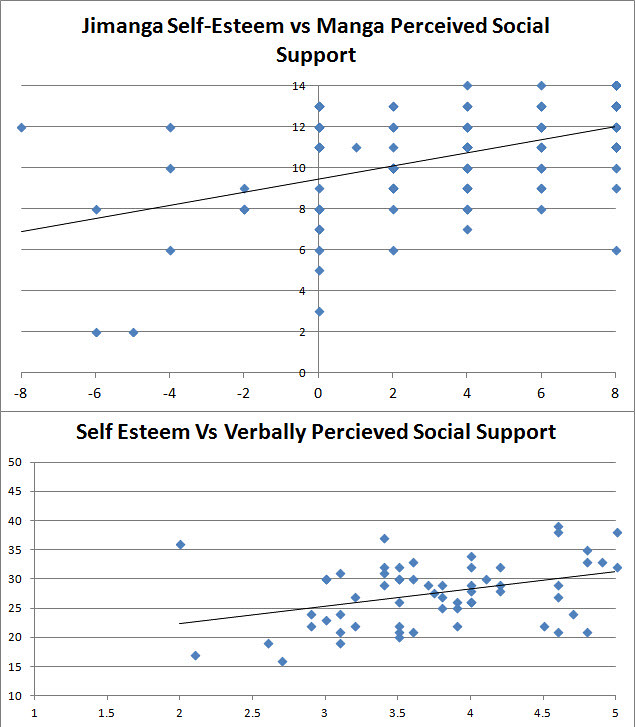
As well as being more positive, jimanga (manga self-esteem scale), in its first iteration, and the manga social support scale, likewise, correlate more than verbal Self Esteem and Perceived Social Support. The verbal and visual self esteem scales do not correlate at all. http://flic.kr/p/qBWCsQ

Rabu, 21 Januari 2015

Manga Social Support Scale


The correlation between self-esteem and percieved social support is very strong among American. For example a Pearson correlation coefficient of a massive r= 0.82 was found by Budd, Buschman, & Esch, (2009). People who talk the talk, and are typically positive about themselves, have lots of friends, or say that they have lots of friends. This is all as it should be since self-esteem may be a "sociometer" (Leary & Baumeister, 2000) measuring ones social worth.

Japanese show only a weak correlation between self-esteem and perceived social support. In a recent survey of mine in Japan, the correlation between perceived social support and self-esteem was found to be 0.36. This is assumed to be because as "collectivists," the Japanese are thought to place a greater emphasis on humility and social censure and unpopularity may be heaped upon those who talk themselves up.

All the same, the lack of self-esteem among Japanese, with levels at about 63% of Americans, is thought to be a problem. I think that problemitization of the lack of self esteem among Japanese, as measured by the Rosenberg Self Esteem scale is "Because of the pivotal and often grossly exaggerated role attributed to verbal language"(Furth, 1973) which is as unimportant to the Japanese (Kim, 2002) as it is to the deaf (Furth, ibid).

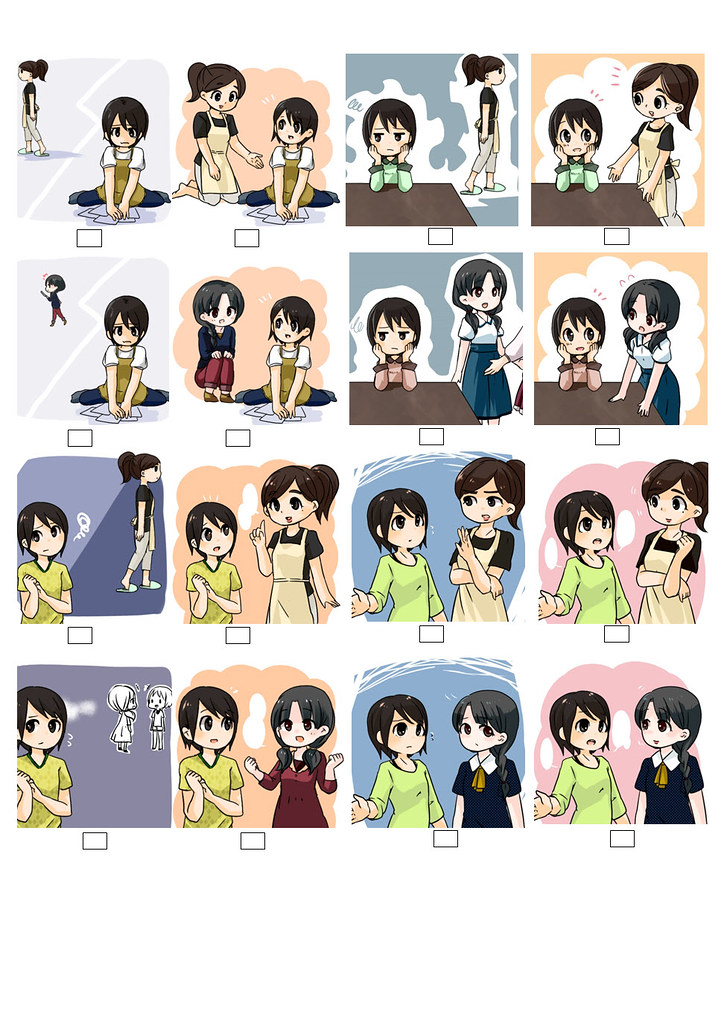
The correlation between Manga Social Support and the Jimanga Manga Self esteem Scale, was however a more robust 0.52. Not as strong as found linguistically among Americans, but at least those that represent themselves positively in manga, represent their social support positively in manga as well. I hope to be able to have the artist, Ms. M. Fujimura, make a male version of the above scale with a male protagonist and male friends, which should improve the correlation.

Thanks to Ms. Fujimura and Professor Yoshiko Tanno of Tokyo University, whose invitation to present to his seminar students, about 10 years ago, inspired this research.

Bibliography
Budd, A., Buschman, C., & Esch, L. (2009). The correlation of self-esteem and perceived social support. Undergraduate Research Journal for the Human Sciences, 8(1). Retrieved from http://ift.tt/1yOMVh6
Furth, H. G. (1973). Further thoughts on thinking and language. Psychological Bulletin, 79(3), 215–216. doi:10.1037/h0034011
Kim, H. (2002). We talk, therefore we think? A cultural analysis of the effect of talking on thinking. Journal of Personality and Social Psychology.
Leary, M. R., & Baumeister, R. F. (2000). The nature and function of self-esteem: Sociometer theory. Retrieved from http://ift.tt/1AQEj4E http://flic.kr/p/qBhJpH

Selasa, 20 Januari 2015

Taking The First Steps To Learning Japanese


Mark Gallucci is a Japan Society Communications intern. In addition to receiving his Bachelor of Arts in Journalism from the University at Albany, he completed a study-abroad program in Kansai Gaidai University, Japan. As an English-Japanese tutor, Mark talks about his experience learning Japanese and shares some tips for self-study and classroom-based learning.

Coming from an English background, learning Japanese can seem like a daunting endeavor. It’s easy to look at the written language and be intimidated by the complexity of its three writing systems—hiragana, katakana and kanji—when compared to the English alphabet. But Japanese is a language like any other, and learning it is just a matter of taking the first step.

Before I finally decided to learn Japanese, I went back and forth several times. I was a junior in college, and I’d never had the chance to take Japanese classes in high school, which offered only Spanish, French, Italian, and German.

After a bit of research, I decided that self-study would be a great way to start. I found tons of websites and programs that could help, but before I could begin, I noticed that there were several different paths of study to choose from, depending on your priorities.

You can ignore the writing system and focus solely on speaking, you can choose to learn kanji later, or you can start with kanji. If you’re looking to watch Japanese TV or anime, or listen to Japanese music, you can prioritize speaking and listening skills. But if you’re looking to communicate with people in writing, especially online, or if reading manga or classic literature are goals, then a solid knowledge of kanji is vital.

It’s for that reason that I chose to learn kanji first. It may seem counterintuitive, as it involves learning what the characters mean before even learning the words they’re used in. But it also helps when identifying new words. For instance, if you don’t know a certain word but recognize one of the kanji used in it, you can make a reasonable guess as to what that word is.

As for how my choice turned out, two years and one semester of studying abroad in Japan later, I still need English subtitles when I watch Japanese TV, no doubt a result of prioritizing kanji over speaking and listening. On the other hand, I read and reply to messages in Japanese every day, and thanks to speaking practice with friends, can have long conversations with native Japanese speakers without having to resort to English to get my point across. And while I did end up taking several classes along the way, there were two resources that I found invaluable in my studies.

For kanji, vocabulary, and other things I need to memorize, I use Anki, a popular, completely free digital flashcard program that has tons of user-created decks, including ones for hiragana and katakana. This is a great tool for memorizing large amounts of information. For everything else, I use Lang-8, a platform for free language exchange – you write entries in the language you’re learning, and native speakers of that language will correct it for you. You can then return the favor by correcting entries written in your native language. It’s also common for language learners to exchange Skype info. There’s nothing more helpful than having a native speaker correct your Japanese as you talk.

What I love about both of these resources is that whether you’re taking classes or not, they’re both very useful and can adapt to your current skill level. Plus, they provide a nice mix of textbook learning and exposure to “real” Japanese.


The Classroom Path

Self-study alone may not be enough to reach your goals, and this is where classes come in. Having a native Japanese teacher answer questions and having a clear, stable measure of progression is something that only classes can provide. There’s also the routine. It’s a lot easier to skip a day of Anki reviews than it is to skip a day of class. Not to mention that if you’re just starting out and have no idea what to do, a class will have a set curriculum, and you don't have to figure it out on your own.

Should you opt for classes, the spring session at Japan Society's Toyota Language Center starts at the beginning of February, with thirteen levels of Japanese courses available, meeting once or twice weekly. Kanji courses and specialized courses are also offered. For anime fans interested in learning Japanese, they are offering for the first time a weekly beginners class that uses anime to teach basic vocabulary, sentence structure, and conversational skills.

But if you’re still on the fence, you can get a feel for the classroom environment with one of Japan Society’s free trial lessons taught by Language Center Director Tomoyo Kamimura.

In an interview about the classroom experience, Kamimura-sensei said of her students’ trial lesson experience, “They definitely got the sense of what it is like to learn Japanese and seemed to have enjoyed the lesson. Some are interested in signing up for a regular class. I always enjoy teaching and this occasion was no exception. I hope they got a taste of what it’s like to study and learn Japanese in this brief session.”

Part of that experience is working with other students, a point of focus for classes at Japan Society, and one which Kamimura says can be very effective.

“It kind of motivates you to stay in the class, because when you’re alone, it’s hard to have self-discipline.”

It’s this challenge that can cause people to quit learning a language midway, which is why it’s important, even for those who self-study, to talk to other language learners to compare progress.

Because there are several different areas to focus on when learning a language, there’s no “right” way to learn, but no matter how you’re learning, nothing’s quite like having a conversation in the language you’re learning with native speakers, a fact that Kamimura acknowledges.

“I have had several students who taught themselves through self-study. Many of them were not sure if they were doing it right, so they wanted to take lessons. Amazingly, some of them are very nearly fluent! For me, it may be possible to learn grammar from a book if you have a very conceptual, abstract mind-set. But in my experience, if you can arrange a language exchange with a Japanese student—I have paired up several people here—it works very well. You spend one or one and a half hours speaking only Japanese, then one hour speaking English. You have to get exposure to real Japanese, not just what’s on a screen or in a book. So I do believe in self-study to a certain extent.”

For me, the biggest benefit of taking classes was gauging my progress. When you’re studying in a very unstructured way, there’s no real measure of progress other than looking at past essays or entries you wrote and finding all the mistakes you made. After a while of self-studying , it felt good to take a class, learn new things, and see that my process really was showing results.

Additionally, for beginners who still aren’t sure where to start, classes can provide a foundation to build upon while simultaneously giving students an opportunity to meet new people who share a common goal, and learn from them as well.

“One good thing about taking a class with others, at Japan Society or at college, is, let’s say you hear people making mistakes, and you know the answer. The teacher asks a question, and someone answers it completely wrong, and you think, ‘Oh, that’s wrong, I think that’s wrong’ and the teacher explains why it’s wrong… So you learn from other people’s mistakes.”

After all, making mistakes leads to more efficient learning in the long run.

--Mark Gallucci

Senin, 19 Januari 2015

5 questions for Nick Rowe about the "victory" of the right:


Nick Rowe writes:
How come no economist on the right is asking "Where are the Galbraiths of yesteryear?"? It's because Milton Friedman won the debate, and John Kenneth Galbraith lost...The right won the economics debate; left and right are just haggling over details. [emphasis mine]
This basically agrees with Chris House, who claims that the facts in economics have a well-known conservative bias.

I wonder if this might not be another instance of "Eternally Recurring 1970s Syndrome." Rowe writes about the 70s like that was when it all went down:
We easily forget how daft the 1970's really were, and some ideas were much worse than pet rocks. (Marxism was by far the worst, of course, and had a lot of support amongst university intellectuals, though not much in economics departments.) When inflation was too high, and we wanted to bring inflation down, many (most?) macroeconomists advocated direct controls on prices and wages. And governments in Canada, the US, the UK (there must have been more) actually implemented direct controls on prices and wages to bring inflation down. Milton Friedman actually had to argue against price and wage controls and against the prevailing wisdom that inflation was caused by monopoly power, monopoly unions, a grab-bag of sociological factors, and had nothing to do with monetary policy.
I was born after the 70s, and so to me that decade doesn't loom quite so large (see Malmendier and Nagel on how those big macro experiences stick with us). So here are the questions I have for Nick Rowe, and for others who may agree with him:


Question 1: What was the left's position in this debate that the right won in the 70s? 

Was the bulk of the left really in favor of Marxism, rather than just a small fringe element? Isn't that setting the bar a little low for the right to win? Or was the left's vision for the U.S. economy centered on price controls for everything?

What exactly was Galbraith's plan that Friedman defeated?

Or was the right's victory the turn toward neoliberalism  (deregulation, freer trade, lower top marginal tax rates) in rich countries?


Question 2: What about the Austrians and other elements of the right that Friedman fought against?

Milton Friedman famously clashed with "Austrians". They definitely seem more rightist, politically, than Friedman. And although they succeeded in injecting some silly ideas into the minds of some people in the finance industry, the Austrians generally lost out to Friedman. Why doesn't this affect the idea that "the right" won the debate?

Also, what about the RBCers? Friedman fought with them, and monetarism (i.e. New Keynesianism) has probably eked out a slim victory in that battle. Do RBCers count as "the right" in your view?


Question 3: What about the turn against monetarism since the crisis?

Although monetarist (New Keynesian) models continue to be the ones used at central banks, and although some heavy-hitting macro people continue to work on them, these models have received a lot of flak and disfavor in academia since 2008, and attention has turned toward models of the economy in which market failures in the financial sector cause business cycles.

Does this constitute "haggling over details"?


Question 4: Has the victory of the right translated into an enduring policy victory?

Since Friedman's time, many types of regulation have decreased, and many types of price controls have vanished. But some types of regulation - environmental regulation, for instance - that the left has advocated have increased in rich countries. And many are struggling to bring back financial regulation.

Meanwhile, government spending continues to climb and climb as a percentage of GDP in rich countries. Tax revenue has not fallen as a percent of GDP. Income redistribution has increased in most rich countries.

Education has not been privatized. Health care has not been privatized, and even in the U.S. is moving toward more government control.

Do these developments point to a policy victory for Friedman and his slice of the right?


Question 5: Is it accurate to say that the left won the economics debate in the 1900s-1930s, and that since then, left and right have been haggling over details?

In the period between 1900 and 1940, many curbs were placed on laissez-faire capitalism. Child labor laws. Workplace safety regulations. Progressive income tax. Product safety and consumer protection laws. Weekends. Social Security. Medicare (and in some countries, universal health care). Land preserves. Antitrust law. Minimum wages.

In the era since Milton Friedman, none of these policies has been eliminated, and few if any have been substantially reduced. Nor have economists formed anything resembling a consensus against any of these policies. The continue to define and shape the lives of most people in rich countries.

So why is it not correct to say that the left won the economic debate in the early 20th century, and Friedman and his slice of the right were just haggling - mostly unsuccessfully - over the details?


Updates

See Nick Rowe in the comment section for answers, and more discussion!

Robert Waldmann offers his thoughts here.

David Glasner criticizes Milton Friedman here.