Senin, 30 Maret 2015

The Gates of Hell

The Gates of Hell

I wrote recently about the creation myth of Guam. To recap, it goes like this.

Human souls were all slaves in hell but due to a conflagration, one soul managed to escape to Guam where he made a human child out of soften rock and gave it a soul made of the sun. When the king of hell came looking for his lost soul he thought it must be that of the child and tried to bring him back down to hell, but hard as he tried, he could take the child to hell, because its soul was made from the sun.

The creation myth of Guam is almost a paraphrase of that of the Japanese in the Kojiki where it relates that soul of the Japanese is also made from the sun -- the mirror of the sun -- and that the creator of this sun-mirror-soul went to hell - or the underworld - and came back.

Indeed, the deities and heroes of Japanese mythology are always going somewhere rather under-worldly. Susano'o visits the Sun who hides in a cave with hellish consequences. Yamasachi HIko goes down to the kingdom in the sea. But they always manage to come back. And their soul remains, according Heisig's reading of Nishida, visual, self-seeing, in the light, made of the sun. How did the Japanese achieve this?

Consider first the alternative. What is hell or "the underworld." Having at last worked out what Derrida means by "mourning," and what Freud was hinting at by his "acoustic cap," I now realize that hell is that which was nearest and dearest to me, and where in large part I live. Hell is a place where there are dead people. I don't see them, I talk to them. I talk principally to a dead woman, a woman who was never really alive, or even a woman, in my head. This is the essence of the narrative self. Mead calls it a Generalized other, Bakhtin a "super-addressee," Freud the super ego, Lacan (m)other, Adam Smith "the impartial spectator" and I think that the Bible refers to it at first as "Eve." A dead woman to keep you company, for you to get to know, and have relations with. Hell indeed. (There is a Christian solution, that involves replacing the internal interlocutor, with another "of Adam" and, quite understandably, hating on sex.)

So how did the Japanese manage to avoid talking to the dead woman? There are various scenes in the mythology. Izanagi runs throwing down garments which change into food (this chase with dropped objects turning into things that slow down ones attacker is repeated all over the world. I have no idea what it means). And in the next myth cycle, as mentioned recently, the proto-Japanese get the woman to come out of her cave with a sexy dance, a laugh, a mirror and a some zizag pieces of paper to stop her going back in again. In this post I concentrate on the last two, shown in the images above.

The mirror was for her to look at her self. She became convinced it was her self and told the Japanese to worship it as if it was her, which they had done every since, eating her mirror every New Year, until quite recently.
The zigzag pieces of paper have two functions. One in purification rituals where I think they are used to soak up words since the woes of humans are in large part the names given to those woes (e.g. of the proliferation of mental illnesses). As blank pieces of paper are waved over Japanese heads a priest may also chant a prayer about how impurities were written onto little pieces of wood which are used to take all them back to the underworld where they belong.

The other use of zigzag strips is that they can also be used for all the sacred stamped pieces of paper which are used to symbolize identity in Japan, and to encourage the Japanese to realise that words are things in the world - not things that should be in your head. And until recently (Kim, 2002) the Japanese managed to keep the words out of their mirror soul.


But alas it seems to me that the Gates of Hell are opening and the children of the sun are in danger of being sucked back in. How might this be achieved?

The following is the beginning of a recent Japanese journal article (Iwanaga, Kashiwagi, Arayama, Fujioka & Hashimoto, 2013) in my translation (the original is appended below) which, intentionally or not, aims to import Western psychology into Japan.

"As typified by the way in which the phrase "dropouts" (ochikobore) was reported in Japanese newspapers and became a social problem initiated by the report from the national educational research association in 1971, the remaining years of the 1970's saw the symbolic emergence of a variety of educational problems. Thereafter there was an increase in problems such as juvenile delinquency (shounen hikou), school violence (kounaibouryoku), vandalism (kibutsuhason), academic slacking (taigaku), the 1980s saw the arrival of problems such as the increasingly atrocious nature of adolescent crimes including the murder of parents with a metal baseball bat (kinzokubatto ni yoru ryoushin satugaijiken) and the attack and murder of homeless people in Yokohama (furoushashuugekijiken), domestic violence, and bullying, and then in the 1990's the seriousness of educational problems such as the dramatic increase in delinquency (futoukou), dropping out of high school (koukou chuutai), and a series of murders by adolescents steadily increased. "(Iwanaga, Kashiwagi, Arayama, Fujioka & Hashimoto, 2013, p.101)

As you can see the writers are partially aware that all the "problems" that have assailed Japan since the 1970's are in part an "emblematic emergence" or impurities. While some of these problem have worsened in fact, many of them are simply the sort of thing that should be tractable to purification. The Japanese are not for instance assailed by an increase in adolescent crime which as Youro (2003) in his book "the Wall of Foolishness" points out, has decreased and become less violent post war in Japan.

The Japanese are assailed by a variety of emblems - names of problems - which nonetheless cause real suffering.

If it were only this plague of names of social ailments swarming out of hell, then I think that the Japanese would be
fairly safe. The problem is that the above paper, Japanese Education Department, and a great many Japanese clinical psychologists and educators, are offering the Japanese the infernal equivalent of the mirror: self-esteem, a dialogue with the dead woman that allows one to enjoy "mourning," telling oneself for instance, that one is beautiful as one stuffs one's face. The title of the paper (Iwanaga, Kashiwagi, Arayama, Fujioka & Hashimoto, 2013) is "Research on the Determining Factors of the Present State of Childrens' Self-esteem," in which the authors blame the lack of Japanese self-esteem -- the Japanese hardly sext themselves at all-- on the emergence of all the social ailments. What fiendish genius: the cause is being represented as a cure! The Japanese may indeed be dragged back in.

Note Opening paragraph of (Iwanaga, Kashiwagi, Arayama, Fujioka & Hashimoto, 2013) in the original
1971年に出された全国教育研究所連盟の報告書(1を契機として,「落ちこぼれ」という言葉が新聞で報道され,社会問題化したことに象徴的に現れているように,1970年代以降,わが国においては教育問題が顕在化することになる.その後,少年非行,校内暴力,器物破損,怠学へと問題は拡散し,80年代には金属バットによる両親殺害事件,浮浪者襲撃事件など青少年犯罪の凶悪化が問題視され,家庭内暴力,いじめ問題が,そして90年代にはいると不登校の急増,高校の中途退学問題,連続的に起こった青少年の殺人事件など,教育問題は深刻さを増していく

Bibliography
Iwanaga, S., Kashiwagi, T., Arayama, A., Fujioka Y., & Hashimoto, H. 岩永定, 柏木智子, 芝山明義, 藤岡泰子, & 橋本洋治. (2013). 子どもの自己肯定意識の実態とその規定要因に関する研究. Retrieved from reposit.lib.kumamoto-
Yourou T. 養老孟司. (2003). バカの壁. 新潮社. Retrieved from 218.219.153.210/jsk02/jsk03_toshin_v1.pdf

Image bottom
お祓い串 by Una Pan, on Flickr

Minggu, 29 Maret 2015

A misguided attack on Land Value Taxes


The idea of a Land Value Tax (LVT) is to tax the value of land independently of the value of improvements on that land (e.g. buildings, farms, or mines). Separating the value of a plot of land from the value of the structure built on top of it is a very difficult thing to do, since you can't usually observe the value of a piece of land both before and after the improvement is made. This implementation issue is the main problem with the LVT.

Periodically, people make criticisms of the LVT, and they usually boil down to this measurement problem. For example, Zac Gochenour and Bryan Caplan go to great lengths to show that a tax on the value of unimproved land reduces the incentive to search for better improvements. But under a true LVT, improvements would receive a tax credit, which would remove this problem entirely - if, of course, you can measure the value of the improvement. (Actually, in the case Gochenour and Caplan describe, the measurement of the value of the improvement would actually be easier than usual, since you could do a before/after observation.)

Adam Ozimek of Forbes has another argument against the LVT, which he claims doesn't boil down to the measurement problem. But I think his argument is mistaken. Adam writes:
[T]here are a significant amount of spillovers in local real estate investment. Land value is not just capitalized value of publicly provided public goods, but of nearby privately provided positive spillovers. It’s widely recognized that when individuals clean up a property, or open a popular business, there are often spillover values in the neighborhood. Urban economists recognize that the collective value of these spillovers is huge, and in fact makes up a significant amount of land value. 
The fact that private amenities have positive spillovers suggests that they will be underprovided by competitive markets. However, by allowing some of the value of spillovers to be captured, higher land values provide real estate developers, businesses, and even households with incentives to create them. 
The value of unimproved land does increase with improvements on neighboring land. But this does not mean that land value allows a landlord to capture the value of the spillovers created by his own investment. It does not.

Suppose there are two adjacent plots of initially undeveloped land, A and B. A is owned by Andy and B by Barbara. Andy pays for a nice house on plot A. This raises the value of plot B, and enriches Barbara. If no Coasean side payments are made, then Andy fails to capture the value of his investment in the nice house. Barbara gets a windfall from Andy's investment.

Now suppose there is a 100% LVT. When Andy builds his house, he pays no additional tax. But Barbara pays some tax - she pays the full value of the windfall she received from Andy's investment. Andy's incentive to build the house on plot A is unchanged under the LVT. And Barbara's incentive to build a house on plot B is likewise unchanged. 

So I think Adam's critique is just mistaken. 

But, you may ask, what if there is a spillover not to the value of Barbara's land, but to the value of her potential future improvements? Adam raises this possibility later in his post:
Real estate developers who move into neighborhoods with high vacancies, low demand, and high crime are often hoping that positive spillovers from their investment will spur additional investments from others, which will in turn make their investment more valuable.
This is easy to fit into the example above. Suppose the value of a house on plot B is 1.5 times as high if there is also a house on plot A. That's realistic, since a plot of undeveloped land may make a neighborhood less attractive. In this case, isn't Andy overtaxed by the LVT?

No. His incentive to build the house is exactly the same as it would be without the LVT, since without the LVT he would also fail to capture the spillover benefit on Barbara's improvements. There is an uncompensated positive externality, but it's no bigger with the LVT than without it.

In other words, the problem of neighborhood externalities is a thorny one, but the LVT does not make it worse (or better). The big problem with the LVT remains the measurement problem. Of course, that problem cannot be waved away.


Updates

Just to formalize the above intuition a little more, here's the Andy-Barbara example as a 2-person game. Define:

HA = the value of a house on plot A when there is no house on plot B
CA = the cost of building a house on plot A
LA = the increase in land value of plot A when there is a house on plot B
NA = the increase in the value of a house on plot A when there is a house on plot B
Without loss of generality let the value of a plot of land be 0 when there is no house on the other plot.

Each player decides whether to build a house or not. With a land value tax, LA=LB=0. Here are the games with and without a land value tax:


You can easily see that the condition for (Don't Build, Don't Build) to be a Nash equilibrium in the first game is the same as in the second game - namely, that H-C < 0 for both players.

You can also see that the condition for (Build, Build) to be a Nash equilibrium in the first game is the same as in the second game - namely, that H-C+N > 0 for both players.

Therefore, the presence of an LVT won't affect the outcome of which houses get built. This outcome also doesn't change if you make the game sequential.

On a related note, people on Twitter read this post and started bugging me to cite empirical work, which I had previously failed to locate. But I looked again, and this time I found a couple things. For instance, there was a 1997 study in National Tax Journal that examined Pittsburgh's experiment with an LVT in 1979-1980. The study found that the LVT increased building activity. A 2010 study in the Journal of Urban Economics found similar results when examining a number of LVTs implemented in cities in Pennsylvania; not only did LVTs increase the supply of housing, they also increased density.

Kamis, 26 Maret 2015

Life, Time and Identity

Life, Time and Identity

I take the liberty of using a Japanese newspaper article announcing the tragedy of Germanwings flight 9525 to illustrate differences in the way that Japanese view time.

First of all with regard to the two lines below the article. There is research to show that when Japanese and Westerners are asked to draw a time line and put their life - a mark for their birth and a mark for their death - upon it, Westerners put the two marks close together whereas Japanese put their marks at either end of the line - 57.9% of Japanese females are classified as having an egocentric time perspective using 90% of the line on their lives, significantly more than among Australians(Shiraishi, 1996). Shiraishi suggests that this is because the Japanese were older than the Australians. Cottle (1976: see Cottle, Howard, & Pleck, 1969) however found that older Western children have a less egocentric time perspective so the fact that the Western adolescents were younger makes this difference even more striking. Speaking for myself, the reason why I would be put the two marks close together is because, compared to the enormity of time itself, my life is but a blip upon it. Why do the Japanese put their marks at either end of the line?

With regard to the Japanese newspaper article announcing the recent tragedy, one characteristic is that it announced from the very first, as a headline the number of Japanese persons presumed to be on the flight. My condolences to their families. While Japanese newspapers are a little more self absorbed, British newspapers also mentioned the number of British passengers.

Another characteristic of Japanese, but not British, newspaper articles is that they always say both the local time, and in the small red rectangle above the equivalent time in Japan. Japanese international newspaper articles and television reports, always do this: give both the time at where the event occurred, and the corresponding Tokyo time.

Taken together with the differences in how Japanese mark their time lines, I suggest that the reason for both the egocentric time perspective, and the incessant reminders of the equivalent local time in Japan, is that the Japanese do not believe time to be something unitary and objective but a subjective quality of experience (a sort of qualia). So there is not one massive march of time but there are many times, their own which began at their birth and ends at their death, and that shared to and extent by people in the Tokyo time zone but not by people in France. For the Japanese, time is not the sort of thing that has an "itself."

This relates to how Westerners conceive of their identities to exist in time or space. The Japanese identity is exists at a place in space and centres on the face (Watsuji). That the Japanese have many "kyara" in each of these places, one for home, another for work does not make them any less self consistent. The Japanese have a spatial (Nishida) geography of the self (Miyamoto, Nisbett & Masuda, 2006; Nisbett, 2010; ), that is no less consistent than the self-narrative.

On the contrary, while I think am the same in all spaces and places, I am "sometimes" something and sometimes something else in any one place ( Cousins, 1980), since for my self is my self-narrative, a history, which exists in Time which is itself which is extended and objective. Thus, for the Japanese their selves in the absence of a spatial situation is merely a "default," (Yamagishi, et. al) for me it is my first and primary self in time: who I am.

Similarly again, conversely, for me space, res extensa, the image is merely a qualia, a quality of subjective experience. For me, space does not have an itself, indeed if empty it is nothing at all.

Bibliography
Cottle, T. J. (1976). Perceiving time: a psychological investigation with men and women. John Wiley & Sons Australia, Limited.
Cottle, T. J., Howard, P., & Pleck, J. (1969). Adolescent perceptions of time: The effect of age, sex, and social class1. Journal of Personality, 37(4), 636–650. http://doi.org/10.1111/j.1467-6494.1969.tb01770.x
Cousins, Steven D. "Culture and self-perception in Japan and the United States." Journal of Personality and Social Psychology 56.1 (1989): 124.
Miyamoto, Y., Nisbett, R. E., & Masuda, T. (2006). Culture and the physical environment holistic versus analytic perceptual affordances. Psychological Science, 17(2), 113-119.
Nisbett, R. (2010). The Geography of Thought: How Asians and Westerners Think Differently... and. Simon and Schuster.
Yamagishi, T., Hashimoto, H., Cook, K. S., Kiyonari, T., Shinada, M., Mifune, N., ... & Li, Y. (2012). Modesty in self‐presentation: A comparison between the USA and Japan. Asian Journal of Social Psychology, 15(1), 60-68.
Shiraishi, T. 白井利明. (1996). 日本の女子青年の時間知覚における Cottle の仮説の検討―サークル・テストとライン・テストの結果から―. Retrieved from https://150.86.125.91/dspace/handle/123456789/2830

Rabu, 25 Maret 2015

City Views and the Horror of Impartial Spectation


This video shows the the view over Yamaguchi City from Elephant Head Mountain at the entrance to Oouchi Mihori area of Yamaguchi City. You can climb this mountain from the rear of Toushiro Tea Shop opposite Yellow Hat and Uniqlo in Oouchi Mihori, or from the rear of Itukushima Shrine next to Shinwaniishibashi junction with the four legged pedestrian overpass. There car parks the beginning of both paths. The path from the shrine is wooded and natural. The path from behind the tea shop is made of concrete.

In this video I argue that Japanese people tend to avoid places with good panoramic views since they associate them with the divine which, in the Japanese case, visually spectates rather than listens. The Japanese simulate birds eye views of themselves and their situations in their minds but since this Other is that which allows them to have a self they also hide from themselves that they are doing this 'impartial spectating' (Smith, 1759). As a result of which, while the Japanese are happy and inclined to create imaginative artworks, such as pictures of the floating world and childrens' paintings, from the point of view of the birds eye view (Masuda, Gonzalez, Kwan, & Nisbett, 2008), the Japanese do not actually want to go there, to the dreaded viewing platform.

Often times Japanese are even unaware that viewpoints exist in reality. One of my colleagues was of the opinion that there is nowhere from where our town could be viewed, but in addition to this viewing platform, I live on a mountain or hill of 118m, which taller than the viewing platform shown in this video, at a mere 85m, right in the centre of Yamaguchi City overlooking both the older part of the city and the Hot Spa area. The under-utilization of Japanese viewpoints represents a tremendous potential tourism industry.

The the birds eye viewpoint is an abject place, a terrifying location that should not exist since it always exists as hidden simulation. In Japanese Horror monstresses (a neologism I use because generally Japanese monsters are female) often hang out on ceilings, looking down, or emerge from mirrors and other images. They also hang out on mountain tops as mountain aunties (yamanba).

There should be a Western equivalent of this phenomenon "Nacalianly" transformed from the visual into the linguistic. As a Westerner I should have a horror of "going" to the place where I can 'impartially' hear myself speak, the equivalent of the Japanese birds eye view. But, logophonic "places" are not really "places," but discursive 'viewpoints' or logical 'positions' (ronten 論点 not shiten 視点), so I was (until I am writing this now) confused as to where the "real" equivalent of the "impartial spectator" that I simulate in my mind might be situated in the world. Where is the linguistic version of a mountain top? Where am I scared to go?

I hypothesize now that the place that I am scared of visiting is "the text," or a particular type of text that is addressed to no one in particular. I can write a blog, here, since I imagine that I am speaking to someone, that this burogu is a dialogue with a real other. But as soon as I attempt to write, objectively, for publication, I face "The Problem of the Text" (Bakhtin, 1986) and the absence of a dialogical other and must confront -- or not confront by not writing -- my super-addressee: a monster in my mind. In fact, as I attempt to write, I often find myself going to look at visual views, especially that from the balcony at the end of my fourth floor corridor at Yamaguchi University, perhaps in order to escape *the horror of linguistic impartial spectation*.

This realisation may make it easier for me to write. Perhaps I should write on top of mountains.

Viewing platform in Google Earth
https://goo.gl/maps/SocFV
Viewing platform  in Google Maps
https://goo.gl/maps/SqQXt

Bibliography
Bakhtin, M. (1986). The Problem of the Text in Linguistics, Philology, and the Human Sciences: An Experiment in Philosophical Analysis. Speech Genres and Other Late Essays, 103-31.
Masuda, T., Gonzalez, R., Kwan, L., & Nisbett, R. E. (2008). Culture and aesthetic preference: Comparing the attention to context of East Asians and Americans. Personality and Social Psychology Bulletin, 34(9), 1260-1275.
Smith, A. (1759). Theory of Moral Sentiments. Retrieved 2015/03/26 from http://www.ibiblio.org/ml/libri/s/SmithA_MoralSentiments_p.pdf

Senin, 23 Maret 2015

SSRIs and Suicide in Japan

SSRIs and Suicide in Japan
Upon hearing of Watter's book (Watters, 2010; ウォッターズ. 2013) and the allegations he made regarding the lack of rigour in introducing new antidepressant drugs (SSRIs) to Japan, and knowing how easy it would be to portray the Japanese as depressed compared to Westerners due to their lack of a need for positive self regard (lack of a need to boast: see Heine, Lehman, Markus, Kitayama, 1999), I became alarmed at the possibility that there may be a link between SSRI use and suicide in Japan.

Fortunately there is a study (Nakagawa., Grunebaum., Ellis, Oquendo, Kashima, Gibbons, & Mann, 2007) that apears to prove the opposite: SSRIs were concluded to reduce suicide among the Japanese as well. Phew

The main graphs for men and women from that study is shown above top. I have added some arrows drawn in by hand (without any calculation) to illustrate the my understanding of the authors' conclusions.

The first author claims on a Paxil web page paxil.jp/documents/da/ev/ev004.php (from where the above image is taken) that while there is an overall correlation between SSRI antidepressant use and suicide (illustrated by my red arrows for both men and women) when one looks at the correlation between SSRI use and suicide in each age cohort, one finds a negative correlation between SSRI use and suicide rate as shown by the gently downward sloping blue arrows. The author claims that this is an illustration of "Simpson's Paradox," and that his data shows that SSRIs reduce suicide if one compares like with like.

(Simpson's Paradox is real, as many of the illustrations in the wikipedia page linked demonstrate. I have called Simpson's paradox on the data that suggests that Japanese working mothers have more children, arguing that this is in fact due to the high birth rate among poor women. I suggested, though have no evidence to demonstrate, that the tendency for dual income parents to have more children might be reversed if similar income groups were compared. )

So is this research fair to conclude that SSRI's reduce suicide rates among Japanese? On the face of it I was persuaded by the paper's conclusions since age does seem to be a very major predictor of suicide, and confounding factor in the relationship between SSRIs and sucide, so it would make sense to compare the relationship between SSRI use and suicide among similar age cohorts.

At the same time, I had assumed that the high instance of suicide among older people is due to the higher instance of health related suicide - the most common cause of suicide, rather than depression related suicide. What surprises me is that older people should be taking so much more antidepressants. In other words

1) If older Japanese people are simply more depressed than younger people, and therefore both taking more anti-depressants and committing suicide more, then Nakagawa et al.'s conclusions, and the suggestion that one should look at age cohorts, would seem to be entirely sound.

2) If older Japanese people are being diagnosed more as depressed, taking more antidepressants and therefore committing suicide more then that would be a tragedy.

How can one differentiate between the two hypotheses?

Prior to the introduction of antidepressants ("a cold of the heart") there were far fewer diagnoses of depression in Japan so it would be difficult and unfair to look at diagnoses of depression in the various age groups prior to the introduction of antidepressants. Of course there would have been fewer diagnoses since it was only after the arrival of the drugs that doctors started asking the questionnaires that would allow the prescription of the drugs.

However, if the arrival of anti depressant drugs should have been accompanied by an increase in suicide in older but not younger people then that might suggest reason (2).

After going through this reasoning, I went to see Japanese government data showing suicide rates for age cohorts, which I add below the first set of graphs.

Scarily, there does seem to be an event in about 1999 which spreads the suicide rate especially amongst males with many more older people suddenly killing themselves. The ratio of the suicide rates of young people 15-24, to that of 45 to 64 year olds jumps from three to five to one. In other words, prior to the arrival of antidepressants, the would be "confounding factor:" "old people are depressed and kill themselves more" was not nearly so true.

As pointed out by his New York Times article (Did Antidepressants Depress Japan?) and indeed Nakagawa et al.'s article shows that the introduction of antidepressants was also 1999.

That sudden dramatic post 1999 rise in death by suicide among older men represents in the first ten years of the decade represents more than 120,000 lost lives.

It also seems to me that if one answers a popular Japanese language self-check form for depression in a Japanese geezer (ojisan) way, being honest, as Japanese people are about ones declining vigour, then one is diagnosed with being "slightly depressed," merely by being honest, and perhaps therefore given drugs. This might provide a mechanism for why older people in Japan would be likely to be prescribed more anti-depression drugs.

There is also data to suggest that Japanese try harder in situations of adversity, so that would provide a mechanism for why those traditional Japanese might take their own lives when proscribed SSRIs (Heine, et. al, 2001).

At the very least Nakagawa's statement that, "After eliminating the effects of long-term linear trends, we found annual increases in antidepressant treatment were associated with annual decreases in suicide rates. " appears to be difficult to comprehend in view of the fact that 1999 was marked by a striking non linear increase in Japanese suicide rates, and it appears that that the "long term linear trends" were eliminated only for the period AFTER the introduction of SSRIs (1999-2003) and the contemporaneous step like increase in suicide among older males that continued and continues more than a decade later.

Bibliogaphy
Heine, S. J., Kitayama, S., Lehman, D. R., Takata, T., Ide, E., Leung, C., & Matsumoto, H. (2001). Divergent consequences of success and failure in Japan and North America: An investigation of self-improving motivations and malleable selves. Journal of Personality and Social Psychology, 81(4), 599.
Heine, S. J., Lehman, D. R., Markus, H. R., & Kitayama, S. (1999). Is there a universal need for positive self-regard?. Psychological review, 106(4), 766.
Nakagawa, A., Grunebaum, M. F., Ellis, S. P., Oquendo, M. A., Kashima, H., Gibbons, R. D., & Mann, J. J. (2007). Association of suicide and antidepressant prescription rates in Japan, 1999–2003. The Journal of clinical psychiatry, 68(6), 908. Retreived from http://www.ncbi.nlm.nih.gov/pmc/articles/PMC3804897/
Watters, E. (2010). Crazy like us: The globalization of the American psyche. Simon and Schuster.
ウォッターズ.E著 阿部 宏美訳 (2013)『クレイジー・ライク・アメリカ:心の病はいかに輸出されたか』紀伊國屋書店

Affirmative action for conservatives?


Yesterday it was my pleasure to hang out with Jonathan Haidt, a social psychologist working at NYU Stern. Many interesting things were discussed. Much yummy Japanese food was eaten.

One thing we briefly discussed was Haidt's complaint that social psychology has been hijacked by political interests. This is interesting, because a lot of people say that about economics, but in social psych the political types seem to have made much more headway (though politicization probably matters a lot less in social psych, because the fates of millions of jobs and trillions of dollars don't hinge on psych policies the way they hinge on economic policies).

Anyway, the question is what to do about it. Haidt recommends "affirmative action for conservatives":
I'd like us to set a goal for [the Society for Personality and Social Psychology] that we become 10% conservative by 2020. Yes, I am actually recommending affirmative action for conservatives. Set aside any moral arguments; my claim is that it would be good for us. 
Just Imagine if we had a true diversity of perspectives in social psychology. Imagine if conservative students felt free enough to challenge our dominant ideas, and bold enough to pull us out of our deepest ideological ruts. That is my vision for our bright post-partisan future.
This is an interesting idea. But I have a couple of problems with it:

1. Unlike, say, race, political affiliation is a matter of choice. If we start giving preferential treatment to people who say they're conservative, won't people just pretend to be conservative in order to get a leg up in the brutal academic job market? Incentives matter.

2. Affirmative action type programs never perfectly cancel out bias. Instead, they partially counteract bias in some ways and create bias in others. If you start giving jobs preferentially to conservatives, it seems like you could end up with a lot of low-skill conservatives. Conservative researchers might be quietly ignored and disrespected, with the assumption that "he checked the box to get in". This is one of the big problems with race-based affirmative action, and it seems like it would work for political affiliation just as strongly.

3. What are "conservative" ideas anyway? In econ, "conservatives" (or "libertarians", as economic conservatives insist you call them) want to cut government intervention in the economy. In social psych, it seems like "conservative" means something totally different. What if the "conservative" ideas in a field just suck? Shouldn't we be afraid of permanently enshrining bad ideas?

Academia is about ideas. If you treat a package of ideas as if it were an identity group like race or gender, and offer it permanent shelter within academia, I feel like you're restricting the ability of ideas to improve.

But that leaves the question of how to fight against political hijacking of an academic field. Maybe the best way to do it is simply to fight ideas with ideas. If conservative ideas aren't getting enough play in social psych, start giving them play. Write some papers on conservative topics - if you're famous, who cares if no one publishes them, just post them as working papers on your website. Or start a blog, like Scott Sumner did in econ. Gather like-minded academics, using tools like the internet and human networks. Eventually, people will read your ideas and join your movement. If that group reaches critical mass, you can start new conventions, new societies, new journals, etc. As Gandhi said, "Be the change you wish to see in the world."

In fact, this is exactly why academia has tenure in the first place. It's so you can speak out against consensus and not be afraid for your career. The system isn't broken - just use it!

Minggu, 22 Maret 2015

Curved Jewels as (Internal) Ears

Magatama Curved Jewels as (Inner) Ears

Children and adults can make curved jewels at the Yoshinogari museum of ancient Japanese culture in Saga (吉野ヶ里歴史公園) for about 2USD a jewel. My children enjoyed making one each this weekend.

Curved jewels (magatama) are one of the few things mentioned in Japanese mythology that are also found in reality.

As 'transitional object' in both myth and reality, they form one of the three sacred items symbolic of the Japanese imperial lineage the other two being a mirror, of the Sun Goddess, and the sword, that was found inside the tail of a multi-headed snake.

In Japanese mythology, the Sun Goddess is wearing a necklace of curved jewels when she meets her brother Susano who takes some of these jewels, puts them into his mouth, chews (onomatopoeically "kami-kami") them to bits and spits them out into the 'central well of heaven' to create other gods (kami) and imperial ancestors.

This act continues the Japanese mythological theme of "creation via dripping" often onto a reflective surface. The creative act of chewing symbols and spitting them out onto a mirror making the noise of what one is making ("kami" or deities), struck me as being a pagan expression of creation via the word - we speak to internalised other in the mirror of our mind, thereby making the world, speciated, en-wordified.

In Japanese mythology this act of creation, however, ends in disaster. Susano commits all manner of "sins" and his sister the Sun Goddess is lost to the world, since she hides in her cave. When the sun goddess has hidden in her cave, Amenouzume (lit "the headdress wearing woman of heaven) the founder of Japanese masked theatre (and I believe Susano in drag) wears a special headdress including curved jewels, to encourage the sun goddess to come back out of her cave by performing an erotic dance on top of a drum which made all present laugh, which encourages the Sun Goddess to come out of her cave again.

[My interpretation is that this is Susano attempting to return from the hell of the narrative self, by enacting it as an erotic solo, transsexual, auditory - hence the drum - dance to achieve enlightenment through satire and humour. Derrida represents the tragedy in a book of self addressed loving, erotic postcards. Japanese mythology and dance is more behavioural. ]

The curved jewels are said to have first have been made by deity by the name of "Parent of the Jewels" whose shrine is about 20 km from where I live in Yamaguchi Prefecture near Hōfu City (Tamanooya Jinja 玉祖神社).

This brings me to the occurrence of curved jewels in reality. They are found widely in ancient Japanese Joumon (lit. "string pattern" [pottery]) archaeological sites and in ancient burial mounds and in ancient archaeological royal sites from Korea.

The Japanese claim that the curved jewels spread from Japan to Korea, whereas Koreans claim that they spread from Korea to Japan. In Korea they are called gogok or comma shaped jewels and are found paired with mirrors on the regalia of Korean Kings in decidedly ear shaped forms, hanging from a tree shaped crown (similar that worn by Ameno-Uzume, the head-dress-woman, my "Sunsano in drag").

The fact that they hang from a tree has suggested that they represent a fruit.

[A fruit reminds me of Adam's apple, which gets stuck in our throat. I would also be inclined to suggest that the tree crown may also have had a practical purposes as a primitive "selfie-stick" to enable its wearer to see himself reflected, and echoed, in mirrors and jewels, there dangling.]

There are several other theories as to the significance of the shape of curved or comma jewels, all of the following from Wikipedia.
The shape of an animal tusk
The shape of the moon
The shape of a two or three part tomoe (as represented in the above image top row)
The shape of the moon
The shape of the soul
The shape of ear decorations

I had liked the part tomoe (Taoist and Shinto symbol) interpretation, for no good reason, but the ear decoration theory is more persuasive.

According to recent research (Suzuki, 2006) on curved jewels unearthed in Korea and Japan, curved jewels are found alongside "nearly circular ear jewellery split into two halves. The visual evidence for ear jewellery as the origin of curved jewels appears to be strong (see the above link and bottom left in the above image).

This interpretation does not conflict with the tomoe or soul interpretation. Various scholars (Mead, Bakhtin, Freud, Lacan, Derrida) claim that the self is dependent upon the assumption of an ear into the psyche. As such, a fitting together (either as a circle or tomoe) ear-shaped or ear-associated jewel may have represented a transitional, partial-self-object.

It is known that mirrors were given to others as remembrance tokens or keepsakes by the ancient Japanese from poems in the Book of Ten Thousand Leaves (manyoushuu). Looking at a mirror presented by a loved one, one might feel their gaze. Hearing the sound of the clinking of a curved jewel, made from the earring of ones mother or girlfriend, one might imagine the attention of their loving ear.

I have also claimed that headless deformed Venus figurines, including ancient Japanese dogu and and ancient Jewish Ishtar idols, may have represented the represented part of an autoscopic visual self. 'The ancients' may have known more about the parts from which the self is created, or at least been more fully aware that the self is created from parts. Moderns may have become more prudish, and lost our sense of humour.

In Japanese mythology, when Susano chewed the Sun Goddesses' curved jewels and spat them out into a reflective surface (in which he may have been reflected as his sister, I claim), she took his sword and chewed it and spat it out likewise into the well of heaven. The curved jewels therefore form a pair with swords. In a myth parallel to that in which the sword (Kusanagi no Tsurugi) was found in the tail of a snake, the sword is associated with the naming of its owner. Indeed it could be argued that the sword that Susano finds in the snake is his symbolic self-representation. If jewels represent internalised ears, then it would be appropriate that they be paired with swords as self symbols or names. Mirrors can represent the perspective/gaze, and the transitional, part-self image that is gazed at, and the world-heart in which it takes place.

It seems to me that my self-narrative and any internal ear take place on or in the mirror of my consciousness which sees as it is seen.

In China, "nearly circular" earrings (I thought that they were "butt" shaped earrings in an earlier version of this post!) are sometimes represented as a snake or dragon biting its own tail. Out out damn butt (! I jest, ketsu, 玦) snake! My self narrative is gay.

That in Japan the "incomplete circle" 玦 "pig dragon" earrings are broken into two, and worn as necklaces seems to me to represent the way in which language and the linguistic self in Japan does not form an "incomplete circle," completed by the reality of the ear or face, nor go around in Japanese people's minds but is broken. The linguistic self, the "I" of the cogito, is in Japan, as Mori claims, broken, a "you for you."

Under this reading, the myths of Susano - with his sister and in Izumo - are about how one form of selfing defeated another: in Japan the paradoxical circle of light defeated the incomplete snake circle of speaking. Or paraphrasing the myth from Guam, some humans managed to escape from hell to live in the light of the sun, without physically or imaginatively nailing themselves to a tree.

Perhaps I should dress up in drag and dance in front of a mirror. I did in fact recommend dancing in front of a mirror to a schizophrenic many years ago. That patient showed remarkable but only temporary improvement.


Images
http://shiga-bunkazai.jp/%E8%AA%BF%E6%9F%BB%E5%93%A1%E3%81%AE%E3%81%8A%E3%81%99%E3%81%99%E3%82%81%E3%81%AE%E9%80%B8%E5%93%81%E3%80%80no-84/

Suzuki, K. 鈴木克彦 (2006) "縄文勾玉の起源に関する考証."『玉文化』3号.

Opium War Three or a Blessing?

Opium War Three

Since the late 1990s European and American drug manufacturers have been carrying out research into attitudes towards depression in countries across the world and have been asking, for example in the above survey, are you satisfied with the way that depression is treated in your company. Only 21% of Japanese respondents said that they are "satisfied" which is the lowest in the world, and shows according to the professor who carried out the survey, that Japanese responses to depression are backward.

The biggest problem with surveys such as these is that in any self-evaluative measure, Westerners are generally inclined to rate themselves (Heine, Lehman, Markus, & Kitayama, 1999) and their groups (Heine and Lehman, 1997) unrealistically positively, i.e in the vernacular we are full of ****, whereas Japanese tend to rate themselves realistically (Heine et. al. ibid). Indeed, the West, the tendency to be realistic is only prevalent among the clinically depressed (Taylor & Brown, 1988)!

This should show the Japanese that Western society is awash with arrogance, pride, and is sick to its core. Instead however, the Japanese are taking Westerners as role models, purchasing their drugs and contemporaneously with the sky rocketing use of Western anti-depressants, there has been an great increase in suicide. This is not the first time that Westerners have sold drugs to East Asians. I strikes me as being extremely worrying, and possibly tragic, misguided in the extreme (See Watters, 2010;ウォッターズ, 2013).

It should be noted however, that the vast majority of studies show that the use of antidepressants either do not effect or in the case of SNRIs reduce suicide, among Caucasians and African Americans (Clouston, Rubin, Clen & Link, 2014) in England (Gunnell, Middleton., Whitley, Dorling, & Frankel, 2003 and Japanese (Nakagawa., Grunebaum., Ellis, Oquendo, Kashima, Gibbons, & Mann, 2007). So lets hope that even if the reasons for their introduction are not necessarily entirely rigorous (As claimed by Watters, 2010;ウォッターズ, 2013), SSRIs are still a blessing.


Article above by
Isawa, T. 伊沢友之(2015年3月18日)職場のうつ病社員支援、日本は最下位 16カ国調査. 朝日新聞.

Bibliography
Barbui, C., Campomori, A., D'avanzo, B., Negri, E., & Garattini, S. (1999). Antidepressant drug use in Italy since the introduction of SSRIs: national trends, regional differences and impact on suicide rates. Social psychiatry and psychiatric epidemiology, 34(3), 152-156.
Clouston, S. A., Rubin, M. S., Colen, C. G., & Link, B. G. (2014). Social inequalities in suicide: the role of selective serotonin reuptake inhibitors. American journal of epidemiology, 180(7), 696-704.
Gunnell, D., Middleton, N., Whitley, E., Dorling, D., & Frankel, S. (2003). Why are suicide rates rising in young men but falling in the elderly?—a time-series analysis of trends in England and Wales 1950–1998. Social science & medicine, 57(4), 595-611.
Heine, S. J., & Lehman, D. R. (1997). The cultural construction of self-enhancement: an examination of group-serving biases. Journal of personality and social psychology, 72(6), 1268.
Heine, S. J., Lehman, D. R., Markus, H. R., & Kitayama, S. (1999). Is there a universal need for positive self-regard?. Psychological review, 106(4), 766.
Taylor, S. E., & Brown, J. D. (1988). Illusion and well-being: a social psychological perspective on mental health. Psychological bulletin, 103(2), 193.
Nakagawa, A., Grunebaum, M. F., Ellis, S. P., Oquendo, M. A., Kashima, H., Gibbons, R. D., & Mann, J. J. (2007). Association of suicide and antidepressant prescription rates in Japan, 1999–2003. The Journal of clinical psychiatry, 68(6), 908.
Watters, E. (2010). Crazy like us: The globalization of the American psyche. Simon and Schuster.
ウォッターズ.E著 阿部 宏美訳 (2013)『クレイジー・ライク・アメリカ:心の病はいかに輸出されたか』紀伊國屋書店

Jumat, 20 Maret 2015

A case where RBC works


I am a fan of John Cochrane because of his intellectual honesty. He's always very up-front and clear about what his priors and his politics are. But he almost never lets that make him tendentious (the one exception being when he is talking directly or indirectly about Paul Krugman). He goes out of his way to acknowledge alternative interpretations and the limits of knowledge.

This post on news shocks is a good example of what I mean. Cochrane reports on a paper by Arezki, Ramey, and Sheng that uses a very simple macro model to explain the economic response to big oil discoveries. Cochrane notes that the paper doesn't need a lot of the fancy friction-mining and utility-mining that are common in macro these days:
My comment was something to the effect of "this paper is much more important than you think. You match the dynamic response of economies to this large and very well identified shock with a standard, transparent and intuitive neoclassical model. Here's a list of some of the ingredients you didn't need: Sticky prices, sticky wages, money, monetary policy, (i.e. interest rates that respond via a policy rule to output and inflation or zero bounds that stop them from doing so), home bias, segmented financial markets, credit constraints, liquidity constraints, hand-to-mouth consumers, financial intermediation, liquidity spirals, fire sales, leverage, sudden stops, hot money, collateral constraints, incomplete markets, idiosyncratic risks, strange preferences including habits, nonexpected utility, ambiguity aversion, and so forth, behavioral biases, nonexpected utility, or rare disasters. If those ingredients are really there, they ought to matter for explaining the response to your shocks too. After all, there is only one economic structure, which is hit by many shocks. So your paper calls into question just how many of those ingredients are really there at all."
Cochrane himself has done a little utility-mining, in his famous habit formation model of asset pricing with John Campbell. But in general, as an opponent of government intervention in the economy, he would (I am guessing) probably rather that the economy work according to a simple RBC-style model where there are no big market failures that would necessitate countercyclical policy.

The Arezki et al. paper is a victory for that kind of simple RBC-type model. But it's a limited victory, since the fluctuations produced by oil news shocks don't look like most business cycles, and because simple models like this don't explain things like the Great Recession. Cochrane, unlike someone making a lawyerly case, goes out of his way to point this out:
Valerie, presenting the paper, was a bit discouraged. This "news shock" doesn't generate a pattern that looks like standard recessions, because GDP and employment go in the opposite direction... 
Thomas Philippon, whose previous paper had a pretty masterful collection of [complex elements], quickly pointed out my overstatement. One needs not need every ingredient to understand every shock. Constraint variables are inequalities. A positive news shock may not cause credit constraints etc. to bind, while a negative shock may reveal them. 
Good point. And really, the proof is in the pudding. If those ingredients are not necessary, then I should produce a model without them that produces events like 2008. But we've been debating the ingredients and shock necessary to explain 1932 for 82 years, so that approach, though correct, might take a while.
Quite true. And many bloggers or op-ed writers would not go out of their way to point this out.

Anyway, to touch on Cochrane's actual point, it's very interesting that simple RBC-type models should be so good at explaining something like an oil shock and so bad at explaining things like big recessions. This fact could lead economists toward something incredibly valuable: an understanding of the scope conditions of RBC-type models.

Scope conditions are the conditions under which a model works well. (**Physics analogy alert**) For example, we know that a model of frictionless motion works pretty well on an ice skating rink and pretty badly under the ocean. And we know exactly why. In decision theory, I personally think that experiments are starting to teach us the scope conditions of super-basic econ 101 demand theory: it works well for one-shot decisions, and not very well for dynamic situations with lots of uncertainty.

But for macro, it's inherently very hard to identify scope conditions, because there's so much going on at once that you can't get a clean comparison between the cases when a model works and the cases when it fails. That's what makes this Arezki et al. paper so interesting - it gives us a clear case (oil discovery shocks) when a mostly frictionless, very forward-looking, perfectly rational representative agent model with Econ 101 type preferences really works. That, in turn, lets us look at cases where RBC models don't work, and ask "How is this case different from an oil discovery shock?" For example, it might be a negative shock as a opposed to a positive one. It might be a shock to a different sector of the economy. It might be an immediate productivity shock instead of a news shock. Etc. Having a case where RBC models actually work helps us narrow down the list of possible reasons why they usually fail.

There will inevitably be many such differences, but they narrow down the types of models we want to consider. If a model fits the Great Recession but doesn't reduce to the Arezki et al. result when applied to an oil discovery shock, we should be skeptical that that is the right model of the Great Recession. As we accumulate more clear-cut cases like the one in Arezki et al., we increase our list of limiting cases that macro models should reduce to in well-defined limits. That in turn moves us closer to what we really want - a model that really explains why big recessions happen, and what can be done to prevent or combat them.

In other words, having a bunch of limiting cases like Arezki et al. lets us throw away macro models. I personally think that's the real problem in the macro literature - the profession lets a thousand flowers bloom, but the flowers never get cut. Clear results like this one give macroeconomists a pair of scissors.

Kamis, 19 Maret 2015

Food Autonomy in the Matrivisual


Not withstanding the superb research by Hazel Marcus (Kitayama, Snibbe, Markus, & Suzuki, 2004; Markus, 2008; Markus & Schwartz, 2010; Savani, Markus, & Conner, 2008; Savani, Markus, Naidu, Kumar, & Berlia, 2010) on the way in which non W.E.I.R.D (White Educated Industrial Rich Democratic) (Henrich, Heine, & Norenzayan, 2010) persons are not so interested in making choices, it is my opinion that the cultural desire to exercise ones autonomy depends upon the medium or channel in which the choice is to be made.

"Choices" generally refer to verbal expressions, vocalised or thought. Westerners look at menus and make orders and people bring them things. Westerners like to do this. They feel that it increases their self-esteem, empowers them, and makes them feel like God, in whose image they were made, with the word.

The Japanese however often say "I'll have that too" copying the first person to order, and feel less desire to make choices as expressed in verbal orders for food. The Japanese even feel that making choices and orders to be a burden so that good service in Japan, as shown in the above video is often believed to be one in which the verbal choices are made by an expert host who serves his guests with the food that is in that season and locale, the most delicious, and it was indeed delicious and looked great.

But at the same time, the Japanese are very keen to express their autonomy in the visio-behavioural domain. For this reason it is another strong characteristic of Japanese food as served at Japanese restaurants, that it allows the patrons to make it themselves, there on the table according to their proclivities.

Making a sexist assumption, which I believe largely underpins these differences, Japanese restaurants allow and facilitate mummy-autonomy rather than daddy-autonomy. If you want to bark orders to a wife, do not come to Japan. If you want to be free to make food how you like it, then Japan is heaven. Strangely, among feminists, Japan has a bad press.

I also note that the Japanese creation myth or mix starts with what might be called celestial cooking. The first deities mix the 'oily' primal soup and make the first island by dripping salty water. Christians believe in and enjoy creation 'ex-nihilo' by vocalisation. Japanese enjoy creation ex-soup by stirring, and dripping -- a common creative trope in Shinto mythology -- and a lot of fun at the farewell party banquet table.


Notes
'ex-nihilo' is a lie, about a lie!

Bibliography
Henrich, J., Heine, S. J., & Norenzayan, A. (2010). The weirdest people in the world? Behavioral and Brain Sciences, 33(2-3), 61–83. Retrieved from http://journals.cambridge.org/abstract_S0140525X0999152X
Kitayama, S., Snibbe, A. C., Markus, H. R., & Suzuki, T. (2004). Is There Any ‘Free’ Choice? Psychological Science, 15(8), 527.
Markus, H. R. (2008). Does Choice Mean Freedom and Well-Being?. Presented at the International Society for  Cross-Cultural Psychology, Melbourne, Australia. Retrieved from http://www.jstor.org/stable/10.1086/651242
Markus, H. R., & Schwartz, B. (2010). Does Choice Mean Freedom and Well-Being? Journal of Consumer Research, 37(2), 344–355. Retrieved from http://www.jstor.org/stable/10.1086/651242
Savani, K., Markus, H. R., & Conner, A. L. (2008). Let your preference be your guide? Preferences and choices are more tightly linked for North Americans than for Indians. Journal of Personality and Social Psychology, 95(4), 861–876.
Savani, K., Markus, H. R., Naidu, N. V. R., Kumar, S., & Berlia, N. (2010). What Counts as a Choice?: U.S. Americans Are More Likely Than Indians to Construe Actions as Choices. Psychological Science, 21(3), 391–398. http://doi.org/10.1177/0956797609359908

Christmas Illuminations


It was partly thanks to the Japanese that the Christians became the scourge of the earth! The Jesuits -- officially the Society of Jesus -- were not great in number. Inspired by the founder Ignatius of Loyola - a former soldier from Spain - a group of six friends set sail with traders to spread the word, and Francisco Xavier found himself in Japan.

There it was the Jesuits' initial success with the Japanese, who initially found the Jesuits very compelling, that inspired Europeans to make large monetary donations to the Jesuits and for the Jesuits and other Christian religious orders to set off proselyting around the world, and -- as the Japanese had been warned by the British inhabitant of Japan William Adams -- subsequently colonizing some, or many of the countries in which there were Christian converts.

In Japan initially the the Jesuits and the Japanese were mutually appreciative of each other. The Jesuits wrote back with glowing praise regarding the Japanese people. Xavier wrote "[Japan] surpasses in goodness any of the nations lately discovered...none that has more natural goodness than the Japanese" (Xavier in Coleridge, 1872, p237) and "They are wonderfully inclined to all that is good and honest, and have an extreme eagerness to learn" (ibid, p238).

According to Francisco's writing - which can be read online -- the Japanese appeared to have been impressed with the humility, poverty, chastity, bravery (in the face of Buddhist repression) and helping the poor - perhaps in contradistinction to the lay appreciation of Buddhist priests. The Buddhists also had no explanation for how the world was created, the Buddha having refused to answer the question regarding the origin of the illusory world, telling people to get over it. The Christians who as we know, claim that God created the world with his word. Impressed by all this initially, there were a great many Japanese converts including among their leaders. Later Jesuits were less popular.

After the long period of Christian repression, when Christian missionaries returned in the post revolution, Meiji period, there were far fewer converts and Japanese remain largely disinterested in Christianity to this day. There is however, a great consumerist splurge at Christmas, a reinterpretation of the message of love as one related to Erotic love, and a great many illuminations especially in my town of Yamaguchi, where Francisco Xavier preached.

Coleridge, H. J. (1872). The life and letters of St. Francis Xavier : in two volumes. Asian Educational Services. https://archive.org/details/thelifeandletter02coleuoft

Trapping Time: Taming Impermance


The Japanese have a fascination with and aesthetic appreciation - wabi - of the passing of time. They enjoy going to see cherry blossom, which marks the beginning of spring, and enjoy cherry blossom most when it is falling in clouds of pink snow; when it is at its most ephemeral. Thus it would seem that the Japanese enjoy an awareness of temporal flow and impermanence. SInce it is true that things are always changing, whereas there is a tendency to think that they are remaining the same, this makes the Japanese sound very Buddhist, very enlightened.

On other hand it might be argued that Britons who like to surround themselves with antiques, old cutlery and china, old houses, and relics of the past, are demonstrating a desire to stop time, and ignore impermanence and temporal flow.

But then it also occurred to me that, according to the central theory of this blog, Westerners are inclined to identify with their self narrative, which as Bruner (1987) emphasises usually has a temporal unfolding, a plot, a history, and are therefore quite happy to be aware of the the movement of time, and the awareness of their development and difference over time. The Japanese on the other hand might be happier to be aware of their changing "kyara" or visually cognised character, in each of several social spaces (Fujimura, 2015), but attempt to maintain temporal intransigence, very successfully often. The Japanese age really well.

And then it occurred to me that even when Japanese are being at their most impermanent, such as when they are enjoying the passing of the seasons and, quintessentially, cherry blossom, they do so situating these seasonal events within a yearly calendar that transforms the natural phenomena into a place within a series of symbols or icons. Cherry blossom are thus yanked out of the immediacy of temporal flow, and tamed to becomes the symbol of March and that spring has arrived again.

This transformation reminded me of the theory of Clifford Geertz (1973) on persons and time and Bali (I say the Trobriand Islands in the video). He argues that since the Balinese emphasise socio-temporal role names (infant, teenage, dad, granddad) as do the Japanese rather than individual names over the course of the lifespan, this de-emphasises the passing of time - except on the days when roles change - and gives the impression of a motionless present. One can gain this impression in Japan. For many years one remains the same until suddenly one because a "granddad," like the end of the Japanese myth "Urashima Taro." There is also something motionless about time in Japan.

Similarly by situating the flow of the seasons within a series of socio-temporal nature-roles, the flow of natural time is at once exposed and hidden. Cherry blossom become permanently flowing and yet not flowing at all, trapped within the expression of March-ness. This reminded me of cine-graph images like that below.


Into the same rivers we step and do not step, we are and are not? I am confused. The Japanese have a different appreciation of time.

Bruner, J. (1987). Life as narrative. Social research, 11-32.
Clifford, G. (1973). The interpretation of cultures. New York: Basic, 412-453.
Fujimura, M. (2015). キャラと視点 (Kyara and Perspective). Unpublished graduation thesis. Yamaguchi University, Department of Economics.

Why did rich-world deficits start exploding around 1980?


The U.S. federal deficit, which had been decreasing since the end of WW2, began to trend upward beginning around 1980:


Why? Well, the proximate cause was big tax cuts, without any offsetting spending cuts. The beast was not starved, and tax cuts did not pay for themselves.

But what was the political-economic cause? I have a theory.

Economists have studied mechanisms by which a government might pay for public goods (i.e., things that the market won't provide enough of on its own). All the mechanisms basically boil down to either a Vickrey-Groves-Clarke mechanism or an AGV mechanism (AGV stands for some French names). These are ways of determining how much each taxpayer pays for the public goods.

The VCG mechanism, which is similar to what Google uses to sell ads, can't balance the budget. Deficits grow and grow. The AGV mechanism, on the other hand, balances the budget on average. It does this by taxing rich people a lot. However, the AGV mechanism doesn't satisfy something called "individual rationality" - it taxes the rich people so much that they'd like to leave entirely.

If the rich people can't leave, you can tax your captive rich people a lot and balanced the budget. But once they get the ability to leave, you have to cut taxes, and then you can't provide public goods without big deficits.

So one story of the explosion in U.S. government debt is that around 1980, globalization (i.e., European and Asian catch-up growth) progressed to the point where rich people - or companies, which are not explicitly dealt with in the VCG or AGV mechanisms - could threaten to leave unless we cut their taxes. So we did cut the taxes - we switched from AGV to VCG, and could no longer balance the budget.

Now a big caveat is that lots of the things our government pays for aren't public goods, they're transfers. Their level is set not by some consideration of economic efficiency, but by some more complicated political mechanism. So this mechanism-design-based story doesn't fully explain why we failed to cut government spending. It also leaves out the distinction between corporations - whose taxes were cut mostly by loopholes rather than tax rate reductions - and individuals. And it doesn't explain why U.S. deficits stopped expanding as a percentage of GDP in the 1990s, and again since 2011.

So the story isn't entirely satisfying. But it's really striking that deficits started trending upward all over the rich world around the same time. And, via Marginal Revolution, here's some evidence that rich people do sometimes move around to take advantage of lower tax rates - probably a lot more in Europe and Asia than in the U.S.

Anyway, I think the mechanism design story could an overlooked part of the explanation for why rich-world governments have borrowed so much money since the 1980s.

Rabu, 18 Maret 2015

41.6% of high School Students Enjoy Studying English: Too Kind


Japan Today reports with its usual tone of anti-Japanese mirth, that "58.4% of high school seniors say they don't like studying English." This implies that 41.6% of Japanese high school students like studying English! Japanese language education is doing something right.

But then, personally I think that that percentage is far too high for success. English lessons are, especially if communicative, seen to be a time for having fun. Students come to my classes expecting something like tea-time-with-Timothy, and are painfully surprised. If the Japanese want to learn to communicate in English, before they graduate from university, lessons need to be a lot more harsh than tea-time, and mine are which is why they are so unpopular ;-; If I could persuade 41.6% of students to like my lessons I would be very happy.

Foreign languages are pools of non-meaning into which learners must jump, even though humans fear the absence of meaning almost as as much as death (Heine & Proulx, 2006). People, even the Japanese to an extent, narrate themselves into existence, so the absence of a response - which happens often when one is attempting to speak a foreign language - is a sort of death, or hell (Bakhtin, 1986).

The Japanese are a very polite bunch of people, who do not wish to cause others distress, so Japanese teachers teach vocabulary and grammar forever rather than demand that their students jump into a Bakhtinian hell. But jump they must. Japanese kindness (yasashisa) is thus perhaps the biggest block to English improvement. Teachers and students need to realise that in order to gain communicative competence they will have to learn to put each other on the block.

I teach my English classes upon the model of martial arts classes where the idea is to attack ones opponent. While the Japanese are very kind to each other in most social situations, they are aware that the objective is to knock their opponents brains out (figuratively) in kendo (Japanese swordsmanship) and Karate classes, and change their behaviour accordingly. Ordinarily gentle high-school girls transform into killer swords women in the kendo dojo. Since my classes also contain a lot of role playing, I am thinking of calling this martial role-playing English teaching technique Ninja English (忍者英語).


私の英語の授業を履修してください。多少つらいですが、英語が話せるようになりますよ。 Image: School boy 2 by Romeas ロメアス Thomas トマ, on Flick Bakhtin, M. (1986). The Problem of the Text in Linguistics, Philology, and the Human Sciences: An Experiment in Philosophical Analysis. Speech Genres and Other Late Essays, 103-31. Heine, S. J., Proulx, T., & Vohs, K. D. (2006). The meaning maintenance model: On the coherence of social motivations. Personality and Social Psychology Review, 10(2), 88-110. http://flic.kr/p/rFGA1n

Provide all the Accoutrements of a Temple

All the Accoutrements of a Temple

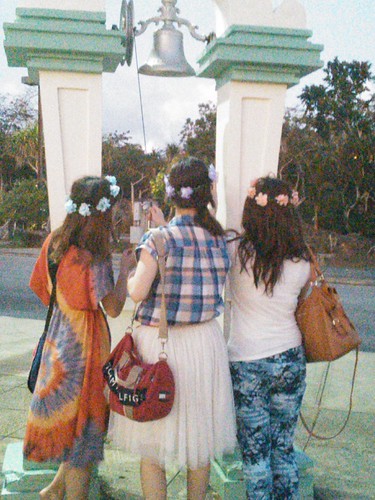
This is a bell at Two Lovers Point in Guam. The management of this most popular iconic spot on the resort island of Guam are at least subconsciously aware that if you want Japanese tourists to come to your destination, then provide them with all the accoutrements of a pagan temple: a legend, something symbolic ideally natural, some good luck charms (locks), a place to leave votive offerings (the rails to leave love locks), a way of making non-linguistic noise either by clapping, or ideally by a bell (as pictured above), and an opportunity for autoscopy: a mirror or place to take a selfie. Tourism is secular pilgrimage.

"Race and IQ": a brain-eating memetic parasite


"Almost got me with a weaponised meme."
  - from The Quantum Thief

In nature, there are a number of brain parasites that control their hosts' behavior, turning them partially or fully into zombies. Many of these are fatal. Humans are mostly safe from these threats, but I believe that we face an analogous threat from memetic "brain worms" - ideas that crawl inside our heads, hull out a little portion of our brains, and begin steering our thoughts toward intellectual self-destruction. For example, there's "Austrianism," which convinces people that loose monetary policy is the source of all macroeconomic problems. But that is hardly the worst.

Perhaps the most potent and deadly memetic parasite I know of is called "Race and IQ". This is the belief that average differences in measured IQ across different consensus-defined racial groups are really, really important to society. 

That's the core belief, but there are some associated ones. 

The first is a persecution complex. "Race and IQ" people believe that they are oppressed rationalists/empiricists fighting the good fight against mainstream/liberal culture, which is engaged in a massive effort to deny or cover up The Truth. This can cause severe perceptual distortions, e.g. the notion that people who deny that race is an important or interesting correlate of IQ are denying the validity or existence of IQ itself, or the partial heredity of cognitive abilities. Like most persecution complexes, it also tends to cause aggressive, paranoid behavior.

The second is the certainty that the aforementioned average IQ gaps are due entirely to deep, fundamental (but always unspecified or hypothesized) genetic differences between broad racial ancestries, rather than to things like selective immigration.

The third is the belief that "Race and IQ" is responsible for many or even most of the economic phenomena in the world - the wealth and poverty of nations, growth rates, savings rates, bubbles, etc.

Furthermore, "Race and IQ" seems to act as a sort of gateway drug. Once people's brains have been infected with this parasite, they become more susceptible to stereotypes of all kinds. Soon, they will believe every stereotype about women, about gays, about Jews, about "Latin lovers," about Germany and Greece - about anything and anyone. The older the stereotype, and the more associated with right-wing politics it is, the more likely they are to believe it. They will start inventing new stereotypes about population genetics to explain almost any phenomenon they see - they become addicted to stereotyping. This may be a side effect of the persecution complex - once you think that the mainstream is engaged in a big cover-up effort against one stereotype, why not all of them? And not only do the "Race and IQ" zombies believe in stereotypes, they start trying to apply them in daily life. You know a meme is a brain-eater when it makes people incapable of distinguishing between statistical significance and goodness-of-fit!

In fact, this brain parasite has been around for a long time. In The Great Gatsby, a character suddenly starts spouting the "Race and IQ" canon:
“Civilization’s going to pieces,” broke out Tom violently. “I’ve gotten to be a terrible pessimist about things. Have you read ‘The Rise of the Colored Empires’ by this man Goddard?” 
“Why, no,” I answered, rather surprised by his tone. 
“Well, it’s a fine book, and everybody ought to read it. The idea is if we don’t look out the white race will be — will be utterly submerged. It’s all scientific stuff; it’s been proved.” 
“Tom’s getting very profound,” said Daisy, with an expression of unthoughtful sadness. “He reads deep books with long words in them. What was that word we ——” 
“Well, these books are all scientific,” insisted Tom, glancing at her impatiently. “This fellow has worked out the whole thing. It’s up to us, who are the dominant race, to watch out or these other races will have control of things.”...
“This idea is that we’re Nordics. I am, and you are, and you are, and ——” After an infinitesimal hesitation he included Daisy with a slight nod, and she winked at me again. “— And we’ve produced all the things that go to make civilization — oh, science and art, and all that. Do you see?” 
There was something pathetic in his concentration, as if his complacency, more acute than of old, was not enough to him any more...Something was making him nibble at the edge of stale ideas as if his sturdy physical egotism no longer nourished his peremptory heart.
If this describes someone you've interacted with, or read on the internet, well, now you know what it is.

If you read blogs, you've probably seen a few "Race and IQ" zombies infesting comment sections. But the scary thing about this memetic parasite is that it has shown an ability to (occasionally) infect even the most intelligent minds. It ate James Watson's brain. It might or might not have eaten William Shockley's brain. It has probably eaten the brains of one or two economists over the years. It's sad and scary to see a once powerful mind reduced from exploring the mysteries of the Universe to exploring this lazy, tired, mostly-irrational worldview.

Why is the human brain so vulnerable to this parasite? Here are a few conjectures:

* There is innate pleasure in being the iconoclast - the one guy who's right while all of society is wrong. "Race and IQ", with its persecution complex and its veneer of science-y-ness, lets you play at being Giordano Bruno.

* When smart guys get old they usually lose their edge. Being smart has been part of their self-image all their lives, and now that's being taken away from them by nature. Imagining oneself as part of a naturally intellectually superior race is a way of substituting group pride for individual pride.

* Tribalism and racism, of course, are deeply rooted. People want a reason to believe they have some giant gang out there that will back them up. "Race and IQ" feeds this desire.

In any case, "Race and IQ" is a worrying parasite because I don't know of a cure. Memetic parasites cannot be cleansed with logic and facts, but often there is a sort of anti-parasite agent available - a benign alternative belief system that the infected can be diverted towards. Austrianism, for example, can be cured with MMT. But I don't know of any equivalent "halfway house" belief system that is effective in getting people off of the "Race and IQ" train.

I think finding a cure for this brain parasite would yield substantial rewards for public health.

Japanese Try Harder When they Fail


As demonstrated by Heine et al.,'s famed experiment, (2001) the Japanese try harder when they fail, whereas Americans try harder when they succeed.

This is explained upon the theorisation that the important thing for North Americans is to feel good about themselves, so they try hard when they succeed, whereas the important thing for Japanese is to feel appreciated and socially included so they try hard when they fail. I remain highly impressed by this research and have been teaching its conclusions in my cultural psychology classes for the past several years.

But upon reflection, the former explanation regarding North Americans is more persuasive than the latter regarding Japanese. Groups express gratitude as much as they sanction so why should it be that Japanese try harder when they fail?

Another possible explanation might be due to the fact that the task was a linguistic one - a word game. North Americans are obsessed with word games, and expect themselves to be good at them. Japanese however, do not expect themselves to be good at word games and would be less likely to feel bad about having failed at the task. What would have happened if the task was to create something in folded paper, or some sort of visual manipulation task?

This question relates to the other main theoretical thrust of the paper in question: the assertion that Japanese believe themselves and their performance, to be tractable to effort, whereas North Americans believe themselves to have intrinsic aptitudes and abilities that are not tractable to effort. Thus North Americans attempt to find the areas in which they themselves and only themselves excel, and avoid those areas where they fail, whereas Japanese are more inclined to believe that given the right environment (the right club, the right coach, the right incentive) anyone can achieve anything if they put themselves in the right environment and try hard.

I believe that Heine's theory conforms to an extent to the facts. Yes, Japanese are more inclined to believe in the power of effort and whereas yes, Americans are more inclined to believe in the importance of aptitude.

I am aware that the third experiment in the same paper tested whether manipulation of the these self views effect performance. Japanese and American subjects were told that their performance would, or would not, vary according to effort, or conversely that performance was, or was not, related to aptitude. It was found that, in the failure condition, telling Japanese that the task was tractable to effort changed their effort little, whereas telling North Americans that the task was tractable to effort changed and enhanced their performance a lot. It was argued that therefore, Japanese chronically presume their performance to be dependent upon effort (so being told that "effort work"s had little effect) whereas Americans when told that effort is effective, tried harder.

[I have tried the reverse manipulation in the success situation with non-significant but Heine predict result among Japanese. Japanese were told that that they had succeeded at a word game - thinking up positive adjectives and then being told that the average student can only think of x adjectives where x is less than the true mean. One third of the subjects were told that the task was about ability (才能) a third were told that the task was tractable to effort and a third were told nothing. I then left the room, saying that I had to get another survey and told them that they could write some more positive adjectives if they like below the line signifying those that they had written with the test time. The group that were told that the task was about ability wrote more extra words that those in the other conditions but not significantly. Having an American mindset, about words at least, makes Japanese try harder in success situations whereas having a Japanese mindset makes Americans rebound better in failure situations.]

But what if the task itself were culturally dependent? Is it that Japanese believe themselves to malleable, and North Americans believe themselves to be a product of their aptitudes as Heine argues?

Or could it be that with regard to word games (the task) North Americans believe themselves, as narrative selves, to be intractable to effort, whereas Japanese who see word games as irrelevant, believe that effort works?

The cultural attitude towards effort and aptitude was also tested, in experiment 4 or 5 of the same paper, finding North Americans to far more inclined to believe in aptitude, and Japanese far more inclined to believe in effort. However the tasks (that I can remember) were ability in History and piano playing, both rather 'logo-phono-centric.' If it is true that North Americans and Westerners in general believe themselves to be self narratives, whereas Japanese do not, then narratival ability -- definitely history, perhaps music -- may be seen to be aptitude based by North Americans and Westerners.

If however Japanese believe themselves to be autoscopically apprehended corporealities then visual tasks might be believed to be more aptitude based.

This, my hypothesis, is fraught. Even very visual, corporeal activities, such as baseball, are believed to be very tractable to effort in Japan.

At the same time, I continue to believe that the "centre of gravity" of the Japanese self may be visual, and that of Westerners narratival, so the belief in effort-changeable malleability, or conversely in aptitude, may depend upon the conception of self, and the nature of the task.

AND, oh dear, these considerations lead me to question the nature of 'identity' across time and space. Narratives exist in time, vision exist in space. Hence anyone believing in a visual self or a narratival self would be likely to believe in differing amounts of 'malleability' in the spacial and temporal dimensions.

Those believing in the centre of gravity of the narratival self would be more inclined to believe in a history, their ongoing story and temporal variability combined with a socio-spatial consistency (changing in time, invariant in space in any one time) whereas those believing that the centre of gravity of their selves is their face, would be more inclined to believe in their spatial dimensionality or plurality or extendedness in socio-spatial situations, and time invariance (changing in space, invariant in time).

Image above translated from figure 1 in Heine, S. J., Kitayama, S., Lehman, D. R., Takata, T., Ide, E., Leung, C., & Matsumoto, H. (2001). Divergent consequences of success and failure in Japan and North America: An investigation of self-improving motivations and malleable selves. Journal of Personality and Social Psychology, 81(4), 599.

Jumat, 13 Maret 2015

Americans are better behaved than ever


David Brooks thinks Americans - in particular, less educated, less affluent Americans - are losing their morality. He blames this on the death of collectively enforced social norms:
We now have multiple generations of people caught in recurring feedback loops of economic stress and family breakdown, often leading to something approaching an anarchy of the intimate life...It’s not only money and better policy that are missing in these circles; it’s norms...In many parts of America there are no minimally agreed upon standards for what it means to be a father. There are no basic codes and rules woven into daily life, which people can absorb unconsciously and follow automatically...These norms weren’t destroyed because of people with bad values. They were destroyed by a plague of nonjudgmentalism, which refused to assert that one way of behaving was better than another. People got out of the habit of setting standards or understanding how they were set.
I think David Brooks should look at the statistics on American behavior.
In other words, Americans are becoming better and better behaved in almost every way. 

So David Brooks is cooking up off-the-cuff sociological theories to explain SOMETHING THAT ISN'T EVEN HAPPENING. And then he is recommending big changes in American culture and society, based on his off-the-cuff sociological explanation for SOMETHING THAT ISN'T EVEN HAPPENING.

(So of course we also don't need to invoke poverty to explain the nonexistent "increase in bad behavior"!) 

Yes, Americans - especially lower-class Americans - are suffering from family breakdown and social isolation. These seem like problems of loneliness, not of loss of morality. They're obviously not leading to increases in violence or drug abuse.

You see, the problem with being a grumpy old guy scanning the media for negative anecdotes and grumbling about the world going to hell in a handbasket, and how the only solution is to somehow revamp society to bring back old social norms is that someone might actually listen to what you say.