Rabu, 29 April 2015

A follow-up on college and signaling


The other day I wrote a Bloomberg post about the fad of describing all communication and information extraction as "signaling" even when a Spence-style signaling model doesn't apply.

Some people have been telling me that this Garett Jones tweet is a reply to my piece. Garett writes:
Emoteconomist: One who is sure competition would eliminate inefficient diploma discrimination, but not inefficient gender discrimination.
Personally, I would apply the term "emoteconomist" to a much wider array of economists, but that's beside the point. I highly doubt this tweet is aimed at me or my piece. Garett knows that I have often written in support of Gary Becker's idea that economic competition decreases inefficient gender discrimination. He also of course knows the difference between preference-based discrimination (as in a Becker model) and signaling (as in a Spence model). So Garett's tweet is almost certainly not directed at my piece.

However, this Bryan Caplan post most certainly is a reply to my piece. At first I intended to rest my case, but Bryan has decided to delay our Bloggingheads debate two years (to coincide with the planned release of his book on the topic), so I might as well make some short reply.

Bryan does agree with a few of my points. For example, he agrees that college is unlikely to be important as an intelligence signal. But he disagrees strongly with my contention that college is not needed as a signal of working ability and temperament. In my piece I wrote:
So is college a way to signal conscientiousness and willingness to work? Maybe. But an even better way to signal that would be to actually work at a job for four years. One would think that if young people needed to do some hard work to signal their work ethics, some companies would spring up that gave young people real productive work to do, and provided evidence of their performance. Instead of paying through the nose to send a signal of your industriousness, you could get paid. But we don't see this happening.
Bryan replies:
Like most economists, Noah needs to be more sociological.  In a cultural vacuum, working four years might be a great signal of work ethic.  But no human being lives in a cultural vacuum.  We live in societies thick with norms and expectations. And in our society, people with strong work ethics go to college and people with bad work ethics don't.   
Disagree?  Just picture how your parents would react if you told them, "I'm not going to college.  I'm just going to get a job."  In our society, your parents definitely wouldn't respond, "That makes sense, because you're such a hard worker."  Why not?  Because in our society, most hard-workers choose college.  If a hard-working kid refuses to copy their behavior, people - including employers - understandably treat him as if he's lazy.  Because lazy is how he looks.
Actually, when I think about the college-as-signaling hypothesis, I do often think sociologically. But, as so often, the society I think of is not the United States - it's Japan. In Japan, it is taken as a given that college students don't work hard at their studies. College is even nicknamed "moratorium". Japanese college kids are expected to enjoy themselves and not work hard - in fact, when I ask Japanese young people why they don't consider going to America for college, they usually tell me that American students work too hard. And yet, top Japanese employers all require a college education (usually a Japanese college education) as a precondition for hiring.

But to be honest, Bryan is right that I don't think very sociologically. I don't really know much about sociology. Does he? Perhaps we should call in a sociologist. I will do so on Twitter.

Anyway, Bryan then writes:
Noah overlooks another key trait that education signals: sheer conformity to social norms.  In our society, you're supposed to go to college, and you're supposed to finish.  If you don't, the labor market sensibly questions your willingness to be a submissive worker bee. 
I agree that college, in America and also in Japan, is a hallowed cultural institution, and that there is a lot of social pressure on people to do it. But this seems like part of college's consumption value, not its value as a costly, Spence-style signal.

Next, Bryan quotes this part of my post:
There are many other reasons to doubt the signaling theory of college. A more likely explanation for college's enduring importance is that it provides a large number of benefits that are very hard to measure -- building social networks, broadening people's perspective, giving young people practice learning difficult new mental tasks and so forth. 
He replies:
I'm glad to hear this.  Noah inadvertently grants one of my key points: Most of education's labor market payoff is unrelated to the material your professors explicitly teach you.  Once you accept this heresy, you're stuck with some combination of my multidimensional signaling story, and Noah's amorphous, evasive "large number of benefits that are very hard to measure" story.  If that's the choice, my story will end up with the lions' share of the mix.  Noah is welcome to the leftovers.
Ah, but wait! College most certainly does provide some direct and obvious skill-based human capital benefits: reading, writing, working in groups, communicating, arguing, doing math, programming computers, etc. My point about non-obvious forms of human capital - human networks, cognitive broadening, emotional growth, exposure to new career ideas, sexual maturity and marriage - was in addition to the obvious benefits of coursework and instruction. And a third big chunk of college's value is consumption, which Bryan basically ignores.

After those three big bites, it is Bryan's "conformity signaling" that is left to hunt for the table scraps!

Finally, Bryan mentions the "sheepskin effect":
Final challenge for Noah: If education's rewards stem from this "large number of benefits that are very hard to measure," why on earth would the payoff for graduation vastly exceed the payoff for a typical year of education?  My explanation, of course, is that given the vast social pressure to cross educational milestones, failure to graduate sends a very negative signal to the labor market, leading to discontinuous rewards.  What's Noah's alternative?  Do schools really delay "building social networks, broadening people's perspective, giving young people practice learning difficult new mental tasks and so forth" to senior year?
I have no ready explanation of sheepskin effects - perhaps they are used by employers to extract a signal of how well one actually learned things in one's college courses. But signal extraction does not imply Spence-style signaling. Spence-style signaling must be costly, and for students who have done enough to graduate, collecting that sheepskin is simply not costly.

So I don't need to explain the sheepskin effect in order to rule out Bryan's explanation. Bryan views the sheepskin effect as evidence of signaling, but since it implies that much of the college payoff comes without cost, I view it as clear evidence against the signaling model of college.

Anyway, I think that about takes care of Bryan's points. As a final note, Bryan wants me to be more sociological, but I think he should be more psychological! If college really is wasteful, costly signaling, as Bryan posits, then people who complete it should view it as a wasteful, unnecessary chore. It should be something they wish they didn't have to do. But I bet a substantial majority of college graduates, if you ask them, will speak quite highly of their time in college, and will not wish that they had been able to go directly into the workforce instead.


P.S. - If you don't understand that signal extraction does not imply signaling, just contemplate the following sentence: "Fire doesn't emit smoke in order to prove to observers that it's really a fire."

Selasa, 28 April 2015

Climaticity Quote


From the preface to Tetsuro Watsuji "Climaticity" (Fudo) by  自分が風土性の問題を考え始めたのは、1927年の初夏、ベルリンにおいてハイディがーの『有と時間』を読んだ時である。人の存在の構造を時間性として把握として活かされたときに、なぜ同時に空間性が同じく根源的な存在構造として、活かされて来ないのか、それが自分には問題であった。もちろんハイデッガーにおいても空間性が全然顔を出さないのではない。人の存在における具体的な空間への注意からして、ドイツ浪漫派の「行ける自然」が新しく蘇生させられるかに見えている。しかしそれは時間性の強い照明のなかでほどんど影をを失い去った。そこに自分はハイデッガーの仕組みの限界を見たのである。空間性に即せざる時間性はいまだ真に時間性ではない。ハイデッガーがそこに留ったのは彼のDaseinがあくまでも個人に過ぎなかったからである。彼は人間存在をただ人の存在として捉えた。それは人間存在の個人的・社会なる2重構造から見れば単に抽象的ななる一面に過ぎぬ。そこで人間存在がその具体的なる二重性において把握せられるとき、時間性は空間性と相即して来るのである。ハイデッガーにおいて充分具体的に現れて来ない歴史性もかくして初めてその深層を露呈する、とともに、その歴史性が風土性と相即するものであることも明らかとなるのである。 I started thinking about environmenticity/climaticity (fudo) in the early summer of 1947 when I read Heidegger's "Being and Time." It seemed problematic to me that when time was used to grasp the structure of human existence, spatiality was not used as a fundamental structure of existence as well. Of course it is not as if spatiality does not show its face at all. It seems to me that attention to "livable nature" is resurfacing in the form of German romanticism. However, under in the strong light of attention to temporality, it seems a pale attention to nature indeed. That is where I saw the limits of the Heideggerian thesis. Any temporality belonging to spatiality is not a real temporality. The reason why Heidegger stopped at this juncture is because his Dasein is no more that the individual. He perceived human existence to be the existence of the person. But that is no more than simply the symbolic half of the social personal nature of the individual. Thus when human existence is understood in its concrete duality, temporality will be seen to be equivalent to spatiality. Further, not only will the historicity that receives short shrift in Heidigger become apparent, this historicity will be comprehended to be equivalent to climaticity. Heidegger seems to have taken Descartes' "I think therefore I am" as starting point. Descartes argued that "res extensa", the spatial, this world that we see, can be doubted; it is a realm of fleeting uncertainty. But the thought, in language, that emerges from that morass of extended images exists. It is. Heidegger asked of the nature of this emergent existent and concluded afaik, the "meaning of being is time". Western, narrative entities, subsequently abstractions or fictions, are made of and in time. Watsuji argued that there is another side to humans - not only their self speech - and that rather, the time of the narrative is merely the historicity or movement of nature: everything can be subsumed to space in motion. He did not feel trapped at all. http://flic.kr/p/sndSfg

Japanese Superstitions

Japanese Superstitions

The Japanese are often described as having little interest in religion. Be that as it may, the Japanese have a great many superstitions. Some of these superstitions originated in religious belief.

For instance, it is thought unlucky for a woman to enter a tunnel construction site, for fear of offending the spirit of the mountain. There are other superstitious prejudices

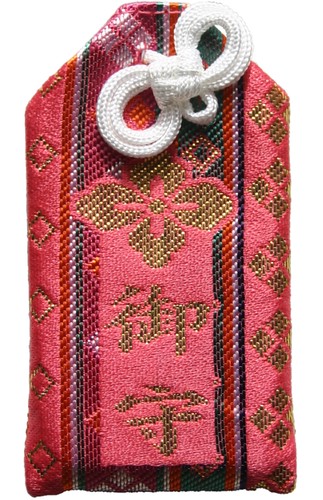
Many Japanese carry talisman (omamori) and other good luck charms such as that pictured above.

If you select an unlucky fortune strip of paper (omikuji) at a shrine. then you should tie it to a tree at the shrine and leave it there, but if you select a lucky fortune strip then it is okay to put it in. your pocket as a sort of talisman for a while. (Or am I making. this up? No, someone did tell me this once.)

A modern one is, if a couple go on their first date to Disney land, in Tokyo presumably, then the couple will split up Similarly modern sounding is if you pierce your ear and a white thread appears from the hole, then if you pull it you will go blind.

New shoes should be worn (for the first time?) in the morning. I am not sure why but one website claims that it is to discourage people from venturing out at night.

The number 4 is unlucky since it is pronounce in the same way. as the word for death. The number nine is also similarly a homonym. for suffering. These numbers are therefore often avoided in hospital and hotel room and floor numbering systems

The number of strokes it takes to write the kanji in ones name. determines ones luck. This site in Japanese allows you to find. out if any particularly surname, given name combination is lucky. or unlucky. We consulted it when choosing the name of our son. www.naming.jp/

If you whistle at night a snake, ghost or monster will come and get you. Originates in the time when there was slavery in Japan and one would attract a trader (to whom one might sell someone) by whistling at night. Thus children were taught to avoid whistling. at night by stories of snakes and ghosts. This was the 3rd most popularly believed superstition among Japanese men and women in 2006.

There are many superstitions related to the Chinese calendar. and various regular unlucky and lucky days related to Buddhist. 'six day' interpretations of the calendar. A calendar related superstitions that seems to have been widely believed is that females born in the year of the fire horse (every sixty years, last time 1966) will turn into devils and cause suffering to their husband and children. The birth rate nominally declined by 25% in the last Fire Horse year, perhaps partly because those born early and late in those years are registered as having been born the year before or the year after.

Children who go to sleep with their shoes on will die before their parents (or at least that is what I think it means - literally, "will not be present at their parents death"). Apparently this. originates in advice for over protective parents, especially. considering that children use their feet to control their body. temperature so they are better off without nocturnal foot covering.

People who cut their nails at night will die before their parents. Perhaps this is because of the danger of cutting ones self. in the dark and getting an infection. There is also a pun. on "night nails" and "shortening ones time" both rendered Yotsume or Yodzume. This was the most popularly believed. superstition among Japanese men and women in 2006

If you eat seaweed such as wakame and konbu (typically. included in Japanese soups) then you will get more hair. I guess that his originates in the slight visual similarity between thick black Japanese hair and seaweed. I can vouch for the fact that this superstition is untrue, since. I like both wakame and konbu but my hair has fallen out

A cold will get better after you have given it to one hundred. people. Perhaps this is one reason why the Japanese are. particularly keen to wear masks when they have colds. The. mask prevents them from giving their cold to others. If they. did not wear the mask then they would not just be careless, but thought to be selfishly trying to give their cold to one hundred people so as to cure it. This superstition was particularly popular amongst men (4th most popularly) rather than amongst women (9th most popularly believed)

If you hiccup one hundred times you will die. Perhaps this was. a way of getting rid of the hiccups since it is know that concentrating on something (such as a counting task - typically counting backwards from one hundred) is likely to cure ones hiccups

If you see a hearse you should hide your thumb (your parent finger) lest your parent or a relative should die. This is surely partly due. to the pun on thumb (parent finger) and parent. This was the 2nd. most popularly believed superstition among Japanese men and women in 2006

There are many superstitions related to puns and the power of words. It is bad luck to say "go home" or "split" at a wedding lest the bride. or the couple should do just that.

If pull out white hair then you will grow more. This may be said in other countries, and may not originate in Japan

If you sneeze then it means that someone is gossiping about you. If you sneeze once then someone is praising you and if twice. then someone is speaking ill of you

If a tea stalk (a bit of tea) comes to the surface in your tea it is good luck.

Stupid people do not catch colds. This may be a way of consoling. people with colds - at least it proves you are not stupid.

Crows cawing is unlucky.

It rains when cats wash their faces.

If you dream of a snake you will get rich.

Snakes are generally. connected with money. People put snake skins in their wallets. Finding a snake skin around the house is a good thing.

People. born in the year of the snake (like myself) will not trouble for money, apparently.

You should not sleep with your pillow to the North since this is the. way that the dead are laid to rest so that their soul knows to go. in the right direction. I am not sure where (I would have thought to. the West since that is the direction of the pure land, but...)

You should not kill a spider that you see in the morning or night. I think that it may be reincarnated relative that has come to watch. over you. Perhaps

It is unlucky to eat eel and pickled plums (ume boshi). Both. eels and pickled plums are strong tasting salty foods. If one. had the sort of rich taste in food to want to eat both eel and. pickled plum in the same meal then one might have a blood. pressure problem

If you lie down straight after eating then you become (as fat as) a horse. Is this a superstition or just common sense?

Similarly common sensical is that yawns are infectious. They. really are, even among humans and pets.

Stupid people like high places. This is perhaps to encourage. humility. High places suggests the ability to look down on others, which is what stupid people like to do. Alas, I like high places. with good views.

Something that happens twice will happen a third time. A lot. like the Western superstition about bad/good things coming. in threes

If you make 1000 origami cranes (birds) then you will be cured. of disease. This superstition was made famous by the attempt. by Sadako Sasaki, an 9 year old girl at the time when, at home one mile away from ground zero, an atom bomb was dropped on. Hiroshima. At age eleven she developed leukaemia and made. 1300 cranes from medicine wrappers and scraps of paper, before her death at the age of 12. Her story became famous. with the publication in 1977 of "Sadako and the Thousand
Paper Cranes" by Eleanor Coerr

Next ones are a little bit sexual, so do not read on if you find that. sort of thing offensive The only 'superstition' mentioned in the Wikipedia article directly. related to Shinto is that preventing women from entering certain. places, particularly tunnels. The reason being that the god of the mountain, ("yama no. kami") would be annoyed to have another female entering her 'tunnel'. There are many places which women. due to their being defiled are also not allowed to enter such as. behind the sushi bar counter (the fish would rot), a Sumo wring. (the subject of some controversy), the baseball dugout and some. sacred mountains,

If gentlemen or boys urinate on worms then their penis will swell up, and probably not in a good way (judging from the kanji)

The above was based on these Japanese language pages.
Excellent large scale survey of most commonly believed superstitions. according to sex. www.fgn.jp/mpac/sample/__datas__/impacter/200607_29.html.
Wikipedia article on superstitions. ja.wikipedia.org/wiki/%E8%BF%B7%E4%BF%A1
Blog article about superstitions. www.mix-up.jp/sakana/archives/2006/02/post_168.html

Minggu, 26 April 2015

Guns don't kill people. Labor kills people.


Arthur Chu, Jeopardy champ extraordinaire, tweets:
"Capitalism made your iPhone" 
No, LABOR made your iPhone. Labor makes things under any -ism. The -isms just determine who gets paid
He's right that "-isms", in econ terms, are about distribution of resources (though he should broaden his definition of resources to include control, not just payment).

But is he right that "labor made your iPhone"?

Consider the following two situations:
A) I make fire by rubbing two sticks together.
B) I make fire by using a butane lighter.

In both of these situations, you can say "labor made the fire". But in the first situation, there was a lot more labor for the same amount of fire. Saying only that "labor made the fire" leaves out this important fact.

Now suppose I want to make fire with no tools. No matter how much labor I apply - the labor of millions of people over millions of years - I will not be able to make fire. 

So saying that "labor makes fire" also leaves out this important point - the necessity of having tools.

Labor is a necessary input into producing an iPhone. But there are other necessary inputs - machines, buildings, land, natural resources, vehicles, tools, etc. And labor is not a sufficient input for making an iPhone - without the right tools and the right organizational system, no amount of labor will get the job done.

But didn't labor "make" the machines, buildings, etc.? Since labor is necessary to create any intentionally produced good, you can say "Labor is what makes everything" if you want to. But you know what else is necessary to create those goods? Electromagnetism, gravity, and the strong and weak nuclear forces. So I could reply to Arthur Chu by saying "Labor didn't make your iPhone. Physics made your iPhone." Now who's right?

The basic point here is that our language, and our intuitive way of thinking about causation, views everything as perfect substitutes. A + B = C. If A + B = C, then you can determine how much of C is due to A, and how much is due to B.

But in reality, things are only partial substitutes. You more often have stuff like
(A^a)(B^b) = C. When you have complementarity, it doesn't make sense to ask how much of C is due to A, and how much is due to B. But we always do it anyway. Arthur Chu's tweet is one example. The slogan "Guns don't kill people, people kill people" is another example. A third example is the perennial debate over whether humans have "free will."

Our intuitive concept of causal attribution is simply wrong and useless in most cases.

Kamis, 23 April 2015

Do Foreigners make more Gestures?

Foreigners make more Gestures?

It is a common perception in Japan that non Japanese make more and more exaggerated gestures while talk to each other than Japanese. This excerpt from a comic (Oguri, 2010, p.8) on the differences between a Japanese woman and her foreign husband includes the copy "Well of course foreigners have much more exaggerated gestures, as we all know."

On the other hand, Western perception of Japanese gestures is mixed. On the one hand there is a perception that the Japanese wear for instance a "mask of inscrutability" and are covered "beneath courteous reserve" (Craigie, 2004, p. 172). In Japan "people have to suppress their true feelings practically all the time" (Rice, 2004, p144).

大げさで読みにくいジェスチャー
At the other extreme, caricatures of Japanese such as in the Directors Cut of Grand Blue where a Japanese diving coach works his diver so hard the later feints, or Isuro "Kamikazi" Tanaka played by Takaaki Ishibashi "who helps excite the team" with his frantic overwrought gestures in Major League 2. Japanese gestures can appear exaggerated to Westerners too. Part of the reason for both Japanese and Westerners thinking that the other's gestures are exagerrated is likely due to the fact that the gestures themselves are different, and phenomena to which one is not accustomed stand out.

Surprising though it may seem to Japanese, research on nodding beat gestures (Maynard, 1987: see also Kita, 2009) generated during speech production, showed that Japanese approximately four times more nods, once ever 5.57 seconds whereas Americans nod only every 22.5 seconds (informal study, Maynard, 1987, p602, note 4). Both Japanese and Americans nod at the beats, and baton touch turn-taking position. But Japanese nod, not only at these times and in the back channel, but also in the middle of their own statements.

So who does make more gestures. A quick comparison of a couple of wedding speakers in Japanese in English on Youtube demonstrates the source of this difference. Americans wave their hands more and use obvious exaggerated, semi iconic facial gestures (like those caricatured above) more liberally but Japanese use a great deal of nodding and bowing to emphasise what their are saying, demonstrate sincerity and as beats. No wonder Japanese speakers get "shoulder ache" (katakori). Conclusive research on the relative importance of gesture remains to be done.

The Japanese, like Italians, also have a wide lexicon of iconic gestures that can be used in place of speech. And as always, I argue that Japan is NOT a high context culture (Hall, 1966; Honna, 1988: see Tsuda, 1992) but that visual communication is the central media and in Japan language is considered to be part of the context. This means that language will often be used to express flattery and other pleasantries (tatemae, such saying "I'll think about it") in stead of "no". Whereas the true meaning (honne) is expressed in the face, posture, pause and expression. Returning to Major League 2, for all his exaggeration, famed Japanese comedian Takaaki' Ishibashi's caricature of the Japanese is faithful. His expressions move from one form to the next like a Kabuki actor, or Kyari Pamyu Pamyu, nothing is left to chance, there is in Barthes' words "perfect domination of the codes" (1989, p.10)

The closest that a Western scholar gets to recognising that gesture and the non-verbal could be central to self and meaning in Japan is Roland Barthes' "Empire of Signs" (1983) (based in part on the observations of Maurice Pinguet).

Now it happens that in this country (Japan) the empire of signifiers is so immense, so in excess of speech, that the exchange of signs retains of a fascinating richness, mobility, and subtlety, despite the opacity of the language, sometimes even as a consequence of that opacity. The reason for this is that in Japan the body exists, acts, shows itself, give itself, without hysteria, without narcissism, but according to a pure - though subtly discontinuous - erotic project. It is not the voice (with which we identify the "rights" of the person) which communicates (communicates what? our-necessarily beautiful-soul? our sincerity? our prestige?) but the whole, body (eyes, smile, hair, gestures, clothing) which sustains with you a son of babble that the perfect domination of the codes strips of all regressive, infantile character. To make a date (by gestures, drawings on paper, proper names) may take an hour, but during that hour, fur a message which would. be abolished in an instant if it were to be spoken (simultaneously quite essential and quite insignificant), it is the other's entire body which has been known, savoured, received, and which has displayed (to no real purpose) its own narrative, its own text. (Barthes, 1983, p.10)

Barthes comes close. He can't help making a "text" of the Japanese body, the only way that he can admit it has meaning since in his hierarchy only language can truly mean (see Barthes, diagram p. 113).
The Hierarchy of the Sign

Barthes famously claims that "the centre (of Japan, the Japanese subject) is empty," and in the above passage that its communication has "no real purpose," but at the same time Japan has forced him to question the purpose of his own vocalisations. And he is wrong that the body talk is erotic. He is talking to and about himself. Japanese signs and selves are cute. The relative absence of words, and the erotic beguiled him to conclude that the centre of Japan is empty. The self and centre of Japan does not have or needs words, but is is far from empty rather visual and raging, fury Kyari Pamyu Pamyu barfing eyeballs full.

Finally, while Merbihain's 93% (Mehrabian & Ferris, 1967) has been rejected even by Mehrabian (Mehrabian, 1995: see Lapakko, 1997) it is clear that non-verbal communication is extremely important. Bearing this in mind the pressing question for me is how Hall (1976) had the gall (!) to claim that those cultures that do not see language as central to human communication are "high context" at all? That nonverbal communication is contextual assumes that language is central, privileged when in fact in Japan, it is often the reverse.

Taking one example, Hall claims that in Japan people expect more of others.

"It is very seldom in Japan that someone will correct you or explain things to you. You are supposed to know and they get quite upset when you don’t. ... People raised in high context cultures expect more of others than to the participants in low-context systems. When talking about something that they have on their minds, a high context individual will expect his interlocutor to know what is bothering him, so that he doesn't have to be specific." (Hall, 1976, p98)

Do Westerners really expect less of others?

I find that in interaction with Japanese I often expect them to have heard my words, the generalities that I have stated, and to apply them across multiple situations. I expect this of them. When I bothered about some situation where previously expressed verbal wishes and requirements are not being met, I expect others to know and get quite upset (like a arrogant fool) when they don't. Americans expect others to understand their generalities - their linguistic expressions - as Japanese expect others to look, mirror and behave appropriate to the situation. This is due to the fact that the central mode of meaning is different not because members of either culture place greater or lesser expectations upon others.

Dumping the hierarchy of the old Western text/context word/world dualism will help us to understand the Japanese and ourselves.


Bibliography
Barthes, R. (1972). Mythologies. (A. Lavers, Trans.). Farrar, Straus and Giroux.
Barthes, R. (1983). Empire of Signs. (R. Howard, Trans.). Hill and Wang.
Craigie, R. (2004). Behind the Japanese Mask: A British Ambassador in Japan, 1937-1942. Routledge.
Hall, E. T. (1976). Beyond Culture. Anchor Press.
Kita, S. (2009). Cross-cultural variation of speech-accompanying gesture: A review. Language and Cognitive Processes, 24(2), 145–167. doi.org/10.1080/01690960802586188
Knapp, M., Hall, J., & Horgan, T. (2013). Nonverbal Communication in Human Interaction. Cengage Learning.
Lapakko, D. (1997). Three cheers for language: A closer examination of a widely cited study of nonverbal communication. Communication Education, 46(1), 63–67. Retrieved from www.tandfonline.com/doi/abs/10.1080/03634529709379073
Maynard, S. K. (1987). Interactional functions of a nonverbal sign Head movement in japanese dyadic casual conversation. Journal of Pragmatics, 11(5), 589–606. doi.org/10.1016/0378-2166(87)90181-0
Mehrabian, A., & Ferris, S. R. (1967). Inference of attitudes from nonverbal communication in two channels. Journal of Consulting Psychology, 31(3), 248. Retrieved from psycnet.apa.org/journals/ccp/31/3/248/
Oguri, S. (2010). Dārin wa gaikokujin.
Rice, J. (2004). Behind the Japanese mask--: how to understand the Japanese culture-- and work successfully with it. Oxford: HowToBooks.

Selasa, 21 April 2015

The Mystery Of Merii of Hama And The Birth Of 'Yokohama Rosa'

Merii of Hama on the streets of Yokohama. Circa 1990.

"What? What’s my name? I’ve long forgotten my real name. But people call me all sorts of names. Like Merii of Hama, Mary, ‘Merican Li’l or Rosa. But Rosa is my favorite of all." – Yokohama Rosa


Nearly 15 years ago, Japan’s legendary TV/film/stage actress Michiko Godai encountered Merii-san on the streets of Yokohama (Japan’s second largest city just outside of Tokyo), roaming around with her oversized rolling suitcase and face painted as white as fresh snow. On first sight, Godai wanted to learn more about the mysterious woman. Who was she? Where did she come from? What was her story?

Godai began her investigation by searching for the makeup store where Merii-san bought her white face paint. She learned that Merii-san once fancied expensive American brand makeup products, but with her dwindling savings, the shop owner introduced her to a 500 yen stage paint which ended up becoming her signature look, together with thick kabuki-like eyeliner.

Godai then found the dry cleaner that laundered Meri-san’s frilly white dresses and would kindly allow her to change in the store before returning to the streets, the hair salon that styled her hair until their clients requested that she no longer be allowed in, and the café that held a rose cup just for her use so as not to alienate the other customers.

Godai, together with the late playwright Giho Sugiyama, strung these stories carefully together like beads on a chain, and the powerful one-woman play Yokohama Rosa was born. 

“Through Rosa, I want to depict Japan’s postwar history and convey it (to future generations),” Godai told the Asahi Shimbun about why she created the play. Since its premiere in April 1996 at the Mitsukoshi Theatre in Tokyo, the piece has been presented 110 times to more than 51,000 people. Beginning in 2003, the piece has been performed each August in Yokohama’s Red Brick Warehouse in commemoration of the end of WWII.

Having its U.S. premiere this weekend as part of Japan Society's Stories from the War series marking the 70th anniversary of the war's end, Godai said, “A war produces tragedies regardless of whether a country wins or loses it... I want Americans to see 'Yokohama Rosa' as a message to pray for peace.”

Michiko Godai portrays Merii over the decades. Photos by © Hideo Mori.

Details of Merii-san’s early life are vague and inconclusive, as she never let down her guard to tell anyone her true story. Merii-san’s Japanese Wikipedia page states that:
She was born in 1921 in Okayama Prefecture to a farming family. The oldest daughter of eight, she was married just briefly. After the war she worked at a local food joint that catered to foreign soldiers. It was there where she met and fell in love with a U.S. Army Official who whisked her off to Tokyo before getting drafted into the Korean War, never to return. Abandoned and forlorn, she turned towards Yokosuka (home of the Yokosuka naval base) in Yokohama, where she began her life as a pan-pan [the word in occupied Japan for prostitute*]. Some records say this was the early 60s, others the mid-50s. She began garnering real attention in the 80s, then disappeared in the mid-90s. She was said to have died in a nursing home near her hometown in 2005 at the age of 84. Numerous songs, manga, films and even a novel and poem exist, inspired by her story.
In 1995, Michiko Godai visited the GM Building where former pan-pan Merii-san (then in her seventies) dwelled and “worked” as a so-called Elevator Girl, escorting people up and down to the floors they wished to go. The tips that she made were now her only source of income. Godai explained to Merii-san that she would like to do a one-woman play about her life and according to Godai she smiled and said, “Is that so?”

Godai’s Yokohama Rosa is a fictionalized account inspired by the woman who came to be known as Merii-san. The 100 minute play traces the life of a woman known as Yokohama Rosa from the time she arrives in Yokohama, through her journey into prostitution, to her love-affair with a foreign soldier and her fears and insecurities about time moving on and her own aging.

The play depicts an innocent life completely tossed and turned by war (in this play not only is WWII considered, but also the wars in Korea and Vietnam) and is performed with live musicians and a panoramic display of striking images from the times. Part post-war history lesson, part testament to the perseverance of the human spirit, Merri-san's story, and the story of all women she represents, lives on through Michiko Godai's heartrending performance in this poignant production.

--Lara Mones

Merii of Hama on the streets of Yokohama. Circa 1990.

*Pan-pan (pronounced pahn-pahn, unknown origin) n. 1. The word for street walker or prostitute used in Japan at the end of WWII. (Kojien); 2. Prostitutes who catered to the Occupied Troops. At the end of WWII, the terms pan-pan girl and pan-suke emerged to describe the prostitutes who appeared on the streets and who specifically worked for the GI troops in Occupied Japan. While the origins of the word are uncertain, some believe it to have come from the English word “pom-pom” meaning sex, while others, the American pronunciation of the Indonesian word for woman “Perem-paun” (pronounced purom pan). Still others believe that it came from the onomatopoeia “pen-pen” describing the shamisen (aka geishas). Whatever its origin, the word that the GIs used became “pan-pan” when it eventually reached the years of the Japanese. (Zokugo); 3. Today, the word or sound “pan-pan” is a commonly used adjective meaning full or to be stretched tight. Via.

Sources:

Shiroi Kao no Densetsu wo Motomete: Yokohama kara Yokohama Rosa he no Deshin, Michiko Godai

Yokohama Rosa, Giho Sugiyama and Michiko Godai

Yokohama Merii (film), Takayuki Nakamura

Kojien Dictionary and zokugo-dict.com

Senin, 20 April 2015

Learning Japanese: Enhance Classes With A Listening and Reading Routine

Learning Japanese? Go for 'total immersion' even if not in Japan. Via.

Of all the ways to start studying Japanese, many find taking classes to be one of the most effective. But making the most of class means more than studying. Of course, memorizing vocabulary, reviewing class materials, and participating in lessons are vital, but there are other things you can do to be prepared. It starts with developing a routine that exposes you to Japanese beyond class and textbooks.

Unless you’re living in Japan, you probably won't experience Japanese involuntarily, so you have to seek it out for yourself. This means making Japanese a part of your daily life, such as watching Japanese television shows on sites like Crunchyroll. From hit dramas such as I’m Mita, Your Housekeeper to classic anime such as Bakemonogatari, Crunchyroll gives access to videos more than a week old for free, or you can pay a monthly fee to access videos as soon as they are released, as well as HD video and streaming to almost any device.

As for reading, NHK offers a variety of simplified news articles in Japanese, and you can also buy manga from sites such as YesAsia or in person at stores such as Kinokuniya. There are lists upon lists of recommended manga for beginners out there, but perhaps the most compelling recommendation comes from Khatzumoto of All Japanese All The Time: “Don’t read according to your level, read according to your interest.”

Having Skype conversations with native Japanese speakers is one of the best ways to utilize your Japanese. If you make mistakes, you can simply ask your friend where you went wrong, all while helping them work on their English. Lang-8 is a great place to make friends for tlanguage exchange.

Discussing the Japanese language classroom experience, Tomoyo Kamimura, head of Japan Society’s Language Center tells students “if you can arrange a language exchange with a Japanese student—I have paired up several people here—it works very well. You spend one or one and a half hours speaking only Japanese, then one hour speaking English. You have to get exposure to real Japanese, not just what’s on a screen or in a book.”

Podcasts can be a great way to expose yourself to Japanese even while doing something else. Japan's esteemed news outlet Nikkei offers hours of Japanese podcast programs available online for free. TBS Radio also offers tons of content, and for news on the latest technology and trends, Hotcast is a great choice. In addition to podcasts, there is a decent amount of free audiobooks available for download, some with transcripts in Japanese, and others with translations.

Listening is great practice without having to “do” anything (besides focus, of course). This is especially useful for commuters and anyone who doesn’t have the time to sit in front of their computer watching J-dramas for an hour at a time. And you can still listen to things you enjoy – music, news, sports, reviews of books, video games or movies – only now, you’re getting accustomed to the language you’re learning at the same time.

It’s all a matter of input preceding output – input being reading and listening, and output being writing and speaking. These are the main components of a language, and it’s important as a beginner to prioritize them depending on how you’re primarily using Japanese. Many Japanese learners choose to focus on speaking and listening in order to have conversations in Japanese, while focusing less on writing and reading kanji.

To help with both, it’s a good idea to add every single word you’re interested in that you hear or read to your Anki decks, so that you can review them until you’ve got them memorized. Once you’ve done that, you can try them out in class or when talking to friends to make sure you’re using them correctly. Even just five to ten words a day can make a big difference in improving your vocabulary.

Whatever you choose to focus on, keeping a steady schedule is important. Anki reviews pile up if ignored for a day, so keeping your review count at a relatively low level and adding each day is a good way to stay on top of them. As a general rule, expect to be reviewing for at least an hour if you have more than a hundred reviews due for the day. This is easily managed by setting review limits in the program itself, and it’s also important to note that there are both iPhone and Android apps available, which can help you finish those reviews even when you are not home.

With a daily routine, learning a language becomes much less daunting and much more doable. Even a typical routine, such as listening to an interesting podcast on the train, watching your favorite show at home, and reviewing words you’ve learned before you go to sleep or first thing in the morning will help your Japanese improve outside of class, so you can spend more of your class time learning instead of trying to catch up.

–Mark Gallucci

Gallucci is a Communications intern at Japan Society. He received his Bachelor of Arts in Journalism from the University at Albany and completed a study-abroad program in Kansai Gaidai University, Japan. He has worked as an English-Japanese tutor and is currently enrolled at Japan Society’s Language Center.

Minggu, 19 April 2015

Sorting by Words and Images

Sorting by Words and Images

Norenzayan, Smith, Kim, & Nisbett (2002) cool research on how Westerners and Asians sort shapes into groups (figure 4 of which reproduced above without permission) is described as a preference for formal or intuitive reasoning. Masuda (2010) describes it under the rubric of his and Nisbett's (2004) distinction between "analytic and holistic thought." Asians sort the left target images into the left hand groups and the right target images into the right hand groups whereas North Americans sort them in the reverse ways.

The reason for this difference is, it seems to me, that the Asians are sorting the target images according to visual similarity according to their face since the visual is felt to be important and alive.

W.I.E.R.D. (Henrich, Heine & Norenzayan, 2010) Westerners, infected as they are by the addiction to hearing themselves speak are looking for a linguistic rule to apply and find it in the 'hair' of the shapes right and the stalks of the flowers left and apply that rule. The hair and the stalks are in a sense in the background. The faces of the little men and flowers are focal and yet, Westerners are not talking to the "The Boss" (Masuda, 2010) the faces of the men and flowers, but to the "trees" (Nisbett, 2004) the minor background details. The reason for this is that Westerners believe that language is the vector of meaning and life.

To humans, life is meaning (Heine, Proulx, & Vohs, 2006) but Westerners hear meaning in words, and Japanese see meaning in faces and characters.

Image based upon figure 4 page 664 of (Norenzayan, Smith, Kim, & Nisbett, 2002)
Henrich, J., Heine, S. J., & Norenzayan, A. (2010). Most people are not WEIRD. Nature, 466(7302), 29–29.
Heine, S. J., Proulx, T., & Vohs, K. D. (2006). The meaning maintenance model: On the coherence of social motivations. Personality and Social Psychology Review, 10(2), 88–110.
Masuda. 増田貴彦. (2010). ボスだけを見る欧米人 みんなの顔まで見る日本人. 講談社.
Nisbett, R. (2004). The Geography of Thought: How Asians and Westerners Think Differently...and Why. Free Press.
Norenzayan, A., Smith, E. E., Kim, B. J., & Nisbett, R. E. (2002). Cultural preferences for formal versus intuitive reasoning. Cognitive Science, 26(5), 653–684.

Reciprocal Resurrection of Simulacra

Reciprocal Resurrection of Simulacra

This essay explores the intersection between Derrida's Post Card (1987), and Baudrillard's simulacra (1995) in Western and Japanese culture: word/idea pairs and images respectively.

Most Western philosophers are unintentionally obfuscating. They want to tell their readers that it is okay, That the way we understand the world is not a grotesque lie. A few, larger French philosophers such as Baudrillard (1995) and Derrida (1987, 1998, 2011) attempts to pull the lie apart, to expose its untruth. But, because they are polite and the lie ingrained, they is not quite persuasive enough. Obfuscators take the mickey out of their "Parisian logic" (Mulligan, 1991).

In order to see oneself it is self-evident that one has to model the perspective of an other and or mirror. However, when talking about oneself to oneself, this need for another, real or simulated, is not apparent. Many clever people (I am thinking of Steven Heine e.g. in Heine, 2003) claim that face, or image is essentially for others whereas language, (that most social of media!) and our Western narratives selves are for ourselves.

Indeed, most Westerners think, that when they think they are thinking, talking simply to themselves (and not to Mel Gibson's Satan, above right). Seeing oneself requires a spatial distance that makes the alterity of self-observer far more apparent. But speaking, hearing oneself speak, does not seem necessarily to involve anyone else, real or imagined, at all. Derrida rejects this possibility forcefully (Garver, 1973).

The truth in my humble opinion, and experience is, that as Derrida argues, speaking to oneself does require an other, simulated or real. But few people, or atheists at least, seem to realise this. How can I convince folks of the truth, that self-narrative requires an other to be meaningful?

Derrida's gambit is something on the lines of the following.

When I talk about myself I use signs, signs like "Tim" and "I". Each time I say or think a sign I may be slurred or abbreviate but for the phoneme to mean, it needs to be one of a group of other iterations of the same sign. Signs are iterative. I can say Tim TIM Tm, tem, timu, timm, with all sorts of slurings and blurrings but for "tim" to mean me it must be member of the set of signs that are iterable. It must be one of the sayings of "Tim." "Tim" as a sign is a sign by virtue of the fact that it is recognisable and distinguishable from tin (can).

Therefore, Derrida opines, since signs have this property in themselves of being repeatable and recognisable their use implies a distance or disappearance of the subject that uses them. Derrida fundamental insight is I think that this iterability implies speech is no different from writing.

Mulligan (1998) is right to point out that it is going to be difficult to convince anyone that the iterability of signs implies anything threatening about the Western self. Conversely, the fact that signs are iterable (repeatable in time) is a phenomena that obfuscating philosophers have used as evidence for the existence of "presence:" the co-temporal, co-presence of "ideas".

That signs are essentially "iterable" is a proposition that Derrida gets from Husserl who he paraphrases in the following way.

"When in fact I effectively use words, and whether or not I do it for communicative ends (let us consider signs in general, prior to this distinction), I must from the outset operate (within) a structure of repetition.... A sign is never an event, if by event we mean an irreplaceable empirical particular. A sign which would take place but “once” would not be a sign; a purely idiomatic sign would not be a sign. A signifier (in general) must be formally recognizable in spite of, and through, the diversity of empirical characteristics which may modify it. It must remain the same, and be able to be repeated as such, despite and across the deformations which the empirical event necessarily makes it undergo. A phoneme or grapheme is necessarily always to some extent different each time that it is presented in an Operation or perception. But, it can function as a sign, and in general as language only if a formal identity enables it to be issued again and to be recognized. (Derrida, 1967, p55—56; Derrida, 2001, p.42 see Mulligan, 1992, p.5.)

Derrida also states more pithily “a sign which would take place but `once’ would not be a sign”

Hansen (1993) traces this distinction too, between sign tokens or instantiations and signs, and points out Western philosophers since Plato and Aristotle have claimed that (Aristotle writes, see Hansen, 1993) "spoken sounds are symbols of affections in the soul, and written marks symbols of the spoken sounds. And just as written marks are not the same for all men, neither are spoken sounds. But what these are in the first place signs of-affections in the soul-are the same for all; and what these affections are likenesses of - actual things - are also the same."

This is basically the same argument as presented by Husserl about 2000 years earlier. Our feeling of their being identity in difference, of a unity, despite multiple instantiations, demonstrates to us that there must be existences underpinning them. Words are somehow the same every time we use them. This is not true, but we feel it strongly.

I think it is possible to be far more persuasive, and threatening, by taking a detour through Japanese culture. The use of Japanese culture as an analogy is similar to writing a book of self addressed postcards (Derrida, 1987) to illustrate the weirdness of self-addressed speech, except that the Japanese, unlike the postcard writer of Derrida's book (ibid), are not fictional, and I believe they send themselves blank postcards - images without words (Kim, 2002) in the form of selfies, purikura (Toriyama et al., 2014), souvenir photos (kinenshashin: see Davidson, 2006 p36), third person memories (Cohen, Hoshino-Browne, & Leung, 2007), and autoscopic video games (Masuda and Takemoto in preparation).

I argue that whereas Westerners hear a shared, identical unity behind multiple slightly differing sound tokens, Japanese may feel the same way about images. A copy of a shrine, horse, bonsai tree, karate form or a face, though it changes in each instantiation call to the Japanese mind a similar sense of unity as called to the mind of Westerners when they hear words.

Despite, upon consideration there being a plurality of word phenomena, each instantiation is as good as the others. No word is inferior to another, no word is a copy of another word, since they all refer to a (illusionary) underlying unity. All words are authentic because they match up to ghostly metaphysical meanings. Westerners until Dennet (1992) find it difficult to deny the existence of these idealities, because they are one of their number. Our self, existed traditionally as an idea in the mind of God, or according to Dennet, who somehow manages to obfuscate even as he reveals the truth, is an abstraction or fiction.

Similarly Japanese may be able to feel that "foreign villages" (in Japan - gaikokumura 外国村) are as good or the same as villages abroad, or that video tapes of a deceased grandfather require funeral services just as did the body (image) of their grandfather, or that a sculpture or even a picture of a horse (ema 絵馬) is as pleasing to a god as real horse, or that a mask or face can represent the underlying unity of a person (Watsuji, 2011).

Nowhere are simulacra, or authenticopies, more visible than the Japanese religion, Shinto. Shinto shrines, especially that of the sungoddess are rebuilt (senguu 遷宮) made in miniature for household shrine shelves (神棚), and replicated (e.g. the replica of Ise shrine in Yamaguchi city's main shrine) but in all cases thought to be authentic. Japanese deities are infinity divisible (bunrei 分霊) and and transportable (kanjou 勧請) to be enshrined elsewhere (bunsha 分社). Originally this would require the copying of the object felt to contain the spirit/deity (goshintai 御神体), but more often now simply by stamping the characters on a piece of wood, card or paper to form a sacred token (神符), as in the case of the sacred talisman that serve to transport the deity into household shrines (ofuda お札) and inside protective amulets (omamoriお守り). Sometimes these sacred stamped tokens (shinpu/ofuda神符/お札) were felt to fall from the sky causing great merriment, singing, dancing and tourism("("good isn't it?" or "hang loose" ええじゃないか). Just as the Lords prayer on the lips of one bishop is the same as that on the other so the stamped names of Japanese deities are the same in all their instantiations. Conversely, in Japan words without material representation are felt to be hot air, as the Jesuits lamented being required to bring presents and not express gratitude in words.

It does not matter that faces age, seals smudge, or that there are minor differences between sculpted and real horses, just as it does not matter that I might say my name, or I, with a hoarse voice (To the Japanese the voice is always horse..!). That is not to say that the Japanese are fully identified with their bodies. Traditionally the Japanese were also aware of the field of vision, that which which sees, the mirror as soul. But that space is no different from that which is seen, or rather contains the authenticopies as they are, without their need to be unified and represented by an idea.

Narcissus is a fool for mistaking his reflection for himself but there is identity, Echo, in his voice (Brenkman, 1976). Likewise Susano'o is a fool for repeating his words but there is identity, Amaterasus, in his image. Iterability in time is like copiability in space - there is a ridiculous distance. When Narcissus falls in love with his self reflected in the water we want to shout "but that isn't you!" There is an obvious plurality, a painful not-one-ness. It is as ridiculous to a Japanese person to hear someone speaking to themselves or praising themselves as it is to a Westerner watching Narcissus love his image. in each case evaluating subject can not escape from evaluated object, and the loop is felt incomplete.

These differences in perception depend upon culture not some inherent superiority of one or other media. Writing is no more a record of speech than speech refers to writing.

This is due to the nature of the Other being simulated in the mind. There never was a layer of ideas, or metaphysical realm, just a partner in the heart. Westerners from Plato to Baudrillard (1995) tell us that is God that In the West we feel (and or do not feel) as if a super-addressee is always listening and Japanese feel (and or do not feel) as if someone is always watching.

By "and or do not feel" I mean that the Other is both felt and hidden. That on the one hand I "feel" someone is listening make this preposterous self-speech that I do, even in my head, meaningful, pleasurable but on the other if the door were to open and I were to see what I am speaking to, I would recoil in horror. So in that sense I do not feel the presence of the other. I will come back to this.

I think that the two forms of ridiculous distance should start to erase each other in those that experience them. The way in which Post Cards and images destabilise the structure of the word/idea complex is also discussed by Baudrillard (1995).

Baudrillard writes "[Iconoclasts] predicted this omnipotence of simulacra, the faculty simulacra have of effacing God from the conscience of man, and the destructive, annihilating truth that they allow to appear—that deep down God never existed, that only the simulacrum ever existed, even that God himself was never anything but his own simulacrum—from this came their urge to destroy the images.rage to destroy images." (1995, p4)

Baudrillard's term "simulacra" seems too broad, being used to mean words, images, simulated subject positions and even perhaps the imminent universe. Nevertheless he has a point. It seems to me that the two types of simulacra that I differentiate (Western words, and Japanese images or "authenticopies") should have a tendency to draw attention to the limitations of each, and not so much erase but resurrect (!) or make people aware of God, in one person or another, as intra-psychic other.

By consideration of Edo period artwork and research on Japanese artistic representation (Masuda, Wang, Ito, & Senzaki, 2012) third person memories (Cohen, Hoshino-Browne, & Leung, 2007) the Other of the Japanese is not "in the head" but outside of it, a spatial distance but still in their psyche, that is to say a simulated, undead viewpoint. Japanese ancestors look down and protect. Though simulated, I don't think they could ever be as dead as words and images since it is a simulated subject position, but in the title I am using "simulacra" to be simulated subject positions, a viewer, or hearer. It is really these that have ensured the meaning of Western Words and Japanese images.

Theists experience these subject positions as their Gods: ancestors or Amaterasu, and Jesus. Atheists may experience them as the monsters shown above Sadako of "Ringu", (Nakata, 1998) and Satan of "The Passion of the Christ" (Gibson, 2004).

When Baudrillard further writes "If they [iconoclasts] could have believed that these images only obfuscated or masked the Platonic Idea of God, there would have been no reason to destroy them. One can live with the idea of distorted truth. But their metaphysical despair came from the idea that the image didn't conceal anything at all, and that these images were in essence not images, such as an original model would have made them, but perfect simulacra, forever radiant with their own fascination. Thus this death of the divine referential must be exorcised at all costs." (1995, p4) he is correct to say that images do not require a second term, a "divine referential:" ideas. However, both word/ideas and images do require a third term a simulated hearer/view point. Images exist in the mind of their god unmediated.

Returning to the way in which the Other is and is not here.

Husserl is adamant that no one is listening to thought, and it is precisely this fact, coupled with the fact that he can yet understand himself, that convinces him that something other than what happens when we speak to others must be going on. "He believes that he finds pure expression [of another layer of ideal things] in interior monologue because, in interior monologue, my thoughts seem to be present to me at the very instant that I say them." (VP, p. xxv). This argument convinces cleverer people than me, such as Mulligan.

When a Japanese person is looking at a mirror (which she may not need), or imagining herself, she may feel that that the person in the mirror or the image in her mind is herself. Looking at a Japanese person looking at a mirror I may want to to say "no, that is not you! Look you are on this side of the mirror not that thing over there!" But the Japanese lady is cleverer than me. She "knows", like Husserl "knows", there is no one else in her head, so there is no way someone can watch from the wings to claim "You are not the person reflected in the mirror."

To me sight is always seen by someone (an eye) just as to the Japanese (Mori, 1999) language is always heard by someone (an ear). Language in Japan is always contextual. Sight in the West is always contextual. Conversely, the "third person perspective" (Mori, ibid) exists in language in the West, and in those birds eye views that the Japanese see, feel and represent.

The experience of hearing oneself speak proves to Husserl that speech can be heard and understood without another listener (other than the one speaking) because he feels he is absolutely alone. Specifically Husserl can understand the word "I" to refer to himself.

The experience of seeing oneself imagined proves to Japanese that images can be seen and understood without another viewer (other than the one seen) because she feels she is absolutely alone facing the mirror. Specifically she can understand the image to be herself.

Addressing Husserl, Derrida says that consciousness is temporised, and that the other needed and simulated to understand the interior I is deferred in time. "You don't realise that you are writing letters to yourself in the future/ reading letters from yourself in the past." You are not alone at the level of simulacra.

Addressing the Japanese person I want to say that consciousness is spatialised, and that the other needed and simulated to understand the interior self image is distanced. "You don't realise that you are signing to yourself at a distance/ seeing yourself from a distance." You are not alone at the level of simulacra.

It is so obvious to me, a Westerner, that one can see imagine oneself from the outside. That is obvious to the Japanese too. But if the Japanese have an extra viewpoint that is horrifying, then erasing that viewpoint, and yet at the same time viewing themselves from it, they can misunderstand themselves as that which is seen, forgetting that they are not turning to meet the gaze of a monster, distanced, in the image.

It is obvious to a Japanese person that I can defer understanding, when I practice justifying myself for instance (Haidt, 2001). That is obvious to me too. But I if I have an extra ear-point, a super-addressee that is horrifying, then erasing that ear-point, and at the same time hearing myself from it, I can misunderstand myself as that I am that which is said, forgetting that all I am doing is deferring speaking to a monster deferred. Who am I going to meet?

All is needed for self is an other in mind which is too horrible to be fully aware of. That one is aware of but can not admit of, nor gaze at. Someone you know is there behind a door. Someone that will open a door one day, when Japanese people go somewhere.

That there are two ways of doing this auto-affection (which are interlinked) may at the boundary between the two make obfuscation apparent.

Am I oversimplifying? Regarding Derrida, his translator writes "In other words, if we think of interior monologue, we see that difference between hearing and speaking is necessary, we see that dialogue comes first. But through dialogue (the iteration or the back and forth) of the same, a self is produced. And yet, the process of dialogue, differentiation-repetition, never completes itself in identity; the movement continues to go beyond to infinity; the movement continues to go beyond to infinity so that identity is always deferred. always a step beyond." That sounds very complicated.

But if self-speech is just practice speech (Haidt, 2001) that we do all the time before meeting people to whom we explain ourselves to, then self speech is surprisingly mundane. Self speech might be compared to a love-song to a lover that we'll never meet, or a series of amorous post cards to yourself in the future (Derrida, 1987), or those letters that remain unopened in a Chronicle of a Death Foretold.

Bibliography
Baudrillard, J. (1995). Simulcra and Simulation. (S. F. Glaser, Trans.). Univ of Michigan Pr.
Brenkman, J. (1976). Narcissus in the Text. Georgia Review, 30(2), 293–327. Retrieved from www.jstor.org/stable/41399656
Cohen, D., Hoshino-Browne, E., & Leung, A. K. (2007). Culture and the structure of personal experience: Insider and outsider phenomenologies of the self and social world. Advances in Experimental Social Psychology, 39, 1–67.
Davidson, C. N. (2006). 36 Views of Mount Fuji: On Finding Myself in Japan. Duke University Press.
Dennett, D. C. (1992). The Self as a Center of Narrative Gravity. Self and Consciousness: Multiple Perspectives. Retrieved from ase.tufts.edu/cogstud/papers/selfctr.htm
Derrida, J. (1987). The Post Card: From Socrates to Freud and Beyond. (A. Bass, Trans.) (1 edition). Chicago: University Of Chicago Press.
Derrida, J. (1998). Of grammatology. (G. C. Spivak, Trans.). JHU Press.
Derrida, J. (2011). Voice and Phenomenon: Introduction to the Problem of the Sign in Husserl’s Phenomenology. Northwestern Univ Pr.
Haidt, J. (2001). The emotional dog and its rational tail: a social intuitionist approach to moral judgment. Psychological Review, 108(4), 814. Retrieved from psycnet.apa.org/journals/rev/108/4/814/
Hansen, C. (1993). Chinese Ideographs and Western Ideas. The Journal of Asian Studies, 52(02), 373–399. doi.org/10.2307/2059652
Heine, S. J. (2003). An exploration of cultural variation in self-enhancing and self-improving motivations. In Nebraska symposium on motivation (Vol. 49, pp. 101–128). Retrieved from books.google.co.jp/books?hl=en&lr=&id=UCl0stabm54...
Husserl, E. (2001). Logical Investigations Volume 1 (Revised Edition). London ; New York: Routledge.
Kim, H. S. (2002). We talk, therefore we think? A cultural analysis of the effect of talking on thinking. Journal of Personality and Social Psychology, 83(4), 828.
Masuda, T., Wang, H., Ito, K., & Senzaki, S. (2012). Culture and the Mind: Implications for Art, Design, and Advertisement. Handbook of Research on International Advertising, 109.
Mulligan, K. (1991). How not to read: Derrida on Husserl. Topoi, 10(2), 199–208.
Watsuji, T. (2011). Mask and Persona. Japan Studies Review, 15, 147–155. Retrieved from asian.fiu.edu/projects-and-grants/japan-studies-review/jo...
Toriyama et al. 烏山史織, 齋藤美保子, カラスヤマシオリ, サイトウミホコ, KARASUYAMA, S., & SAITO, M. (2014). Awareness of Purikura in youths: A comparison of high school and university student’s. 鹿児島大学教育学部教育実践研究紀要=Bulletin of the Educational Research and Practice, Faculty of Education, Kagoshima University, 23, 83–94. Retrieved from ci.nii.ac.jp/naid/120005434882
Mori, A. 森有正. (1999). 森有正エッセー集成〈5〉. 筑摩書房.

Sabtu, 18 April 2015

Symmetry on Mars


It is often argued that there is something pleasing to the eye about symmetry and Western pottery, textiles, gardens and architecture has a tendency to be symmetrical. Japanese art in the same classes however tends to shun symmetry and aim for assymetry and the "surnatural." Part of the reason for this may be that Japan is a matriachy and it is males that prefer symmetry. In a study of Western males and females, shown above, it was found that males prefered symmetrical designs both in the real world and the abstract, whereas Western women (presumably influenced by males) show little to no preference for the symmetrical. I hypothesise that the the assymentrical looks natural, individual, non-artificial and more attractive, at least to those who prefer those characteristics. Facial symmetry is prefered to varying degree by both sexes, but I believe that women exhibit it more. I think that this because both sexes are bisexual, haunted by simulations and projections of their opposite sex parents, males more so than females. Freud had a very lopsided face. http://flic.kr/p/rU3Fzq

Rabu, 15 April 2015

Steve Williamson is right that I am confused


In a post for Bloomberg View, I wrote about the history of the sticky-price revolution of the late 1990s and early 2000s:
In 1994, economists Greg Mankiw and Lawrence Ball wrote an essay for the National Bureau of Economic Research entitled “A Sticky-Price Manifesto.”...[T]he essay heralded the beginning of a macroeconomics mini-revolution. It was a direct threat to the line of research that had been dominant in the 1980s, which tried to explain recessions without sticky prices... 
The economic establishment reacted harshly to the upstarts. “Why do I have to read this?" fumed Robert Lucas, the dean of macroeconomics. "This paper contributes nothing.” He went on to accuse the sticky-pricers of being opposed to science and progress. 
But Lucas fumed in vain. During the following decade, the sticky-price models went from strength to strength. New math was developed to make them easier to use. Possible reasons for price stickiness were investigated -- for example, “menu costs,” in which the seemingly trivial costs of changing prices add up to a big problem across the broader economy. 
Even more telling, sticky-price theorists proved that you didn’t need a lot of price stickiness to mess up the smooth working of the economy. Even the tiniest dash of stickiness would turn all kinds of theories on their heads. Economists Susanto Basu, John Fernald, and my doctoral adviser Miles Kimball, for example, showed that when prices are even a little sticky, bursts of technological progress actually hurt the economy for a short while, by causing a burst of deflation, before eventually boosting growth. Over time, the addition of various other economic mechanisms, like labor search, has further reduced the amount of price stickiness required to cause major recessions. 
Sticky-price models have become the dominant models used at central banks. The smoothly adjusting, flexible-price models of the 1980s are basically not used anywhere, by anyone, for anything. 
Even some of the biggest skeptics of sticky prices are coming around. In 2004, economists Mark Bils and Peter Klenow looked at how businesses changed prices, and found that the changes were too frequent to be consistent with the sticky-price story. But in 2014, they reversed their stance, looking at evidence on the adjustment of markets in recessions and concluding that “sticky prices...deserve a central place in business cycle research.” Meanwhile...Patrick Kehoe...long-time [opponent] of the mainstream sticky-price models, nevertheless wrote a paper in 2010 entitled “Prices are Sticky After All.”... 
The moral of the story is that if you just keep pounding away with theory and evidence, even the toughest orthodoxy in a mean, confrontational field like macroeconomics will eventually have to give you some respect.
Steve Williamson wrote a response to my post, and for the life of me I can't tell what he's trying to say. He calls me "confused". Well, after reading his post, I am confused.

Williamson takes some potshots at Ball and Mankiw:
The "Sticky Price Manifesto" is in part a survey of the menu cost literature, but it reads like a religious polemic... 
Why should we care what Ball and Mankiw think is going on in the minds of their staw-men opponents, or in the classrooms of those straw-men? Why should we care what Ball and Mankiw "believe?"... 
Noah seems to think that Lucas was being unduly harsh [in his response to Ball and Mankiw], and that he was somehow feeling threatened by these "upstarts." It's pretty clear, actually, that Lucas just thinks it's a bad paper - religion, not science - and that Ball and Mankiw could do a lot better...
He then asserts that New Keynesian models don't have anything to do with the stuff Ball and Mankiw were writing about:
Noah is more than a little confused about the genesis of sticky-price New Keynesian (NK) models. In particular, he thinks that Ball and Mankiw's "Sticky Price Manifesto" was a watershed in the NK revolution. Far from it... 
Where did NK come from? Which of the three threads in post-macro revolution Keynesian economics - coordination failures, sunspots, menu costs - morphs into Woodfordian NK models? To a first approximation, none of them. Perhaps NK owes a little to the menu cost approach, but it's really a direct offshoot of real business cycle theory. Take a Kydland and Prescott (1982) RBC model, eliminate some bells and whistles, add Dixit-Stiglitz monopolistic competition, and you have Rotemberg and Woodford's chapter from "Frontiers of Business Cycle Research." Add some price stickiness, and you have NK. So, NK basically leapfrogs most of the "Keynesian" literature from the 1980s. It's much more about RBC than about Ball and Mankiw.
(For a brief intro to Mankiw's contribution to the New Keynesian research program, see the Wikipedia page for New Keynesian economics. See also the Wikipedia page for Steve Williamson.)

Williamson then tries to claim ownership of New Keynesian models for Chicago/Robert Lucas/RBC/His Majesty the King of Spain/I'm not sure:
[I]t's worth noting that Mike Woodford, the key player in NK macro, was at the University of Chicago from 1986 to 1992, the latter 3 years in the Department of Economics with - guess who - Bob Lucas. Indeed, they wrote a paper together. It's about - guess what - a kind of sticky price model with non-neutralities of money. Later on, Lucas wrote about sticky prices with Mike Golosov. So, I think we could make the case that the influence of Lucas on NK is huge, and that of Ball and Mankiw is tiny.
He then goes off on a long tangent about how central bankers might use sticky-price models to think about financial stability (which, apparently, he thinks is now the main priority for central banks).

It's kind of funny to see Williamson trying to wrest historical credit for New Keynesian models from Mankiw & co., since just in his previous post he had this to say:
Mike Woodford can correct me on this, but my impression is that he came out of graduate school with a specific goal in mind, which was creating a version of Keynesian economics that would fit into modern macro. Ed Prescott's project left central bankers scratching their heads about what they were supposed to be doing, and Woodford and others stepped into the void. Interest and Prices is, I think, intended as a handbook for central bankers. There was a lot of effort put into marketing the whole NK project to the world's central banks. This is ongoing, and has been institutionalized[.]
So NK was reverse-engineering of Keynesian ideas. But actually it was just RBC. But it succeeded because it was promoted via a slick marketing campaign. But actually Lucas was one of its founders.

Also, microfoundations are important. But Mankiw's efforts to microfound sticky prices with menu costs was totally unimportant to the creation of sticky-price macro models.

Got that?

Damn, I guess I am confused.

Predicting Japanese Earthquakes Again

Predicting Japanese Earthquakes

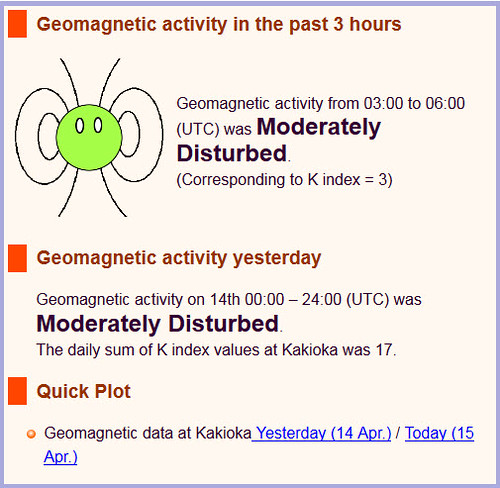
The homepage of the Kakioka Magnetic Observatory shown above says that geomagnetic activity is not a good predictor of earthquakes.

But, what with all the dolphins (Melon Head Whales), 150 of them that washed up on a beach North of Tokyo I was reminded of the brilliant research by Motoji Ikeya, on the way that catfish (thought to cause earthquakes in Japanese legend), oar fish (thought to predict them in Japanese legend) and other sea and land mammals sense the rock crushing piezoelectric activity causing magnetic fields and ionization of the air and can be used to predict earthquakes.

An American company uses the same principle to attempt to predict earthquakes using magnetometers and publishes world wide data (mainly for California and Taiwan) on their Quakefinder web site. However, they do not have any sensors in Japan. QuakeFinder does have a great Google Tech Talk video explaining their quake prediction research.


There appear to be however a few places in Japan that publish electromagnetic activity, particularly the Kakioka Magnetic Observatory in Kakioka north of Tsukuba (i.e. about 100km north of Tokyo). Their main English page shown in the screen shot above says that "Geomagnetic activity from 03:00 to 06:00 (UTC) was Moderately Disturbed." I am not sure if that is near enough to Tokyo to be of any use at all, even if if magnetic activity were of use. The same site offers data from The same site has another page that shows detailed data from four places in Japan
Kakioka About 100km north of Tokyo
Memambetsu (top of Hokkaoido)
Chichijima Island a LONG way south of Tokyo in the Pacific
Kanoya (nr Kagoshima) But I am not sure how to read the plots, and there is no cute graphic (as in the above image) to show whether the readings are high or not.

A Japanese space agency measures "Sporadic E propagation" and has traffic lights indicating the level of activity at four sites in Japan (Hokkaido, Tokyo, Kagoshima and Okinawa). None of them are red right now.

None of these measuring stations are anywhere near me. Perhaps I should look at our pet goldfish, or go to see if the carp in the university pond are jumping out of the water, or arranged in lines. Fish may arrange themselves in lines so as to avoid placing their bodies across the direction of greatest magnetic field, or jump out of the water when the magnetic field becomes unbearable.

Or I could keep a catfish. Americans are blissfully unaware that catfish are earthquake predictors, so when catfish die they think it was something to do with the water despite there being no harm to another water creature. See the mystery that occurred in Texas that preceded earthquakes, and Virginia at about the same time. I am not entirely sure whether it is a good idea to be aware or not but, the late professor Ikeya felt that paying attention to pets and other animals could save lives as explained in his short children's book.


The reason for melon head whales, and other marine mammals beaching, themselves is entirely different and explained on Captain David Williams' excellent website The Truth about Why Whales Strandings. Since, he claims and I believe him, that whale strandings are more to do with sonic seismic events, it is less likely that they would predict imminent earthquakes, but rather the fact that a submarine earthquake has already occurred. He suggests that the recent beachings in Japan are due to there having been a seismic event near Guam about a month ago. However, since seismic events occur in groups, and there were beachings prior to the big Fukushima Tsunami, and whales are linked with earthquakes in North American Mythology, there is that possibility and the connection between abnormal whale activity and earthquakes is common knowledge (see this auto translation) in whaling earthquake prone Japan.


Selasa, 14 April 2015

Did macro theory fail us in the crisis?


David Andolfatto and Mark Thoma have posts defending macro theory from (some of) the people who say it failed us in the crisis. Both are good posts, and you should read both.

Anyway, here's a quick (and probably incomplete) taxonomy of criticisms people make about macro with regards to the crisis:

1. "Macro models failed to predict the crisis, therefore DSGE sucks."

This is the criticism that Andolfatto and Thoma reject. I basically agree. There are no other models out there that did forecast the crisis. Nor are expert predictions any better.

Personally I think DSGE techniques haven't  reaped dramatic benefits (yet). But what other alternative is better? When I ask angry "heterodox" people "what better alternative models are there?", they usually either mention some models but fail to provide links and then quickly change the subject, or they link me to reports that are basically just chartblogging. Yeah, sure, if you put out hand-wavey reports saying "capitalism sux, there's gonna be a crash!" every year or two, you're eventually going to be able to say "see, I told you so". But that's no replacement for real modeling.


2. "Macroeconomists were too confident before the crisis, and that gave policymakers false confidence."

It is pretty obvious to anyone who has ever interacted with macroeconomists that most of them take their models way too seriously (this is even more true of the "heterodox", to the degree that they even have models). It's a common disease of academics in general - you have to spend so much effort pushing your theories that overconfidence is selected for.

Did this confidence leak over into the policymaking sphere? I don't have evidence here, but I doubt it. Most of the Fed people are a LOT less confident than academics. And they were being advised by a lot more than just the academic crowd - they had a big stable of chartbloggers, hand-wavers, etc. to draw upon. Plus they themselves had Old Keynesian models in their bag of tricks. As for politicians, it's not clear they even know that academic macroeconomics exists.

If the Fed people were overconfident in 2005-6, I suspect it was mostly due to natural cognitive biases - "Everything seems like it's been going OK for a couple decades, I guess we're doing something right" - rather than the overconfidence of the academics they interacted with.

But I could be wrong.


3. "Macroeconomists weren't focusing on finance enough before the crisis."

Thoma says that this is a valid criticism, and I agree. There are a bazillion models out there. But just having models out there isn't enough; if you're going to give policymakers real advice, you're going to have to choose which model - or which basket of models - to base your advice on. Macroeconomists weren't very worried about finance before the crisis - you didn't see a lot of people waving copies of Geanakoplos (2003) and saying we could be courting disaster.

Belief in the Great Moderation, and in the Fed's ability to stabilize the economy, was too strong. The central problem of depression prevention had not, in fact, been solved. But an awful lot of top macroeconomists - not just Lucas, but the New Keynesians too - thought it had. Their favorite models didn't have any finance in them, with the possible lone exception of the Bernanke-Gertler "financial accelerator" models.

That was a big mistake, especially since the Great Depression and crises in other countries (e.g. Japan) should have suggested that financial crashes were a big deal. To their credit, though, mainstream macroeconomists have been hastening to correct the mistake. Certainly they're going to pay more attention to finance for at least a few more decades.


4. "Macroeconomists don't do enough to kill their models off."

This is something I hear surprisingly few people say, given that I think it's the best of the criticisms out there. If you let a million flowers bloom but don't cut any of the flowers, you get a big warehouse full of flowers. OK, so that metaphor went nowhere, but you get the point. Macroeconomists, when they get defensive, tend to say something along the lines of "We got models for everythin'!" But is that a good thing??

I feel like if you have models for everything, you don't actually have any models at all. Without a way of choosing between models, your near-infinite stable of models turns into one big giant mega-model that can give anyone any results he wants. Worried about a financial crisis? Pull out a model that tells you a financial crisis could be looming. Worried about inflation? Pull out a model where inflation is a big danger. And so on.

Now, technically, you could choose between models based on the plausibility of the assumptions. But three things make this impossible in practice. First, the need for tractability means that the assumptions in almost any modern macro model will be utterly implausible to anyone who has not spent decades in a monastery high in the Himalayas training himself in the art of self-deception. Second, the assumptions are so stylized that it takes a huge amount of talent just to figure out what they are - in fact, we're starting to see the emergence of top macro people, like Matt Rognlie, who specialize in figuring out what the heck models are actually saying. And third, with a near-infinite catalog of models to comb through, there's just no way to compare any significant number of them all at once.

If you ever want macro models to actually be useful, it's not enough to just wave your hands and say "all models are wrong". It's not enough to treat models as ways to "organize our thinking". You've got to have a way to take them to data and decide if you should keep them around, send them back to the shop for alterations, or burn them in a fire.


5. "The crisis exposed the fact that macroeconomics doesn't work."

Well, sure. But it also showed that we need to keep trying to make it work. And macroeconomists, as a whole, don't absorb a significant fraction of our GDP, so I'm not incredibly worried.


Updates

Bumped from the comments, by an anonymous commenter:
[D]on't focus on macro *theory*. It's macro empirics I'd worry about. theory ahead of measurement etc. The difference post crisis is you see greater prominence of macro papers using micro data (e.g. mian sufi or autor/dorn/hanson/acemoglu).
Great point.