According many Japanese commentators such as Shiba Ryoutaro (1986) the rule of law, and laws themselves, are extremely important in the USA, in places where traditional praxes, ways of doing things may suffice in Japan. Indeed one of the ways in which Japan is now awash with Western culture is that it is being swamped with requirements to manualize everything. Wakamatsu (2007), a former Toyota line manager, argues that the recent glut of written materials (shiryou 資料) can kill efficiency with a lethal dose ([chi]shiryou)死量) of voluminous paper (shiryou 紙量). I think he is right. The recent lack of competitive efficiency of Japanese companies is I believe due to their sinking under mountains of shiryou with western sounding names (po-toforio, adomisshion porishi-, gurajue-shon porishi-), in an attempt to be as linguistically regulated as Western countries.
Despite the fact that the West, or at least the USA, is know as being the land of the "shiryou" Westerners at the same time like to draw attention to some of the places in which Japanese have traditionally been very strict, as in the above image, school student dress regulations. And these regulations certainly are very strict, attempting to define each measurement, each cloth colour, the types of hairstyle that are allowed. So why is it that in this particular area, the Japanese have voluminous regulations?
There are so many regulations on appearance because the Japanese desire to express themselves in their appearance so much, that regulations of this severity are required to prevent them from being outlandish (which somehow the Japanese are also claimed to be).
I do not mean to suggest that Japanese are any more or less collectivistic than Westerners. Elsewhere, however, always the focus is upon collectivism and individualism. The image above is from a paper entitled "The Nail That Came out all the Way," which suggests that Japanese outlandishness is individualistic aberration in the face of ruthless, 'militaristic', collectivism. Many people still hold this impression of Japan. Bearing in mind the way that individualism is valourised in the West, being thought a militantly collectivistic country is, needless to say not a positive impression.
The truth is that Japanese dress and dress codes are neither outlandishly individualistic nor collectivist to the point of being militaristic, but that the Japanese have a stronger desire to express themselves matri-visually, in their wombimagocentric culture. They care not a toss about daddy and his logos, but they want to look cool at least in large part for mummy, or at least originating in the pleasure of her simulated gaze.
The hairstyle shown above bottom (from Google image search) is called a "wolf cut" which is spiky at the front, with along wolf's mane hanging behind, is certainly pretty noticeable. No wolf cuts is one of the items of the above dress code. That Japanese schools wish to ban wolf-cuts does need to surprise. That British school do not have an explicit ban on the "wolf cut" is more to do with the lack of self-expression in the area, that liberal nature of British school dress codes. Correspondingly there are few hate speech laws, or other curbs on linguistic expression, since, for the most part, the Japanese do not desire to be radical in their speech, but they do have some wild haircuts.
Image top from Thorsten Morimoto, 1996, p206, originally from Sakamoto, 1986. Image bottom from Google image search "ウルフカット"
Thorsten Morimoto, M. (1996). The Nail That Came Out All the Way. In W. Dissanayake (Ed.), Narratives of agency: Self-making in China, India, and Japan. U of Minnesota Press. 坂本秀夫. (1986). 「校則」の研究―だれのための生徒心得か. 東京: 三一書房. 司馬遼太郎. (1986). アメリカ素描. 読売新聞社. 若松義人. (2007). トヨタの上司は現場で何を伝えているのか. Tōkyō: PHP研究所.
The lion, naked, prostrate and clearly lacking a womb, is scared. Sazae can tame anything and has tamed a sealion too, left. Like most Japanese women most of the time, Sazae appears to be on stage. She alone is fully aware of an audience. The lion is, like the Western wife perhaps, aware of the audience only through Sazae. The young chap with the ball, Katsuo I presume, is as yet oblivious. The audience constrains Sazae as it empowers her. In Japan phallogocentrism is replaced by wombimagocentrism*. When the audience watches, the women are in control, as they are controlled. Give up on the "different voice" (Gilligan, 1962) and get wombimagocentric now.
長谷川町子美術館の著作権です。おちりさげご希望でありましたら、下記のコメント欄かnihonbunka.comのメールリンクまでご連絡ください。 Gilligan, C. (1982). In a different voice. Harvard University Press.
Notes * I think that this can be pronounced a bit like the Wombles, wom-bi-mago-centrism.
Addenda
What is it about logocentricism that is phallic?
Lacan mentions that mothers are often primary caregivers whereas males are fathers by virtue of their symbolic (linguistic) position in society, and often because of their work. In some societies the brothers are those which work to support sisters and their children and are treated much like fathers to those that they support.
In patriarchal societies, patriarchs may hope that their work, their significant acts, their money is rewarded on an exchange basis, with "presence" and "affection." The "philosophy of presence", where signifier are co-present with meaning in the "car-loving" mind, may be enacted in logocentric bedroom.
Logocentrists place themselves into the imagined dialogue between their parents.
"Car-loving" is one of Derrida's puns on "auto-affection", or onanism.
There have been several studies on Japanese and American facial expressions. Perhaps the most famous is that of David Matsumoto (see Gudykunst & Nishida, 1994) that found that Japanese were worse at recognising the four negative 'universal' expressions (fear, anger, disgust, sadness) not because these emotional expressions are not universal, but because negative emotions are repressed in Japanese culture where there is a greater stress upon harmony. This interpretation is plausible, but I remain rather unconvinced.
In this post I concentrate, however, on self-consistency in expression of emotions, but first a recap on linguistic self-expression. Westerners, or at least North Americans are almost always positive about themselves, irrespective of social situation (Kanagawa, Cross, & Markus, 2001) and even when what they are expressing is negative. Negative traits are "spun" to be positive ones.
Further, even though Americans "spin" or "enhance" their verbal expressions so that everything is positive, Americans nonetheless believe that the words of others represent their true feelings, even when they are told that the person they are listening to is reading a text that has been given to them whereas Japanese do not (Miyamoto & Kitayama, 2002).
The tendency for Westeners to believe in the consistency of verbal expressions and true feeling or self is called "The Fundamental Attribution Bias." In Japan it is however well-known and assumed that people say one thing in social situations (tatemae) whereas they mean another (honne).
I argue that this situation is reversed, or Nacalianly transformed, in Japan when one considers Japanese facial expressions.
The first phenomenon is equivocal.
Gundykunst and Nishida found that when Japanese and Americans were shown a negative film in the supposed absence of an observer (but in fact the subjects were videoed watching the film) both Americans and Japanese showed negative emotions. However, the Japanese, but not the Americans, affected positive facial expressions when describing the movie to an experimenter. This might be construed to suggest that the Japanese are less consistent in their facial expressions, but I suggest that the Japanese would attempt to affect the same smile whether they were describing a negative film or a horrible one, irrespective of who they are talking to.
It is clear at least that the Japanese have "spun" or "enahnced" their expression to make it positive when in some sense the reality was not.
Secondly when asked to rate emotion and expression of others, Gudykunst and Nishida (1994) found that Americans rated other's emotions and facial expressions differently, whereas Japanese rated emotions and facial expressions as being the same. The Japanese appeared to believe that faces expressed only true emotions.
This result is what I would call the Japanese Fundamental Attribution Bias, and the Western version of "honne and tatemae." In respect of the latter, "The face is no index to the heart," says an English proverb, "A fair face my hide a foul heart" says an American one, and the face - being potentiallly and often "two faced" - is the sine qua non of inconsistency.
These phenomena expose the same paradox: despite the fact that both Americans and Japanese "spin" their self-expressions in a positive direction in language and facial-expressions respectively, both Americans and Japanese believe in the consistency and truth of the modality that they are spinning or enhancing, and do not believe in the veridacy of the one that they are not.
This paradox is due to the modality or theatre (Weber, 2004) that matters. Americans are chronically exposed to the ear of the 'generalised other' (Mead, 1967), whereas Japanese to the 'eye of the world' (seken). In each of these theatres each attempts to appease and express their meaning, being, their selves to a hidden, intra-psychic other.
As mentioned in a previous post, Westerners claim that they are talking to only themselves, and Japanese that they are expressing themselves only to other people, but these explanations fall apart since Americans could be verbally honest if only to themselves, and Japanese would know that that they are facially dishonest to others.
The nature of self as being for Other makes us all bullshit and yet, believe it.
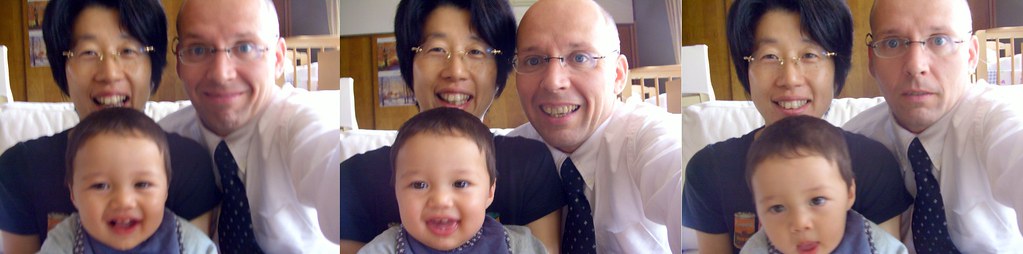
The image shows my wife, son and myself from some years ago and was chosen because the Westerner, and partial Westerner, are showing less consistency in their facial expressions.
Addenda I am very stupid but disgusting and in a position to realise it. Japanese culture will teach even the most stupid and disgusting of people the truth.
Bibliography Gudykunst, W. B., & Nishida, T. (1994). Bridging Japanese/North American differences (Vol. 1). Sage. Kanagawa, C., Cross, S. E., & Markus, H. R. (2001). ‘Who am I?’ The cultural psychology of the conceptual self. Personality and Social Psychology Bulletin, 27(1), 90–103. Mead, G. H. (1967). Mind, self, and society: From the standpoint of a social behaviorist (Vol. 1). The University of Chicago Press. Miyamoto, Y., & Kitayama, S. (2002). Cultural variation in correspondence bias: The critical role of attitude diagnosticity of socially constrained behavior. Journal of Personality and Social Psychology, 83(5), 1239. Weber, S. (2004). Theatricality as Medium. Fordham Univ Press. (as yet un-read, but I dig the term and I am a major fan)
A recent video showing the extent to which Japanese children return wallets moved me to tears.
In the USA when a child found some money (admittedly not inside a wallet) he was lauded for giving it to someone else.
Handing the money into lost property did not seem to cross anyone's mind in the USA.
Western commentators since the Edo period have marvelled at Japanese honesty with regard to personal possessions and the absence of theft. They also marvelled at the sexual mores (nakedness and the prevalence of prostitution), and speech crime (e.g. flattery, deceit, and creative accounting). That said I believe the Japanese to be the most moral nation on earth.
"The Lost Letter Technique" made famous by Milligram et. al. (1965) found that 70% of personally address letters but only 25 of Nazi/Communist party addressed "lost letters" were returned. Earlier research by Merritt and Fowler (1948: see Liggett, Blair, & Kennison, 2010) found that 85% of letters, but only 54% of letters presumed to contain money were returned.
And yes, there is comparative Lost Letter Technique research. West (2003) dropped phones and wallets containing cash in Tokyo and New York and the results were T 95% vs NY 77% for phones and T 85% vs NY30% for cash. That makes Tokyoites about three times more honest when it comes to returning wallets. Near Tokyo rates of return were obtained outside a Japanese supermarket in New York, so this is not something geographical. The Japanese are extremely honest when it comes to personal property.
In Japan stealing is almost absent, but creative accounting and linguistic obfuscation is reported to be prevalent. In the historical record numerous commentators report the low level of stealing (Bird, 1880; Cocks & Thompson, 2010; Coleridge, 1872; Golovnin, Rīkord, & Shishkov, 1824) and the strict way in which it is dealt with. At the same time, visitors have noted that linguistic misdemeanour's such as flattery, deceit, and "the squeeze" (taking a kickback of up to 100% to 200% of cost: see Bird 1880).
I claim, as always, that the amazing way in which the Japanese do not steal things but are at the same time able to "squeeze" double or triple the expenses from their employer relates to the nature of the Other (and horror) in Japanese culture.
Westerners have a horrible other that listens. This encourages us to be fairly honest, if very self-serving, in our self-narrative. Our narratives are self-enhancing but are constrained by the need for them to be palatable to another imagined human being. On the other hand, we feel no one is watching, so how we look, however, is far less fraught, ego-involved. We can get very fat, or even justify theft as redistribution of wealth (Robin Hood), since "property is [or can be argued, narrated to be] theft." We are good at promises and institutions of linguistic trust (such as insurance, and financial products) since we want to be heard to be, narrated to be, good.
The Japanese, on the other hand, have an Other (that is almost as horrifying) that looks, concealed not in the head but amongst the crowd. This encourages them to be fairly upstanding, if very self-serving, in their posture (sekentei). Their self-imaginings are self-enhancing but are constrained by the need for them to be palatable to another imagined human being. So the Japanese abhor crimes and misdemeanour's that can be seen, such as theft and physical violence. When it comes to linguistic malfeasance such as "the squeeze" or kick-back however, this can be seen as just a way of doing business involving no visual injury. The Japanese are good at creating things (monozukiri) since they want to be seen, imagined to be, good.
This modal -- language vs vision -- difference highlights one aspect of the origin of the myths of individualism and collectivism. It is not in fact the case that the Japanese are any more or less individualistic or collectivist, nor Westerners likewise. Both Japanese and Westerners care to an extent about real others and care more about their horrible intra psychic familiars, but in each case the horror of the familiar must be hidden.
It is only because our familiars, our imaginary friends, are horrible that they can remain hidden and continue to be familiar. Identity is a contradiction that depends upon horror, or sin, on a split that must be felt to be, but not be cognised as being. Identity or self is impossible (nothing can see or say itself) but the dream of its possibility is maintained by desire for, and abhorrence -- and resultant obfuscation -- of the duality required.
In the Western case the necessary, horrible imaginary friend is hidden *inside* the person as an interlocutor that, as inside the person, can only therefore be denied by being claimed to be part of, and one with the self. Eve, that gross "knowing" helper we have, is hidden by virtue of being thought of as just another me (see Levinas vs Derrida and "altrui"). She disappears because, as Adam Smith says, we are just splitting ourselves into two of ourselves. If there is just me and me, then there appears to be nothing disgusting going on. Westerners think, "I think to myself."
But if on the other hand the Other is external, as is required by any visual (self) cognition, there is little way of claiming that the Other is me. Spatial dualism, or rather distance, eye and surface, as required by visual cognition, becomes apparent, and undeniable. So the Japanese claim that all they are doing is being collectivist. The Japanese horrible Other is just another person, one of many other people. The Japanese hide the horror, their familiar, their imaginary friend, in the crowd.
Individualism and collectivism are myths by which means we hide Eve/Amaterasu, a part of our souls, our "helpmeets"or "paraclete" (John's term for Jesus).
In a similar way to paradox of Japanese morality in which Japanese will not steal your wallet even if you leave it on a table at a restaurant and walk out, but may (or did) charge a kickback doubling or tripling the price, the British will be utterly polite, honest and even humorous as they sell you narcotics and destroy your country, as we did to China for 150 years. Some estimate that the enforced import of opium into China resulted in the deaths of 100 million Chinese, but at least one British academic makes jokes about it .
Paraphrasing Isaiah, those that worship the logos have a tendency to smear over their eyes so that they cannot see, and those that worship idols have a tendency to smear over their hearts so they cannot comprehend.
Bibliography (all available online) Bird, I. L. (1880). Unbeaten Tracks in Japan: An Account of Travels in the Interior Including Visits to the Aborigines of Yezo and the Shrines of Nikkô and Isé. J. Murray. Cocks, R., & Thompson, E. M. (2010). Diary of Richard Cocks, Cape-Merchant in the English Factory in Japan, 1615–1622: With Correspondence. Cambridge: Cambridge University Press. Coleridge, H. J. (1872). The life and letters of St. Francis Xavier : in two volumes. Asian Educational Services. Golovnin, V. M., Rīkord, P. Ī., & Shishkov, A. S. (1824). Memoirs of a Captivity in Japan, During the Years 1811, 1812, and 1813: With Observations on the Country and the People. H. Colburn and Company. Liggett, L., Blair, C., & Kennison, S. (2010). Measuring gender differences in attitudes using the lost-letter technique. Journal of Scientific Psychology, 16–24. Retrieved from http://www.psyencelab.com/images/Measuring_Gender_Differences_in_Attitudes_Using_the_Lost-Letter_Technique.pdf Milgram, S., Mann, L., & Harter, S. (n.d.). The lost-letter technique: A tool of social research. Retrieved from http://www.communicationcache.com/uploads/1/0/8/8/10887248/the_lost-letter_technique-_a_tool_of_social_research.pdf West, M. D. (2003). Losers: recovering lost property in Japan and the United States. Law & Society Review, 37(2), 369–424. Retrieved from http://onlinelibrary.wiley.com/doi/10.1111/1540-5893.3702007/full
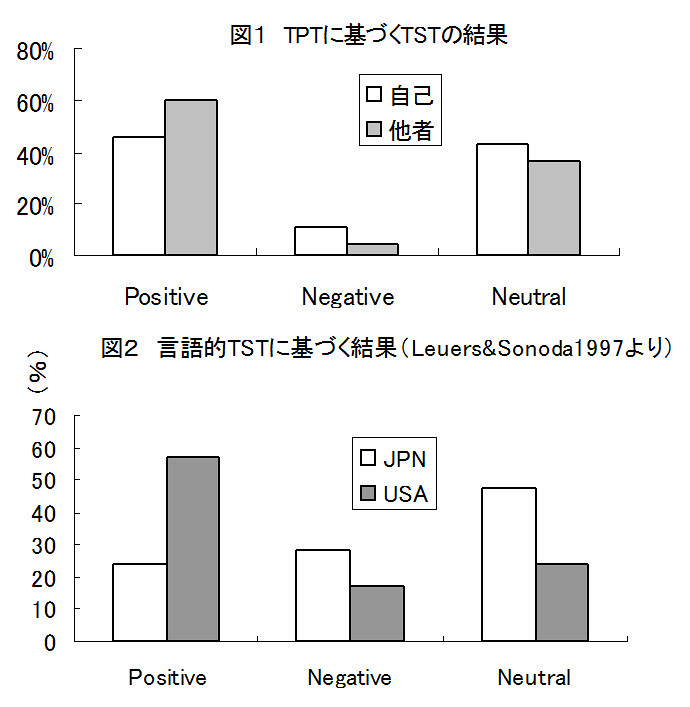
Leuers (now Takemoto, this author) and Sonoda (1998) found that Japanese self representations using auto-photography in Twenty Photographs Test show the same sort of positivity as found American linguistic self descriptions in a Twenty Statements Test. The best thing about this specific research was that it seems to have inspired a Japanese psychotherapist, Yasuyo Mukoyama, (2010), to write a book about the use of auto-photography as new therapeutic technique -- The Auto-photographic Method -- in Japan. I highly approve. Leuers = Takémoto, T. R. S., & Sonoda, N. (1998, October). 心像的自己に関する比較文化的研究(1) Cross Cultural Research on the Specular Self. Oral Presentation口頭発表 presented at the The 62th Annual Convention of the Japanese Psychologiocal Association English日本心理学第64回大会, Tokyo Gakugei Daigaku. Retrieved from http://ift.tt/1BmRnQs Mukoyama, Yasuyo 向山泰代. (2010). 自叙写真法による自己認知の測定に関する研究. ナカニシヤ出版. http://flic.kr/p/sDP6X1
If you identify with your face as the centre of your persona (Watsuji, 2011), point at it to indicate yourself (Leuers & Sonoda, 1998), then it is not surprising that make up has a very positive effect upon how you are feeling. Moritsuchi et al. (2006) separated female subjects into two groups one of which were given a full make over by a professional make-up artist, the other who where asked to wait. The latter group showed little change except in a decrease in liveness and increased tiredness. The former group became less stress, less depressed, less angry (less animosity), more lively, less tired, and less confused. It is not surprising that Japan women spend the most per head on cosmetics.
That this spending data has an inverse correlation with well-being says less about how happy Japanese women are, than how those that identify with their self-narrative, rather than their faces, are inclined to think positively, and prevaricate about their level of happiness.
Indeed, in the same experiment (Moritsuchi et al., 2006), the make-up condition start in a state of more negative affect, and overall (bottom graph) while those that wore make up had significantly increased psychological well-being, whereas the control group remained the same, at the same time the made up group reported themselves as less happy than the un-made up group. Bearing in mind how make-up improved their state of mind, this difference is likely to be due to the way in which focus upon improving appearance may make people less inclined to "self-enhance" -- speak bs.
Conversely, pride, or linguistic self-esteem, takes people away from the light as is suggested by the strong correlation between self-esteem (self-bs) and calorie intake and obesity.
Image from page 114-115 in (Moritsuchi et al., 2006) Morichi, Hirose, Tanaka, and Hisayo 森地恵理子, 広瀬統, 中田悟, & 久世淳子. (2006). メイクアップの心理的効果と生体防御機能に及ぼす影響. 日本福祉大学情報社会科学論集, 9, 111–116. Retrieved from research.n-fukushi.ac.jp/ps/research/usr/db/pdfs/00074-00... Leuers = Takémoto, T. R. S., & Sonoda, N. (1998, October). 心像的自己に関する比較文化的研究(1) Cross Cultural Research on the Specular Self. Oral Presentation口頭発表 presented at the The 62th Annual Convention of the Japanese Psychologiocal Association English日本心理学第64回大会, Tokyo Gakugei Daigaku. Retrieved from http://nihonbunka.com/docs/shinzoutekijiko1.doc Watsuji, T. (2011). Mask and Persona. Japan Studies Review, 15, 147–155. Retrieved from asian.fiu.edu/projects-and-grants/japan-studies-review/jo...
Yogo et. al. (1990) found that as women's make-up improved from no make, normal make up to make up provided by a make-up artist, their confidence and satisfaction increased, and their anxiety decreased. This is very much to be expected in a visual soul-as-mirror rather than soul-as-narrative country like Japan. Better make-up and other visual self-presentation in Japan corresponds to better self reports among Westerners and is likely to result in improved confidence and effect.
At the same time however, the pitch of their voice increased. Or because a high pitched voice is an indicator of positive effect like laughter or a smile? Or conversely is this because they were aware that a high pitched voice is desired by others - as suggested by the high pitched voice in which shop assistants and telephone operators are required to speak - and their increased confidence and positive affect allowed them to use that other-wise unpalatable falsetto? Finally, since it is found that Japanese use tone of voice in contradistinction to linguistic content does their higher pitched voice represent a greater emphasis on tone and a further de-emphasising of self-narrative? In any event higher tone of voice, together with thicker make up probably represent a greater identification with female gender stereotypes, which are generally viewed more positively, rather than negatively, in Japan. The Japanese are members of womankind.
Oda, Hashimoto, Kashio and Dohi (2003) based upon the theoretical distinction of Hashimoto and Kashio (2003) found that overall Japanese (or at least Japanese mothers) dress up for internal reasons rather than to impress others.
Quoting Yamabe(1993: See Hashimoto and Kashio), Yashimoto and Kashio note that dressing up or primping (oshare) has generally been studied from the perspective of outward appearance, but is in fact also an expression of identity. Hashimoto and Kashio (2003) went on to develop an internal and external dressing up questionnaire and found that the internal aspect of dressing up for oneself is more important than the extrinsic motivation to dress up for others overall, especially in older Japanese.
This is hardly surprising given that the Japanese are especially capable of and chronically inclined to autoscopy through the use of simulated intra-psychic other. Since the Japanese dress up for themselves, for a simulated self-directed gaze rather than real gaze, they pay more attention to underwear. Real others can not see underwear, but a simulated gaze can see inside things, as the Japanese are found to be able to do.
Strangely however, attention to underwear is an item on the both the internal and external motivation to dress up questionnaire, where wearing underwear that does not affect ones outer wear correlates with intrinsically motivated primping but paying attention to the design of ones underwear correlates with extrinsically motivated primping. This implies that Japanese wear designer underwear to show to others.
Bull and Gibson-Robinson (1981) found that the appropriate way to express oneself visually, via ones clothes, in the UK depended upon the social situation. Smartly dressed suited persons (line A) obtained more charitable donations when they visited terrace houses (place A or B), but more informal clothes (line B) obtained higher donations when asking at high rises blocks (place C) of flats. Visual self consistency is inappropriate in the UK as verbal self-consistency is inappropriate in Japan. I predict however that in Japan one formal suited kind of attire would be appropriate in all situations and obtain the most charitable donations.
Bull, R., & Gibson-Robinson, E. (1981). The influences of eye-gaze, style of dress, and locality on the amounts of money donated to a charity. Human Relations, 34(10), 895-905. Kanagawa, C., Cross, S. E., & Markus, H. R. (2001). ‘Who am I?’ The cultural psychology of the conceptual self. Personality and Social Psychology Bulletin, 27(1), 90–103.
[Ernest Mason} "Satow's friend Dr. Willis, was critical of the arrogance of his fellow countrymen towards the Japanese.
A small foreign official will abuse a Japanese officer of equal rank with our Under-Secretary of State in a manner that, if it were countryman, he would be the laws the country either have to kill him, or kill himself. We bully and beat the lower orders, and respect in no way the higher classes. A great deal of this is common to all foreigners, but we especially sow the seeds of discord and dislike. The Japanese better classes grow quite alarmed t our customs, they fear they will lose all hold on their poorer countrymen, and though some Japanese may like you individually they hate your country. To the proud Japanese it must be painful to see the air of superiority the commonest foreigner assumes in his presence, and I have great doubt whether Brown or Japanese or Robertson would not go full gallop through a procession with the Tycoon at one end ad the Mikado at the other if sad experience [Namamugi Incident] had not proved the danger of such an experiment. We may disguise it as we like, we are a set of tyrants from the moment we set foot on Eastern soil and we cannot help it, it is I fear inherent in the nature of things, the less civilized man must suffer in the ratio of his ignorance by intercourse with his more intelligent brothers. "(Cortazzi, 2013, p.61)
I am not entirely sure to whom in the last clause the good doctor refers to. I hope, and believe, he is suggesting that the British were ignorant and uncivilised compared to the Japanese and "suffered" in the sense of being tyrants, insufferable.
Cortazzi, H. (2013). Victorians in Japan: In and around the Treaty Ports. A&C Black.
Linguistic self-enhancement has generally been considered to be rather disgusting in Japan, or at least something that the Japanese have avoided. In my experience, and in historical accounts of Western impressions of Japan, boastfulness is almost completely, and notably, absent.
One of the few accounts of Japanese boastfulness is that of a highly Westernised scholar of things Western (rangakusha). After several months in captivity in Japan, the Russian spy Vasiliĭ Mikhaĭlovich Golovin remarked in 1811 that the Japanese geometrician and astronomer, Mamia Rinso (Mamiya Rinzo) "manifested his pride, however, by constant boasting of the deeds he had performed, and the labours he had endured." (Golovin, 1824, p284) but further that, "I must here remark, that this was the first Japanese ventured, in our presence, to swagger and assume // importance on account of his military skill, and his vapouring made not only us but even his own countrymen sometimes laugh at him. " (Golovin, 1824, pp. 285-286). In other words, the only Japanese person to boast, in Golovin's experience, was one who had been influenced by Western culture.
I have found two other records of instances of boastfulness in Japan in the pre-twentieth century historical record and both of them relate to sex.
"One old couple, who kept one of these shops, we were on intimate terms with; that is to say, we seldom passed without a few words to them. One day, seeing the old woman by herself, we asked her wherever husband was, and were told that she supposed 'he was after the girls', after which she laughed, as if delighted at the idea of having such a gay old dog for a spouse... The next time we visited the shop, we rallied the old fellow on being such a gay Lothario; be he did not seem as proud of the reputation as his wife was, and indignantly declared the aspersion cast on him to be totally without foundation. We were half inclined to believe him, and even now think that the old woman's statement may have only been a vainglorious boast"(Cortazzi, 2013,, p67)
Edward de Fonblanque writes, in 1860, of another rare instance Japanese boastfulness, which is also sexual.
"Nor were business wants alone consulted, for the Government had considerately provide a magnificent building, all lacquer and caving and delicate painting, in which the Tojin [Foreigner] might pass their leisure hours in the company of painted musume [literally daughter, but the meaning her is girl], dressed in gorgeous robes, and coifées in the most wonderful manner. I visited the Gankiro, taking the precaution to go there in broad day, and for my character's sake, in good company, and was a little startled at the systematic way in which the authorities conduct this establishment. Two officers showed us over the building, and pointed out its beauties which as much pride as if they were exhibiting an ancient temple sacred to their dearest gods. This was the court-yard; that was to be a fish-pond with fountains (the building was still incomplete at this time); in this room refreshments might be procured -that was the theatre; those little nooks into which you entered by a slide panel in the wall were dormitories, encumbered with no unnecessary furniture, there, affixed to the walls, was the tariff of charges, which I leave to the imagination; and in that house, across the court, seated in rows on the verandah, were the moosmes themselves. We were invited to step over for its was only under male escort that they might enter the main building? My curiosity had, however, been sufficiently gratified and I departed, quite ready to believe in anything that might hear as to the morals of the Japanese. (Cortazzi, 2013, p274.)
The Japanese are perhaps similarly reserved towards boastfulness and sexuality. Japanese humour, unlike that of the British, rarely revolves around innuendo. But in my experience (and research on the latter), both sexuality and boastfulness do appear when the Japanese have been drinking.
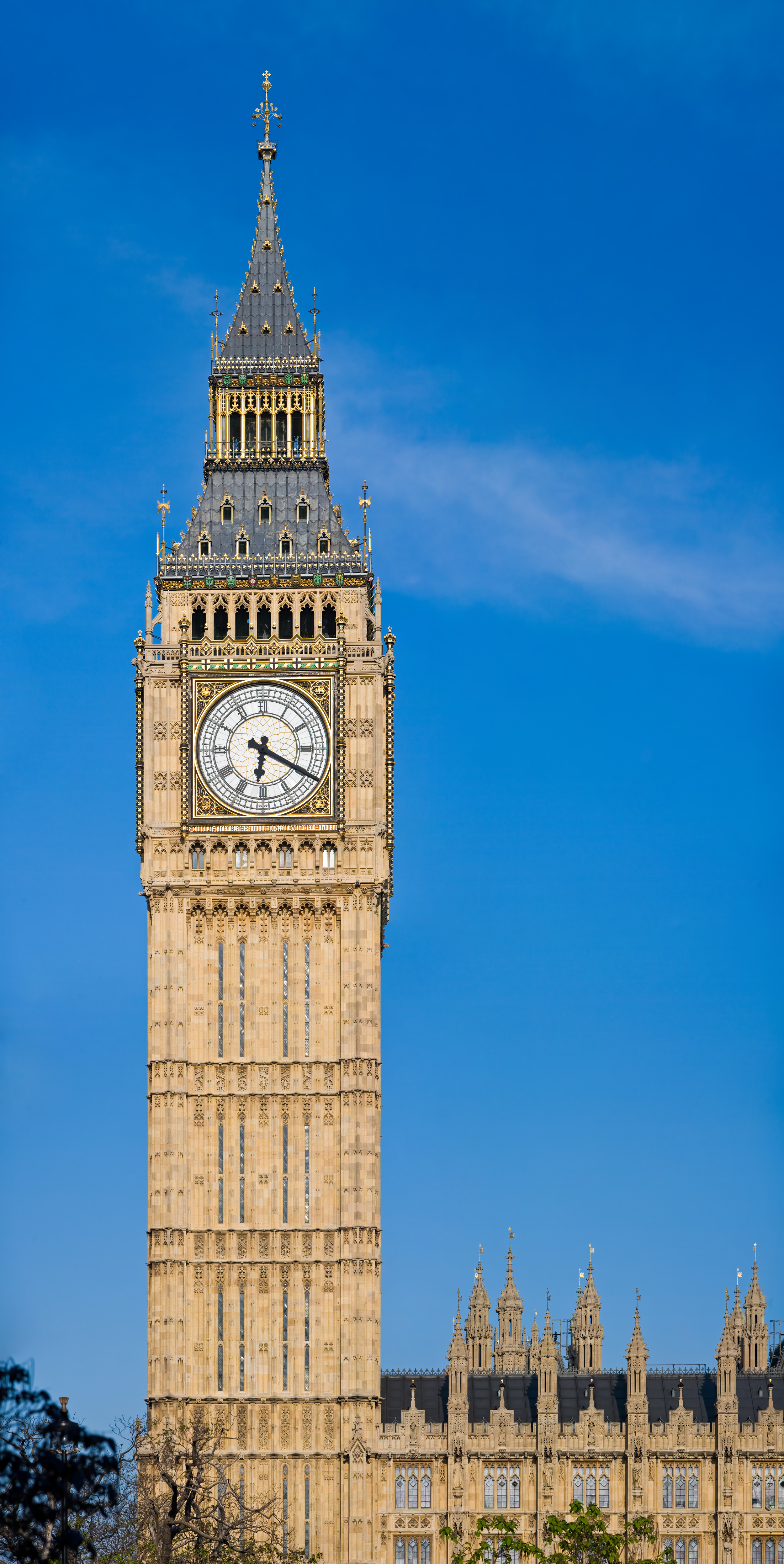
For example when attending a party with some Japanese sports persons, I found myself invited to drink at a table of similarly inebriated Japanese. It was late in the day, we had all had a few glasses of sake. One gentleman asked mischievously "So you are English? (omitting the subject and particles) England has Big Ben doesn't it? / You have a big ben don't you?" (イギリス人ですか。*ビッグ・ベン*はありますよね?). I think my host repeat "big ben", nodding in a conspiratorial way for emphasis. This was a very rare case of innuendo and inviting the opportunity to boast, once again on a sexual topic, which from a Japanese perspective may regarded, with some disdain - but at times enjoyment - to be of similar ilk.
Is there any inherent connection between linguistic self-enhancement and sex? Or on the contrary between visual self-enhancement and the storge appreciation of cuteness? Some theoreticians of language, its origins and merits suggest that it may have something do with peacocking. Derrida argues that linguistic thought, as self addressed love letter, is like onanism. One of the characteristics of linguistic as opposed to visual self-enhancement is that it takes places inside rather than outside the head. While linguistic self love becomes silent, ashamed, and interior (see Vigotsky on self-speech and the way it becomes hidden) visual self-love always presupposes an exterior, viewer. Does the interiority of self-serving interior dialogue, knowing oneself via ones self-narrative, imply or promote a sexual "autoaffection"? I tend to think so.
I think I told my hosts that I had not seen Big Ben. Lame!
Image of Big Ben from Wikimedia Cortazzi, H. (2013). Victorians in Japan: In and around the Treaty Ports. A&C Black. Golovnin, V. M., Rīkord, P. Ī., & Shishkov, A. S. (1824). Memoirs of a Captivity in Japan, During the Years 1811, 1812, and 1813: With Observations on the Country and the People. H. Colburn and Company.
Isabella Bird (1880) notes that the strangest thing about Japan or perhaps the strangest sight of her life (last quote) is that in summer Japanese men went around mainly in their loin-cloths (which she calls "maro") or sometimes nothing at all. "The houses are very poor, the summer costume of the men consists of the maro (fundoshi) only. "p. 245 "As far as I could see across the slush, there were wheels at work, up which copper-skinned men, naked, except for the maro or loin-cloth, were industriously climbing." p.85 "You see the father who wears nothing but a maro in the bosom of his family. " p.139 "Few of the men wore anything but the maro"p. 187 "The men may be said to wear nothing" p.150 "Do you remember a sentence in Dr. Macgregor's last sermon? "hat strange sights some of you will see!" Could there be a strange onr that a decent-looking middle aged man, lying on his chest in the verandah, raised on his elbows, and intently reading a book, clothed only in a pair of spectacles. "p.128 Bird, I. L. (1880). Unbeaten Tracks in Japan: An Account of Travels in the Interior Including Visits to the Aborigines of Yezo and the Shrines of Nikkô and Isé. J. Murray. Bird, I. L. (1880). Unbeaten Tracks in Japan: An Account of Travels in the Interior Including Visits to the Aborigines of Yezo and the Shrines of Nikkô and Isé. J. Murray. http://flic.kr/p/sfwakV
Much is known about the "the first English man in Japan" William Adams of Gillingham, Kent, who was to become Miura Anjin and the basis for the novel Shogun. Richard Cocks, from Staffordshire, arrived in Japan about a decade after Adams and remains in relative obscurity. Cocks stayed in Japan ten years, tried and failed to set up a traiding "factory," to rival the Dutch, and died on the way back to England in discrace, to be buried at sea, "under a discharge of ordinance." His diary of his life in Japan can be read for free online. http://flic.kr/p/tc66sd
A woman in a white mask emerges on stage and slowly glides down a narrow path. Clad in a vibrant blue veil and robes of blue and shimmering gold, she stops and turns. Beneath the pulse of drums and intermittent shrieks of flutes characteristic of the music of ancient Japan, the fluid hum of Gregorian chant gives the scene an otherworldly feeling—eerie, incongruous, mesmerizing.
Slowly, the woman begins to kneel, then rises, extending her hand. She walks center stage, quickening her pace as she approaches the audience. Finally, she shields her face with her arm and begins to slowly dance about the stage, alternating slow and fast gliding that ends in a dramatic flip of her long sleeve above her head. With a giant cross looming behind her, a revelation is at hand: The Holy Mother has arrived.
So ends Holy Mother in Nagasaki, a noh play of the classical tradition written in 2005. Part of Japan Society’s new and traditional noh presentation commemorating the 70th anniversary of the end of WWII, the story unfolds at the famous Urakami Cathedral, as a priest tells a traveler the tale of Nagasaki’s suffering following the dropping of the second atomic bomb in Japan. The majestic cathedral rose as a beacon of hope and religious freedom in the late 19th century after years of Christian persecution in Japan, and then was completely destroyed in the atomic bombing of Nagasaki.
The priest recounts hardships the survivors faced, and the resolve they had to rebuild the cathedral. He also shares the story of a woman who appeared the evening of the bombing to console the victims. No one knew who the woman was, but many believed she might be the Holy Mother returned.
In addition to being true to noh theater traditions that go back over 600 years, the tale is deeply rooted in the history of Christianity in Japan. (Nagasaki was the first port open to foreigners, so it has an unusual history of foreign influx compared to other locations in Japan. For example, at the height of Christianity’s spread to Japan, so many churches were built in Nagasaki that it became known as “Little Rome”.)
The Urakami Cathedral before and after the bombing. Via.
Furthering the spread of Christianity, Sumitada Omura became the first of Japan’s daimyo (feudal lords) to convert. He ceded Nagasaki and Mogi to the Society of Jesus in 1580, which began to worry then-shogun Hideyoshi Toyotomi, who began his crusade against Christianity in 1587 when he demanded that all foreign missionaries leave the country.
Tensions came to a head in 1597, when Toyotomi ordered the execution of 26 Christians on a hill in Nagasaki by crucifixion. From there, sanctions against Christianity only grew stricter, as in 1614, Christianity was banned by Tokugawa Ieyasu, Toyotomi’s successor.
Japanese Christians were forced to practice in secret while pretending to be Buddhist, a practice that would continue for nearly 250 years until the Meiji government officially lifted the ban in 1873.
The most shocking part of the ordeal, however, came eight years earlier, when a group of these so-called “Hidden Christians” visited Oura Cathedral, newly built by a French missionary and reserved only for foreigners, in order to proclaim their faith. Father Bernard Petitjean, the priest at the cathedral, was extremely excited to discover that there in fact existed towns and villages full of Christians in Nagasaki, encouraging the Hidden Christians to practice their faith openly.
But Christianity was still illegal, which meant that 3,400 of these newly found Christians were arrested, some tortured, and 36 put to death. The Hidden Christians would have to remain that way for a few more years.
When it was finally safe to do so, approximately 30,000 Hidden Christians finally emerged, their faith having survived nearly two and a half centuries in secrecy. In a letter to Japan’s bishops written in March, Pope Francis said, “If our missionary efforts are to bear fruit, the example of the 'hidden Christians' has much to teach us.”
But even after their religious freedom had been won, the struggle of the Hidden Christians was not over. Due to years of persecution, many of them had been and were still living in poverty. Despite this, they decided to build churches, reducing the cost as much as possible by using lime they had made by burning shells, and drawing patterns on window glasses instead of using stained glass. Due in large part to their efforts, today there are more than 130 churches in Nagasaki Prefecture, more than anywhere else in Japan.
A Noh Theater Prayer for Healing and Peace
When programming the performing arts portion of Japan Society's Stories from the War series commemorating the end of WWII, Artistic Director Yoko Shioya felt that one of the most important “stories” Japan can share with the world is the aftermath of the atomic bombings.
In the program notes, Shioya writes that Holy Mother in Nagasaki "not only speaks about this sorrowful story, but also conveys the strong belief in the resilient spirit of humanity."
The play was written by the late Dr. Tomio Tada, an internationally renowned scientist (in the 1970s he discovered the suppressor T cells that subdue immune response) and respected author. Of several noh plays, he wrote two about the atomic bombings: Holy Mother in Nagasaki, and Genbaku-ki (Atomic Bomb Mourning) about Hiroshima.
"In the program notes from the Nagasaki premiere Tada explained that while the latter was written as a requiem, the former was written as a paean for revitalization, and he intentionally decided on these two different themes based on his observations of both of the A-bomb-ravaged cities," writes Shioya.
In an interview after performances of Holy Mother in Nagasaki began at Japan Society, Shioya posited that perhaps it was the element of Christianity that gave the play its inherent message of hope. Religious themes of classic noh are typically derived from Buddhism, which sees the soul go through an eternal cycle of rebirth, whereas Christianity sees the spirit set free in an eternal afterlife.
Shioya also feels that the centuries-old stylized noh might be one of the best art forms that addresses eternal challenges for human beings. Shimizu Kanji, lead actor in Holy Mother in Nagasaki and a designated Intangible Cultural Asset by the Japanese government, explains further in his portion of the program notes:
In many stories of noh drama, a ghost appears and recounts the story of his life—what events occurred, how he died, who mourns for him and where he is buried. I think these elements must be important for human beings. This consideration led me to realize that there are countless outrageous ways in which people lose their lives—by the blast of a single bomb or in a massive battle, through an earthquake, a tsunami or a hurricane.
Shimizu recounts the first performance of and how it affected him :
The new noh piece, Holy Mother in Nagasaki, premiered at the Urakami Cathedral in Nagasaki City on November 23, 2005. It was held on the site of the cathedral that was destroyed by the atomic bomb, and on the exact 60th anniversary of the first mass and memorial service held after the bombing. I knew that nothing would be able to reenact that tragic day realistically, yet I wore a noh mask and costume in the role of the spirit of an A-bomb victim and walked slowly down the long aisle toward the altar to read my lines, which narrated "that day." While I was performing, I felt the Gregorian chant sung by the choir run through my body. Since then, we have performed this piece in many cities, and we have now arrived at the 70th anniversary of the end of WWII.
Shimizu says he is humbled to present the noh performance to an American audience, especially during the once-every-five years Treaty on the Non-Proliferation of Nuclear Weapons international assembly at the United Nations, and his hope is that the performance helps those who have lost their lives in such catastrophes to rest peacefully and restores those catastrophically damaged sites back to life. But he notes, "world peace has not yet arrived and the souls of the hibakusha [atomic bomb survivors] remain unhealed."
In Holy Mother in Nagasaki, the traveler listens to the priest's story and finally says, “I have resolved to mourn the victims and pray for world peace.” Once can only assume audiences will do the same.
--Mark Gallucci, Lara Mones, Shannon Jowett †The portions of this article detailing the history of Christianity in Japan were informed by "Churches and Christian Sites in Nagasaki", published by the Nagasaki Prefectural Government.
Top growth theorist Paul Romer has an essay in the AER Papers & Proceedings, in which he comes down harshly "mathiness" in growth theory. "Mathiness" is his term for when people (allegedly) use math in a sloppy way, to support their preferred theories. Romer warns direly that the culture of econ theory has become a lot more tolerant of mathiness:
If mathiness were used infrequently,...it would do localized, temporary damage. Unfortunately...as the quantity increases, mathiness could do permanent damage because it takes costly effort to distinguish mathiness from mathematical theory.
The market for mathematical theory can survive a few...articles filled with mathiness. Readers will put a small discount on any article with mathematical symbols, but will still find it worth their while to work through and verify that the formal arguments are correct, that the connection between the symbols and the words is tight, and that the theoretical concepts have implications for measurement and observation. But after readers have been disappointed too often by mathiness that wastes their time, they will stop taking seriously any paper that contains mathematical symbols. In response, authors will stop doing the hard work that it takes to supply real mathematical theory. If no one is putting in the work to distinguish between mathiness and mathematical theory, why not cut a few corners and take advantage of the slippage that mathiness allows? The market for mathematical theory will collapse. Only mathiness will be left. It will be worth little, but cheap to produce, so it might survive as entertainment.
[I]n the new equilibrium: empirical work is science; theory is entertainment. Presenting a model is like doing a card trick. Everybody knows that there will be some sleight of hand. There is no intent to deceive because no one takes it seriously. Perhaps our norms will soon be like those in professional magic; it will be impolite, perhaps even an ethical breach, to reveal how someone’s trick works.
When I learned mathematical economics, a different equilibrium prevailed. Not universally, but much more so than today, when economic theorists used math to explore abstractions, it was a point of pride to do so with clarity, precision, and rigor...If we have already reached the lemons market equilibrium where only mathiness is on offer, future generations of economists will suffer.
Romer has now joined the chorus of old famous guys - Krugman, Solow, Stiglitz, Farmer - who are very vocally mad about the way mainstream economics theory is done.
Romer is not afraid to name names. Interestingly, although he's talking only about growth theory and not about business cycle theory, most of the people he's mad at are the same guys that the Keynesians are mad at - Robert Lucas, Ed Prescott, and David K. Levine. He also calls out Thomas Piketty.
Romer gives specific examples of what he calls mathiness (links are to working-paper versions):
1. Prescott and McGrattan (2010): Romer says that this paper includes a term that the authors label "location," but that doesn't correspond to any real measure of location.
2. Boldrin and Levine (2008): Romer criticizes this paper for assuming that a monopolist would also be a price-taker, and for making various hand-wavey arguments.
3. Lucas (2009): Romer criticizes this paper for making a hand-wavey argument to dismiss the idea that investment in embodied technology (books, blueprints, etc.) can be a source of sustained growth, when there are well-known models in which it can. Romer also points out a random math error in the paper, and uses this to argue that reviewers don't pay close attention to math.
4. Lucas and Moll (2014): Romer criticizes this paper especially harshly. Lucas and Moll claim that their model, in which there is no creation of new knowledge, is "observationally equivalent" to models in which new knowledge arrives very slowly. Romer shows that the truth of this claim depends on which order you use when taking a double limit. He reveals that he told the authors about the problem, but that they ignored him and left it in the paper.
5. Piketty and Zucman (2014): Romer points out the by now well-known "gross vs. net" problem in Piketty and Zucman's definition of savings.
All in all, this seems like a pretty loose collection of criticisms. Hand-wavey arguments, dubious definitions, bad assumptions, and math errors are all very different things. So this essay at first can seem like a grab-bag of gripes that Romer has with individual rivals' papers.
But I think Romer is on to something about the culture of econ theory, at least in the "macro"-ish realms of growth, business cycle, macro-labor, macro-trade, and macro-tax theory (I don't know nearly as much about the culture of the "micro"-ish fields like game theory, decision theory, I/O, etc.; and I know that finance theory has a very different culture). In these "macro"-ish fields, people seem to view math more as a tool for stylized description of ideas than as a tool for quantitative prediction of observables.
Romer's examples of "mathiness" are all very recent examples. But going back to earlier models, I don't really see much more tight connection of variables to observables. Yes, in a Solow model you can tie capital K to observable things like structures and machines and vehicles. But you'll be left with a big residual, A. Then you can break A down and extract another term for human capital, H. Can you really measure human capital? Human capital can't be bought and sold on a market; you have to bundle it with other goods. So it's very difficult to get a clean measurement of the value of the existing stock of human capital, the way you could get a clean measurement of the existing stock of delivery trucks. Romer cites human capital as a good example of non-"mathiness", but I don't really see a huge difference between that and the "location" used by Prescott and McGrattan (2010). Maybe a minor difference, but not a huge one. As for the remaining A, there's not really any quantitative way to measure the stock of ideas except as a residual. And as for goofy assumptions, well, any growth model is going to have at least one or two assumptions that would make a newcomer to the econ field throw up her hands in disbelief.
Mathiness isn't anything new, it's just the way these econ fields work. The math is there as a storytelling aid (and possibly as a signal of intellectual ability). I think Karthik Athreya said it best:
My view is that a part of what we do is "organized storytelling, in which we use extremely systematic tools of data analysis and reasoning, sometimes along with more extra-economic means, to persuade others of the usefulness of our assumptions and, hence, of our conclusions...This is perhaps not how one might describe "hard sciences".
Do the guys Romer calls out play a little faster and looser with definitions and rely more on hand-wavey arguments? Oh, I'm sure they do - but that's because they're famous old guys. Writing down hand-wavey stuff is a privilege afforded to famous old guys in every academic discipline I know of. In econ, it gets politely published in top journals, but all the hotshot young people just sort of shake their heads anyway, and the only net effect is to pad out the length of the journals. Are the guys Romer calls out more political than the average economist? Maybe.
But in general, the whole discipline of macro theory - in the general sense, including growth and parts of labor, trade, and tax theory - is chock full of mathiness. Even most of the best models ("best" being a highly relative term, of course). The original Solow model seems to me like a rare exception, not a typical example of the Good Old Stuff.
But in any case, I highly recommend the Romer piece, which is a master class in catching errors in models, as well as a fascinating window into the Byzantine world of academic politics.
Update: Brad DeLong has a follow-up post explaining his view of some of the history behind the argument in the field of growth economics. Basically, the idea is that George Stigler didn't like people using models with imperfect competition, since this might open up a window for government intervention. DeLong thinks that Lucas and other "freshwater" types inherited this anti-imperfect-competition bias, causing them to be too down on Romer's models. This is interesting history that I didn't really know about before.
Noah Smith asks for more evidence that the theory in the McGrattan-Prescott paper that I cite is any worse than the theory I compare it to by Robert Solow and Gary Becker...
There is no such thing as the perfect map. This does not mean that the incoherent scribbling of McGrattan and Prescott are on a par with the coherent, low-resolution Solow map that is so simple that all economists have memorized it. Nor with the Becker map that has become part of the everyday mental model of people inside and outside of economics...
Noah’s jaded question–Is the theory of McGrattan-Prescott really any worse than the theory of Solow and Becker?–may be indicative of what many economists feel after years of being bullied by bad theory. And as I note in the paper, this resignation may be why empirically minded economists like Piketty and Zucman stay as far away from theory as possible...
For specific purposes, some maps are better than others. Sometimes a subway map is better than a topographical map. Sometimes it is the other way around. Starting with any good map, we can always increase the resolution and add detail.
No map is perfect, but this does not mean that all maps are equal. It certainly does not mean that an internally consistent map that with so little detail that you can memorize it is on a par with incoherent scribbling.
In the rest of the post, he goes into depth about why he thinks the McGrattan and Prescott paper constitutes "incoherent scribbling." But he also notes that the other papers he goes after in his "mathiness" piece should not be let off the hook:
Noah also notes that I go into more detail about the problems in the Lucas and Moll (2014) paper. Just to be clear, this is not because it is worse than the papers by McGrattan and Prescott or Boldrin and Levine. Honestly, I’d be hard pressed to say which is the worst. They all display the sloppy mixture of words and symbols that I’m calling mathiness. Each is awful in its own special way.
It appears that Prescott, Lucas, Levine, and others of the unofficial "freshwater" club have annoyed more high-level colleagues than just Paul Krugman. Only a few months ago, Roger Farmer took to his blog to unleash an anti-Prescott blast. Romer and Farmer are not politically-minded media-engaged types like Krugman and DeLong, but their aggravation with the Lucas/Prescott school is, if anything, even more intense.
And yes, Romer is right that I'm jaded. Is it so obvious? *takes swig from hip flask, rubs beard stubble*
いくつかのレベルによる親密さの概念 Figure 1 大坊, 2004, p1. 我々は他者と関係を築き、環境的な相互作用を継続することによって、他者を含めた社会環境において生活することを目指している。このような社会的な関係の要件として、まず他者の存在と、その対人行動がある。この場合の他者は、その当該者の個別的な特徴を反映するだけではなく、働きかける「自己」の行動を映し出す鏡映像となるのもである。この意味するところは、他者の反応である鏡映像によって自分の行動の正当性や自分のいる社会的脈路を知ることができることになる。(大坊, 2004, p1) "We strive to lead our lives in a social environment including others through on going environmental interaction and the formation of relationships with others. The existence of others, and our behaviour toward them is a condition of this sort of social relationship. In this situation others do not only reflect the individual characteristics of the actor but also act as a mirror image of the active self. This means that we are able to know the propriety of our actions and our social contexts, via the reactions of others as mirror image of self. " (Daibou, 20014, p1, Takemoto translation) いつものように、大坊(20014,p1)日本人の自己の他者は他人と論じているが、まず、この他者が「鏡映像」という視覚的なものあることを意識しているようである。一方、大坊先生は、日本人は自分自身を見ることができる。日本人は自分を他人の立場から見ることができる(Cohen & Gunz, 2002; Heine, Takemoto, Moskalenko, Lasaleta, & Henrich, 2008)ということを意識していないようだ。 As always, Professor Daibou too argues that the other that reflects the Japanese self is other people. But firstly he appears to be aware that this other is visual - a mirror image. He does not seem to be aware that the Japanese can see themselves,from the view point of others(Cohen & Gunz, 2002; Heine, Takemoto, Moskalenko, Lasaleta, & Henrich, 2008). If this were not the case, there would be no Individual level in the top part of this graph. Perhaps like Sam Harris, the Japanese are such materialists that they are unaware that matter, and individuality, is an emergent property of dyads or that this diagram needs to be reversed and turned upside down. In the beginning there was not one. The not one dyad has two eyes and no mouth and is rather cute. Bibliography Cohen, D., & Gunz, A. (2002). As seen by the other...: perspectives on the self in the memories and emotional perceptions of Easterners and Westerners. Psychological Science, 13(1), 55–59. Retrieved from http://ift.tt/1H2i1zZ 大坊郁夫. (2004). 親密な関係を映す対人コミュニケーション. 対人社会心理学研究, 4, 1–10. Retrieved from http://ift.tt/1H2i2UA Heine, S. J., Takemoto, T., Moskalenko, S., Lasaleta, J., & Henrich, J. (2008). Mirrors in the head: Cultural variation in objective self-awareness. Personality and Social Psychology Bulletin, 34(7), 879–887. Retrieved from http://ift.tt/1PhAd2i http://flic.kr/p/rQGopK
Brad DeLong thinks I'm nutty when I say that Britain isn't obviously suffering from a persistent shortfall of aggregate demand:
There are no signs looking at wages and prices that this is due to any adverse supply shock...there seem to be no reasons looking at wages, prices, and output to believe that the British economy right now is a full-employment at-capacity-utilization economy. And only in such an economy would monetary and fiscal policies that boost spending simply boost prices and not production... Does the fact that the employment share of British adults is actually high mean that the British economy is, in fact, at potential output? That stimulative monetary and fiscal policies risk rising inflation for no gain? And that it is time to normalize? Certainly Mark Carney at the Bank of England does not believe that is so: From my point of view, why so many Britons have taken so many low-pay low-productivity jobs in the past three years is a mystery. But that they have gives us little reason to think that the British economy is now a full-employment at-capacity-utilization economy in which aggregate demand is now equal to potential output.
First of all, let's get a couple things straight. I don't think British stimulus would be particularly counterproductive, I just don't think austerity would be either. If there's not a big demand gap, multipliers shouldn't be large, so stimulus just won't do a heck of a lot (unless the UK has falling-apart infrastructure like we do), but neither will austerity. Also I doubt AS-AD is even always the right model for the macroeconomy.
But with that said...
With a demand shortfall, we ought to see high unemployment. We also ought to see low inflation.
In the U.S. we saw both of these in 2009-2014. In Britain we saw the former in 2009-11, and we never really saw the latter at all. Here is British core inflation:
The Bank of England's inflation target is 2% (whether that's a ceiling or a target is not certain). But in 2010-2013 - four years!! - UK core inflation was above that target.
So if we stick to the good old Econ 102 AS-AD model, and we look at both prices and quantities, we can come up with the following simple story for the UK:
1. In late 2008 the UK suffered a negative AD shock.
2. Around the same time, the UK suffered a negative AS shock.
3. In early 2010 the negative AD shock began to abate.
4. In 2012 the negative supply shock began to abate.
5. The differences between the UK and the U.S. in GDP, employment, and inflation can be explained by the fact that the UK's AD shock wasn't quite as big or long-lasting, while the U.S. didn't experience a supply shock.
This story also fits what we know about British TFP, which declined from 2007-2009, then flatlined through 2011:
This story is incredibly simplified, and uses a model that probably isn't the best. A real, careful, academic analysis of the situation is certainly warranted. But is there some obvious reason we need to go looking for a story where AD is the only thing moving around here? That story is going to have a lot more moving parts, and it's going to go a lot deeper into micro stuff.
And it will also look like reaching. Why should we demand a story where demand is the whole story? Is this about stabilization policy, or about the size of the British state?
The original book Freakonomics, by Steve Levitt and Stephen Dubner, was a very fun read. But it also slightly annoyed me. Why? Because there's very little actual economics in it! The quantitative empirical work is mostly reduced-form regressions with natural experiments. That's a fine and good research technique, but it's not really special to econ - it doesn't include anything about market design, structural estimation of supply and demand, game theory, search, prices, general equilibrium...nada!
That covers three of the six chapters. The other three include 1) an ethnography of drug dealer culture by a sociologist, the excellent Sudhir Venkatesh, 2) a quick gloss of statistics techniques that applied mathematicians use to catch cheaters, and 3) a historical story about the decline of the KKK.
So this book has sociology, history, stats, and some general empirical techniques that could be used by any social scientist. That doesn't make it bad - most of the research the book showcases is really cool (though Levitt's own study, on abortion and crime, ended up having some serious problems). But it means that an empirical sociologist could easily taken Levitt's place as the technical co-author of the book, alongside journalist Dubner.
But it was an economist Dubner got, and Freakonomics was billed as a pop econ book, not a pop sociology book. Why? It seems to me that it's because economists are respected as all-purpose sages. Like I said in my previous post, economists get taken seriously on any topic imaginable.
To use an even more stark example, take the sequel, Superfreakonomics. There's a chapter in that book that's all about geoengineering. That's an engineering topic. A physics topic. A climate science topic. And yet an economist is put forth as an authority on whether it will work. And this is accepted by the book's legions of fans.
People trust economists on any topic.
Why? I don't know, to be honest. Maybe it's because economists are thought to have high IQ and know a lot of math relative to other social science disciplines. Maybe it's because economists are confident in their ability to model any social phenomenon, like Gary Becker and others of the "imperialist econ" school. Or maybe it's because economists are just more willing to engage with the public and hold forth on any topic. After all, op-ed writers are the other group who are treated as all-purpose experts; maybe economists just act like really hi-tech, super-smart op-ed writers.
Or maybe it's because of economists' reputation as being clear-eyed and impartial observers of society. For example, in the intro to Freakonomics, Dubner describes a scene with Steve Levitt:
An elderly homeless man approaches [Levitt's car]. It says he is homeless right on his sign, which also asks for money. He wears a torn jacket, too heavy for the warm day, and a grimy red baseball cap.
[Levitt] doesn’t lock his doors or inch the car forward. Nor does he go scrounging for spare change. He just watches, as if through one-way glass. After a while, the homeless man moves along.
“He had nice headphones,” says [Levitt], still watching in the rearview mirror. “Well, nicer than the ones I have. Otherwise, it doesn’t look like he has many assets.”
If you didn't know Levitt was an economist, this scene would just make him sound like a rich insensitive jerk. But the fact that he's an economist imbues the scene with a different meaning altogether - suddenly, Levitt's clinical detachment seems like a sign of impartiality and rationality. Exactly the qualities we'd want in an all-purpose sage.
Anyway, I don't know the answer. But the observation that people trust economists on any social topic - and even some engineering topics - seems pretty obvious. And pretty freaky.
P.S. - If you want a book that is nothing but hardcore economics, and explains everyday economic phenomena in a way that is humble, entertaining, and useful all at the same time, I recommend Tim Harford's The Undercover Economist. The best version is the audio version.
I hear all the time that economists have "physics envy". This doesn't seem even remotely true. I'm not sure whether "physics envy" means that economists envy physicists, or that economists want to make physics-style theories, or that economists wish their theories worked as well as those of physicists. But none of these are true.
Reasons why economists don't have physics envy include:
1. Economists make a lot more money than physicists.
2. Economists are treated as experts on practically anything. An economist can talk about why hipsters have moustaches, and get taken seriously. An economist can talk about which restaurants are the best, and get taken seriously (Update: NO, I'm not saying Tyler's book is bad, I haven't even read it, so HUSH). An economist can talk about politics, marriage, popular music, sex, race, or sports and get taken as seriously as any expert in those fields. An economist can talk about how much progress physicists are likely to make, and get taken seriously. Physicists get taken seriously when they invent quantitative rules for things, but otherwise are treated as just one more tribe of crazy nerds with their heads in the aether.
3. Economic theorists, traditionally, have been free from the constraints of empirical validation. Econ didn't start out with any data to speak of, so it developed a culture where data wasn't the measure of a good theory. That culture has been slowly changing, as IT and statistics allow us to do much more empirics. The wild econ theorist is being slowly tamed, though they occasionally buck against their new constraints. But economics is still nowhere near as enslaved to empirics as physics is. Ed Witten, a brilliant physicist who invented superstring theory and won a Fields Medal, will probably never get a Nobel prize, since no one has yet figured out a way to test superstring theory. In econ, though, un-validated theories - even empirically unsuccessful theories - do sometimes get Nobel prizes, especially in macro.
4. Economists and physicists have totally different reasons for thinking their theories are beautiful. Physicists tend to appreciate the symmetry of their theories, or their connection to geometry. Economists tend to appreciate the fact that their theories can be derived from axioms of human behavior. Economists don't usually see themselves as a high-up floor on the tower of science that begins with math and progresses through physics to chem, then bio, then psych. They tend to see their own field as part of an entirely different tower, unsupported by the other sciences, built on the foundation of axioms - not empirical laws or derived properties - of human behavior.
(Note for physics/math people: what economists call "axioms" are what physicists call "postulates".)
5. Economics theories aren't really much like physics theories in the first place. In particular, the word "equilibrium" means totally different things in the two fields. In econ, the word "equilibrium" is incredibly general - it just means the solution of any system of equations in an economics model, really. A few economic equilibria are similar to equilibria in physics models, but not most. A lot of people outside econ don't seem to understand how economists use the word.
So economists don't have physics envy. But there is a related field that absolutely does have physics envy: Financial engineering.
Financial engineering doesn't use the axiomatic stuff econ uses - instead it fits curves, like applied math. Often, the math is very similar to that used by physicists, and this is why physicists often go into financial engineering. But financial engineering doesn't work nearly as well as physics, which definitely leads financial engineers to wish that it did work as well.
So if you want to tease anyone for having "physics envy," tease financial engineers, not economists. The only way economists are ever going to envy physicists is if they find out how much physicists...well, never mind.
Robin Hanson responds to my Bloomberg View post about signaling.
More generally I call a message “signaling” if it has these features:
It is not sent mainly via the literal meanings of words said.
It is not easily or soon verifiable.
It is mainly about the senders’ personal features, perhaps via association with groups.
It is about sender “quality” dimensions where more is better, so senders want others to believe quality is as high as possible, while others want to assess more accurately. Such qualities are not just unitary, but can include degrees of loyalty to particular allies.
Cheap talk cannot send a message like this; one cannot just say such a thing, one must show it. And since it cannot be verified, one must show it indirectly, via how such features make one more willing or able to do something. And since willingness and ability track costs, these are “costly” signals.
This seems to add a few arbitrary restrictions to the set of things we might try to describe with a Spence-style signaling model. That's perfectly OK (especially since I was complaining about the overuse of the term, not the underuse!). But I think it also makes things a bit more complex than they need to be.
Let's focus on what I think are the three key characteristics of signaling models:
1. The signal must be costly to send for all types.
2. Different types must have different costs to sending the signal.
3. If you take away the cost differential there will be a pooling equilibrium.
The first condition assures us that the asymmetric information imposes costs on the economy; without (1), the model just becomes a truth-telling mechanism. Without (1), you just say which type you are, pay 0 cost, and society knows you're telling the truth.
The second condition creates the separating equilibrium. It means that signaling "works", in terms of revealing people's true types.
The third condition is why you need signaling in the first place. The separating equilibrium isn't first-best (that's guaranteed by condition 1), but it's constrained-optimal. The pooling equilibrium - the thing you avoid by creating the cost differential in (2) - is even worse than the separating equilibrium.
Robin thinks that my example of the hipster moustache is signaling, and explains why:
Let’s distinguish three different kinds of messages I might send with my waxed moustache:
1) “I have thick shiney (sic) hair.”...
2) “Hipster is one of my interest areas.”...Technically, this is a “cheap talk” message.
3) “I am especially devoted to the hipster ethos” or “I especially embody hipster ideals.” That is, I am especially willing to identify myself as a hipster, and my personal features are an especially high quality match to ideal hipster features, including having a creative and contrarian yet attractive and coherent personal style that fits with current hipster fashions. These messages are hard to verify, and the interests of observers and I conflict. While observers want to accurately rank me relative to others, I may want them to estimate me as having maximal devotion and quality. Since verification and cheap talk won’t work here, I have to show, not just say, my messages.
To show my hipster devotion, I can choose an appearance that is sufficiently off-putting to many people’s work, home, church, etc. associates. By paying the cost of putting off possible associates, I show my devotion to hipsterism. To show my hipster features, I can pay to track hipster fashions and to continually search in the space of possible appearances for a combination that simultaneously reflects current fashions while being creative, coherent, and showing off my best personal features. Not being a hipster, I don’t know how exactly that works for them. But I do know, for example, that since lipstick and tight clothes make some bodies look better while making other bodies look worse, they are costly signals of the quality of lips and body shape. There must be similar factors for showing off hipster qualities.
#3 is why Robin thinks of hipster moustaches as "signaling."
I think it's obvious that hipster moustaches satisfy my condition 2 from above - hipsters definitely pay a lower cost for having hipster moustaches, for a variety of reasons (most importantly, they like the style more than others do).
But do they satisfy my condition 1? Do hipsters pay a net cost for their moustaches? Robin suggests that they do, because the moustaches are "off-putting" to people at work, church, etc. But I doubt that this is, in fact, true. Do hipsters look in the mirror and think "Dang, I wish I didn't have to grow this stupid moustache just to prove I'm a real hipster"? I doubt it. I bet they intrinsically enjoy having the moustaches. This is very different from the experience of someone who has to work hard to get some pointless credential just so he can get a job - i.e., the situation Spence originally suggested.
I also doubt that the moustaches are particularly off-putting to most of the people hipsters want to associate with. Sure, people in some Baptist church in Alabama would be put off if I walked in with a big ol' moustache. But I bet hipsters have no desire to actually go hang out in that Baptist church. Also, I bet they tend to have jobs with people who aren't offended or repulsed by hipster moustaches, because I bet they would really hate the kind of workplace environment where people are repulsed by moustaches. So the mere fact that some people are repulsed by hipster moustaches doesn't mean that hipsters actually pay a cost from that repulsion. In fact, offending those people may give hipsters pleasure.
Next: do hipster moustaches satisfy my condition 3 from above? Are there a bunch of wannabe hipsters who would love to pass themselves off as hipsters if they just didn't have to grow that damn moustache? I doubt it. What non-hipster wants to be a hipster? Maybe a few. Maybe there's some guy out there who really has a thing for hipster girls, and who thinks that they only date hipster guys (False, btw!). But I bet these wannabes are few enough in number that distinguishing themselves from the wannabes is not a huge concern for the hardcore hipsters. (I could be wrong; perhaps America gazes upon envy at the hipster community, bitterly wishing it could be part of the fun!)
Anyway, it's possible that hipster moustaches satisfy all 3 conditions of a true signaling model, but I doubt it. More likely it's just a truth-telling equilibrium.
It also seems likely that much of the fad for labeling non-signaling mechanisms "signaling" is just a nerdy way of insulting countercultures and subcultures. It's a fancy way of saying "Hey hippie, get a haircut!" - of attempting to enforce social conformity by accusing standouts of inauthenticity. But it doesn't really seem to get the economics right, except maybe in a few scattered situations.
(P.S. - If you want mathematical models of conformity, nonconformity, subcultures, hipsters, etc., I would recommend this or this.)
Life's a mukashi banashi! Illustration by Benjamin Warren.
Whether it’s a turtle ride to an underwater palace, bamboo-born princesses, or a thumb-sized samurai besting beasts, Japanese folklore conjures worlds unlike any other where truly anything is possible.
In his fourth volume of Japanese Fairy Tales, Professor Keisuke Nishimoto of Showa Woman's College of Tokyo writes, "[these tales] are more than just entertaining; they also address some of life's enduring themes: how to live a good, kind life; how to achieve happiness; and the price to be paid for cruelty, greediness, and cowardice."
Today Japan Society marked Kodomo no hi, Japan's annual festival to celebrate children's happiness and wellbeing with its first-ever Folklore Family Day, transforming three floors of its landmark building into immersive worlds of Japan's most enchanting and enriching mukashi banashi (folktales).
“We want to share the mystery of stories from a different culture,” Jeffrey Miller, director of Japan Society's Education and Family Program told The New York Times, adding that children would see that “the humanity in these stories is common to all cultures.”
Japan Society brought to life several folktales, including stories familiar throughout the world such Momotaro (Peach Boy) and Kintaro (Golden Boy). Other featured stories just as beloved and time-honored in Japan, but perhaps less well known outside the country were Urashima Taro, Kaguya-hime (Bamboo Princess) and Issun-bōshi (One-Inch Boy).
Fathoming A Treasure More Valuable Than Time
One day the son of a modest fisherman, Urashima Taro (1) comes across a group of mischievous boys taunting and torturing a tortoise. Thinking quickly, Urashima offers to buy it from them, then releases it back to the sea as soon as they have gone. The following day while out fishing on his boat, Urashima is greeted by the tortoise, who expresses its gratitude with a trip to the Dragon King’s Palace at the bottom of the sea. Once they arrive, the tortoise transforms into a beautiful princess and asks Urashima to marry her, which he accepts.
A few short days later, Urashima begins to miss his family, whom he had nearly forgotten during the adventure, and asks the princess to let him go see them. She obliges, giving him a precious keepsake: a box which he must promise never to open. He agrees, returning to the surface, where he finds that more than 300 years have passed. Realizing that he’s outlived all of his friends and family, he opens the box in his grief, releasing a small cloud of smoke. He starts to feel weak, with his hair turning grey and his face wrinkling up, as the box had contained his old age.
(Searching for the many meanings hidden in this tale, it's important to understand the rich history of Japan's fishing culture. Up until just one hundred years ago, one out of every twenty Japanese were fishermen.)
Lunacy In Not Letting Go
Discovered in a bamboo stalk by a childless elderly couple, Kaguya-hime, the Bamboo Princess (2) wishes for nothing more than to spend the rest of her time on Earth with her parents. She grows up to be one of the most beloved women in the land, but with no desire to marry, she sends every suitor off to complete impossibly difficult tasks before they can win her hand in marriage. Several men set out on their journeys, with some attempting to deceive the princess, and others simply realizing the futility of their efforts. None complete their tasks (and not all of them make it back alive).
Though the princess manages to avoid marriage, she realizes she won't be able to stay with her parents forever. She tells them she must go back to the moon, her true home. Her parents are devastated, and eventually word reaches the Emperor, who sends his troops to prevent the princess from returning to the moon, to no avail.
Kaguya-hime puts on a special robe that erases her memories as she walks to the carriage sent to take her to the moon. Before she leaves, she hands the Emperor’s servant a letter and a portion of the elixir of eternal life that she herself has imbibed. Upon reading the letter, which proclaims the Princess’s desire to marry the Emperor if only it were possible, the Emperor, still in love with her, orders his servant to climb the highest mountain in all of Japan, then burn the potion and the letter at its peak, so that the smoke carries his sorrows to the heavens. That mountain eventually became known as Mt. Fuji, and on days when smoke rises up from the mountain, it is believed the letter and potion continues to burn its message for the princess.
Another elderly couple have been praying at a local shrine every day for a child, when Issun-bōshi, or One-Inch Boy (3) arrives. No bigger than a man’s thumb, he is nevertheless determined to become a samurai. When he comes of age, he asks his parents for a needle to use as a sword, a straw for a sheath, a rice bowl for a boat, and a chopstick for an oar, and sets off for adventure. Riding his bowl down the river and fending off a hungry fish with his chopstick-oar, he eventually makes it to the city and starts working for a wealthy man, whose daughter he quickly befriends. One day, while the two are playing outside, they are approached by a group of ogres who intend to kidnap the girl, who was actually a princess.
One-Inch Boy resists and one of the ogres swallows him whole. He responds by poking the ogre’s stomach full of holes with his sword. In incredible pain, the ogre spits out One-Inch-Boy and flees, dropping his magic mallet in the process. The princess picks it up, chants, “Grow, One-Inch Boy, grow!” Soon enough, One-Inch Boy quickly outgrows his name, rivaling the princess in height. The story ends with him marrying the princess and becoming a samurai as he had always dreamed.
Enduring Lessons From The Monstrous Mystery
In their delightful (and deceptive) simplicity, folktales, fables and myth are ancient tools to help us cope with life's difficult twists and turns. On the surface, Urashima Taro shows us there are rewards for doing right; but dive deeper into the story and we find that the act of doing right is its own reward: peril awaits those who are distracted by meaningless treasure. Kaguya-hime teaches the importance of loving and appreciating your family, and the difficulty and inevitability of having to let go (imagine a grief so profound it causes Mt. Fuji to bellow!) Sharing many similarities with Tom Thumb from English folklore, Issun-bōshi stresses the importance of inner strength and self-sufficiency, regardless of how immense the challenges one may face.
"The great ideas of courage, duty, beauty, desire, cause, man and animals are themes throughout western literature and many also appear in Japanese children's stories," notes Miller.
According to maverick mythologist Joseph Campbell, there are four purposes to myth (4): to inspire awe of the "monstrous mystery" of existence; to present the inner and outer cosmos in a way that simultaneously dazzles and describes the universe; to advance a society (or community or family) through a shared understanding of right and wrong; and to "carry the individual through the stages of his life, from birth through maturity through senility to death… in accords with the social order of his group, the cosmos as understood by his group, and the monstrous mystery."
Through its Folklore Family Day, Miller says, "Japan Society's Education and Family programs share the great wealth that comes from considering tales that cause children and adults to be in awe and wonder. The imagination of a child is not a small thing and we desire to share stories that excite."
Miller points to a quote from Anthony Esolen's Ten Ways to Destroy Your Child’s Imagination: "Fairy tales and folk tales are for children and childlike people, not because they are little and inconsequential, but because they are as enormous as life itself.”