Selasa, 30 Juni 2015

What if Uber goes unter?


Recently, a California court ruled that Uber has to treat its drivers as employees, with all the regulatory costs that entails. Most people think that this will hamper Uber a bit but not kill it. But a few, like Megan McArdle, think that the ruling spells Uber's demise. What if McArdle is right? What do we conclude?

First of all, it's important to point out that Uber might die for reasons totally unrelated to the California decision. Companies die all the time for reasons totally unrelated to regulation. Recent financial statements show Uber taking a pretty big loss at some point in the recent past, which might mean that competition has been a lot stiffer than expected. So if Uber dies, disentangling causality will be very difficult.

But IF the California ruling, and others like it, are what put a stake through Uber's heart, then I think we conclude two things:

1. Uber wasn't actually that amazing of an idea.

2. Our labor regulation is too stringent.

Why do we conclude #1? Because there are lots of ideas that absorb the cost of labor regulations and manage to keep on turning a profit. Wal-Mart does it. McDonald's does it. If you can't even clear that hurdle, your idea wasn't really creating that much value.

Why do we conclude #2? Because Uber is providing lots of people with work. Many people who would not otherwise be driving taxis are now becoming Uber drivers. That they are choosing to do this means that Uber is good for labor markets. In the interests of improving our labor markets, we should reduce regulations that keep people from doing jobs they'd be willing to do, as long as those jobs are safe and meet other minimum standards of quality (such as paying overtime). Assuming that Uber driving is a safe job that meets minimum standards of quality - which I'm willing to assume - we don't want to regulate the job out of existence. 

I suspect that neither (1) nor (2) is true. I suspect that Uber actually creates more than a tiny sliver of value, with its network effect and its circumvention of the local monopoly of taxicabs. And I also suspect that American labor regulations are not so onerous that they are putting large numbers of people out of a job.

Thus, I predict that the California ruling will not kill Uber. Uber may still die of other causes, but I don't think that being forced to call its employees "employees" will do it in.

Senin, 29 Juni 2015

Complete Absence of Graffiti in Japan

Complete Absence of Graffiti in Japan

The Ruth Benedictine notion, supported by almost every other scholar of Japan culture, that Japanese moral behaviour is a form of image maintenance geared towards protecting and maintaining their good image in the eyes of others is given lie by the complete almost absence of graffiti in Japan. British and American university toilets are scattered with generally lewd and or offensive, and sometimes amusing, graffiti. But even though the Japanese are at least as good at pictorial art and as witty, and at least as begrudging of their teachers such as me, there is a complete absence of graffiti in all the cubicles in Yamaguchi University, including the one nearest my research room. If this were a British university there would be a giant bald head with a slit down the middle.

The Japanese think they are just being Collectivist

The Japanese think they are just being Collectivist
The Japanese think that they are being collectivist but there is one simulated autoscopic gaze whose x-ray eyes they can cannot meet. Likewise, we Westerners think that we are only speaking to ourselves and our absent friends but there is one ear that we ignore. Paraphrasing Archimedes, "Give me a place to stand on, and I will make the Earth." Just one subject position hidden: that is all it takes to believe in a visual, or verbal (Kantian, ideal) world.

The need to hide the superaddressee is the reason why Westerners think they are individualists and Japanese think that they are collectivists. The horrific other can be hidden, as well as by being horrific, in one of two ways.

If the superaddressee is an ear then it can't be hidden publicly since one would need to go around talking out loud all the time. This is what children do at first (c.f. Vygotsky) but the content of the chanting that they do is too weird for them to keep doing it out loud. Once they start doing it quietly it does not take long before they think that they are talking purely and simply to themselves (but as Vygotsky demonstrates, children still in the talking out loud stage give up if put in a room full of foreign language speakers). Since we Westerners kid ourselves that we are talking only to ourselves, we claim that we are individualists. Individualism is a lie that helps keep the sin, that is so horrific, hidden.

If the superaddressee is an eye, then it emphasises its own duality be requiring space, or a gap, between the see-er and seen. The way that phonemes require a temporal gap is less obvious. Westerners imaging that it is possible to understand the living word in mind even as it is spoken in immediate "presence." To hide their sin, which is not nearly so disgusting since the superaddressee is less passive, the Japanese claim that they only care about the eyes of others. This allows them to forget that they are posturing to vast and scary Starman, or sun goddess. While, however, individualism is a lie since meaning is always transitive, it is in fact possible to be collectivist. In this situation the Japanese mirror is clean; the abject feminine can be washed from it. For this reason I believe, it may be necessary to be born again, as a Japanese, in the sense of someone who lives in the light, in order to be saved from the beast!

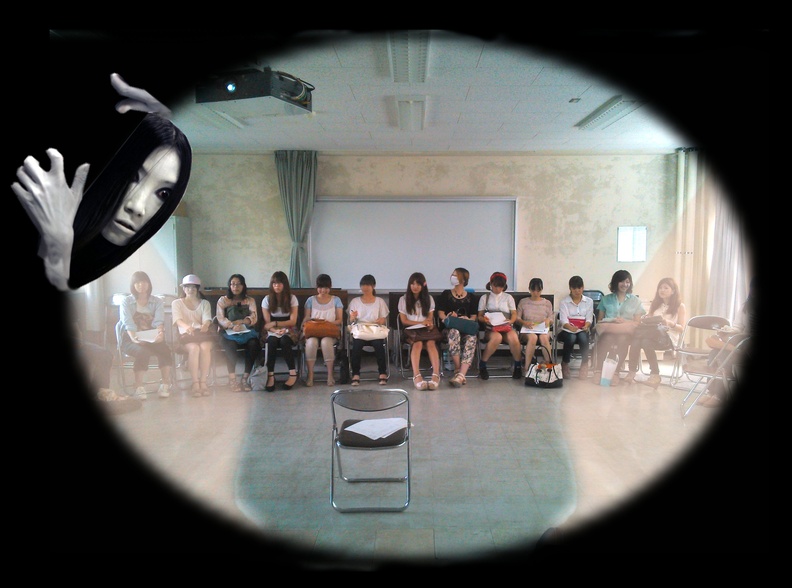
Kayako Saeki pictured above, always looks like she is trying to get out of the image, because like Sadako, she is. Furthermore she is not really modelled as a member of the crowd, with a face that can be seen from the front, but rather as or in the boundary of experience: the first person view of the subject. The Japanese, I believe, look out of her eyes. She is especially difficult to see because East Asians have smaller, invisible, noses like Gachapin!

Image of Kayoko Saeki copyright Aiko Horiuchi and Ghost House Pictures / Vertigo Entertainment

The X-Ray Eye in the Sky

The X-Ray Eye in the Sky
Ball and Torrance (1978: see Kim, 2002) demonstrated that the Japanese can visualise inside things. Since as demonstrated by our research they have a sort of mirror in their heart (Heine, Takemoto, Moskalenko, Lasaleta, & Henrich, 2008) their internal visualisation ability applies to their underwear, car interiors and hearts. This self directed eye is not something that the Japanese are fully aware of, but is rather the eye of the Other of the Japanese self, their super-ego which also prevents them from writing graffiti in toilet stall, or robbing people even in the dark. The eye in the Japanese sky sees inside things, and in infra-red too, but perhaps not quite so well. Tthe Japanese do tend to get a little more boisterous at night, and there is a division of what one is and is not allowed to do before and after sundown - specifically drink alcohol.

Image bottom left from Vip Style Magazine (July, 2015) p. 131
Image bottom right copyright 株式会社雅
お取り下げご希望でありましたら、下記のコメント欄かnihonbunka.comまでご連絡ください。

Ball, O. E., & Torrance, E. P. (1978). Culture and Tendencies to Draw Objects in Internal Visual Perspective. Perceptual and Motor Skills, 47(3f), 1071–1075. doi.org/10.2466/pms.1978.47.3f.1071
Heine, S. J., Takemoto, T., Moskalenko, S., Lasaleta, J., & Henrich, J. (2008). Mirrors in the head: Cultural variation in objective self-awareness. Personality and Social Psychology Bulletin, 34(7), 879–887. Retrieved from www2.psych.ubc.ca/~heine/docs/2008Mirrors.pdf
Ball, O. E., & Torrance, E. P. (1978). Culture and Tendencies to Draw Objects in Internal Visual Perspective. Perceptual and Motor Skills, 47(3f), 1071–1075. doi.org/10.2466/pms.1978.47.3f.1071

Heine, S. J., Takemoto, T., Moskalenko, S., Lasaleta, J., & Henrich, J. (2008). Mirrors in the head: Cultural variation in objective self-awareness. Personality and Social Psychology Bulletin, 34(7), 879–887. Retrieved from www2.psych.ubc.ca/~heine/docs/2008Mirrors.pdf

Outside Black Interior Pink

Outside Black Interior Pink

If you tried to have a conversation with this lady you might mistakenly think that she is alll and humble lacking in individuality. She has dressed up her car interior in vivid pink, leaving the outside black with only a hint of weird. The Japanese have an X-ray eye that can see even into their hearts. No Japanese can meet its gaze and live.

Vip Style Magazine (July, 2015) p. 131

お取り下げご希望でありましたら、下記のコメント欄かnihonbunka.comまでご連絡ください。

Sabtu, 27 Juni 2015

I.Q. and the Wealth of States


One of the simplest theories of human prosperity is the idea that societal wealth comes from an intelligent populace. Obviously this is true to some degree; if you went around and forced everyone in the country to take a bunch of brain-killing drugs, economic activity would definitely decline. The question is how much this currently matters on the margin.

Some people think it matters a lot. Richard Lynn, a British psychologist, wrote a book called I.Q. and the Wealth of Nations, suggesting that average population I.Q. drives differences in national wealth. Garett Jones of George Mason University is writing a book called Hive Mind that suggests much the same thing, asserting that there are production externalities associated with high I.Q. Motivated by this hypothesis, there is a line of research in development economics dedicated to finding interventions that boost population I.Q.

Well, here is some new and relevant evidence. Eric A. Hanushek, Jens Ruhose, and Ludger Woessmann have a new NBER working paper in which they look at U.S. states. From the abstract:
In a complement to international studies of income differences, we investigate the extent to which quality-adjusted measures of human capital can explain within-country income differences. We develop detailed measures of state human capital based on school attainment from census micro data and on cognitive skills from state- and country-of-origin achievement tests. Partitioning current state workforces into state locals, interstate migrants, and immigrants, we adjust achievement scores for selective migration...We find that differences in human capital account for 20-35 percent of the current variation in per-capita GDP among states, with roughly even contributions by school attainment and cognitive skills. Similar results emerge from growth accounting analyses.
Note that the authors control for selective immigration, an oft-neglected factor in debates about I.Q.

So the upper bound for the amount of state income differences that can be explained by population I.Q. differences is about a third. If we assume that achievement scores are a good measure of I.Q. and that school attainment doesn't improve I.Q. very much, then the number goes down to about one-sixth.

Now, it's important to remember that this study, well-executed though it is, doesn't isolate causation. It doesn't show the degree to which state average I.Q. can be raised by raising state income.

What it shows is that the vast majority of differences in state income are not due to variations in state average I.Q. If we had an I.Q.-boosting device, boosting the average I.Q. of Ohioans by 1% would raise Ohio's average income by at most around around 0.17%.

Of course, that's a marginal effect. If we boosted the average I.Q. of Ohioans by 400%, we might see much more (or much less) than a 68% increase in their income. And if we gave Ohioans brain-killing drugs (insert Ohio State football joke here) that cut their I.Q. in half, we might see much more (or much less) than an 8.5% decrease in state income.

But anyway, what this really shows is that there is Something Else that is driving state income differences. My personal guess is that this Something Else is mainly "external multipliers" from trade (the Krugman/Fujita theory). Institutions probably play a substantial role as well (the Acemoglu/Robinson theory). That's certainly relevant for the debate about different models of capitalism, where we often compare the U.S. to Scandinavia and other rich places.

In any case, this result should be sobering for proponents of I.Q. as the Grand Unified Theory of economic development. Average I.Q. is not unimportant for rich countries, and we should definitely try to raise it through better nutrition, education, and (eventually) brain-boosting technologies. And it still might matter a lot for some poor countries. But for rich countries, there are things that matter a lot more.


Update

Scott Alexander seems to think that my post gives a slanted interpretation of the results of this study - that if you present the numbers in a different way, they tell a very different story, and in fact imply that "IQ is everything after all." So just in case there was any ambiguity, let me give a concrete example of what this paper says about the impact of average population IQ on GDP.

Suppose you were to take the state of Ohio, and use an IQ-boosting device to boost Ohio's average IQ by 18 points. This paper predicts that Ohio's GDP would rise by 16 percent, or about $5,600 per person.

18 IQ points is the difference between the commonly reported average IQs of Mexico and South Korea, as listed in this table. A $5600 rise in GDP would take Ohio's per capita GDP from about the level of Italy to somewhere between the levels of France and Belgium (see here for those GDP numbers).

So I think this very clearly backs up my summary of the paper's result.

Kamis, 25 Juni 2015

Shame and the Male Gaze

Shame and the Male Gaze

The image on the left is from a book recommending Nudism to Westerners, in an attempt to "grow up without Shame". The genitals have been by me blurred to conform with current Japanese law. The image on the right is from Nakao (2010) "Since when did the Japanese find being naked embarrassing" and is one of the sketches by Heine in Admiral Perry's impressions of Japan at the end of the Edo period. According to Nakano (2012) and for that matter Isabella Bird, the Japanese did not have anything against the display of genitals until shocked Westerners arrived.

The Japanese did have words about the separation of the sexes however. It was said that Japanese males and females should only "share seats" (sit together) up to the age of 7 (Nakano, 2010, p. 18 「男女7歳にして席を同じうせず」) and that among samurai talking (yes!) to the opposite sex was avoided with males and females being kept strictly apart in the Edo period. (武士では男女が言葉すら交わすことも憚れた時代、男女の別厳しく問われた時代ではなかったか。」ibid).

I wonder if the Western nudists achieve their aim of growing up without shame. I went to a boarding school and managed to cease from being ashamed of my body, especially when as a late developer I had no pubic hair and a small penis compared to my peers. My shame was so great that I think that in order to beat it I had I no longer identified with my body at all. I can remember that the greatest time that I felt shame was when a house master, a father figure of sorts, came into the boys showers when I and some of my peers were there.

I guess that if the Japanese were in gaze of a mother then they would not feel ashamed, and it is only because the gaze felt is somewhat sexualised, that one might feel ashamed at all. Since Westerners feel shame towards their nudity and guilt about their moral behaviour, and Japanese felt shame about their moral behaviour but no shame or guilt about their nudity.

Does this suggest that a reversal therefore of the parent that looks and listens. As a boy I used to imagine that my father was watching, and cheering, me when I ran in cross country races.

Hypothesis

West it is felt that there is a
Motherly ear listening (according to Freud and Derrida at least)
Fatherly/Male gaze watching (which would make sense explaining the reason why nudity is so shameful)

Japan it is felt that there is a
Motherly gaze watching (hence the absence of shame towards nudity, since the mother gaze is non sexualised)
Fatherly/Male ear listening (hence the strictness with regard to talking to the opposite sex).

In my lectures I make Japanese men and women, who do not otherwise sit together, sit and talk to each other. What a Westernising devil! Perhaps I should cease and desist.

If anyone wishes I cease and desist with regard to the image on the left please leave a comment below or email me via nihonbunka.com.

Nakano, A. 中野明. (2010). 裸はいつから恥ずかしくなったか―日本人の羞恥心. Tōkyō: 新潮社.
Bird, I. L. (1880). Unbeaten Tracks in Japan: An Account of Travels in the Interior Including Visits to the Aborigines of Yezo and the Shrines of Nikkô and Isé. J. Murray.
Smith, D. C., & Sparks, W. (1986). Growing Up Without Shame. Elysium Growth Press, book.

Senin, 22 Juni 2015

Barutan Sadako Kayako Returning Japanese to the Image

Barutan Sadako Kayako Returning Japanese to the Image

When the centre of gravity of your self (Dennet, 1992) is your face (Watsuji, 1935/2011) then the discovery of the visually spectating other in your psyche, hidden in the eyes of others, or the eyes of the world (seken) or the sun, returns one to a dead image. In Japan the dead are images but the Japanese, like Westerners, are not aware that they are, as images and voices respectively, we are already dead. Barutan Seijin (the alien from Barutan Star has a ray that freezes people. Sadako turns her victim silent and negative with her gaze. Kayako drags people into mirrors or into photo developer. In all cases the victim is dragged back into the image.

Visual spectators are more active than linguistic ones and can kill just with a stare. They also tend to silence their victims rather than turn them into a scream. The the scream of frozen team member (taiin) in Ultraman (as well as Ultraman himself), and that of Sadako's victim are silent, whereas Kayako's victims do not bother to scream. They know where they are going.

Being of the "imaginaire" (Naclanianly, Lacan) Japanese monsters do not speak but make noise like this.

Dennett, D. C. (1992). The self as a center of narrative gravity. Self and consciousness: Multiple perspectives.
Watsuji, T. (2011). Mask and Persona. Trans. Carl M. Johnson. Japan Studies Review. XV, 147-155. In English https://asian.fiu.edu/projects-and-grants/japan-studies-review/journal-archive/2011.pdf In the original Japanese http://www.aozora.gr.jp/cards/001395/files/49911_41926.html

James Wan Dead Silence: Crossover Horror


Dead Silence is about a female ventriloquist that was turned into a ventriloquists puppet when she died. She, as the puppet, rips out the tongues of anyone who screams in her presence. It was directed by James Wan, a Malaysian Chinese in the USA. The death by screaming meme is common to Western horror - were I believe that we realise we are already a dead voice, and already dead voice. This is exemplified most forcefully in The Blair Witch Project where the brash narrative of American films students, are reduced to childish whimpering. Then finally, after they see the writing on the wall, and the filming becomes first person view and they are made to stand in the corner all that is left is a scream.

The whole monstrous ventriloquist structure is very much a metaphor for the structure of the Western self - it is exactly the metaphor I used when I experienced it.

At the same time, the reducing of victims to silence is a theme from Asian horror - where people are dragged into mirrors (Grudge) developer fluid (Grudge) turned into a negative (Ringu) or frozen (Barutan Seijin) i.e. and generally silenced (the legend of Enma, Ringu, Audition) and returned to the image since East Asians, or at least Japanese, think that they are their face. King Emna at the gates of East Asian Hell hangs the wicked on hooks by their tongues and shows them a magic mirror containing their lives. In Enma's famous book are not their deeds (as is the case with St. Peter's book) but only their names. http://flic.kr/p/v4dsox

Paedo Nation, Paedo Fantasy, or Child God

Paedo Nation, Paedo Fantasy, or Child God
Japan seems to have a bit of a poor reputation among its foreign residents for having paedophillic tendencies based upon the Japanese preference for young female stars (see comments here for example). Is this reputation fair? The graphs on the left from Kenrick and Keefe (1992) for Americans, top, and Oda (2000), based on analyses of lonely hearts advertisements show that Japanese have only a slight preference for younger women in the case of older Japanese men. American 50-somethings advertise for women over about 35 whereas Japanese 50 sometimes (8 years later) advertised for women over 30. At younger male ages the differences in age preference between Japanese and Americans is minimal.

What then of the prevalence of very young women appearing as scantily clad "idols" on Japanese television and in magazines? The important difference may be that they are not real. Buunk, Dijkstra., Kenrick, and Warntjes (2001) surveyed Americans to regarding their stated minimum age preferences for marriage partners, relationship partners, someone with whom one could fall in love, partners in a causal affair and sexual fantasy partners. They found that only those males in their twenties saw women below twenty as a potential partner even in a fantasy (approximately 18). Bearing in mind that the average age of AKB48 was approximately 22 years, they would seem on that basis of appropriate age for a US band. The average age of the HTK28 idol group based in Fukuoka was however 13.8 at their formation and 16.6 more recently. This is lower than any of the stated ages in the above American male focused research (Buunk, Dijkstra., Kenrick, and Warntjes, 2001) .

An important point may be however that Japanese "idol" groups stress their purity -- they are fired if they have a relationship -- and it is argued that they may be thought of under the literal meaning of "idol," an object of veneration or worship, and not a potential partner of any kind. On the other hand however, the particular appeal of the recent spate of XYZ48 idol groups is that they appear on stages and even shake hands with their fans. They have brought a greater degree of reality to the idol genre (Nishio, 2013, p90). Even so this may mean that simply, like shrine visiting, the fans now can get up close to their idols in the literal sense. It may still be the case that they are not seen as partners in any kind of fantasy, but that they are in a sense child gods. Indeed the depiction of children as gods in Japanese festivals has a long tradition.
 
The truth is that I do not have data on the extent to which fans of idols see them purely as objects of veneration or partners but the difference in attitudes reflects a massive difference in cultures.

www.japantoday.com/category/entertainment/view/one-finali...
11歳のAKBメンバーが登場したことについての英語話者のコメント
No. Wrong. Stop. Now. いや!悪い!止めろ!今!
twelve years old do those creepy predatory bikini pics 12歳でビキニ姿の卑怯で強奪的な写真も撮る
Sick...病気
The utter debasement of a child.子供の心を踏み潰している
what the f. are the parents thinking? 両氏は何を考えているだろう?
Disgusting! This is soft kiddy porn. If the fans were the same age it would not be a problem but the fans are older men! ぞっとする!これはソフトな児童ポルノ。ファンが同じ年齢ならまだしも、しかしファンがおやじだ。
The peadophiles who watch these girls will be so happy!
AKBを見るのは、小児愛者・子どもを性的に虐待する犯罪者で
喜びそうだ
Stepping up the ante from "quite very creepy" to "incredibly creepy".かなりキモイから、驚くほどキモイへ
Paedogeddon is upon us 小児性愛の悪と善の最終決戦開始前

お取り下げご希望でありましたら、コメント欄、またはnihonbunka.comのメールリンクからご連絡ください。
Kenrick, D. T., & Keefe, R. C. (1992). Age preferences in mates reflect sex differences in human reproductive strategies. Behavioral and Brain Sciences, 15(01), 75-91.
西尾久美子. (2013). エンターテイメント事業の比較分析: 宝塚歌劇と AKB48.
小田亮. (2000). 日本人における配偶相手の好みにみられる性差: 結婚相手募集広告の分析から.
Buunk, B. P., Dijkstra, P., Kenrick, D. T., & Warntjes, A. (2001). Age preferences for mates as related to gender, own age, and involvement level. Evolution and Human Behavior, 22(4), 241-250.

Jumat, 19 Juni 2015

Positive Thinking and the Absense of Suicide


The Japanese are famous for having been able and willing to lay down their lives for a cause. Suicide in Japan was not considered to be a sin. Sometimes rather honour, or even good manners required it. Certainly many young Japanese seem to have felt, or were taught to feel, that becoming suicide pilots was preferable to being invaded, and having their culture destroyed. I have argued that from an aesthetic, autoscopic, perspective a life and actions towards death may be considered to be the most aesthetic and pleasing to the eye, whereas the decision to "I will now set out on a suicide mission" may fall foul of the ghost of non-contradiction and various other Cretans that protect linguistic thought.

Kant (1797), who based his morality on rationality condemns suicide in the following way immediately after the statement of his foundation of morals "the categorical imperative."

If then there is a supreme principle or, in respect of the human will, a categorical imperative, it must be one which, being drawn from the conception of that which is necessarily and end for everyone because it is an end in itself, constitutes an objective principle of will, and can there fore serve as a universal practical law. The foundation of this principle is: rational nature exist as an end in itself. Man (sic) necessarily conceives his own existence as being so; so far then this is a subjective principle of human actions. [snip] So act as to treat humanity, whether in thing own person or in that of any other in every case as an end withal, never as means only. [snip]
Firstly, under the head of necessary duty to oneself: He who contemplates suicide should ask himself whether his actions can be consistent with the idea of humanity as an end in itself. If he destroys himself in order to escape from painful circumstances, he uses a person merely as a mean to maintain a tolerable condition up to the end of life. But a man is not a thing, that is to say, something which can be used merely as means, but in all his actions be always considered as an end in himself. I cannot therefore, dispose an any way of a many in my own persona so as to mutilate him, or to damage or kill him. (Kant, 1797[2008}, p34. My emphasis)

To summarize Kant's view, if you talk to yourself and ask yourself about it, then answering "yes" to "shall I kill myself now?" is categorically unreasonable, upon the assumption that rational being (or hearing oneself speak) is the ultimate end of "man."

After three decades of economic stagnation, and a rise in suicide coincident with the commencement of SSRI antidepressants, the Japanese are now putting great effort into the reduction of the level of suicide in Japan.

Oka, (2015) one of authors of the booklet founded by Kounosuke Matsushita pictured above, entitled "Every day will be fun. Positive Thinking is Best!" went to the municipality with the lowest suicide rate in Japan and through a series of interviews with a large number of the inhabitants found that they thought extremely positively. In a rare example of Japanese self praise one informant respond "Its because its just right here," "It is just the best place to live."

Christian religiosity also correlate with positive thinking (Rudski, 2004) and the absence of suicide (Dervic et al., 2004). After finding a correlation between optimism and religiosity and pessimism and its absence Rudski writes "One can easily speculate that religiosity offers an attractive answer to finding meaning in an often-confusing existence and that such answers are often optimistic in nature with promises of eternal life. (Rudski, 2004, p373). Dervic et al. write "Religious affiliation is associated with less suicidal behavior in depressed inpatients. After other factors were controlled, it was found that greater moral objections to suicide [snip] may function as protective factors against suicide attempts. (Dervic et al., 2004, p2303)

So if one were to introduce more "positive thinking", and even Christianity, into Japan it would probably result in a reduction of suicide, and the destruction of Japanese culture. What would the "suicide pilots" have thought? Where they simply misguided or did they represent Japanese culture? Their squadrons were named such things as "Mountain Cherry" after Motoori Norinaga poems, one of which goes "If asked the nature of the Japanese heart, tell them that it is the blossom of mountain cherry, fragrant in the summer sun."

The eradication of suicide or as the title of one book puts it the move from a "suicide society" to a "society that is good to live in" (Shimizu, 2010) often seems to be contaminant with a shift from traditional Japanese to Western values. Books on the eradication of suicide have section titles such as "The Japanese who ask "Can you fight 24 hours a day?" are worker ants." (Shimizu, ibid) "Japanese society is like a hair dryer with only an on button" (ibid) "Thinking about the value of not doing, but being" (ibid). This last movement is one from *seeing* value as manifested in action, to having value as a result of some hidden "being" (the philosophy of presence) that even Japanese people will one day be felt to possess. The title of Dr. Oka's 2013 book, "The town that is good to live in, has a low suicide rate for a reason" likewise, gives the Western game away: that people need a "reason" (words, value purports to exist, inhere, without any action) for living well. When the Japanese believe this then they will be damned too. They will need to be whispering to a dead mother in their heads, or with their heads in the underworld, telling themselves that they are really valuable people.

It is interesting that one of the founders of the West, after Plato, Jesus Christ was also fairly suicidal in the sense that he seems to have gone on what could be described as a suicide mission. He was the Kamikaze that would have sank sin. Does this mean that he was Japanese? While he was a walking bible, the word made flesh, Jesus is also said to have also kept on going on about "the light". And as Kieerkegard (1843) points out, contra Kant, the Christian religion encourages people to live not rationally but in faith. Perhaps he was the word made flesh who wanted to bring the word into the light. He certainly saw no irrationality in his mission, which was perhaps an aesthetically attractive one. Despite being the word made flesh, and and may become a replacement Eve, helpmeet or paraclete, as mentioned before, he may also silence words in mind. A suicidal listener that brings those that talk to him into the light. I reminded of James Cameron's two messianic heroes in Terminator 2: Judgment Day who sacrificed themselves to destroy what they had created (essentially a sort of time slip or loop) in the case of Miles, or that rationality that which they incarnated, in the case of the T-1000. This moved a long way from suicide in Japan.


Dervic, K., Oquendo, M. A., Grunebaum, M. F., Ellis, S., Burke, A. K., & Mann, J. J. (2004). Religious Affiliation and Suicide Attempt. American Journal of Psychiatry, 161(12), 2303–2308. doi.org/10.1176/appi.ajp.161.12.2303
Kant, I. (2008). On the Metaphysics of Morals and Ethics: Kant. Wilder Publications.
Oka, M. 岡檀. (2015, May 9). そもそも「前向き」って何だろう. 月刊PHP.
Rudski, J. (2004). The illusion of control, superstitious belief, and optimism. Current Psychology, 22(4), 306–315. doi.org/10.1007/s12144-004-1036-8

Kamis, 18 Juni 2015

Horror as the Origin of Self

Horror as the Origin of Self

Lacan argues that the self is an illusion, or (mere) representation, at the intersection between, at first, a reflected image in a mirror, and later, the "I" narrated in language, in either case seen and then later heard and understood from the point of view of a simulated fictive other. I believe that here in Japan the sequence or importance, is reversed, with autoscopy, self-sight rather than self-speech, being the preferred, adult mode of expressing the self.

Numerous psychologists claim that in order to know ones self one needs to see oneself from the perspective of another. We could not evaluate ourselves unless we were to see it from the point of view of another self, or "impartial spectator" (Smith). In order to have a self we need to use language and internalise a generalised other (Mead). Since we are separated from our mothers by our fathers we internalise the lost mother from whose perspective we hear ourselves via an "acoustic cap" (Freud). While we speak about ourselves in rehearsal (Haidt) to imagined others (Bakhtin, Hermans and Kempen) we always have an extra other to whom we address ourselves in addition to these imagined others, a "super addressee" (Bakhtin) though we are rarely fully aware of doing so.

Indeed it seems to me that his selfing that we do could not be done if we were aware of the other in self, so something horrible must be going on. As Satre points out we can, or should, know that any representation is not oneself since it is within consciousness. Self therefore entails a paradox. Freud and Derrida point this out. The awareness of the other, would make it clear that the self is also a representation, an other. For the most part we are blissfully unaware that we are a group, that we are representing ourselves for someone at once so familiar, and yet now so unfamiliar, uncanny, fearful. The other needs to be taboo and horrible since otherwise we would see it. It becomes doubly taboo and horrible because we have also lived a life engaging it, and realize that our being is nothing but this deed. The horror is in sense a the solution to the paradox, a way of scumbling over it, ensuring that we do not see it, so that we can maintain it.

Concretely speaking, Freud and Derrida hint -- they do not bring themselves to say it -- that the horror that keeps us unaware of the way in which we speaking to a simulation based upon our mothers, is that the relationship becomes sexualized. This is I believe the meaning of the myth of the Fall in the bible, and the malfeasance that precedes the death of the Sun Goddess in the Kokiji. Westerners hid the self-desire. Japanese brought it out into the open.

We, westerners, speak to the internal simulated woman, a second mother, as daddy would which means that (at least in the case of males) the relationship they have with our internal other is horrible in most of the ways that we society trains us not to like. It is masturbatory, homosexual, incestuous, and paedophilia, and perhaps murderous since in our imagination we replace our father. We have thus created an identity in a narrative which continues the most disgusting of plots, which at the same time sustains our being. We are up to our necks in it and like Macbeth -- "things bad begun make good themselves by ill" -- and must keep doing it rather than face up to the horror of what we have been doing, kept doing, again and again, all along.

We can try and replace the internal interlocutor with someone very asexual and unselfish so that at least our self-love, which is at the heart of self, becomes less grotesque and self-serving. It is not that we have an imaginary friend but how we have it, how we know it, that makes it horrific.

In Japan however, the other is visual a forgotten terrifying eye or gaze. It is not quite so hideous. It not sexualized. It is out in the open. The structure is only as hideous as a grown adult looking at themselves like they are their own child. It is even portrayed in almost comic ways in for instances the video forKyary Pamyu Pamyu's Pan Pan Pan, as the mother that looks in through the window. However, in the Japanese case also, the structure has the aforementioned Macbethian-force-to-continue, since once a Japanese persons starts off petting their "selves", as image, in this way, then the realisation that they have been doing this is equivalent to the loss of their identity. The image that they thought to be themselves becomes a mere image, and they die.

In these permissive days, after 'the sexual revolution,' it is this second loss and destruction of self, which is the more horrific. The older one becomes the greater the horror of having lived ones life as a pornographic or sickly ingratiating, self-admiring fiction. Oh my god what have I done?

Since speech is required of the Western type of selfing, and the speech that we do to this monster inside us, is a ritual chant of our behaviour carried out by children up to age five (Vigotsky), we gradually become quiet and presume, or claim, ourselves to be speaking to ourselves. We presume that our thoughts are expressing timeless ideas in our minds that accompany words in the presence of the moment (Derrida), when in fact we are rather engaging in a grotesque radio play that will not stop, that never stops. I cannot turn off the radio, but the way that linguistic selfing can be made silent and hidden from others in this way allows us to hide our deed, by claiming that we are only speaking to ourselves. It is for this reason that we claim that we are individualists, that our self-speech is self-consumed, rather than faces up to the horror who we are sharing "a chamber" of our chest with, and what we are doing with "her."

The Japanese eye of the Other is hidden in the world -- in their psyche but necessarily if it is to see their face, outside their head -- and so they like to think that they are merely performing their selves for the eyes of the world (for which there is a word in Japanese: seken no me). Being a groupist, or someone who values harmony is something that the Japanese have traditionally taken pride in. As long as they are only doing things for others they can remain blissfully unaware of the eye before whom they peacock themselves for themselves, almost as grotesquely as Westerners self-enhance in their self speech.

The way in which the other remains hidden in Western culture is reflected in common tropes in horror Japan and the West. There are two prime differences. The first is in the nature of the grotesque self love that we are hiding, the second is the medium from which horror emerges.

Since the self love that we do and yet find so disgusting is sexual in the West, there is always some sexual element to Western horror. The Myth of the Fall relates how we got to "know" Eve and covered our nakedness. Derrida even goes so far as to claim that being ashamed of nakedness is a condition of being a "man" (human), and indeed this has long been a Western presumption. Western horror is almost always sexual. The Western monster is always coming looking for a bride (long list of horror). People who fornicate are slashed to pieces. Murders and violence takes place on wedding nights, in bedrooms, showers and beds. Anyone who gets naked in a Western horror movie will soon die. The monster wants to have sex with his victim since this is what the monster inside us is doing with our "selves."

In Japan there was no shame associated with nakedness. There remains far less. The self-love that the Japanese find so disgusting (which is also included in the Western version, which adds sexuality as another layer) is that between a mother and child, revolving around amae or dependence, so in Japanese horror the monster is a female that turns her victims into children before killing them. Male Japanese victims whimper and die before the female monstrous eye that thinks them cute. Western monsters are thwarted transsexual deviants, Japanese monsters wanted to have children.

The second difference in horror Western and Japanese is in the way in which the monstrous in each culture emerges from one or other media.

Western horror emerges from language and the voice. Voice takes on a life as it has within us and prefigures that death that it has already caused. One of the most vivid expressions of horror emerging out of language is in The Shining where Jacks repetition of "All work and no play makes Jack a dull boy," prefigures his murderous insanity as does the writing in reverse on the wall by his son, "redrum" (Murder). Writing on the walls, and glass, is a common trope in Western horror. Writing prophesizes the horror, telling us of the death that we are living. There is horrific wall writing on a mirror in What Lies Beneath, Black Swan, and I Know What You Did Last Summer, on walls in Candyman, The Exorcist III, Stigmata, Mother's Day, The Shining (1980), Hide and Seek, The Haunting (1999, 1963), The Lost Boys, The Blair Witch Project (1999, as runes near the climax), and twice in Se7en (1995), on glass in Carrie and twice in The Strangers (2008), on the stomach, written from inside, of the possessed girl in The Exorcist (1973). Most of the images taken from these movies, are from this blog post where a reader quipped, "if you can't read, horror movies will lose you". Derrida attempts the same reveal in his book, The Post Card. Writing is no different from speaking but it is more obviously dead, horrific.

Words can't live of course, so we are in that sense already dead. But if we make our word play self-serving and pornographic enough to be really stimulating, then we can believe in the living word, that the narrative is the centre of gravity of the self (Dennet), and keep the horrible other hidden. Murderers in Western horror also often phone in first. In Halloween (1974), Scream (1996), When a Stranger Calls (1979, 2006) the murderer phones the victims. The horrific denouement occurs when the phone call turns out to come within the same house, or from someone who is watching, because the monstrous speaker and listener are strangers within us, within the home of our heart. Often the horror takes place only, at least at first, in a phone call or audio such as the opening sequence of The Strangers (2008) and climax of The Blair Witch Project (1999). At others times such as in two of the most famous Western horror movies ever made, Psycho (1960) - which represents the Western psyche pretty perfectly and often tops lists of the scariest horror movies - and the Exorcist (1973), the monster is only a voice that inhabits an otherwise innocent protagonist. We might be innocent if we did not have that voice that whispers within us.

Japanese horror on the other hand generally emerges from the image, such as lanterns, scrolls, television sets, mirrors, and photographs immersed in darkroom developer. When Japanese realize that they have been simulating an eye that loves them, they realize that their self is a dead image and die. Japanese monsters thus draw their victims into the images from whence they came. Sadako in the Ringu emerges from a video tape (image repository) of a well (with a reflective surface) from a television screen and turns her victim into a negative. The monster of Juon emerges from a developing photograph and a mirror to drag her victims into them. Ghosts routinely emerge from wall scrolls. Oiwayasan emerges from a lantern after being strapped two-dimensional to a door dropped into a lack to drag her victim into the same lake. The monstrous feminine in Joyuurei emerges from a film and drags her victim away somewhere.

Do Western monsters turn their victims into words or voice? They should. I think that is the significance of the ubiquitous Western horror scream. Men in Japanese horror movies whimper or make no sound as they die. Japanese horror often involves silent death being draw into an image. But the women, especially, who die in Western horror movies often die in and as a scream. Western death is being drawn into the vocal, scream because that is all we ever were. "I am, I exist, whenever it is uttered from me," because I am no more no less than an utterance, voice, scream.

There are other reversals. The Japanese think of themselves as their face or mask (Watsuji, Nishida) - that their own visually regarded aspect is alive, but that their voice is a dead representation. Westerners believe that their self-speech is alive, but their face is dead representation. As each type of horror makes the media that is felt to be alive to be horrific, but at the same time emphasizes the dead nature of the media which believed to be is dead. In Japanese horror, Ema the lord of hell puts hooks through the tongues of the dead, there is a silent telephone call (Ringu), or a telephone call from themselves dying (Chakushinari) that prefigures death. Japanese monsters often have especially dead speech like the sound of a Geiger counter. In Western horror the monster has an especially dead face, is often wearing a mask, as in The Strangers (2008), Halloween (1978), Friday the 13th Part III (1982), Scream (1996), The Silence of the Lambs (1991), Saw (2004) sometimes, an emphatically dead mask, such as the face of another person strapped to the monster's head in The Texas Chainsaw Massacre (1974) and the Jigsaw Tobin Bell face skin mask in the Saw series. A fuller list of horrible masks can be found at TV Tropes and a top ten video here. This is what we Westerners are: a monstrous would-be-living voice, wearing a dead mask.

I think it probable that humans internalize both types of Other and identify with both types of self-representation to greater or lesser degree. The breakdown of either type of self-identification can lead to the breakdown of self.

One thing that more than one religion have in common is the insistence upon human "sin". Even disparate religions such as Christianity and Buddhism maintain that humans have in some way sinned. The assertion that I had sin almost as a result of my birth seemed to me to be an offensive lie designed to cower and control. Later however, it seems to me that on the contrary the big advantage of religion, over science which speaks in less emotive terms, is its stress upon sin and its attempt to provide a cure. The problem with science of the self, as I am attempting here, is that this, what is going on, might become something we accept. That is not my intention. I think that the reality is worse that I can possibly describe and hope that readers approach the issue with "fear and trembling". It is possible that the more I write about this the more I damn myself and others.

Once again, in conclusion, there is no such thing as self except as other. Consciousness is everything, the whole universe including everyone in it, but it contains no self. Self arises from views of others. Thus anyone who has a self is either fully embedded in their groups and identifies solely with how others observe themselves, or they are sinning: cognizing, and enjoying, themselves in the simulated eye or ear of another. For this to take place for an other to be hidden within the psyche something supernatural, horrible or both must be going on, otherwise we would face the other and see it for what it is. At the same time something "pleasant" must be going on for that horror to have been chosen over truth in the first place. The horror is another aspect of the pleasure, or desire, that gives rise to illusion of individuality: which is in fact, a monstrous group called "self".

Bathing with Daughter: Daddy Arrested

Bathing with Daughter: Daddy Arrested
In my lecture on comparative morality as part of my inter-cultural communication course, I suggest that one should be careful about admitting that one is bathing with ones children in the UK since you might be arrested. I based this wild assertion on the controversial case of a two doctors in Cleveland, UK in the 1980s brought sexual abuse charges against parents that had been showering with their children. The children were diagnosed using a controversial physical test, but I believe that the initial suspicion was aroused due the children's showering practices. If they had been bathing as opposed to showering, with daddy, I think still greater suspicion would have been aroused especially in view of the fact that this practice is seen in Japan as a form of "skinship" (a Japanese portmanteau from skin and friendship but more touchy feely) or a social bonding leisure activity (see below).

It seems that my warning was appropriate. This recent Asahi Newspaper article relates that the Japanese Foreign Ministry has now issued a warning on its homepage saying that in a Japanese national living in an "advanced / first world" nation wrote an school essay entitled "I am looking forward to bathing with daddy," as a result of which the school informed the police and the father was arrested under suspicion of sexual abuse.

The foreign office homepage is here, complete with cartoons showing the co-bathing father being reprimanded by a policeman suggesting that photos (no one takes photos) or memories of bathing with his daughter are pornographic. Another cartoon warns against leaving children in cars.

The above article also states that the average age to which Japanese daughters bathe with their father is 9 years of age, reducing to about 10% of eleven year old daughters. 10% of eleven year old Japanese daughters are getting into a 1.5m square bath with their father partly because (so one person mentioned in the article opines) Japanese fathers are estranged due to the amount of time they spend working. Since they can only spend a smaller amount of time with their children it is appropriate, it is argued, that they spend it closer proximity with their offspring.

My favourite philosopher, Derrida (2008) writes that shame regarding nakedness is fundamental condition of being human and having morality.

"It is generally thought, although none of the philosophers that I am about to examine actually mention it, that the property unique to animals what is in the last instance distinguishes them from man (sic), is their being naked without knowing it. Not being naked therefore, not having knowledge of their nudity, in short, without consciousness of good and evil." (Derrida, 2008, p4-5; Derrida, 2002

That is not to say that the Japanese are animals, but not "men." It is my belief that the Japanese are humans in a different way.

Derrida, J., & Wills, D. (2002). The animal that therefore I am (more to follow). Critical Inquiry, 369–418. Retrieved from www.englweb.umd.edu/englfac/KChuh/Clark.Seminar.Doc.1.Der...

Minggu, 14 Juni 2015

Deirdre McCloskey Says Things

Some sadistic person or another referred me to this 51-page Deirdre McCloskey review of Thomas Piketty's book. I must remember to find who that person is and either play a mean prank on them in return, or demand that they buy me an expensive lunch. Fair is fair.

Deirdre McCloskey is the kind of writer who can take a perfectly fine sentence like "Capitalism has made humanity rich," and mutate it into a horror show like this:
Since those founding geniuses of Classical economics, a trade-tested betterment (a locution to be preferred to “capitalism,” with its erroneous implication that capital accumulation, not innovation, is what made us better off) has enormously enriched large parts of a humanity now seven times larger in population than in 1800, and bids fair in the next fifty years or so to enrich everyone on the planet.
I don't know about you, but I bid fair to give up well before page 51 of that locution.

But my main problem with Ms. McCloskey is not the poorly executed flowery baroque writing style, or even the reminder that plenty of people mistake flowery baroque writing for good writing. It's that McCloskey frequently makes declarations that are, to put it politely, in contradiction of the facts. She says these things with utmost confidence but without evidence or support, making it clear that the fact that she has said them is evidence enough. She argues from authority, and the authority is always herself.

This is NOT a post about Piketty or his arguments (of which I already have more than enough reason to be skeptical). It is NOT a post about McCloskey's rebuttal to those arguments. This is a post about McCloskey's style of argumentation.

Reading and critiquing McCloskey's thoughts on Piketty would be a bad move for me. First of all, it would require me to read dozens more pages of McCloskey than I have already read. Second, it would require me to know more about Piketty than I do (I haven't read Capital, nor do I own it). Third, it would turn the discussion political, which would detract from the main point of this post, which is that McCloskey is prone to silly-talk. Fourth, it would get very very very long, and you would get very very very bored.

So instead, I will simply critique the first three pages of the review, which are an introduction to the rest of the piece. McCloskey uses this introduction to praise Piketty, to compare him to physicists, and to insult most of the economics profession.

Here are nine excerpts that made my head explode:


1. p. 2:
[E]conomic history is one of the few scientifically quantitative branches of economics. In economic history, as in experimental economics and a few other fields, the economists confront the evidence (as they do not for example in most macroeconomics or industrial organization or international trade theory nowadays). 
And with a wave of her pen, Deirdre McCloskey dismisses the entire existence of the vast fields of empirical industrial organization, trade empirics, and empirical macro. Such is the power of argumentum ad verecundiam sui.

So I guess it was useless for Liran Einav, a Stanford economist who studies empirical IO, to write this in 2010:
The field of industrial organization has made dramatic advances over the last few decades in developing empirical methods for analyzing imperfect competition and the organization of markets. These new methods have diffused widely: into merger reviews and antitrust litigation, regulatory decision making, price setting by retailers, the design of auctions and marketplaces, and into neighboring fields in economics, marketing, and engineering. Increasing access to firm-level data and in some cases the ability to cooperate with governments in experimental research designs is offering new settings and opportunities to apply these ideas in empirical work.
After all, what does Einav know of his field? Deirdre McCloskey has said that Einav's field does not look at the evidence, and thus it is Truth.

Also, the Gravity Model of trade, often praised (by lesser lights, naturally) as one of the most empirically successful theories of all time, must now sadly be consigned to the graveyard, since Deirdre McCloskey has declared that trade theory fails to confront the evidence.


2. p. 2:
When you think about it, all evidence must be in the past, and some of the most interesting and scientifically relevant is in the more or less remote past... 
[Piketty] does not get entangled as so many economists do in the sole empirical tool they are taught, namely, regression analysis on someone else’s “data” (one of the problems is the very word data, meaning “things given”: scientists should deal in capta, “things seized”). 
Let's forgive the flamboyant vacuousness of the statement "When you think about it, all evidence must be in the past". Let's briefly mention the fact that that trivially true statement in no way implies the second part of the sentence. And let's move on to the fact that the two halves of the above quote are diametrically opposed to each other.

If scientists should seize "capta" instead of receiving "data", doesn't this make economic history unscientific? I mean, you can't do any experiments on history, can you? Are there any historical capta? McCloskey is barely finished praising her own field for looking at evidence when she scorns other fields for looking at very similar kinds of evidence!


3. p. 2-3:
Piketty constructs or uses statistics of aggregate capital and of inequality and then plots them out for inspection, which is what physicists, for example, also do in dealing with their experiments and observations. 
Physicists make graphs of things! Piketty makes graphs of things! Piketty is just like a physicist!

I wonder what else physicists do in dealing with their experiments and observations. Use computer software programs to display the statistics? Print out their plots on paper sheets for inspection? Sip coffee and check Twitter? I could be like a physicist too! Except I hate coffee, dammit.


4. p. 3:
Nor does [Piketty] commit the other sin, which is to waste scientific time on existence theorems. Physicists, again, don’t. If we economists are going to persist in physics envy let’s at least learn what physicists actually do. 
Wow, I'm glad that I have Deirdre McCloskey to tell me what physicists actually do. I'd hate to rely on an unreliable source like Google Scholar, who sneakily tries to convince me that physicists write papers with titles such as:

"Existence theorem for solitary waves on lattices"

"Vortex condensation in the Chern-Simons Higgs model: an existence theorem"

"General non-existence theorem for phase transitions in one-dimensional systems with short range interactions, and physical examples of such transitions"

"Existence theorem for solutions of Witten's equation and nonnegativity of total mass"

"A global existence theorem for the general coagulation–fragmentation equation with unbounded kernels"

"A Sharp Existence Theorem for Vortices in the Theory of Branes"

etc. etc. etc....

Thanks to Deirdre McCloskey's expansive sentence structure and snappish wit, I can safely assume that the 699,000 results for my Google Scholar search for "physics existence theorem" do not, in fact, exist (while the 417,000 results I get for "economics existence theorem" must be regarded as real). In addition, I can get a partial tuition reimbursement for the portion of my college physics education I spent watching professors prove existence theorems on the board.


5. p. 2:
[Piketty] does not commit one of the two sins of modern economics, the use of meaningless “tests” of statistical significance[.]
Is McCloskey unaware of the fact that physicists regularly use statistical significance testing, of the classic R.A. Fisher type?


6. p. 3:
Piketty stays close to the facts, and does not, say, wander into the pointless worlds of non-cooperative game theory, long demolished by experimental economics. 
Oh, right. Noncooperative game theory was demolished. Apparently Google and a bunch of other tech companies failed to get the memo when they hired auction theorists to design their online auctions for them.

Or perhaps by "demolished," McCloskey means "embraced by mathematicians, computer scientists, and engineers."

But DEIRDRE MCCLOSKEY SAYS THINGS, AND THUS THEY MUST BE TRUE!!


7. p. 3:
True, the book is probably doomed to be one of those more purchased than read...younger readers will remember Stephen Hawking’s A Brief History of Time (1988).
Deirdre McCloskey realizes that A Brief History of Time is only 212 pages long and has a lot of pictures, right?

It's always good to remember that just because you talk about books without having read them doesn't mean that everyone else does the same.


8. p. 4:
To be fair to Piketty, a buyer of the hardback rather than the Kindle edition is probably a more serious reader, and would go further.
This comes immediately after McCloskey claims that people buy books in order to display them on their coffee tables - something that you can't do with a Kindle version. Yet McCloskey now claims that hardback readers are more likely to be serious readers - utterly without evidence, of course.


9. p. 4:
I shall say some hard things, because they are true and important
This pretty much sums it up, folks.


So let me recap: All of these quotes came from the first three pages of a review that is 51 pages long. In three short pages, McCloskey manages to unfairly malign almost every branch of economics, make mutually contradictory assertions about how economists should use evidence, make false statements about physics that could have been corrected with a 5-second Google search, randomly insult a good popular physics book, and randomly insult Kindle readers, all in a mass of tangled, overwrought prose.

Yeah, there's no way I'm going to read 48 more pages of that. In fact, I'm not sure why I clicked on this link at all, given that everything else I've read of McCloskey's has been in the same vein (here's another example). Fool me twice, shame on me. Fool me five or six times, and I need a better hobby.

As a side note, John Cochrane agrees with my critique of the first 3 pages of McCloskey, and (more politely) notes several of the same errors. Yay!! He notes that McCloskey has written a writing guide, and failed to follow her own advice. (He also says that the review gets much better when it gets to the actual Piketty-related substance. So I suppose I'll put pages 4 through 51 on my "to read" list...possibly far down on the list...)

There is a clear lesson in all this: Do not believe things that Deirdre McCloskey says just because she says them. Google them. Find the facts. Do not nod your head in mute, placid agreement. Do not be seduced by the turgid prose style into thinking that here is an Authority.

Sabtu, 13 Juni 2015

Store of value


Two interesting posts about bitcoin by JP Koning (post 1, post 2) got me thinking about the function of money. Usually we say that money serves three functions: unit of account, medium of exchange, and store of value. But what does it mean to be a "store of value"? More specifically, what does it mean for a form of money to be a "good store of value," i.e., performing this function well?

Suppose, for simplicity's sake, that an asset's value (defined in consumption terms) follows a geometric Brownian motion with constant percentage volatility and drift. So it satisfies:

 dS_t = \mu S_t\,dt + \sigma S_t\,dW_t

Does "good store of value" mean that sigma, the volatility, is low? Or does it mean that mu, the drift, is high? Remember that in the short term, volatility dominates drift, while in the long term, drift dominates. Also remember that there should be a tradeoff between these two - assets with higher volatility will tend to have higher systematic risk, and thus will tend to have higher expected returns (drift). In other words, in general an asset can be either a good long-term store of value, or a good short-term store of value, but not both.

Stocks are a good example of an asset with high positive drift and high volatility. Their value bounces around a lot, but it tends to increase over time. If "store of value" means "value tends to rise over time", then stocks would be a very good candidate. Stocks are a good long-term store of value.

Fiat money with a 2%-inflation-targeting central bank is a good example of an asset with negative drift and low volatility. Over time, you can expect this currency to lose value, since there will tend to be about 2% inflation every year. But the value is highly predictable - it doesn't fluctuate very much at all from day to day. Fiat-money-with-2%-inflation-targeting is a good short-term store of value.

Looking out at the world, I see a whole lot of countries that use fiat money, with something like inflation targeting, as their medium of exchange (i.e., what they use to pay for stuff). And I see zero who use stocks as the medium of exchange, even though the technology now exists for us to make payments in stock shares quite easily (it's just the same as exchanging dollars electronically, really).

So I conclude that we want the medium of exchange - i.e., money - to be a good short-term store of value (i.e., to have low volatility), and that we don't need it to be a good long-term store of value (i.e., we don't care about its expected return).

Why is this the case?

It makes sense if you think about the way that we use money. People don't know exactly when they are going to need to spend money, or how much. If they keep their wealth in assets with high expected returns and high volatility - stocks, etc. - they run the risk of having to sell in a down market in order to pay for unexpected expenses. So it makes sense to keep some of their wealth in a low-volatility, low-expected-return asset like fiat-money-with-2%-inflation-targeting, in the expectation that they'll probably have to use it to pay for something. The low expected return - the fact that cash falls in value a little bit every year - doesn't matter so much, because you don't keep the cash around that long before you spend it.

(Note that this ignores correlations, but those won't end up mattering here.)

So this is why money should be a short-term store of value rather than a long-term store of value. This is why, as David Andolfatto pointed out, gold makes such a lousy form of money.

How about bitcoin? If it keeps experiencing high volatility, then it's not going to become the medium of exchange in the U.S. or other countries with inflation targets. But if volatility falls in consumption terms - in other words, if the bitcoin prices of goods and services become very stable - then bitcoin will have a good chance of becoming the medium of exchange.

One problem, though, is that there's a bit of a chicken-and-egg situation here. The more merchants use bitcoin, the less volatile its consumption value will probably be. But in order for merchants to use it, customers have to use it, and they'll only start using it if there's low volatility.

But if bitcoin eventually manages to solve this chicken-and-egg problem, its promoters hope that it will be able to offer about the same volatility as fiat money but with a higher expected return. That would make bitcoin dominate fiat money, and would kick fiat money right out of the universe of investible assets - or, more realistically, it would force central banks to adopt an inflation target lower than the rate at which bitcoin is mined. That, I think, is the hope of bitcoin enthusiasts who say that bitcoin will "compete with central banks."

So for bitcoin to become money, it has to figure out how to massively reduce the volatility of bitcoin prices of goods and services.


Update

Eli Dourado has a good response. I think we agree on the volatility thing. I glossed over other kinds of transaction costs, which Koning addresses somewhat; on those matters, I'm pretty ignorant, so I will let Eli and JP work it out...

Tyler Cowen thinks Bitcoin's volatility is a bad sign for its chances of future adoption, because it reflects a consensus that Bitcoin will never really catch on. I disagree with Tyler. Suppose, for simplicity's sake, that milk was the only good that people consumed. And suppose that in the future, bitcoin becomes the universal medium of exchange, and that at that time the bitcoin price of milk is about the same as it is today. In this case, there is no benefit to buying a lot of bitcoin today, even if you know for certain that it's going to become universally adopted. Because the price of bitcoin is already "right", in consumption terms. Hoarding a bunch of bitcoin right now doesn't actually improve your tradeoff between future milk and present milk. So the lack of bitcoin speculation doesn't necessarily mean that people have decided that bitcoin is doomed. It could even mean the exact opposite.

Kamis, 11 Juni 2015

A paradigm shift in empirical economics?


Empirical economics is a more and more important part of economics, having taken over the majority of top-journal publishing from theory papers. But there are different flavors of empirical econ. There are good old reduced-form, "reg y x" correlation studies. There are structural vector autoregressions. There are lab experiments. There are structural estimation papers, which estimate the parameters of more complex models that they assume/hope describe the deep structure of the economy.

Then there are natural experiments. These papers try to find some variation in economic variables that is "natural", i.e. exogenous, and look at the effect this variation has on other variables that we're interested in. For example, suppose you wanted to know the benefits of food stamps. This would be hard to identify with a simple correlation, because all kinds of things might affect whether people actually get (or choose to take) food stamps in the first place. But then suppose you found a policy that awarded food stamps to anyone under 6 feet in height, and denied them to anyone over 6 feet. That distinction is pretty arbitrary, at least in the neighborhood of the 6-foot cutoff. So you could compare people who are just over 6 feet with people who are just under, and see whether the latter do better than the former. 

That's called a "regression discontinuity design," and it's one kind of natural experiment, or "quasi-experimental design." It's not as controlled as a lab experiment or field experiment (there could be other policies that also have a cutoff of 6 feet!), but it's much more controlled than anything else, and it's more ecologically valid than a lab experiment and cheaper and more ethically uncomplicated than a field experiment. There are two other methods typically called "quasi-experimental" - these are instrumental variables and difference-in-differences.

Recently, Joshua Angrist and Jorn-Steffen Pischke wrote a book called Mostly Harmless Econometrics in which they trumpet the rise of these methods. That follows a 2010 paper called "The Credibility Revolution in Empirical Economics: How Better Research Design Is Taking the Con out of Econometrics." In their preface, the authors write:
[T]here is no arguing with the fact that experimental and quasi-experimental research designs are increasingly at the heart of the most influential empirical studies in applied economics. 
This has drawn some fire from fans of structural econometrics, who don't like the implication that their own methods are not "harmless". In fact, Angrist and Pischke's preface makes it clear that they do think that "[s]ome of the more exotic [econometric methods] are needlessly complex and may even be harmful." 

But when they say their methods are becoming dominant, Angrist and Pischke have the facts right.Two new survey papers demonstrate this. First, there is "The Empirical Economist's Toolkit: From Models to Methods", by Matthew Panhans and John Singleton, which deals with applied microeconomics. Panhans and Singleton write:
While historians of economics have noted the transition toward empirical work in economics since the 1970s, less understood is the shift toward "quasi-experimental" methods in applied microeconomics. Angrist and Pischke (2010) trumpet the wide application of these methods as a "credibility revolution" in econometrics that has finally provided persuasive answers to a diverse set of questions. Particularly influential in the applied areas of labor, education, public, and health economics, the methods shape the knowledge produced by economists and the expertise they possess. First documenting their growth bibliometrically, this paper aims to illuminate the origins, content, and contexts of quasi-experimental research designs[.]
Here are two of the various graphs they show:


The second recent survey paper is "Natural Experiments in Macroeconomics", by Nicola Fuchs-Schuendeln and Tarek Alexander Hassan, It demonstrates how natural experiments can be used in macro. As you might expect, it's a lot harder to find good natural experiments in macro than in micro, but even there, the technique appears to be making some inroads.

So what does all this mean?

Mainly, I see it as part of the larger trend away from theory and toward empirics in the econ field as a whole. Structural econometrics takes theory very seriously; quasi-experimental econometrics often does not. Angrist and Pischke write:
A principle that guides our discussion is that the [quasi-experimental] estimators in common use almost always have a simple interpretation that is not heavily model-dependent.
It's possible to view structural econometrics as sort of a halfway house between the old, theory-based economics and the new, evidence-based economics. The new paradigm focuses on establishing whether A causes B, without worrying too much about why. (Of course, you can use quasi-experimental methods to test structural models, at least locally - most econ models involve a set of first-order conditions or other equations that can be linearized or otherwise approximated. But you don't have to do that.) Quasi-experimental methods don't get rid of theory; what they do is to let you identify real phenomena without necessarily knowing why they happen, and then go looking for theories to explain them, if such theories don't already exist.

I see this as potentially being a very important shift. The rise of quasi-experimental methods shows that the ground has fundamentally shifted in economics - so much that the whole notion of what "economics" means is undergoing a dramatic change. In the mid-20th century, economics changed from a literary to a mathematical discipline. Now it might be changing from a deductive, philosophical field to an inductive, scientific field. The intricacies of how we imagine the world must work are taking a backseat to the evidence about what is actually happening in the world.

The driver is information technology. This does for econ something similar to what the laboratory did for chemistry - it provides an endless source of data, and it allows (some) controls. 

Now, no paradigm gets things completely right, and no set of methods is always and universally the best. In a paper called "Tantalus on the Road to Asymptopia," reknowned skeptic (skepticonomist?) Ed Leamer cautions against careless, lazy application of quasi-experimental methods. And there are some things that quasi-experimental methods just can't do, such as evaluating counterfactuals far away from current conditions. The bolder the predictions you want to make, the more you need a theory of how the world actually works. (To make an analogy, it's useful to catalogue chemical reactions, but it's more generally useful to have a periodic table, a theory of ionic and covalent bonds, etc.)

But just because you want a good structural theory doesn't mean you can always produce one. In the mid-80s, Ed Prescott declared that theory was "ahead" of measurement. With the "credibility revolution" of quasi-experimental methods, measurement appears to have retaken the lead.


Update: I posted some follow-up thoughts on Twitter. Obviously there is a typo in the first tweet; "quasi-empirical" should have been "quasi-experimental".

Flashed Face Distortion Effect and Japanese Self-Caricaturization

Flashed Face Distortion Effect and Japanese Self Mangaization
The Japanese do not linguistically self enhance (Heine, Lehman, Markus, & Kitayama, 1999) and since language is generally considered to be the universal modality of self, it is often argued that the Japanese do not self enhance at all. However from inspection of their autophotography (Leuers & Sonoda, 1999), collage, and self-manga (such as those of manga artist Yoshinori Kobayashi) it seems that Japanese do enhance their visual self representations. I argue that this is due to fact that Japanese identify with self-manga but not with verbal self representations.

What is it to identify with a self-representation? Many psychologists claim that in order to have or cognise a self we need to see it from the point of view of another within self, "the generalised other" of Mead, the "super-addressee" of Bakhtin, the "alter ego" of Derrida, the "Other" of Lacan, the "impartial spectator" of Smith, "the third person perspective" of Mori (1999), and the "super ego" of Freud.

Bataille (1992, p31) for example says "We do not know ourselves distinctly and clearly until the day we see ourselves from the outside as another."

The Flashed Face Distortion (FFD) effect (Tangen, Murphy, & Thompson, 2011) is a trippy newly discovered illusion in which when faces are flashed side by side we seem distorted, to an extent in caricature (see videos here and here).


It is not clear why. I suggest that it is probably that this caricaturization of faces is not limited to times when faces are flashed, but that we become aware of the caricaturisation when faces are flashed.

Still more recent brain neuro-imaging research (Wen and Kung, 2014) finds that the FFD effect is mediated by at least two neural networks: "one that is likely responsible for perception and another that is likely responsible for subjective feelings and engagement".

Why should subjective feelings and engagement processing take place? Again, it is not clear to me, but it seems likely that "subjective feelings and engagement" would differ for ones own face as opposed to the faces of others.

I created therefore a similar video except with my own face as one of the target faces. The video is far from ideal (as you can see) but it seems that the FFD is much weaker in this situation. The face that I am comparing various versions of my own face to is only slightly distorted or caricaturized whereas my own face does not appear to be caricaturized at all. I presume that this is a function of a variation in subjective feelings and engagement, and because I do not see my own face as the face of another, and either do not bother or feel inclined to caricaturize my own face. But then, I don't think of my face is my self. I think of that which is described by my self narrative as my self.

I hypothesize that from the way in which Japanese enhance their self representations, from the way it is claimed that their "mask" is the centre of their persona (Watsuji, 2011), and from in their self-enhancing self-manga ("jimanga") that Japanese will feel the Flashed Face Distortion (Tangen, Murphy, & Thompson, 2011) effect even when watching a video of their own faces. This is because they are seeing their own face as another and this is, paradoxically, a condition of seeing ones face as ones "self."

Bibliography
Bakhtin, M. M. (1986). Speech Genres and Other Late Essays. (C. Emerson & M. Holquist, Eds., V. W. McGee, Trans.) (Second Printing). University of Texas Press. Retrieved from pubpages.unh.edu/~jds/BAKHTINSG.htm
Bataille, G. (1992). Theory of Religion. (R. Hurley, Trans.). New York: Zone Books.
Derrida, J. (1978). Edmund Husserl’s origin of geometry: An introduction. U of Nebraska Press. Retrieved from books.google.co.jp/books?hl=en&lr=&id=pW9PQxAOo0s...
Freud, S. (1961). The ego and the id. Standard Edition, 19: 12-66. London: Hogarth Press.
Heine, S., Lehman, D., Markus, H., & Kitayama, S. (1999). Is there a universal need for positive self-regard?. Psychological Review. Lacan, J. (2007). Ecrits: The First Complete Edition in English. (B. Fink, Trans.) (1st ed.). W W Norton & Co Inc.
Leuers, T., & Sonoda, N. (1999). The eye of the other and the independent self of the Japanese. In Symposium presentation at the 3rd Conference of the Asian Association of Social Psychology, Taipei, Taiwan. Retrieved from nihonbunka.com/docs/aasp99.htm
Mead, G. H. (1967). Mind, self, and society: From the standpoint of a social behaviorist (Vol. 1). The University of Chicago Press. Nelson, T. O., Metzler, J., & Reed, D. A. (1974). Role of details in the long-term recognition of pictures and verbal descriptions. Journal of Experimental Psychology, 102(1), 184–186. doi.org/10.1037/h0035700
Mori, 森, 有正. (1999). 森有正エッセー集成〈5〉. 筑摩書房.
Smith, A. (1812). The theory of moral sentiments. Retrieved from books.google.co.jp/books?hl=en&lr=&id=d-UUAAAAQAA...
Takemoto, T. (2002). 鏡の前の日本人. In 選書メチエ編集部, ニッポンは面白いか (講談社選書メチエ. 講談社.
Tangen, J. M., Murphy, S. C., & Thompson, M. B. (2011). Flashed face distortion effect: Grotesque faces from relative spaces. Perception-London, 40(5), 628. Retrieved from expertiseandevidence.com/wp-content/uploads/2013/01/TanMu...
Tversky, B., & Baratz, D. (1985). Memory for faces: Are caricatures better than photographs? Memory & Cognition, 13(1), 45–49. Retrieved from link.springer.com/article/10.3758/BF03198442
Wen, T., & Kung, C. C. (2014). Using functional magnetic resonance imaging to explore the flashed face distortion. Retrieved from jov.arvojournals.org/data/Journals/JOV/933545/i1534-7362-...
Watsuji, T. (2011). Mask and Persona. Japan Studies Review, 15, 147–155. Retrieved from asian.fiu.edu/projects-and-grants/japan-studies-review/jo...

Senin, 08 Juni 2015

Revolutionaries

Revolutionaries

Tenskwatawa was a Shawnee "prophet" and revolutionary who had visions of the Great Spirit and attempted to unite First Americans ("American Indians") against European American invaders. He tried to encourage First Americans to have no contact with the Europeans, to cease all trade, and to only give them food if they (I mean we) were starving - an incredibly generous act.

Tenskwatawa claimed to have  a series of visions wherein he was possess by the Great Spirit who said, "The Americans I did not make; they are not my children but the children of the evil spirit. They grew from the scum of the great waters when it was troubled by the evil spirit and the froth was driven into the woods by a strong east wind. They are numerous, but I hate them. My children, you must not speak of this talk to the whites. It must be hidden from them. I am now on the earth sent by the great spirit to instruct you. Each village must send me two or more principal chiefs to represent you, that yo may be taught. The bearer of this talk will point out to you the path to my wigwam. I could not come myself to Abre Crocted, because the world is changed from what it was. It is broken and leans down, and as it declines, the Chippewas and all beyond, will fall off and die; therefore you must come to see me and be instructed. The villages which do not listen to this talk and send me two deputies, will be cut from the face of the earth."

Shortly thereafter the confederation of First Americans, together with the British, fought the Americans in the war of 1812. The result of this war was not good for the First Americans (although the British managed to save Canada for the Commonwealth) and the First Americans were, in very large part, cut off from the face of the earth,as Tenskwatawa predicted.

On the right is Shouin Yoshida . He was a late nineteenth century revolutionary who encouraged the Japanese to arm, and invade or otherwise persuade other Asian countries to federalise with Japan since he felt that Japan was surrounded by European enemies. As we know, the Japanese did do as Shouin suggested but eventually they were pushed back to their island, and finally invaded. Today the inhabitants are gradually becoming Westernised. Tenskwatawa, or at least Shouin Yoshida would be rather upset.

The notion that a people might be formed from 'scum on the water when troubled by the evil spirit' is interesting since it is a theme shared in creation myth of the Japanese. The Japanese trace their own origins to a defilement floating on the surface of the water, a problem which they eventually overcame, temporarily perhaps.