Sabtu, 23 Juli 2016

Magearna is Reason and Eve


Many Japanese animated movies are meditations on the problem of science and the West, and attempt to present solutions as to how the Japanese - as represented by Satoshi, the boy with an "electric rat" and a woman's voice - can save the world. The latest movie (Pokémon the Movie XY&Z: Volcanion and the Mechanical Magearna) from the Pokémon franchise, written by Atsuhiro Tomioka the same writer as the last, replaces Hooper and mini Hooper with Volcanion and Magearna. Volcanion, like Hooper, has a hoop, and is a bit too strong for his and his surroundings good. Magearna is the first robotic pocket monster built by the those blue eyed, blonde, science fanatics based upon Pokémon. She has a metal body, crucifixes for pupils, and a scientific cog-bonnet. Apart from having her own shell-like monster ball, into which she retreats when she is afraid, and the ability to produce bunches of flowers from her hands that put others (other than Volcanion) in a romantic mood, she does not do much, but she has great power. The reason for this is related to her removal "soul hear" which seems to be the very core of science. This heart soul is also said, in the catch copy for the movie, in contradistinction to almost all other Pokémon, to have a voice. For my money, Magearna is the linguistic Other who whispers in the hearts of Western "men". Sometimes as listener she is called Reason, by Jefferson and Dawkins, and shown the greatest respect. "Fix reason firmly in her seat, and call on her tribunal for every fact, every opinion (Jefferson see Dawkins, 2008, p64) But her first name was I think Eve, the first in a long line of Western "robotic" pocket monsters. She is robotic in so far as she is linguistic. She doesn't just bond, and sit on the shoulder of her trainers and friends but alas, whispers to them, in romantic voice of her soul heart. As such she is extremely dangerous, the Sibyl that Heraclitus writes of. This Pokémon movie reached the conclusion that Volcanion should sacrifice himself to save her, and that she should be taken from the land of the blonde blue eyed men and returned to the wild. I thought Jarvis, the lead scientist and baddie (who is nonetheless forgiven as Japanese baddies always are) a little similar to David Bowie. http://flic.kr/p/KpjTEv

Kamis, 21 Juli 2016

Trump happened because conservatism failed


Tyler Cowen (now a Bloomberg View colleague of mine) took a crack at this question back in February, and I've been thinking about it ever since. Here's my unified theory of why a guy like Trump managed to take over the Republican party this year, when nothing similar had ever happened before in living memory.

First of all, a note about causality. Most events are the result of a chain of causes - if one link in the chain falls apart, the event doesn't happen. This is not the way human intuition naturally thinks about causality - we instinctively imagine each event as the sum of causal factors, and attribute some percent of responsibility to each factor. But with a causal chain, each link is responsible for 100% of the causality. Just like the marginal value of a right shoe and the marginal value of a left shoe are both equal to 100% of the total value of a pair of shoes.

So I think that Trump is a special human being. He's a reality star, a possibly-faux-billionaire celebrity who's really good at overselling himself, and has essentially no scruples. There aren't many of those in the United States who want the job of president. In fact, there is probably only one. If Trump had been killed in a car accident in 2014, we might be looking at a much more typical Republican candidate, with the Republican establishment retaining a shaky but intact grasp on the party.

But that's just one link in the chain - one precondition for the Trump Takeover. I think there are two other main links here: 1. The dramatic weakness of the Republican establishment, and 2. The existence of a Trump-friendly voter bloc in the first place.

In the past, the Republican presidential candidate was usually a gray, bland figure, a stalwart conservative but not a fire-breathing one, a man who had worked his way up the ranks. Romney, McCain, Bush II, Dole, and Bush I all fit this description - Reagan was the only possible exception within my lifetime, and even he didn't deviate too far from this model. As a conservative, the Republican nominee would support tax cuts, a business-friendly attitude, a tough-guy attitude toward America's enemies and rivals, and traditional family values based on Christianity. That's what conservatism was.

But in the past fifteen years, the three pillars of conservatism - economic, foreign-policy, and social conservatism - have all had huge, dramatic failures.

Economic conservatism had two big failures. The first failure was when the Bush tax cuts failed to reverse income stagnation:


The second failure was when a lax regulatory climate appeared to give rise to a financial crisis that devastated the job market. That second shock was so huge that it has all kinds of people questioning neoliberalism itself - big, comprehensive alternative policy paradigms like protectionism, socialism, and industrialism are now being openly considered. Those alternatives may or may not gain traction. But certainly, the formula of "cut taxes and let businesses do as they see fit" is now pretty discredited. Some older intellectuals continue to fight doggedly for this economic program, but nowadays they are rightfully ignored.

Simple truth: Economic conservatism failed in the 2000s and 2010s.

Next, foreign policy conservatism. This failed during the George W. Bush administration, when Bush turned bellicose rhetoric into bellicose reality with the disastrous Iraq War. The Iraq War was a disaster because despite winning the war pretty handily and taking low casualties, we received no gains. We spent massive amounts of money and thousands of lives, and temporarily wrecked our international prestige, only to turn Iraq from an unthreatening petty dictatorship into a failed state and a breeding ground for ISIS. It was a failure of the modern conservative approach to war itself.

A more minor failure was the seeming emptiness of Bush's bellicose rhetoric when it came to actual threats. Under Bush's watch, Putin's power grew inexorably, and North Korea got nukes, while Bush barked impotently. This wasn't nearly the kind of disaster that Iraq was, but it probably unsettled some Americans, and it certainly unsettled the foreign-policy establishment.

So foreign-policy conservatism failed in the 2000s.

Finally, social conservatism. This was the biggest failure of all. Social conservatism promised to restore family values by promoting Christianity and resisting things like gay marriage. But as Charles Murray and many others have documented, working-class white America professes more traditional values, but doesn't practice them. On the whole, working-class whites are no longer going to church, are no longer getting married (or staying married), and are having kids out of wedlock - in other words, traditional family values are dying among the very people who were most receptive to social conservatives' message. Here's a graph from the Washington Post:


Social conservatism also failed to make its case to young Americans. Secularism is rising rapidly. Gay marriage enjoys wide support, especially among the young. Americans have resoundingly rejected the values pushed on them by Christian conservatives in the 80s, 90s, and 00s. Here's a graph from Pew:


So social conservatism also failed in the 2000s and 2010s.

Add all this up, and what do you get? A massive, total failure of all three pillars of modern conservatism within a 15-year period. It's little wonder, therefore, that Trump voters were unwilling to vote for Republicans who offered them only more of the same - the same economic policies that seemed to cost them their jobs and businesses and wages, the same foreign policies that embarrassed their country, the same social policies that had done nothing to save their families. Even when the conservative ideology was offered with maximum fire and vitriol, in the person of Ted Cruz, they weren't willing to bite. So they looked around for something else, and Trump was there.

So that leaves us with the final link in the chain: the question of why Trumpism filled the void that conservatism created with its rapid collapse. Why are Trumpians Trumpians in the first place? That's a question I don't think I know how to answer. It's probably something having to do with race, religion, tribalism, xenophobia, etc. It very well might have something to do with globalization and import competition from China. Or it might just be a faction that was there all along, and supported conservatism for a while out of convenience. Or all three. Or something else. I don't know.

But whatever the reason for Trump's support, a necessary piece of the Trump takeover equation was the collapse of the conservative ideology. That epochal event should be a lesson to us all - it's what inevitably happens to an ideology when it succumbs to overreach, dogmatism, and an echo chamber.

I hope I don't ever have to watch the same thing happen to the American left.

Rabu, 20 Juli 2016

The Chinese and The Japanese

The Chinese and The Japanese
Ruth Benedic's (1946) classic "Chrysanthemum and the Sword" has been popular in China (translated as 菊与刀) selling 70,000 copies in 2005 alone, since it would provide an explanation how the Japanese managed to kill so many Chinese and yet exhibit a level of remorse that the Chinese feel to be very inappropriate. Ruth Benedict's answer is that the Japanese lack a conscience, caring only what other's think about them. A great deal of Japanese believe this theory, which itself originates in a disgruntled Japanese called Robert Hashimoto (Lummis).

More contemporary Japanese detractors of Benedict's theory do not rarely argue that the Japanese do in fact have conscience, under the conventional meaning of that term, but rather that "conscience" in the sense of internal, self-directed, self-reproval simply does not exist. The main reason for this is that they are aware that they judge themselves visio-aesthetically, and this is not something that one can do from inside ones own head. The Japanese forget that the mind is not inside the head -- it is easy to do, I have -- but rather the other way around.

The Japanese are therefore in large part blissfully ignorant of the origin of their own morality, which is, the same as that of the Chinese. Both believe that in addition to the censure of other people, heaven is also judging.

In Japanese parlance the kind old sun is watching (otentou sama ga mite iru. お天道さまがみている。See e.g. Akagawa, 2015) and they'd feel her displeasure should they do anything bad.

This does not explain why the Japanese were able to kill so many Chinese, nor why they do not feel more remorse. In order to understand that one would have to read other books, mainly of a more historical nature.

I hope that the Chinese realise that in fact the Japanese do have a conscience before The Chinese and The Japanese come to blows again.

The images above left are the result of an image search for "”菊与刀” 销量" meaning "sales of 'Chrysanthemum and the Sword'" in Chinese, and the cover of a non-academic book entitled "The Kind Old Sun is Watching" (Akagawa, 2015)

Akagawa, J. 赤川浄友. (2015). お天道さまは見ている. 国書刊行会.
Benedict, R. (1946). The chrysanthemum and the sword; patterns of Japanese culture.

Selasa, 19 Juli 2016

Criticisms of NGDP futures targeting


Zak David, a quant trader, recently wrote a post criticizing Scott Sumner's idea of NGDP futures market targeting. Sumner fired back with a defense of the idea, and Zak responded with an update to his post.

I want to see if I can explain Zak's ideas in a little greater detail. Basically, he's right.

To recap, the original NGDP futures targeting idea goes something like this:

1. The Fed sets an NGDP target (say, 5%).

2. The Fed then offers to enter into any number of NGDP futures contract with anyone who wants, at a price equal to the target. So if I take a $1000 long position in these futures, and NGDP comes in at 10% (double the target), I get $2000 back. If I take a $1000 short position, and NGDP comes in at 2.5% (half the target), I get $2000 back. And so on. The Fed is always on the other side of the deal, and I can make as many of these deals as I want (assuming I can post sufficient margin).

3. The Fed then makes monetary policy automatically in response to people entering into these contracts with it. If a person takes a long position in NGDP futures, the Fed tightens a bit to make sure NGDP doesn't actually come in above target.

Zak had three main criticisms of this idea:
A) Informed traders will not trade in this market,
B) Manipulators will trade in the market, and
C) Data revisions will introduce noise into monetary policy.

I'll ignore (C) and try to explain (A) and (B). Keep in mind that I'm not saying anything new in this post; just restating Zak's argument in my own words.

First, let's talk about why informed traders - the people we want to trade these contracts - won't even show up. Suppose I have some knowledge that the Fed doesn't, about macroeconomic forces. For example, suppose I see a big inflationary shock coming that, if the Fed doesn't counteract it, will raise NGDP to 10%. Will I take a long position in an NGDP futures contract in the market described above, thus revealing my private information to the Fed and helping it make better policy?

It depends. IF the Fed hits its NGDP target on average, then I will not. Because in that case, on average, I would lose money betting on the Fed not hitting its target. Why the heck would I bet good money on 10% - or 2%, or 6%, or 5.001% -- when the probability distribution of NGDP is distributed symmetrically around 5%? A negative expected return with positive risk? No thanks!

If the Fed DOESN'T hit its target on average, then I might be able to make some money entering into this futures contract. But if the NGDP futures targeting mechanism doesn't lead to the Fed hitting its target on average, why the heck would we want to use that mechanism to make monetary policy in the first place??

So IF the mechanism works, no informed traders would use it. Hence, whatever information they have about macroeconomic shocks will NOT reach the Fed.

That is criticism (A).

OK, so who definitely would trade in that futures market? Manipulators.

Suppose I'm just some deep-pocketed jerk with zero knowledge of the macroeconomy, and I want to make some free money at the expense of the country and the bond markets. Here's what I do. First, I sell TIPS and buy Treasuries - in other words, I bet against inflation. Then I take a huge amount of long positions in NGDP futures. The Fed tightens monetary policy. My TIPS go down relative to my Treasuries, and I pocket the spread. Then I take a bunch of short positions in NGDP futures -- at the exact same price as before -- to net out my previous long position.

I have manipulated the TIPS and Treasury bond markets. I have caused monetary policy to change. And I have made arbitrage profits.

This is bad, because it introduces noise into monetary policy, and it also causes the bond markets to be less efficient.

That is criticism (B).

Both of these criticisms are valid. In other words, an NGDP futures targeting policy as stated above would introduce zero information to the making of monetary policy, while introducing a nonzero amount of noise. You'd be better off setting monetary policy according to  a random number generator, because at least then you wouldn't be letting crooks rig the bond markets.

So Zak David is correct. The idea is not sound. If you want to use NGDP futures targeting to set monetary policy, you're going to have to think of a much better system than the one described above.

(Fun bonus point: Why doesn't criticism (A) apply to all financial markets? That's probably the biggest question in the field of market microstructure. Check out the Glosten-Milgrom model and the Kyle model for two classic answers to that question.)


Updates

1. Everybody is asking me to link to these old posts (post 1, post 2) by Mike Sankowski criticizing Sumner's idea. Check them out if you're interested in this debate (and if you're not, why have you read this far?).

2. As expected, Scott Sumner fires back. He accuses Zak and me of disbelieving the EMH. Well, does anyone think the EMH holds when the government pegs the price of assets? If the government offered to buy and sell infinite amounts of Tesla stock futures at the price of $200 a share, would that market be efficient? No, it would not. Would $200 be the best estimate of Tesla's future earnings? No, it would not. Scott, just because you call something a "market" doesn't mean it's efficient.

Sumner seems to have thought very little about how markets actually become efficient. Scott, you need price discovery. Which means you need informed traders to trade. Informed traders' trades are the mechanism by which information gets from the world into the price. If informed traders don't trade, the price is based on some combination of A) noise, and B) manipulation. Informed traders only show up if they can profit by trading on their information. For informed traders to profit, someone else must lose money. In most models of market microstructure, the money is lost by liquidity traders (sometimes called "noise traders", though that term is now usually used to mean fools who trade overconfidently on false information).

In Sumner's "market", the only liquidity trader is the Fed itself. If the Fed sets policy such that A) informed traders can make money trading against the Fed, and B) the Fed offers infinite liquidity, that means that informed traders can make infinite money at the Fed's expense. But the Fed controls policy. It can make very, very, very sure it does NOT lose infinite money to informed traders. If the Fed provides infinite liquidity, the only way for the Fed to make sure that it doesn't lose infinite money to informed traders is for the Fed to make sure it doesn't lose any money to informed traders. (Note that this would most likely involve setting monetary policy to overreact to any trade.)

Hence, an informed trader would have to be dumb to trade in Scott's market, because trading in Scott's market means fighting the Fed and losing. Hence, no informed traders will show up. So the only traders who do show up will be A) liquidity/noise traders, B) fools, and C) manipulators. Hence, if the Fed sets monetary policy in reaction to trades in Sumner's market, it will set monetary policy purely in reaction to noise and/or manipulation.

"I am, Because you are"

"I am, because you are"
The sign reads "I am, because you are" or "You are, so I am," which is the philosophy of interdependence (Markus & Kitayama, 1981), or ubuntu, in a nutshell.

Note however that this Japanese interdependence is in the world of speech. The second line reads, "Lets hail each other, and thereby, together do our best." This the above is a slogan encouraging greetings such as "good morning" and "g'day" which the Japanese favour even more than Crocodile Dundee. In the world of language, the Japanese subject, their "I" is "you for you" (Mori, 1999, p.163 complete quote again below).

The interdependence of the Japanese visual self is a little more nuanced. The visual self-encourages and requires an awareness of the social nature of self, and interdependence due to the scopic necessity of focusing upon a surface. This ostensible 'externality' convinces even the Japanese that they are out and out collectivists.

But in the Japanese case, they also believe that the 'the kind old sun is always watching' (See e.g. Akagawa, 2015). Their belief gives them a good measure of independence, and Morality with a capital M. Even if 'everyone else is doing it', the Japanese avoid doing things that look bad because the kind old sun can see them, and they'd feel her displeasure should they do ugly things.

Akagawa, J. 赤川浄友. (2015). お天道さまは見ている. 国書刊行会.
Mori, A. 森有正. (1999). 森有正エッセー集成〈5〉. 筑摩書房.
扨(さ)て私は、「日本人」において「経験」は複数を、更に端的に二人の人間(あるいはその関係)を定義する、と言った。それは一体何を意味しているのであろうか。二人の人間を定義するということは、我々(日本人)の経験と呼ぶものが、自分一個の経験にまで分析されていない、ということである。換言すれば、凡ての経験において、それをもつ主体がどうしても「自己」というものを定義しない、ということである。肉体的に見る限り、一人一人の人間は離れている。常識的にはそこに一人の主題、すなわち自己というものを考えようとする思惑を感ずるが、事態はそのように簡単ではない。それは我々において、「汝」との関係がどれほど深刻であるかを考えてみればある程度納得が行くであろう。もちろん「汝」ということは、日本人のみならず、凡ゆる人間にとって問題となる。要はその問題のなり方である。本質的な点だけに限っていうと、「日本人」においては、「汝」に対立するのは「我」ではないということ、対立するものもまた相手にとっての「汝」なのだ、ということである。私はけして言葉の綾をもてあそんでいるのではない。それは本質的なことなのである。「我と汝」ということが自明のことのように、ある場合には凡ての前提となる合言葉のおうに言われるが、それはこの場合当て嵌まらない。親子の場合をとってみると、親を「汝」として取ると、子が「我」であるのは自明のことのように主和得る。しかしそれはそうではない。子は自分の中に存在の根拠をもつ「我」でなく、当面「汝」である親の「汝」として自分を経験しているのである。Mori, 1999. p.163

Minggu, 17 Juli 2016

The Light that Watches and Protects

The Light that Watches and Protects
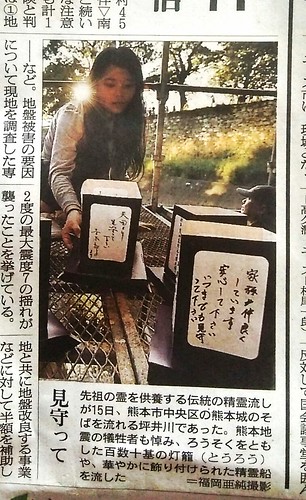
The Japanese represent their ancestors by floating lanterns, that watch over and protect the living. The message, "don't worry, we are getting along together really well. Please watch over and protect us forever," is written on the lantern on the right. The " please watch over us" on the young lady's lantern is prefaced by "Kind old Sun*" since the Japanese traditionally believe that ancestors merge with the Sun(goddess), who is always watching and protecting. The visual aspect of the Japanese Other, watching and protecting as it must an 'external' appearance, convinces most that the Japanese are more collectivist and conformist, but the whispering that Westerners do, though it seems solitary, is no less social. We will realise this eventually.

That it seems as if Tiger Woods' head is appearing from a lantern bottom right is a mere coincidence.

*The literal translation is more like "Mister/Madam Sun". The Japanese salutation "sama" is genderless. "Kind old Sun" is a term of respect and endearment for the sun, like the Japanese original, from Wilfred Owen's poem, Futility.

Central image by Azumi Fukuoka. (2016/7/16). Asahi Newspaper. p1.

お取り下げご希望の場合、下記のコメント欄か、nihonbunka.comのメールリンクまで御一筆いただければありがたいです。

Sabtu, 16 Juli 2016

Secretary and the Beast by Yuu Takahashi

Secretary and the Beast by Yuu Takahashi

This post is of an adult, sexual nature.

At the end of the manga, the "beast" of a company boss has very graphically represented relations every which way with his secretary (aslo) male, in the company shower rooms.

The strange thing is that this is part of a genre of comics (bishounen ai or perhasp in this case close to Yaoi) read predominantly by young Japanese girls, perhaps in their late teens. The reason for this, I believe is, that traditionally in Japan it is only female sexuality and desire which is considered taboo, so as long as their are only blokes, then, while smutty and embarassing, there is nothing really bad about it.

Each society hides the harsh reality of the sexual desire that is at its foundation.

Japanese society is based upon rearing children so wombs, whiles and reality of women's desire is hidden. Women appear only as pretty young men.

Western society is based upon horizontal adult to adult "love." (Childrearing is a bit of a "curse.") The above sort of pornography is a mirrored in that which uses lesbians to titillate Western men. In extremis, the male organ and male desire is hidden or completely absent. Men only appear as vorascious lesbians.

Each to each, the ultimate horror, is unhorrible. At the end of the day, this does not bode well for Japanese Western international relations.

おとりさげごきぼうのばあいはnihonbunka.comのめーるりんくまで

Selasa, 12 Juli 2016

When will China make its move?


I'm now reading Paul Kennedy's The Rise and Fall of the Great Powers, so I thought I'd ask a disturbing, alarmist, but important question. If China makes a bid to overturn the U.S.-led global order by military force, when will that bid come?

(This sounds like a job for...amateur made-up political science!)

First, two preliminary questions: 1) Will such a bid really come? And 2) What would it look like?

My answer to (1) is "maybe, maybe not." So far, there have been several modern examples of great powers not trying to overturn the existing order by force. The UK dominated the seas and built a huge maritime empire, but never tried to leverage its global power to dominate the other great powers of Europe; instead, it tried to maintain a balance of power that allowed it to be rich and secure. The U.S. made a few aggressive moves in the early 1900s, but only reluctantly joined World War 1, and then tried to go isolationist in the interwar years - it eventually became a hegemon, but only reluctantly. And the Soviet Union made a lot of threatening moves and came close to fighting the U.S., but backed off repeatedly. So there's plenty of precedent for new powers refusing to try to overthrow the old ones by force - in fact, the only real violent attempts in the industrial age came from Germany (twice) and Japan. But there still seems to be a decent chance that China will launch an attack against the U.S.-led coalition, given the "Thucydides Trap." So let's consider what happens if it does attack.

As for question (2), my guess is that it would be a naval attack in the South China Sea (against the U.S.) or in the East China Sea (against Japan, which would then call for help from the U.S.). Tensions have been rising slowly but inexorably in both places. A decisive naval victory against the U.S. would A) push American power out of Asia and establish Chinese hegemony in its backyard, and B) cause the U.S.' allies all over the globe to realize that America could no longer protect them, thus effectively ending America's position as a global hegemon. Such a conflict probably wouldn't go nuclear - the U.S. signaled its willingness to die to protect Germany, France, and the rest of Europe from the USSR in the Cold War, but it seems unlikely that it would do the same just to protect freedom of the seas in Asia. So if an attack comes, I expect it to be China trying to sink our Asian fleet. If it does that, it wins.

OK, now on to the main question: When will such an attack come, assuming it comes? Let's imagine we live in a worst-case version of a Paul Kennedy world, where great powers only care about hegemony, rather than the welfare of their people, etc. In that case, this becomes like the old Econ 101 question of when to cut a forest. Basically, if China is going to attack, it will do so whenever the opportunity cost of attacking - i.e., the benefit of waiting - drops below a certain threshold.

What are the benefits of waiting to attack? Basically, continued economic growth and technological progress. If we're in a Paul Kennedy type world, a larger economy means more military power, which means A) a higher chance of beating the U.S., and B) a higher chance of dominating Asia and the world after beating the U.S. Better technology means the same.

So if we're in a Kennedy world, we can think of GDP, maybe with some extra exponent on productivity, as the percent chance of getting "flow hegemony" in the objective function after an attack. But before the attack, flow hegemony is zero (because in this cynical world, power doesn't matter if you don't use it to rule the world). And there's some time discount rate too. So basically, when China's economic growth and productivity growth slow down below some threshold rate (representing the discount rate in their hegemony objective function), that's the time to attack.

Chinese GDP growth has already slowed substantially:


Current official figures are at around 6.6%, though the true figure may be closer to 5%. And many people think that only an unsustainable, unproductive debt-laden construction boom is keeping growth at that pace -- once it ends, many expect China to have to deal with the financial overhang from the boom, which could lead to a decade of slow growth. Productivity growth is much harder to measure, but what few data points we have point to a slowdown in recent years.

One big factor will definitely drag down Chinese growth in the years to come: population shrinkage. According to government estimates, the country's working-age population (15-60) has been declining since 2012, and has now shrunk by 26 million. The decline is projected to continue, accelerating sharply between 2020 and 2025:


Even an immediate baby boom wouldn't affect this number until 2030, so the repeal of the one-child policy will not change anything for a while - and given the low fertility of other Asian countries, and the lack of much interest in having more kids, it seems unlikely that the long-term effect of the repeal of the one-child policy will actually arrest China's population decline.

So after 2020, there will be a sharp decline in China's working-age population. If the "debt overhang" people (Chris Balding, Michael Pettis, etc.) are right, China will also have to deal with another sharp slowdown in growth sometime in the next few years. Meanwhile, productivity is slowing down as China reaches the technological frontier and is thus less able to acquire new tech through FDI joint ventures, forced tech transfers from multinationals, or industrial espionage.

All of this points to a Chinese attack sometime in the remaining years of this decade. IF, of course, they decide to attack at all, and if GDP enters the objective function in the way I just hypothesized.

In any case, after 2020, China's "window" for a successful overthrow of the U.S. might close. Rapid population aging and labor force decline, the slowdown of catch-up growth, and (possibly) the overhang from decades of debt buildup might do more than just reduce the benefit of continuing the "peaceful rise" strategy. They might actually cause severe domestic unrest in China, forcing the country to turn its energy toward domestic security matters. And even if that doesn't happen, China's inevitable economic slowdown may simply weaken the country's total military power, allowing the U.S. and its allies - perhaps including a fast-growing India - to retain hegemony into the indefinite future.

So I think that if China does decide to take the more violent, aggressive great power path, we can expect some action within the next few years.

Senin, 11 Juli 2016

Hanya as First Person Face

Hanya as First Person Face
There is apparently absolutely no connection whatsoever between the character of Hanya, a devil woman, that appears in Noh drama and Shinto mythical plays (pictured above), and the Japanese name for The Heart Sutra which distils the pith of the wisdom of Buddhism into a text of one page. In Buddhist terminology, Hannya refers to knowledge of enlightenment.

The story goes that a Buddhist priest who was adept at making Hanya masks was called "Hanya-monk" (般若坊) due to his predilection for the Heart Sutra, and in any event a purely random connection between the sutra and the mask was made. I will here argue otherwise.

The Heart Sutra (Hanya- Shin-Kyo or Hanya Heart Sutra in Japanese) proclaims that" colour is emptiness" and "emptiness is colour". I can appreciate that assertion. Nishida using the language of phenomenology, asserts the same thing: in the purity of experience, when one has bracketed off all that which can be denied, then this big orb of colour has absolutely no qualities, not even those of subject, nor object which, like our initial certainty of colour (that is "red" isn't it?) dissolve into a purity, about which one can say nothing.

At the same time, I do find it impossible to merge myself with this wall of impossible colours. Intellectually, I agree with Nishida, experientially however, something prevents my dissolution.

Nishida (1965) also claims that the self is is supported by a 'devil hidden in the depths of seeing'. What does he mean?

Going off at what might seem a tangent, Dr. Leroy McDermott (1979), a professor of psychology formerly of the University of Central Missouri, argues that the shape of paleolithic figurines, which tend to be of a plump, lozenge shape, and are found the world over, is not due to the fact that people back then were fat, nor due to some emphasis upon feminine fecundity, but due to the fact that they were of self-person body views.

The first thing that struck me about McDermott's brilliant insight is that I had not even realised that my first person view of my body is any different from the third person view such I am shown in photos or as is reflected in a mirror. It takes however, moment of self inspection to realise that, yes, my hands and feet do of course taper off to spidery extremities, and my chest shoulders and stomach are very large. Even though I am a man, my first person view of myself has full bosom.

My initial interest in Dr. McDermott's research was merely to note that his thesis largely applies to Japanese snow goggle dogu figurines from a similar palaeolithic period. I contacted him with this observation. He responded politely. I wondered whether the famous snow goggled faces of Japanese Venus figurines might also represent a first person view of someone squinting through almost shut eyes.

It was only much later that I became interested in the question as to *why* palaeolithic people made such representations. Here I must respectfully part company with the brilliant Dr. McDermott. He argues that their construction was motivated by a desire for self-representation coupled with the lack of mirrors or reflective technology. But as a McDermott-detractor mentioned to me privately, and as one of the commentators to his paper asserts, even if looking glasses were particularly dark in those days, surfaces of water did exist and, more to the point, sculptors were regularly and universally presented with images of their peers. Even the most primitive person should and would have been able to add two and two, or people and puddle, together. So, there must have been some other reason for the worldwide propensity to reproduce such, to our way of thinking, distorted body views.

This detraction, while tempting, misses a step. It succeeds for me in disconfirming Dr. McDermott's 'lack of mirror technology thesis'. Even palaeolithic sculptors, if motivated solely by the desire to self-represent, would also have been able to extrapolate from puddles and peers. But at the same time, bearing in mind the strong resemblance between palaeolithic figurines and the first person form, as clearly demonstrated by Dr. McDermott's papers, to reject this resemblance as original/causal -- replacing it with some supposed universal woman-shape-worshipping fertility rite -- would be to chuck the baby out with the bath water. The supposed lack of mirrors is bath water, in one way or another. The humongous baby is the amazing and persuasive realisation that the universality of the shape of palaeolithic Venus figurines is due to the fact that they really do represent first person body views. This is the insight that brings science and sensibility to that which was previously considered to be some sort of misguided, magical hocus-pocus.

We are still left with the question as to why did so many peoples all over the globe at a similar stage of human development, find themselves so interested in the form of the first person body view, that they should create sculptures representing first-person-body views over and over again, almost to the exclusion of all other sculptural self-representations? Why were they so obsessed?

I can suggest two reasons from developmental psychology, both of which seem to be overlooked.

The first is that developmental psychologists, from, for example, observation of infants playing the mobiles that are typically left to hang above cribs, reach the conclusion that the first, most primitive, initial, and original recognition and representation of self, occurring many months before we narrate or recognise ourselves in mirrors, is the first person view of self.

Lewis and Brooks-Gunn (1979) for example argue, persuasively to my ears, in the following way.

"Gregory is also about 3 months old. Lately he has begun to coo loudly during those moments between waking and calling his mother by crying. One morning, Gregory's mother walks quietly into his bedroom and finds him awake, on his back, with his right hand extended above him and to the right; his head is turned towards his hand and he is watching his fingers move with considerable interest.

The proprioceptive feedback from the two events and actions (looking and moving one's hands and fingers) are both located in the same nervous system. This example differs markedly from the first since the child can operate on both events, rather than just one event, being external to the organism. The infant, having control of both actions can turn to look at the object or have the object move into the field of vision. This duality of subject and object must represent the beginning of the self as distinct from other." (Lewis & Brooks-Gunn, 1979, p.3.)

Despite the persuasiveness of such developmental psychological theories of the self as originating in self-views, 'this great leap for mankind' is all but ignored in non-developmental psychological theories of the self, such as those of Smith, Mead, Freud, Bakhtin, Vygotsky and the numerous 'narrative self' psychologists. Where did the first person view self disappear to?

And this brings me to my second and more important reason why palaeolithic people the world over may have been interested in representing their first person view of self, which is because she was then, and is now, still here. That deserves capitalisation, and then some. SHE IS STILL HERE!

My sudden use of the feminine pronoun "she" to refer to "the first person view self," runs ahead of its explanation.

In the same aforementioned, fairly mainstream scholarship of the self -- Smith, Mead, Freud, Bakhtin, Vygotsky and others -- there is also mention of the need for an intra-psychic other: some one else in our mind (!). This very peculiar "other" is argued to be essential, but at the same time it is given short shrift. Very little explanation is given of what, where, and how, this most proximal of others might be.

Re-enter the first person self-view, which is closer than the veins in our neck.

Upon inspection of the features of my my own face from my first person view point, it seems to me that it has considerable similarity with the features of the classic, devil woman Hanya mask of Japanese dramatic art.

Note first that Hanya does not look anything like real Japanese ladies, who tend to have small noses, flat cheekbones, and small round chins.

My first person view of my face, and the first person view that Japanese ladies and men have of their faces, however has quite a lot in common the features represented by the Hanya mask. While, unlike Dr. McDermott, I find myself unable to take a first person perspective photo of my face from my the perspective of my own eyes, I hope readers will be persuaded that (numbers correspond to those on the insert bottom left)
1) The nose in both is extremely large at least for a Japanese woman (the Western version of Hanya would be even more grotesque)
2) Our brow impinges upon our view such as is suggested by Hanya's overhung brow
3) The cheeks in my first person view and Hanya's face, protrude absurdly
4) Nothing is visible of my lower face except, with effort my lower lip which may explain the protrusion of Hanya's chin. In other words, my first person face view is all squeezed up around my eyes, with a glimpse of bottom lip like this representation.
5) Unless I or any woman, were to have a long fringe ony that would be visible. My forehead, upper head and hair (if I had any) is invisible. The small forehead of the hanya mask is more appropriate than the my mock-up in the insert.
6) Our mouths are invisible. I am not sure why they are large. The related Shinja ("true snake") mask is portrayed with a tongue which I can see if I stick it out.
7) Our eyes about which our first-person view of our face form but glimpse of a frame, contain the whole world of "colour" or light. As such they may be said to be "metallic" like the tain of mirror, or as in the case of the larger mask, on fire.

This hypothesis does not explain the fangs or horns but if my first person view is really the place where the "demon" (Nishida) is lurking, then their addition may help to that Hanya's countenance is so terrible, that I am generally unable to become aware of her.

And by this means, it is with Hanya's help, I think, that I believe that I am my third person self-representations, and that my representations of others, these little people that walk across my visual field are not empty, but real. I propose therefore that when one sees the truth of the Heart Sutra, one meets Hanya, and vice versa.

The naming of the Heart Sutra is initially quite fortuitous, but turns out to be, in retrospect, no coincidence. That monk knew what he was going on about.

Hanya and my heart are two sides of the same emptiness. Or rather, at the edge of that emptiness, Hanya stands guard.

In other cultural contexts Hanya may be referred to as "the whore." I prefer Hanya since it implies respect.

The main image top centre is a picture of an excellent handcrafted Hanya Craft Mask available for purchase from The Japan Store.

Bibliography
Lewis, M., & Brooks-Gunn, J. (1979). Social Cognition and the Acquisition of Self. Boston, MA: Springer US. Retrieved from link.springer.com/10.1007/978-1-4684-3566-5
McDermott, L. R. (1996). Self-representation in Upper Paleolithic female figurines. Current Anthropology, 37(2), 227–275. websites.rcc.edu/herrera/files/2011/04/PREHISTORIC-Self-R...

Minggu, 03 Juli 2016

Economist gekokujo


"Gekokujo" (下克上) is a Japanese word meaning "low overcoming high". It refers to when the people lower down in a hierarchy rise up and overthrow those above them. Rebellions, mutinies, and populist uprisings are all gekokujo. The word was often used in conjunction with coup attempts by lower-level military officers in the years before WW2. Japan, it turns out, is a lot less hierarchical - or at least, obedient - of a place than people think.

One culture I know that is very hierarchical is the econ profession. It has a centralized job market. Academic hiring is heavily weighted toward candidates from top departments. And it's sort of an open secret that old, famous professors can essentially publish whatever they want in top journals, which gives these old famous people enormous clout.

As in most academic fields, publishing in one of a few top journals is key to career advancement. But in recent years, more and more top-journal publishing has been dominated by one single journal: the American Economic Review:


In econ, the standards for what constitutes good research and what constitutes bad research are less clear than in the natural sciences (though far clearer than in the humanities). That adds to the suspicion among the lower ranks of the profession - grad students, younger profs, profs and students from lower-ranked departments, etc. - that successful economists got where they are by sucking up to old famous people. "It's a sleazy profession," a young and talented assistant prof once confided to me, over a beer. "I'd advise you to get out of it." (I ended up taking his advice.)

Anyway, it makes sense that econ would be ripe for some gekokujo. And it also makes sense that the rebellion would erupt from the Econ Job Market Rumors forum.

Almost everyone except EJMR regulars despises EJMR. The site has a fair amount of the sexism and other aggression so common on anonymous internet forums (it's been called "4chan for economists", which in my opinion is a bit of an insult to 4chan's creativity and sense of humor), but that can't account for the near-universal visceral hatred that most economists feel toward the place. Most people who tell me how much they hate EJMR talk about what one PhD student called its "insecurities, careerism, and insane status and hierarchy obsession." Essentially, EJMR vacillates between slavish worship and bitter disdain for the top people and organizations in the profession. These people deeply believe that they need to suck up to the big dogs to get the brass ring, and even though they go along with it - econ jobs, with their high salary, lucrative consulting gigs, and intellectual prestige, tend to be a pretty nice brass ring - they don't like having to do it. So if econ is going to have an equivalent of the gung-ho young Japanese officers who launched repeated coup attempts in the 1930s, it stands to reason they'd come from EJMR.

It also stands to reason that the target of the uprising would be the AER, one of the profession's most important gatekeepers. So I was hardly surprised to see a publication scandal involving EJMR and the AER. Essentially, EJMR people started accusing an AER editor of 1) favoritism and bias, and 2) overlooked citations. These are typical academic sore points, and of course this dispute obey's Sayre's Law. But I also see it as a proxy for a wider dissatisfaction with the centralized, hierarchical, and somewhat arbitrary nature of a lucrative and prestigious profession.

There's a possible political angle here too, though I don't want to play it up too much. The AER editor being accused of favoritism, and the young authors accused of being the beneficiaries, are all women. The paper is a reduced-form empirical paper of the type that is taking over more and more of econ publishing. And the paper's policy conclusions are that unemployment is bad and that poverty could be transmitted from generation to generation by mechanisms other than genetic ability.

Like Japanese army officers in the 1930s, EJMR people tend to be right-leaning types in addition to careerists. The few times I could bring myself to read EJMR, I always saw a combination of A) disdain for political liberalism, B) disdain toward "reg monkeys" (a pejorative term for economists who do reduced form empirics), and C) bitterness toward women in general and toward allegations of sexism in the econ profession. It seems possible to me that many smart young conservative men were drawn to study economics, attracted by its traditional support for free markets and its traditional skew toward the male demographic - but that when they arrived, they found a profession increasingly tilted toward the left, increasingly populated by women, and increasingly accepting of the use of reduced-form regressions that can easily be interpreted as making a case for government intervention. George Borjas, who came out in support of the rebels, is certainly known to lean pretty strongly to the political right. This episode of EJMR gekokujo might be part of a more general backlash against these trends by angry young conservative men who feel that the econ elite, by favoring women and/or liberal politics, is depriving them of their just desserts.

Or not. That was just a thought I had, and it seemed kind of interesting, so I wrote it down. Don't take these musings of mine as any kind of evidence that left-right politics or gender politics is actually involved. But whatever the larger political context (or lack thereof), it clearly seems to me like a case of econ's "bottom feeders" (as one top economist called EJMR's denizens) rising up against the masters of their lucrative, prestigious little universe. I wouldn't be surprised to see more such "incidents", as Japanese history politely refers to them.


Update

Regarding the sexism thing, someone sent me the following screenshot from an EJMR thread discussing this post:


I don't think this kind of thinking totally dominates EJMR, and I don't know how much it's motivating this particular uproar. But I do think there's a fair amount of it there, which is why I mentioned it. It's also why I didn't try to comment on the merits of the case...I don't like pseudo-corruption and favoritism, and it certainly seems like a pervasive problem in econ, but I'm also pretty wary of joining what might turn out to be a sexist witch hunt...

Also, check out some interesting comments from someone claiming to be a recent job candidate. He or she raises a great point, which is that in the age of empirical economics, data access is really important, and that many young and/or struggling economists are mad about top institutions getting preferential early access to data. Early access allows simple, easy analyses - which many non-top economists are perfectly capable of doing - to get published in top journals, because the data is novel. That, argues the commenter, is causing a lot of anger in the lower ranks of the profession, some of which might be getting displaced as anger against perceived nepotism (which is actually a different issue). That rings true to me, and I will definitely follow up on the data access issue...

Kamis, 30 Juni 2016

Some stuff economists tend to leave out


Chris Arnade got a PhD in theoretical physics, became a bond trader, and then became a photographer who documents drug addiction. He frequently writes on Twitter and elsewhere about social problems. Recently, he wrote a tweetstorm (series of threaded tweets) about his interpretation of Trumpism. I think Chris leaves out a lot of the reasons for Trump support - xenophobia, fear of racial conflict, misplaced nostalgia. I also doubt that the drug addicts that Chris spends his life documenting tend to be Trump supporters. But I think Chris makes some really good points when he writes:
Many people have no chance & they know it & reminded of it daily. On TV, on the web. They see what they are missing. And who is winning...The response to this is, we all have Iphones now. Everyone has all this stuff they never had before...Response 1: Maybe when we measure someone by how much stuff they have, those at bottom will never be happy. Because others have far more...Response 2: Maybe trying to get all that stuff is painful. Maybe the monthly payments needed to keep up isn't fun...Response 3: Maybe, crazy as it might sound, having an Iphone, and other things, just isn’t the key to happiness after all...Response 4: Maybe people need meaning beyond economic. Maybe they need to feel included, to have strong bonds to institutions & groups...Maybe the predatory, hyper rational society we have built has stripped institutions of their meaning...Maybe it has all left people, who used to get meaning from them, with very little, other than anger.
I think there's a lot to this. Putting it in econ language: 1) Social preferences are probably very important in reality. 2) Utility functions often contain inputs like inclusion, human connection, and a sense of meaning, for which no markets exist.

Econ rarely deals with these things. When is the last time you heard an economist talk about how minimum wage policy affects people's desire to feel like society cares about them? When is the last time you heard an economist talk about the need to include strong interpersonal relationships in GDP? When is the last time you saw a welfare analysis of tax policy that took inequality preferences into account?

The formal machinery of economics is totally equipped to deal with these things. You can put love in a utility function right alongside consumption, just call utility u(c,L). You can incorporate community stability into an urban model or a model of migration. You can put social trust as an input into a production function. You can give people a utility boost from having a job, and call it the "dignity of work". You can model the alienation of arm's-length market transactions as a transaction cost, and remove this cost for long-term informal contracts. Almost anything, except for some fairly exotic behavioral biases, can be dealt with using the standard tools of utility maximization and cost minimization that every econ student learns in school.

So why do economics classes, papers, and policy recommendations so rarely include any of these things?

Part of it might just be an accident - or maybe two accidents. Non-market goods like love, trust, connectedness, patriotism, social obligation, fairness, dignity, etc. is usually really easy to put into models - too easy, in fact. Assuming the existence of something really important but really simple is not intellectually or mathematically impressive. It might be the most important thing in the world, but it won't help you look smart for a hiring or tenure committee.

And these non-market goods are also very hard to measure empirically. How do you measure them? What economic data is a proxy for social connectedness, inclusion, or dignity? They'll usually wind up as unobservable parameters, meaning that the data used to evaluate the models will not be super-informative. (Sociologists probably know more about how to do this, but they don't even post their working papers or blog very much, so who knows what they're up to?)

Social preferences, on the other hand, can be devilishly hard to model. Some people do do it, in highly specific, stylized settings (see here and here), and some people do study social preferences empirically (see here and here; thanks to the excellent Ivan Werning for these examples). But they're pretty tough to put into policy evaluation models, and probably too tough for most undergrad classes.

So there are some technical and institutional barriers to putting these things in economic models and in econ classes and textbooks. But I suspect there might be cultural barriers as well. Econ began in an age when severe material deprivation was the main problem afflicting humankind (as it still is in many countries). Economists of the 19th and early 20th centuries correctly grasped that rising material prosperity would override almost any other concern for the destitute masses of the world, if that prosperity became available.

But as soon as countries get past the stage of abject deprivation, non-market goods and social preferences probably become a lot more important. By sweeping these things under the rug, economists are probably A) nudging policymakers to ignore crucially important stuff, B) developing a reputation for being out of touch, and C) opening the discipline to allegations of irrelevance from people who want to see econ replaced with other ways of analyzing the world.

Interestingly, I think a lot of the progress in the public discussion of these things has come from conservative-leaning economists, whose free-market bona fides probably give them the political cover to openly discuss things non-market goods like social trust. That's a positive development, but economists on the other side of the ideological spectrum should probably get in on that game. To their credit, left-leaning economists often do discuss inequality aversion, but this is rarely translated into formal models or official policy advice.

Anyway, I think Arnade has a point, and economists should listen - even though I'm not sure what exactly needs to be done.

Senin, 27 Juni 2016

Sooth Pilgrimage


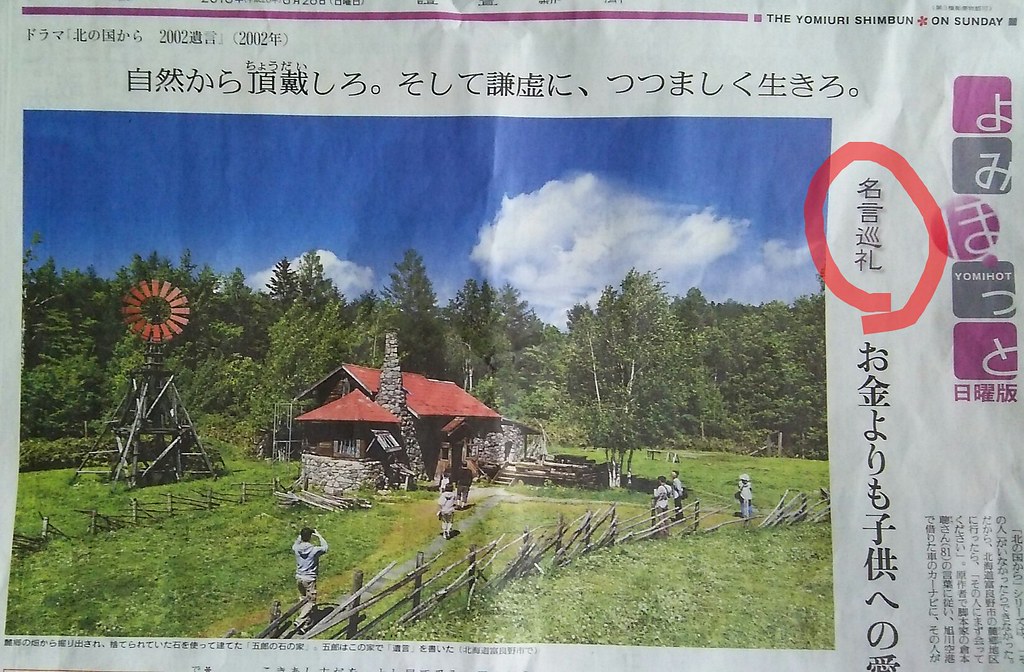
If the comforter watches but does not listen, then there us no objective "third person perspective" (Mori) so language is contextual, situated, out there, and one must travel to where language was uttered to understand it. The farmer who returned from Tokyo to his home town in Hokkaido, upon whom the famous Japanese television series, "From the North Country," (北の国から)is based, said "Receive from nature. Be humble". Japanese tourists, or sooth pilgrims, travel to where sooths were uttered, there receiving it, for that is where the sooth is. The Japanese world is not "inside out", as I have claimed, but has rather no inside nor out. The world is the sensations (Mach). The self is the world and the world is self (Nishida). http://flic.kr/p/JrF7Dt

Senin, 20 Juni 2016

Asian Holisim is Happier: And how happy are you?

Asian Holisim is Happier: And how happy are you?
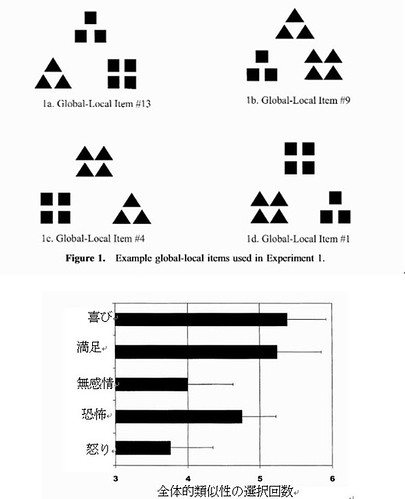
In each of 1a, 1b, 1c and 1d in the above image, which of the two (left or right) figures resembles most the figure above them? This is a test of happiness!

Fredrickson & Branigan(2005)had subjects watch videos of penguins, nature, abstract sticks, a climbers fall, and bullying to promote: pleasure, contentment, the absence of emotion, fear and anger respectively.

Subjects were then shown the four diagrams 1a, 1b, 1c and 1d above which show a single figure above two others and asked which of the two, left or right most resembles the one above. The right hand figure is made up of the same fundamental building block ■ or ▲, whereas the left hand figure is made of the opposite building block but is arranged holistically in the same way as the figure above.

It was found that the more positive emotions resulted in more holistic (left hand) resemblances as per the graph below (with the emotions in the same order as given above). This suggests that those that see the world holistically are happier and those that see it parts, may be in a more negative affective state.

Due to the higher suicide rate in Japan, and naff surveys purporting to guage the well-being of a nation based on one culturally laden question, one is often led to believe that the Japanese are bunch of unhappy people. I think this is very misleading. The higher suicide rate in Japan is due in large part to less negative appraisals of choosing the time and place of ones own death. It is further noted that East Asians in particular and Japanese in general tend to see the world in a more holistic way (Masuda & Nisbett, 2001; McKone et al., 2010). I think that this may be in part because the Japanese are in fact happier.

Fredrickson & Branigan(2005)は、ペンギン・自然・抽象的な模様・登山家の事故とイジメのビデオを使って、喜び・満足・無感情・恐怖と怒りの感情を被験者に持たせ、どれだけ全体的⇔局所的な注意を行っているかを調べた。下記のそれぞれの1a, 1b, 1c, 1dにおいて、上にある形状は下の右か左のどちらに似ているかという質問に対して
全体的局所的
1 a左右
1 b左右
1 c左右
1 d左右
それぞれの4つの設問の下にある2つの形状の右側は、上の物と同じ■か▲かの構成部員からできているから局所に似ているが、左側の形状は構成部員が違っているが全体的には上と同じ三角か四画の配置になっているので全体的に似ている。

その結果

つまり、肯定的感情があるときは全体的な類似性(つまり左側)を選択することが多いです。

Bibliograp;hy
Fredrickson, B. L., & Branigan, C. (2005). Positive emotions broaden the scope of attention and thought‐action repertoires. Cognition and Emotion, 19(3), 313–332. http://doi.org/10.1080/02699930441000238
Masuda, T., & Nisbett, R. E. (2001). Attending holistically versus analytically: comparing the context sensitivity of Japanese and Americans. Journal of Personality and Social Psychology, 81(5), 922. Retrieved from http://psycnet.apa.org/journals/psp/81/5/922/
McKone, E., Aimola Davies, A., Fernando, D., Aalders, R., Leung, H., Wickramariyaratne, T., & Platow, M. J. (2010). Asia has the global advantage: Race and visual attention. Vision Research, 50(16), 1540–1549. http://doi.org/10.1016/j.visres.2010.05.010

Minggu, 19 Juni 2016

Does the Ladder of Life Exist?


The United Nations publishes a world happiness report based upon data from a Gallup survey, ranking countries according to their level of happiness. The Danes game out top. The Japanese were 53rd, one third of the way down the 150 or so countries, which is irregular bearing in mind their high GDP per capital with which "happiness" is shown to correlate.

It transpires however that the Gallup survey does not measure anything I recognise as happiness at all. The actual, and single, question that determines national happiness is as follows.

“Please imagine a ladder, with steps numbered from 0 at the bottom to 10 at the top. The top of the ladder represents the best possible life for you and the bottom of the ladder represents the worst possible life for you. On which step of the ladder would you say you personally feel you stand at this time?” (From the statistical appendix of the report)

(In my Japanese 「0」という一番下の段から、「10」という一番上の段のある梯子を想像してください。一番上の段は、あなたにとって自分の一番よい人生で、一番下の段は自分の一番悪い人生を表しています。今現在、梯子の何番目の段に立っていると感じるといえるでしょうか?)

While the notion of a variety of lives, and the possibility of my being able to live any other life but the one I am living is a little fraught, it is at least imaginable. I might never have left the UK. I might have married someone else, etc.

As the famous song by Chiyoko Shimakura goes, people lead and we all could have lead a variety of lives. Life is varied. And by implication in the song, while life has its ups and downs, it is all good.

The notion on the contrary that these lives could be ranked and arranged in a vertical hierarchy with the "best life" at the top and "the worst life" at the bottom is far more difficult to grasp. It seems to me that certain negatives accompany positives (such as the envy of others with success), and positives with negatives (such as emotion, and humility with suffering).

That this imaginary vertical ranking of lives transpires to correlate - in most instances - with wealth may be because it is in fact encouraging respondents to economically appraise their own lives, ranking it in quantitative terms -- "I've done okay" "I've done well" -- in none other than in dollars and yen. In any event the suggestion that this one question plumbs the depths of national well-being or that it should be used to guide political policy seems to be to be quite absurd, especially in view of the way in which Westerners answer such questions in so unrealistically positive ways. But alas, this and similar measures are being used to inform political policy and the need for public spending. We are not high enough on the ladder. So, do we need to spend more?

The ladder of life does not exist so we should give up trying to climb it.

The above image contains a detail from a still from Chiyoko Shimakura's video for "Jinsei Iroiro" (Lit "Life Variety" or "Life has its Ups and Downs").

Selasa, 14 Juni 2016

The pool player analogy is silly


In a lot of debates about economic methodology, someone will bring up Milton Friedman's "pool player" analogy. The pool player analogy was part of Milton Friedman's rationale for modeling the behavior of economic agents (consumers, firms, etc.) as the optimization of some objective function. Unfortunately, the analogy is A) not that good in the first place, and B) frequently misapplied to make excuses for models that don't match data.

Here's the original analogy:
Consider the problem of predicting the shots made by an expert billiard player. It seems not at all unreasonable that excellent predictions would be yielded by the hypothesis that the billiard player made his shots as if he knew the complicated mathematical formulas that would give the optimum directions of travel, could estimate accurately by eye the angles, etc., describing the location of the balls, could make lightning calculations from the formulas, and could then make the balls travel in the direction indicated by the formulas. Our confidence in this hypothesis is not based on the belief that billiard players, even expert ones, can or do go through the process described; it derives rather from the belief that, unless in some way or other they were capable of reaching essentially the same result, they would not in fact be expert billiard players.  
It is only a short step from these examples to the economic hypothesis that under a wide range of circumstances individual firm behave as if they were seeking rationally to maximize their expected returns (generally if misleadingly called “profits”) 16 and had full knowledge of the data needed to succeed in this attempt; as if, that is, they knew the relevant cost and demand functions, calculated marginal cost and marginal revenue from all actions open to them, and pushed each line of action to the point at which the relevant marginal cost and marginal revenue were equal. Now, of course, businessmen do not actually and literally solve the system of simultaneous equations in terms of which the mathematical economist finds it convenient to express this hypothesis, any more than leaves or billiard players explicitly go through complicated mathematical calculations or falling bodies decide to create a vacuum. The billiard player, if asked how he decides where to hit the ball, may say that he “just figures it out” but then also rubs a rabbit’s foot just to make sure; and the businessman may well say that he prices at average cost, with of course some minor deviations when the market makes it necessary. The one statement is about as helpful as the other, and neither is a relevant test of the associated hypothesis.
Actually, I've always thought that this is kind of a bad analogy, even if it's used the way Friedman intended. Using physics equations to explain pool is either too much work, or not enough.

Suppose the pool player is so perfect that he makes all his shots. In that case, using physics equations to predict what he does is a pointless waste of time and effort. All you need is a map of the pockets. Now you know where the balls go. No equations required! Actually, even that's too much...since in most pool games it doesn't matter which balls go in which pockets, you don't even need a map, you just need to know one fact: he gets them all in. It's a trivial optimization problem.

But if really good pool players made 100% of their shots, there wouldn't be pool tournaments. It would be no fun, because whoever went first would always win. But in fact, there are pool tournaments. So expert pool players do, in fact, miss. They don't quite optimize. So if you want to predict which pool player wins a tournament, or why they miss a shot, you need more than just a simple balls-in-pockets optimization model. And you probably need more than physics - you could use psychology to predict strategic mistakes, biology to predict how arms and hands slightly wobble, and complex physics to predict how small random non-homogeneities in the table and air will cause random deviations from an intended path. 

The point is, if you use an optimization model to represent the behavior of someone who doesn't actually optimize, you're going to get incorrect results.

Of course, the pool player analogy wasn't Friedman's whole argument - the next paragraph is critical:
Confidence in the maximization-of-returns hypothesis is justified by evidence of a very different character. This evidence is in part similar to that adduced on behalf of the billiard-player hypothesis - unless the behavior of businessmen in some way or other approximated behavior consistent with the maximization of returns, it seems unlikely that they would remain in business for long. Let the apparent immediate determinant of business behavior be anything at all - habitual reaction, random chance, or whatnot. Whenever this determinant happens to lead to behavior consistent with rational and informed maximization of returns, the business will prosper and acquire resources with which to expand; whenever it does not, the business will tend to lose resources and can be kept in existence only by the addition of resources from outside. The process of “natural selection” thus helps to validate the hypothesis - or, rather, given natural selection, acceptance of the hypothesis can be based largely on the judgment that it summarizes appropriately the conditions for survival. 
That turns out to just be wrong. There are plenty of theoretical ways that non-profit-maximizing agents can stay around forever. Also, there are always new people and new companies being born and entering the system - there's a sucker born every minute, so as long as they drop out at some finite rate, there's some homeostatic equilibrium with a nonzero amount of suckers present. And finally, this argument obviously doesn't work for consumers, who don't die if they make bad decisions.

So Friedman's analogy was not a great one even on its own terms. Sometimes consumers, firms, and other agents don't perfectly optimize. Sometimes that's important. So you might want to model the ways in which they don't perfectly optimize.

But actually, everything in this post up to now has been a relatively minor point. There's a much bigger reason why the pool player analogy is bad, especially when it comes to macro - it gets chronically misused.

In pool, we know the game, so we know what's being optimized - it's "balls in pockets". But in the economy, we don't know the objective function - even if people optimize, we don't automatically know what they optimize. Studying the economy is more like studying a pool player when you have no idea how pool works.

In economic modeling, people often just assume an objective function for one agent or another, throw that into a larger model, and then look only at some subset of the model's overall implications. But that's throwing away data. For example, many models have consumer preferences that lead to a consumption Euler equation, but the model-makers don't bother to test if the Euler equation correctly describes the real relationship between interest rates and consumption. They don't even care.

If you point this out, they'll often bring up the pool player analogy. "Who cares if the Euler equation matches the data?", they'll say. "All we care about is whether the overall model matches those features of the data that we designed it to match."

This is obviously throwing away a ton of data. And in doing so, it dramatically lowers the empirical bar that a model has to clear. You're essentially tossing a ton of broken, wrong structural assumptions into a model and then calibrating (or estimating) the parameters to match a fairly small set of things, then declaring victory. But because you've got the structure wrong, the model will fail and fail and fail as soon as you take it out of sample, or as soon as you apply it to any data other than the few things it was calibrated to match.

Use broken pieces, and you get a broken machine.

This kind of model-making isn't really like assuming an expert player makes all his shots. It's more like watching an amateur pool player until you he makes three shots in a row, and then concluding he's an expert.

Dani Rodrik, when he talks about these issues, says that unrealistic assumptions are only bad if they're "critical" assumptions - that is, if changing them would change the model substantially. It's OK to have non-critical assumptions that are unrealistic, just like a car will still run fine even if the cup-holder is cracked. That sounds good. In principle I agree. But in practice, how the heck do you know in advance which assumptions are critical? You'd have to go check them all, by introducing alternatives for each and every one (actually every combination of assumptions, since model features tend to interact). No one is actually going to do that. It's a non-starter. 

The real solution, as I see it, is not to put any confidence in models with broken pieces. The dream of having a structural model of the macroeconomy - one that we can trust to be invariant to policy regime changes, one that we can confidently apply to new situations - is a good dream, it's just a long way off. We don't understand most of the structure yet. If you ask me, I think macroeconomists should probably focus their efforts on getting solid, reliable models of each piece of that structure - figure out how consumer behavior really works, figure out how investment costs really work, etc. That's what "macro-focused micro" is really about, I think.

So let's put Friedman's pool player analogy to rest.


Updates

Chris House (who was the first person to ever introduce me to the pool player analogy) has a response to this post. But as far as I can tell, he merely restates Friedman's (flawed) logic without addressing the main points of my post. 

Sabtu, 11 Juni 2016

Econ theory as signaling?


I don't expend much effort dissing macroeconomics these days, but every once in a while it's good to give people a reminder. I wrote a Bloomberg post about how academic macro (or more accurately, mainstream macro theory) has not really helped out the finance industry, the Fed, or coffee house discussions. The reason, as Justin Wolfers recently pointed out, is basically that DSGE models don't work. Brad DeLong then wrote a post riffing on mine, which is excellent and which you should read. A super-fun Twitter discussion then followed, part of which Brad storified for posterity.

But that leaves the question: Assuming Wolfers and DeLong and I aren't just blowing smoke out of our rear ends, and DSGE models really don't work, why do so many macroeconomists spend so much time on them? One obvious hypothesis is that a huge percent of their human capital is already invested in knowing how to do this technique, so they just keep doing what they know how to do, and teaching it to their grad students.

Another hypothesis could be that it's just an equilibrium of a repeated coordination game. Universities pay macroeconomists to do research, but they have absolutely no idea what good macroeconomic research is, so in practice they pay macroeconomists to do whatever other macroeconomists decide is good. Maybe since macro data is very uninformative, no one actually knows what good research looks like, so they all settle on some random thing - DSGE models. This is a kind of Kuhnian explanation.

Another hypothesis is politics - a small conservative old guard thinks that since DSGE is at some level based on RBC, forcing everyone to do DSGE will nudge macro toward anti-interventionist stances on fiscal and monetary policy. And they use their positions of influence at departments, journals, and professional organizations to enforce conformity among the younger, less politicized economists. I don't really buy this hypothesis, but someone usually brings it up.

Yet another hypothesis is that it's just fun for some people to do, or at least to watch other people do, this kind of theory. Paul Romer recently complained that "in the new equilibrium...empirical work is science; theory is entertainment." I'm sure there are people out there for whom this really is the case - I once saw V.V. Chari get very excited that he couldn't use a fixed-point theorem to prove the existence of a solution in one of his models, and had to resort to more exotic methods. Heh. 

But here's another hypothesis: What if it's signaling?

I've been very skeptical of the fad in which everyone invokes signaling to explain social phenomena. I'm also pretty critical of the signaling model of college - yeah, it's probably part of what's going on, but the signal is just too expensive (4+ years of the prime working years of millions of our most talented young people, wasted on signaling?). So I bet it's a smallish piece of the college puzzle.

BUT, when it comes to DSGE, I kind of suspect that signaling could be a bigger piece of what's going on.

That suspicion was probably planted in 2005, before I even went to grad school, by a Japanese economist I knew who had done his PhD at Stanford. He gave me his advice on how to have an econ career: "First, do some hard math thing, like functional analysis. Then everyone will know you're smart, and you can do easy stuff." That's paraphrased only a little (I can't recall his exact wording).

I then watched a number of my grad school classmates go into macroeconomics. Their job market papers all were mainly theory papers, though - in keeping with typical macro practice - they had an empirical section that was usually closely related to the theory. The models all struck me as hopelessly unrealistic and silly, of course, and in private my classmates - the ones I talked to -  agreed that this was the case, and said lots of mean things about DSGE modeling in general, basically saying "This is the game we have to play." Then all of those classmates went on to do much less silly-seeming stuff, usually more focused on empirics, usually for government agencies. Essentially, they followed the advice of that Japanese economist.

Finally, I noticed an interesting data fact. Theory papers are getting much less common in top econ journals, but are still prominent among job market papers. The pattern again looks the same - prove yourself with theory, then do more empirical stuff later on. Of course, this data is for all econ, not just macro, and some percentage is going to just be people in the micro theory field itself. Plus, the thing for job market papers is just one year. So it's far from a slam-dunk case, but it's another piece of evidence that seems to fit the pattern.

But OK, suppose signaling is going on. What's being signaled, why is it valuable, and why is it hard to observe directly? The obvious possibility is that it's signaling intelligence - that the ability to make DSGE models is just an upper-tail IQ test. That's valuable because A) in the long run, people with very high intelligence are going to do good research, and B) intelligence gets much harder to observe in the upper tail. If DSGE is an IQ test, though, the invention of tools like Dynare that make it easier to make DSGE models might push the profession toward a pooling equilibrium, lowering the prestige and/or the salary of macroeconomists.

But it might also be what Bryan Caplan calls "conformity signaling". If macroeconomics research is a coordination game (see above), and if the prevailing research paradigm is not really better than alternatives, then you probably want macroeconomists who are willing to "play the game", as it were. So DSGE might be an expensive way of proving that you're willing to spend a lot of time and effort doing silly stuff that the profession tells you to do.

So there it is: The Signaling Model of Macro Theory Research.


Updates

Of course, all this is predicated on the notion that DSGE models haven't really increased our understanding of the economy. Chris Sims, one of the smartest folks in the business, and a very empirically minded macroeconomist, is a defender of DSGE. And here's another DSGE defense. So again, my premise here could always just be wrong.

Also, there are a lot of DSGE papers I personally like, but they tend to be ones that ingeniously poke holes in other DSGE models. See this discussion in the comments for some of those. Also, a few other examples are here, here, and here.

If you want to know what I think is the actual problem with DSGE models, see my next post