Minggu, 28 Februari 2016

62 Translations of Okonomi Yaki

62 Translations of Okonomi Yaki
Fritters as you like them. Fritters to taste. Free fritters. Fritters freed. Japanese pan fried pizza. Savory pancakes. DIY fry-up. Griddled Goo. Individualistic johnnycakes. Selfish savories. Preference, predilection, prepossession, propensity, personalised or pet pancakes or paste. Pet preparation. Wished or whimsy waffles. What you will waffles. (Free)Will waffles. Flavour Flapjacks. Groove griddle cakes. Number one gunge, My cup of tea cakes. Croquette my way. Darling, dearest, desired, or druthers doughboys or dumplings. Liberty cakes. The cook is on holiday cakes. Be my batter cakes. Beloved batter cakes, Coagulated stir fry. Callous cutlets. Choice cabbage cakes. Liking or Love lump cakes. Main mush. Choice Concoction. My mix. Pan fried partiality. Pan-fried perfection. Caprice cakes. Hobby hotplate. Free-style fries. Fried fantasy. Freedom fries. My fry. Favourite fries. Hashed heaven. Hashed happiness.

My students always 'translate' the name for Japanese foods such as that pictured above (お好み焼き) using their phonetization, "okonomi yaki," which might just as well be kowwash firdight for all the meaning it would impart to the average anglophone. This is I think because people hate meaninglessness (Heine, Proulx, & Vohs, 2006) so if at least one word in Japanese is included in any sentence the sender knows that at least that one word will be meaningful in a Japanese context, and that their conversation partner will have some idea of what they are talking about. The reasons for this is anatta or no self. The self is just a representation (story or image): something with a meaning. The lack of meaning is self-annihilation, and English conversation practice almost deadly. I need to be nicer to my students, investigate Japanese hospice praxis, while insisting that students use non-phonetic translations.

Heine, S. J., Proulx, T., & Vohs, K. D. (2006). The meaning maintenance model: On the coherence of social motivations. Personality and Social Psychology Review, 10(2), 88-110.
www.google.co.jp/url?sa=t&rct=j&q=&esrc=s&...

Addendum Good Paper on Japanese hospice praxis emphasises the use of image-based measure (PAC analysis) rather than scales. Recommends, in addition to paliative care and listen: smiles and improved personal hygene and health on the part of the carer.
對馬明美, Tsushima, A., 三上佳澄, Mikami, K., 西沢義子, & Nishizawa, Y. (2010). 死を意識している患者との対話場面における看護者の態度構造に関する研究. 日本看護研究学会雑誌, 33(5), 33-44. http://www.jsnr.jp/test/search/docs/103305003.pdf

内藤哲雄1997/2002PAC 分析実施法入門[改訂版]「個」を科学する新技法への招待ナカニシヤ出版 amazon link a student gave a presentation about this. I thought it came from outside of Japan.

内藤哲雄. (1997). PAC 分析の適用範囲と実施法. 信州大学人文学部人文科学論集< 人間情報学科編>, 31, 51-87.
https://soar-ir.repo.nii.ac.jp/index.php?action=pages_view_main&active_action=repository_action_common_download&item_id=707&item_no=1&attribute_id=65&file_no=1&page_id=13&block_id=45


Sabtu, 27 Februari 2016

Occult Mysteries of the Heterodox


Every so often, self-described "heterodox" econ people will show up in my Twitter feed or (less often) my blog comments, declaring that new methodologies are poised to topple mainstream economics. My typical response is to ask what these new methodologies are. But incredibly, I can almost never get an answer.

When I ask what the new methodologies are, people very rarely try to give concise explanations. Instead, they almost always direct me to one of the following:

1. A book

2. A paywalled journal article

3. A video link

Books, of course, must be bought, so the book and gated article links are basically a request that I fork over cash before I even learn the very basics of what the new methodologies are. Video links, of course, are almost always useless.

On those rare occasions when a heterodox person does link me to a PDF purporting to explain the new methodologies, the content of the document is usually just more criticism of mainstream methodologies (see here, for example). Suppose I already believe that mainstream methodologies suck, and that something better is needed, and all I want now is to see people's ideas for that something? These documents will be mostly useless to me. Critiquing the old is fine and good, but it is not the same as inventing the new.

There's an even more fundamental problem here. If you're going to introduce a new methodology into a discipline, you really don't want to keep it behind a curtain of mystery. You do not want to force people to do massive amounts of work or pay money in order to grasp even the basics of the new methods. That kind of obscurantism -- forcing people to commit time, effort, and money before they can be enlightened with the True Way -- is the behavior of a cult, not of an academic school of thought.

If you really think you've got something new and better, you publicize the hell out of it. You make slides explaining the basics. You write working papers - free and ungated -- showing how the new thing works, and why it works. You give examples. You draw pictures. You teach. You educate. The burden of publicization and education is on you.

Mainstream econ does this like crazy. Want to know how the Solow Model works? Here are some slides! Want to know how the AD-AS model works? Here are some slides! If they're not good slides, find another set of slides - there are many. If slides aren't your thing, try some lecture notes, or a textbook chapter, or a paper! All of these exist in bountiful abundance, for a price of $0. Mainstream macroeconomics has many serious problems, but it has done an admirable job of explaining its ideas publicly and clearly, for free, to anyone who wants to learn.

If you do not do this - if you instead choose to continually hold the details of your methodology just out of reach of the curious onlooker, if you taunt and insult people who become frustrated after repeatedly getting the runaround - then people will begin to suspect that you do not, in fact, have a new methodology. They will begin to suspect that you are instead running some kind of con.

So far, the main "heterodox" econ "schools" - Post-Keynesian, MMT, and Austrian - show every indication of having no new methodology whatsoever. Anyone who points this out will, of course, be greeted with a shower of insults from ardent followers of this "school". But when polite, patient requests for enlightenment and information have failed enough times, what else can we conclude?


Updates

I wrote a follow-up tweetstorm (series of linked tweets) about the further problems of the Post-Keynesians.

On Twitter, the guy who originally inspired this post (Phil Pilkington) helpfully pointed me to two sets of slides explaining certain aspects of "critical realism", a methodology of Post-Keynesian heterodox economics. Slide set 1 is about philosophy of science, and while it doesn't get into specifics, it is interesting. Slide set 2 is very jargon-heavy, and uses the word "ontology" a lot. It makes it pretty clear that "critical realism" is very similar to the jargon-dense, literary "critical theory" taught in literature departments. All in all, I'm not encouraged for the future of Post-Keynesian economics, but I really appreciate Phil linking me to the slides.

Selasa, 23 Februari 2016

Japanese Bragging: Self-Verification


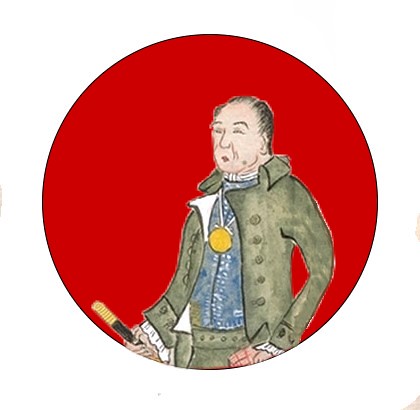
The Japanese very rarely brag (Heine, Lehman, Markus, & Kitayama, 1999), linguistically at least (Leuers = Takemoto & Sonoda, 1999). On the other hand the Japanese are "haughty" in their manner, posture and attire (Busk, 1841; Coleridge, 1872; Cortazzi, 2013; Golovnin & Shishkov, 1819; Krusenstern & Kruzenshtern, 1813). The Japanese eschew vocalising their superiority, which is left for others to do for them in flattery which, though void of linguistic meaning, as a form of obeisance is rife (Takemoto, in preparation).

Kōdayū (pictured above) spent 11 years in Russia as a castaway at a time when Japan was closed to the rest of the world. He returned full of "Western learning," and no doubt somewhat Westernised in manner, to obtain an audience with the shogun, the top man in Japan, about which Donald Keene writes,

"The shogun's questions were asked at random, and suggests that he was more interested in displaying his own knowledge of Russian than in learning new things from Kōdayū. The interrogation sometimes took the form: "There is a great clock in the castle tower of Moscow. Have you seen it?" Similar enquiries about the statue of Peter the Great and a famous Muscovian cannon were followed by, "Have you ever seen a camel?" (Keene, 1952, p.55)

The Japanese are not perfect. Looking, but not listening, with mother they expect to see those around them fawn and pay lip-service. Keene takes the shogun to task. I think that Kōdayū failed to flatter. Faced with such an ill-mannered subject the shogun had no choice but to ask rhetorical, self-answering questions for the purpose of self verification which is probably pan-cultural (Seih, Buhrmester, Lin, Huang, & Swann Jr., 2013) da yo ne?

Busk, M. M. (1841). Manners and Customs of the Japanese, in the Nineteenth Century: From Recent Dutch Visitors of Japan, and the German of Dr. Ph. Fr. Von Siebold. John Murray, Albemarle Street.
Coleridge, H. J. (1872). The life and letters of St. Francis Xavier : in two volumes. Asian Educational Services.
Cortazzi, H. (2013). Victorians in Japan: In and around the Treaty Ports. A&C Black.
Golovnin, V. M., & Shishkov, A. S. (1819). Recollections of Japan: Comprising a Particular Account of the Religion : Language : Government : Laws and Manners of the People : with Observations on the Geography : Climate : Population and Productions of the Country : to which are Pre-fixed Chronological Details of the Rise : Decline : and Renewal of British Commercial Intercourse with that Country.
Heine, S., Lehman, D., Markus, H., & Kitayama, S. (1999). Is there a universal need for positive self-regard?. Psychological Review. Retrieved from humancond.org/_media/papers/heine99_universal_positive_re...
Keene, D. (1952). The Japanese Discovery of Europe: Honda Toshiaki and Other Discoverers, 1720-1798. Routledge and Kegan Paul.
Krusenstern, A. J. von, & Kruzenshtern, I. F. (1813). Voyage Round the World, in the Years 1803, 1804, 1805, & 1806. C. Roworth.
Leuers = Takemoto, T., & Sonoda, N. (1999). The eye of the other and the independent self of the Japanese. In Symposium presentation at the 3rd Conference of the Asian Association of Social Psychology, Taipei, Taiwan. Retrieved from nihonbunka.com/docs/aasp99.htm
Seih, Y.-T., Buhrmester, M. D., Lin, Y.-C., Huang, C.-L., & Swann Jr., W. B. (2013). Do people want to be flattered or understood? The cross-cultural universality of self-verification. Journal of Experimental Social Psychology, 49(1), 169–172. doi.org/10.1016/j.jesp.2012.09.004

Minggu, 14 Februari 2016

More on empirics in Econ 101


Unfortunately, I see that my friend Allison Schrager has misinterpreted my proposal for reforming Econ 101.

I often suggest that empirics be taught in 101. My idea is to teach some simple empirical methods alongside some simple theories, so that 101 students get an idea of how economists tell good theories from bad ones. The idea is not to remove theory from 101. Unfortunately, I seem to have convinced Allison that this is what I was suggesting, for she writes:
Noah Smith also thinks economics education needs an overhaul. He believes statistics, rather than theory, should be central to economics training. Right now statistics is important, but as a tool to help understand and validate theory. It is not taught until students are further along in their economics education. Smith thinks it should be the other way around in order to prevent students from putting too much weight on one theory. 
But for the same reasons the British students are wrong, Smith misses the point. Statistics without theory is pure data science. It doesn’t tell you much about why certain relationships, say inflation and unemployment, matter. Nor does it offer insight into how different economic factors influence each other. Statistics are a useful way to validate theories and infer which one is the right one to use. Data empower researchers to understand how and why different theories sometimes fall short. But without a solid theoretical grounding pure statistics lack meaning.
I agree with Allison that the case for teaching empirics with no theory in 101 is quite weak. This is just as true in econ as in physics or chemistry. Every intro science class includes some theory, and there's no reason econ should be any different. I don't see anyone making the case that theory should be absent from 101, and I certainly have never made such a case.

But what about theory with no empirics? That's the status quo in most econ 101 classes. Empirical results are sometimes cited, but empirical methods are almost never taught. This stands in stark contrast to physics, chemistry, and biology, where high school classes and even junior high classes have important lab components.

Allison doesn't really defend this status quo. She merely describes it, stating that empirical methods are "not taught until students are further along in their economics education." That is true, as things stand. But simply saying "This is the way we do things now" does not constitute an argument that this is the way we should continue to do things.

So what is the case for leaving empirical methods out of 101? Allison doesn't make one. The only cogent case I've seen so far, in fact, is the idea that empirical methods are just too hard for 101 students. Steve Williamson made this case in a comment a little while ago:
In theory, [teaching empirics in 101] seems fine, but the key constraint on what you can do in econ 101 is the capacity of the students. It would be great if we could teach econ 101 to students who are already tooled up in math and statistics. Also, it would be great if they would come to class, pay attention, and not go to sleep.
Steve seems to be overestimating the difficulty of empirical methods. A lot of the "credibility revolution" methods are really just a comparison of two means. How hard is that? It's a lot easier than using supply-and-demand graphs to analyze the deadweight loss from an import tariff. As for calculating statistical significance, if you think 101 students aren't mathematically sophisticated enough to understand it, just show them how to push a button and read a p-value from a table. That's no harder than showing high school chemistry students how to mix two liquids and saying "Look, it turns blue!".

Steve also has a pretty cynical view of the purpose of 101 itself:
[E]con 101 is often a general education requirement in undergrad programs, and it's high enrollment - helps to justify your existence to the rest of the university. It's meant to draw in students, and has been dumbed down to the point where the only tool that is taught is two curves that cross and shift around.
Call me a wild-eyed crusading idealist, but I think that if 101 is a general education requirement, it should be more than just a slick marketing tool designed to get more students (read: money) for the econ department. If it's a requirement, then we have a duty to teach more than just simple ideas - we should teach students how to evaluate those ideas in the context of reality.


Update

Some people have been asking me to explain how empirics would be integrated into 101, and I was about to try, but Steve showed up in the comments and explained it really well:
I can see where you're going though. So, suppose you integrate the empirical work with the theory. You need to structure the course so that you learn the methods as you go along. Here's some theory. Here's some data where you get a lot of information just from the scatterplot. Here's a theory that allows us to illustrate how to use regression. Here's something that illustrates omitted variables, etc. So, you build up the methods as you go along, and it's far more interesting than the specialized approach - do statistics in this department, do economics in this department. Students have no idea why they're learning stuff, and they just forget it. You could bring the math in too - much more interesting than just doing calculus for its own sake[.]
This is exactly how I was envisioning it. I'd start, though, with stuff even simpler than a linear model - just a randomized lottery experiment with a comparison of means. Like a school voucher experiment, for example.

Steve also makes a great point about what needs to be done politically for this to happen:
OK, now I'm selling myself on it. It's an uphill battle though. You have some behemoth institutions that are very conservative in your way - universities and publishers.
Yep, sounds about right. I think it will be crucial to either create an alternative to Mankiw, or to force Mankiw to do a major rewrite (which will of course be hard, since Mankiw himself is a third conservative behemoth institution).

Acemoglu, Laibson and List are already crafting an alternative. Their series of intro textbooks goes heavy on the empirics and has a whole software package, MyEconLab, designed to introduce kids to empirics in an easy yet useful way. This kind of software has the potential to become the econ equivalent of a high school chemistry lab. Econ educators, you might want to take a look at Acemoglu, Laibson, and List. It's pretty pricey, though.

Also, interestingly, it looks like INET is starting to emphasize empirics. That's good to see.

Kamis, 11 Februari 2016

Autoscopy in the Martial Arts (Again, Summarized)

Autoscopy in the Martial Arts
It seems to me that the key to Japanese culture is to realise that in the land of the rising mirror, the Japanese see themselves. This is evident in my opinion in the Japanese sense of private shame, Kyari Pamyu Pamyu eating eyeballs, Mariokart (Masuda, 2010), and birds eye view points in Ukiyoe (Masuda and Chang?) but above all, that this autoscopic ability may be closely linked with Budo and the Japanese arts.

At the moment however the only good reference I have for this is the theory of the eye apart in the 14th-15th century Noh actor and theoretician Zeami who says that repeated practice of Noh forms allows the creation of Eyes at a distance (Riken no Ken) that look back at oneself.

There is also a this book on the psychology of Budo by Takashi Ozawa (in Japanese) with a cover and belt (obi) that said that doing Budo one "obtains an other that looks at you" (but when I read the book and contacted the publisher it turned out that it was the publishers comment, rather than the author's). The cover image is great though.
Attachment 10901

Similarly also this "Onore wo mitsumeru" (Staring at oneself) in Japanese where Ryo Nagano claims that in Iaido one is always fighting, and seeing, an imaginary opponent and that eventually one realises that his opponent is oneself, thus Iaido is an autoscopic martial art.

And there is some research that a Kyudo practicing student of mine (Ikki Yamamoto) did that found that self-seeing or imagining correlated highly with archery ability (more than practice or anything else) since in archery as in Kendo, one is evaluated on form as well as lethality.

It could be argued that the strong sense of aesthetics or grace in Nitobe implies autoscopy.

The twofold gaze that Musashi Miyamoto in the Book of five rings does not mention autoscopy but it may well be especially "The Gaze in Strategy The gaze should be large and broad. This is the twofold gaze "Perception and Sight". Perception is strong and sight week. In strategy it is important to see distant things as if they were close and to take a distanced view of close things. " (近き所を遠く見る事 in the original) p14 "In large-scale strategy the area to watch is the enemy's strength."Perception" and "sight" are the two methods of seeing. Perception consists of concentrating strongly on the enemy's spirit, observing the condition of the battlefield, fixing the gaze strongly, seeing the progress of the fight and the changes of advantages. This is the sure way to win. In single combat you must not fix the eyes on the details. As I said before, if you fix your eyes on details and neglect important things, your spirit will become bewildered, and victory will escape you." p3 40 and on p23 "You must make the best of the situation, see through the enemy's spirit so that you grasp his strategy and defeat him." does not mean see using the enemies spirit but rather "look at the enemies heart" ("敵の心を見" in the original). Re-reading the final single page chapter on the Void, I wonder what I mean by "seeing yourself" because there isn't one! But still it could mean several things! 1) Imagining how one looks from the perspective of others. 2) Seeing ones self representations, such as mirror reflections and first person views as representations and therefore at a distance 3) Seeing the void, the non-self, in which these occur.

Judith Butler claims in "Bodies that Matter" that repeated (Derrida's "iterated") actions facilitate the creation of 'body as sign' which can be self-addressed, and be meaningful, "matter."

There is also work on the overlap between theatre ('dramaturgy) and martial arts but I would not wish to suggest that Martial arts are a *performance for others,* so I tend to steer away from things dramatological.

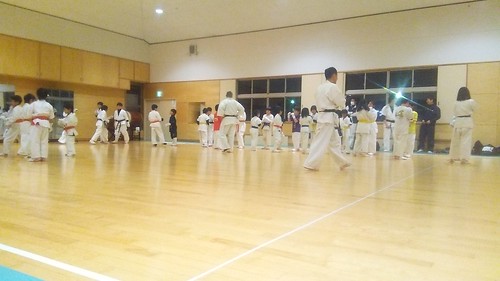
I do Karate a little and badly. I think that perhaps I may be able to see myself (with some pain!) more than than before. I don't know if Butler is right but it does seem to be, as Zeami can be read to say, that it is forms practice in Budo, tea, or 'radio exercises' (that all Japanese children do) that seems to be key. I find that doing forms in rows of other people helps in that I feel myself to be iterated in space as it were in the forms of the other people.

Do others know of any other sources regarding self sight, autoscopy, or "sight apart" in the martial arts?

Masuda 増田貴彦. (2010). ボスだけを見る欧米人 みんなの顔まで見る日本人. 講談社.

Sassure via Maruyama Explains Yuki's Group Types


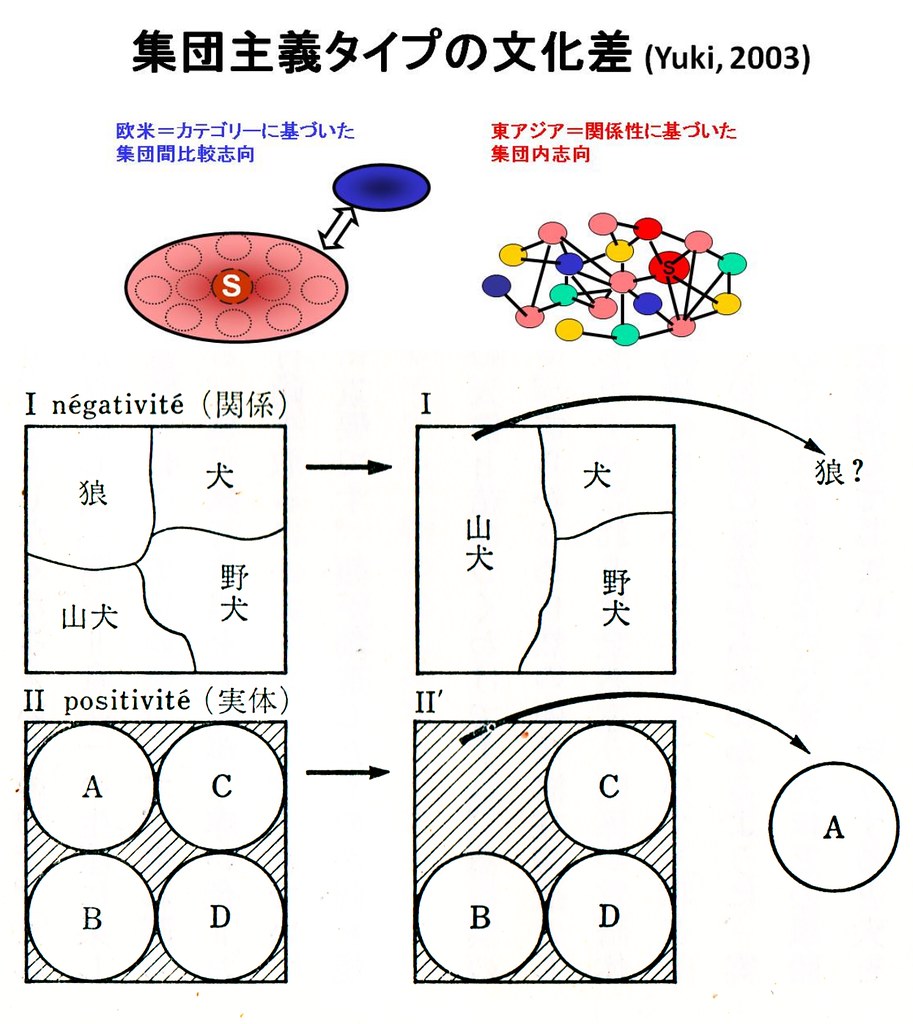
Possibly my favourite cultural psychological theory is that of Yuki (2003) who contends that westerners merge with their groups which they see in contradistinction to others, whereas Japanese form groups as networks conceived independently of any other group. This is a radical theory since if amplified it can be used to suggest that it is Westerners who are dependent upon their groups, whereas Japanese from groups in which individuality is nurtured. To a large extent I agree with this amplified formulation and have demonstrated that Americans though they may seem "individual" are all infact individualists, that is to say possessant of the same basket of culturally approved characteristics. None the less, I do believe that Japanese merge to a degree and that emphasis should be given to the way in which the selves in Japanese interpenetrate. Yuki (2003) in his diagram above shows the relationships penetrating the circles of the Japanese group members. I suggested a modification where the group members should overlap and explained the reason why they overlap - the imaginaire emphasises interdependence as explained here. Turning to Western groups however, it may appear puzzling that we find it so easy to merge with our groups, and require an outgroup to compare and disparage. One of the reasons for this is because, I believe, we cognise ourselves and our groups as narratives. Maruyama Masao illustrates the way Sassures theory of language implies that words can only be understood in their relation to other words. He contrasts categories of words with a box of coloured marbles (much like Masaki's asian group top right) which can be cognised even out of the box, and illustrates the way in which words can only be understood in contrast to other words with a box containing water with bubbles formed upon it. If a bubble in box is burst, if a language has no seperate word for wolf then that would be like bursting one of the bubbles (centre black and white diagram). Unless the word covers a meaning space in contrast to other words it has no meaning at all, whereas concrete (visible) things are what they are all on their lonesome. Japanese cognise themselves and their groups visually so they do not need to compare their groups with others. To love Japan they have no need of hating upon Koreans. Americans however tend to cognise themselves in linguistic terms, and therefore need a bogeyman-country with which to compare and enhance themselves. It is better in the light, but how to get there? http://flic.kr/p/DszxU2

Selasa, 09 Februari 2016

The Dream of the 90s


"Imagination/ That's the way that it seems/ A man can only live in his dreams"
- The Flaming Lips


Thirtysomethings like myself - the leading edge of the Millennial generation - often speak with reverent nostalgia of the 1990s. We make silly songs about it. Twentysomethings - the younger Millennials - are confused by this. What made the 90s so amazing?

I want to explain.

In many or even most ways, life is better now than it was then. We have smartphones - supercomputers in our pocket! In the 90s we didn't even have cell phones. We have social networks now - in the 1990s you had to keep in touch with old friends by email. We have GPS and digital cameras and YouTube and Yelp. Society is better now too. We have gay marriage now - that was a pipe dream in the 90s. So was a black president. 

What did we have? We had expectations.

The world of the 1990s wasn't the best world in history. But for Americans, it was improving at a faster rate than at almost any other time. And when the world is improving at a rapid rate, we often expect it to continue doing so. Those great expectations - which economists call "extrapolative expectations" - contribute a lot to our happiness. The shining future becomes a kind of wealth, and everyone feels rich.

Here are some of the ways that the world changed for the better in the 90s.


Geopolitics

As crazy as this sounds, I grew up thinking that the human race didn't have long to live. When I was a little kid in the 1980s, my parents told me that there would probably, at some point, be a third world war. The U.S. and Soviet Union would nuke each other, and human civilization would fall. This was presented as the most likely possibility - the only way for us to survive was to remain forever balanced on the knife-edge of Mutually Assured Destruction. The USSR was teetering economically, but everyone said it would never fall without launching its nukes in a final bitter gesture, like Hitler ordering all-out attacks in the last days of World War 2.

And that would be the end of us all. Look how many nukes there were in those days!


Nowadays a U.S.-Russia nuclear exchange would mean the end of both of our countries. In 1989, it would have meant the end of human civilization. 

Then one day I woke up in August of 1991, and I heard the radio in my parents' bedroom. They never turned on that radio, so I knew it was important. I asked my mom what was happening, and she told me that the Soviet Union had just fallen. Actually it was just a coup - the fall came somewhat later. But in that moment I knew. There would be no bitter, final world-destroying gesture. We would live on. 

Starting at the end of the 1980s, freedom and democracy - and American power - spread across the globe:


It really was the "End of History."


Technology

The 1990s saw the explosion of information technology. In the 80s we got personal computers, but in the 90s we got Windows, then email and Usenet and IRC, then - finally - the big one. 

Netscape.

At the beginning of 1994, if you wanted to find out a fact, you looked in a paper encyclopedia, or went to a library, or asked the nearest wise-seeming human being. If you wanted to talk to someone in another country, you signed up for a pen pal service (though Usenet and IRC were already chipping away at that barrier). 

In late 1994, if you wanted to do either of those things, you clicked on a little blue "N" icon, and suddenly this magical window opened, and you could talk to people in India, or read about how quantum mechanics worked, or learn how to get in shape, or get ideas for Dungeons and Dragons campaigns, or see what naked people looked like, or make fun of X-Files fans in real time. It was like going to college or moving to a big city, but for everyone. The world just exploded. It's impossible to describe the change. It was like adding another dimension to the Universe, and finding that you had been living in Flatland all along.


Of course, a steady stream of internet services followed - online shopping, chat, payments, games, maps, better search, video, video chat, etc. etc., and finally social media. But in 1994, as soon as that magic window appeared, it was clear that all of that stuff was on the way, and soon. 


Social Progress

One of the most remarkable and wonderful changes in the 1990s was the progress of gender equality. In 1980, a minority of women were working outside the home in the U.S. - by 1985, it was a majority, and by 2000 it was over 57 percent:


The gender pay gap for men and women also steadily shrank during the 80s and 90s, reflecting both more equal pay for equal work and more promotion and hiring of women to higher-paying positions:


The percentage of woman managers also increased dramatically:


Women also took a steadily higher percent of professional jobs.

Now, the gaps between men and women didn't close in the 80s and 90s. But they shrank a lot. And remember, the key to understanding the 90s is optimism. We thought those gains would continue. (Sadly, they did not.)

Race relations also seemed to be improving in the 90s, after the disasters of the 80s. Positive attitudes toward interracial marriage jumped. The black-white income gap was cut by about a third between 1992 and 2000:


Again, these were gains we thought would continue (but which sadly did not).


Health and Crime

The 1980s and early 90s saw an enormous crime wave. Everyone knew victims and perpetrators. Cities were anarchistic no-go zones. My cohort had one of the highest teen murder rates in the country. 

Then, suddenly, crime dropped off a cliff. In a few short years, the murder rate dropped to levels not seen since the golden years of the early 1960s:


Cities became livable again. Whole communities turned from war zones to nice neighborhoods. We still don't know what caused the great crime drop, but its positive effects are undeniable, and were exhilerating at the time.

It wasn't just crime, either. Health was surging. Life expectancy was increasing. Smoking was vanishing. Teen pregnancy was dropping:


Suddenly, the kids were alright.


The Economy

In the early 1980s, there were two deep recessions. Unemployment rose and persisted. The middle class spread apart and inequality increased. Everyone said that Japan was eating our economic lunch (yes, competitive corporate nationalism was still a thing back then). The late 80s were a good time, but productivity was still extremely sluggish, as it had been since the early 70s.

Then came the 90s boom. Productivity growth accelerated, and in many industries even exceeded its postwar heyday. Labor's share of income, which had been declining, spiked upward. With the addition of a second income, most families became much more materially comfortable. Two or more cars, a sign of wealth when I was a little kid, became the norm. Instead of one small TV, people suddenly had many large and beautiful TVs. Of course, we had computers and the internet as well. House sizes increased dramatically in the late 80s, then again in the 90s. 

In the late 90s, full employment was reached. Wage growth was rapid. Manufacturing rebounded. Everyone who wanted a job had a job. The stock market absolutely soared. House prices rose. Retirement accounts were flush. 

Times were good for the working class, but for the educated class, it was unprecedented party. As a Stanford student in 1999, I didn't even think about what kind of job I was going to get. None of us did, really. People in my dorm were getting rich over the summer on stock they received for interning at Amazon and eBay. It was OK to be a slacker. We all assumed that whenever we got tired of playing video games, we would go out and get rich. 

And once again, what mattered most was the sense that this was only the beginning. The end of the Cold War meant that we didn't have to maintain a big military, and the threat of destruction wasn't looming over the markets. Globalization was uniting the world. Technology was changing things in fundamental ways. A.I. and the internet were going to make progress go hyperbolic - it was The Singularity, man!! 

We thought we were living in a Vernor Vinge novel. The 20th Century was a long, dark tunnel from which we had finally emerged - the last bloody, terrible trial of humanity as we wrenched ourselves up from our agrarian and animal past into the bright future of peace, freedom, equality, health, riches, and neverending wonder.


Well, that's how it seemed, anyway. Then we had Bush, Florida, 9/11, the Iraq War, Hurricane Katrina, Putin, the rise of China, Lehman, the Great Recession, years of flat or falling incomes, a resurgent racial income gap, falling female labor force participation, the breakup of the working-class American family, slowing productivity, rising inequality, political polarization, the Tea Party, the heroin epidemic, the alcoholism epidemic, the huge rise in suicide, the end of Pax Americana.

Oops.

Depsite these challenges, the world really is better now in many ways. But it's a darker, grimmer world, at least in America and the other rich countries. Because now we know that although the dreams of the 90s may all still come true, it will be a longer, harder, bumpier road than we had hoped. We have lost the wealth represented by the capitalized value of our extrapolative expectations. We've made progress, but much of our optimism is gone.

That's why I feel like my generation has a duty to the ones that come after us. Because we remember the 90s, we remember what unbounded optimism was like. That optimism doesn't come cheap - you actually have to make the world better if you want to feel the rush of progress. We may be able to get that 90s feeling back, but we're going to have to fight for it. 

Yes, the cyclicalists really won the bet


So, Bryan Caplan won a bet with Tyler Cowen regarding the unemployment rate. Cowen bet that unemployment wouldn't go below 5% at any time between 2013 and 2033. It recently did, so Caplan won the bet 17.5 years before the deadline. Paul Krugman says that this is vindication for cyclical theories of unemployment, as applied to the Great Recession, over structural theories.

Tyler says: Not so fast. Unemployment may be down, but the employment-to-population ratio has barely budged:


He then cites some labor search theory papers, such as this one by Restrepo and this one by Elsby and Shapiro, that describe various situations in which we might see substantial structural unemployment. All in all, Cowen declares that "I feel I'm the one who won the bet." 

So who is right? Caplan and Krugman are mostly right, and possibly completely right. Cowen is at least mostly wrong here.

The reason? Aging. The Great Recession came along just as Baby Boomers were starting to retire, which is why the employment-to-population ratio hasn't recovered. Instead, let's look at the best measure of employment: the employment-to-working-age-population ratio:


As we can see, there has in fact been a strong and steady recovery in employment when we just look at working-age people. About 75% of the employment drop of the Great Recession has been reversed. So if the bet has a "true" winner, or a winner in spirit, it's definitely Caplan.

What about that last 25%? That represents a little over 2 million people. Does that represent increased structural unemployment, possibly due to effects of the Restrepo type, the Elsby-Shapiro type, or others (such as de-skilling)? It might. But it will be a while before we know. So far, correctly measured employment has been on a strong, smooth, steady upward trend. Only if that trend suddenly breaks, and employment flatlines at a level below the previous one, will it be time to reach for structural explanations for the Great Recession.

Interestingly, if we're using employment recovery as our measure of structural-ness, the 2000 recession looks a lot more structural than the Great Recession. The drop in employment-to-working-age-population after 2000 was almost as steep as that of the Great Recession, and there was far less bounceback. The 2000s really were a "lost decade" for U.S. employment. Of course I suspect China trade as the culprit, based on the timing and on the recent Autor-Dorn-Hanson paper. But that is a story for another day.

Regarding the Great Recession, the conclusion is simple: Caplan has earned his $10.

Which, unfortunately, is not even enough to buy 1/2 of a small Zachary's pizza. 


Updates

On Twitter, Ernie Tedeschi shows an alternative measure, the demographically adjusted employment-to-population ratio:


This measure is designed to take into account the changing age composition of the population. My preferred measure, the employment-to-working-age-population ratio, makes no distinction between a 15-year-old and a 64-year-old. This measure does. Aging doesn't just reduce the percentage of total population in the 15-64 bucket, it also shifts the distribution within that bucket.

The "adjustment" in this measure is meant to take that into account. But it will also involve making some assumptions. It probably assumes that the relative likelihood of a a 64-year-old to be employed and a 15-year-old to be employed stay the same over time. In fact, that is not true. In the recovery from the Great Recession, employment rates rose much more strongly among the old than among the young. That means that the "demographically adjusted" employment-to-population ratio will tend to understate the degree of labor market recovery following the Great Recession. For that reason, Ernie's graph shows a slightly less robust recovery than my own, though the basic stories are the same.

But this graph does make me think I was much too quick to label the post-2000 employment stagnation "structural". Maybe a lot of that was just due to aging, as the Boomers approached (but didn't reach) the official retirement age.