Senin, 25 April 2016

Two Reasons For Gattai


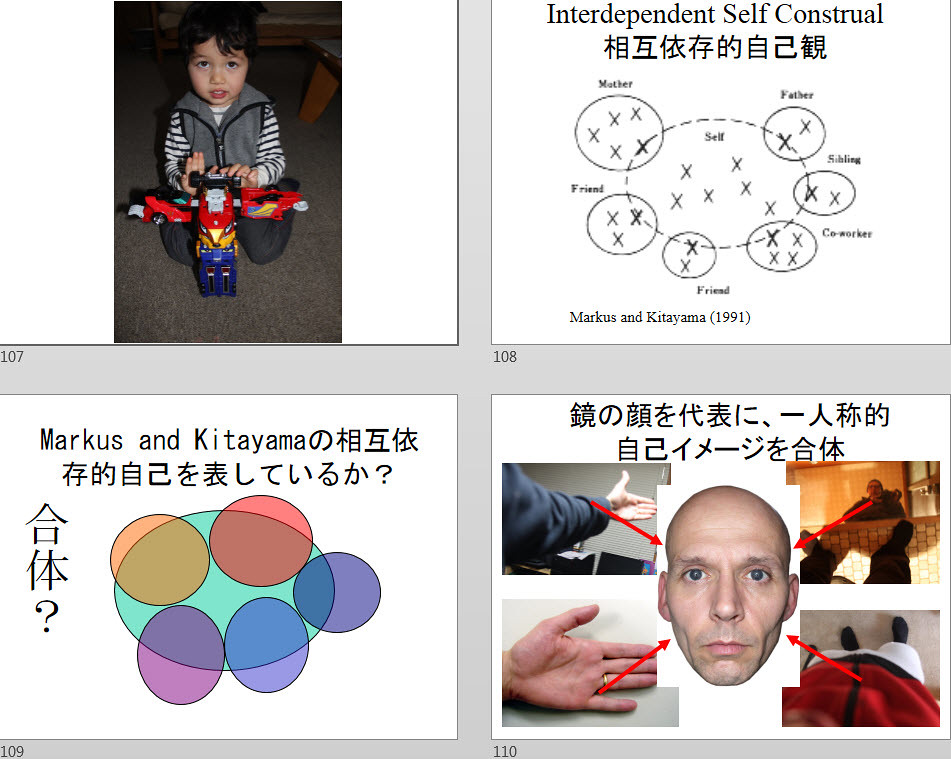
Japanese superheroes are always merging, with an ecstactic cry of "gattai!" This merging scene mesmerized Japanese children who rehearse similar using merging superhero toys. The merged superheroes are often much larger in size. Often its is the familiars of the super-heroes (as my son is holding top left) rather than the heroes themselves that merge. The superheroes themselves will then sometimes fly up inside the merged giant to control it. Since the superheroes are possesed by the familiars, receiving their super power from them, this tinal structure has the topography of a Klien bottle. In the past I had thought that perhaps the merging represented the way in which Japanese must merge multiple interdependent (Marks & Kitayama, 1991) or "dialogic" (Hermans and Kempen, Bakhtin, but in fact in the visual domain) self views from the view points of others, and, relatedly whether Japanese children are merging various self body views, perhaps also with that of their face as viewed in a mirror. I have more recently realised the enormous size of my first person body views and presume that this difference in scale explains the size differences between the superheroes before and after they merge. http://flic.kr/p/FFH3xk

Life Update: Leaving Stony Brook, joining Bloomberg View


Short version: I've joined Bloomberg View as a full-time writer. I'm leaving Stony Brook, and leaving academia, effective August 15, 2016. Bloomberg View had approached me a year ago about possibly working for them full-time. So I took a 1-year leave from Stony Brook, partially to finish some research stuff I had to do, and partially to decide whether I should switch jobs (I retained my Stony Brook affiliation during that time, and kept advising students and working with Stony Brook professors, but didn't teach classes). Early this year, Bloomberg made me a very nice offer for a full-time position, and I decided to take it. The offer included the chance to live in the San Francisco Bay Area, where I've long wanted to live, so I've moved to SF.

Longer version: Back in 2006, the original reason I thought of getting an econ PhD was actually to become an econ pundit and writer. I saw the quality of the econ commentary out there, and decided that it could be much improved - that there was a huge breakdown in the pipeline of good and useful ideas between academia and the public debate. I admired economists like Brad DeLong and Paul Krugman, and writers like Matt Yglesias, who took some steps to bridge that gap, but I thought that much more needed to be done. I wanted to make sure that good ideas, rather than politically motivated propaganda or silly oversimplifications, made it out of the ivory tower and into the public consciousness.

As soon as I started grad school, I essentially forgot that dream entirely. I got absorbed in the grad school stuff, first in macroeconomics, then later in my dissertation and behavioral finance (which was much more fun and satisfying than macro). And I enjoyed the academic life at Stony Brook, especially the people there. Now, with this Bloomberg job, I'll sadly be leaving that behind - but in the end, I came right back around to where I started. In terms of bringing good ideas from academia into the public consciousness, progress has been made, but much remains to be done. Fortunately, Bloomberg is a great platform to do this, and I'll be working with some great econ writers like Narayana Kocherlakota, Justin Fox, and many others.

As for Stony Brook, I will miss everyone there. It's a good, fast-growing department. The behavioral finance group there is strong and growing, with Danling Jiang, Stefan Zeisberger, and others. The people in charge of the College of Business, including the dean, Manuel London, are really excellent leaders, and the department is much friendlier and less politics-ridden than basically any other I've seen. They'll be hiring my replacement soon, so if you're a job candidate in behavioral finance, and you'd like to live in New York, I'd recommend Stony Brook.

Anyway, to you grad students out there, I certainly wouldn't regard me as a role model - my career is weird and unusual, and was probably always destined to be that way. I'd still recommend the economics PhD, and the life of an economist, to a whole lot of people out there.

That's all that's changed. I'll still be blogging here, and I'll still be around on Twitter!

Sabtu, 23 April 2016

Policy recommendations and wishful thinking


There was a bit of a blow-up earlier this year over Gerald Friedman's analysis of Bernie Sanders' economic plans. Paul Krugman, Christina and David Romer, Brad DeLong and others (including yours truly) said that Friedman was being overly optimistic about the effects of stimulus - some said he had overestimated the remaining output gap, others questioned the use of "Verdoorn's Law" to predict that stimulus can increase productivity growth to very high levels. Others, like JW Mason and Dean Baker, defended Sanders.

To me, it seemed that the coup-de-grace was delivered by Justin Wolfers:
When I pointed Mr. Friedman to this critique of his analysis, he simultaneously accepted and rejected it 
He accepted it, telling me that “I may have made a mistake.” 
But he also rejected this critique, arguing that his figures are based on an alternative view of the world, stating: “To me, when the government spends money, stimulates the economy, hires people who spend, that stimulates more private investment. That remains, and at the next year, you’re starting at the higher level.” He admits that this “is not standard macro,” and described it as the understanding of an earlier generation of economists — a sub-tribe of Keynesians he called “Joan Robinson Keynesians.”
When you get someone to admit they made a mistake in their analysis, it seems like it's over. Friedman admits he made a mistake and then says that his conclusion was right anyway, because we can go find some alternative assumptions that make his original conclusion hold. To me this is transparently assuming the conclusion. That's a big no-no, and while a lot of macroeconomists probably do this, it looks really bad to admit to it!

(I'm also starting to realize that "Joan Robinson" is a sort of an invincible rhetorical refuge for lefty macro types, the way "Friedrich Hayek" is for righty macro types.)

But anyway, the fracas quieted down, but now it's back. Friedman and allies are no longer saying that their analysis is "just standard economics", since they had to switch to non-standard economics to make the conclusions come out the way they wanted. The line now is that Krugman, the Romers, et al. are just a bunch of pessimists, who are unintentionally playing into the hands of conservatives.

Here's Friedman, writing at the INET website:
Professional economists tend to embrace an economic theory that government can do little more than fuss around the edges. From that stance, what do they have to offer ordinary people for whom the economy is not working? Not a whole lot...The angry reaction to my report revealed that by some combination of rationalization and the dominance of neoclassical microeconomics since the 1970s, liberal economists have virtually abandoned Keynesian economics.. 
There is, of course, a politics as well as a psychology to this economic theory...The role of economists and other policy elites (Paul Krugman is fond of the term “wonks”) is to explain to the general public why they should be reconciled with stagnant incomes, and to rebuke those, like myself, who say otherwise[.]
And here's Mason, being interviewed in Jacobin:
The position on the other side, the CEA chairs and various other people who’ve been the most vocal critics of [Friedman's] estimates, has been implicitly or explicitly: “This is as good as we can do.”...“No you can’t.” That’s the other side here: all the reasons for why you can’t do anything. Just give up! Then this notion that Republicans make everything impossible is just another bit of ammunition for “No you can’t.”... 
Right now, we have a system that says as soon as wages start rising, you have to throttle back demand. In many ways, the people running the show don’t necessarily want very fast growth. They prefer an economy that’s sort of sputtering along because it’s one that involves a lot of insecurity and a lot of weakness for working people. When there’s a chronic oversupply of labor people can’t rock the boat.
On Twitter, Mason clarified that when he talks about "the people running the show," he meant the Republicans, not Krugman, the Romers, et al. Basically, he's accusing mainstream liberal economists of unintentionally playing into the hands of conservatives.

Krugman was not happy about this, and blogger ProGrowthLiberal was pretty mad:
The claim that economists like Christina and David Romer bought into the New Classical revolution is both absurd and dishonest...[W]e critics do admit we are below full employment and we have been calling for fiscal stimulus. On this score, the latest from J.W. Mason is even more dishonest than the latest from Gerald Friedman. Guys – you do not win a debate by lying about the other side’s position.
I think PGL is going a little far here - Friedman and Mason aren't lying about their liberal opponents' positions. They aren't claiming Krugman, et al. are New Classicals, only that in the current political and economic situation, they might as well be. Also, Jacobin appeared to put words in Mason's mouth.

But anyway, I don't like what Friedman and Mason are doing. I think economists have a duty to look at the facts as objectively as they can, regardless of their emotions and desires. You shouldn't prefer Model B over Model A just because one leads to "hope" and the other to "hopelessness". 

Suppose you're a doctor, and your patient has knee pain, so you prescribe some anti-inflammatories. The inflammation goes away and the knee pain gets somewhat better, but doesn't go away entirely, and you conclude that inflammation wasn't the only thing that was causing pain. You don't prescribe a 10x dose of the original anti-inflammatory just because doing otherwise would mean abandoning hope. That would be silly! Even if the patient has an evil boss who doesn't want him to recover, you still don't recommend the 10x dose of anti-inflammatories.

Friedman and Mason seem to be arguing that our belief about the facts should be driven, at least in part, by our desire to avoid a feeling of powerlessness. They also seem to be saying that if the facts seem to support conservative policies, even a tiny bit, we should reinterpret the facts.

I don't like this approach. It seems anti-rationalist to me, and I think that if wonks behave this way, they'll end up recommending lots of bad policies. 

Kamis, 21 April 2016

Japanese Translation of Sheeple


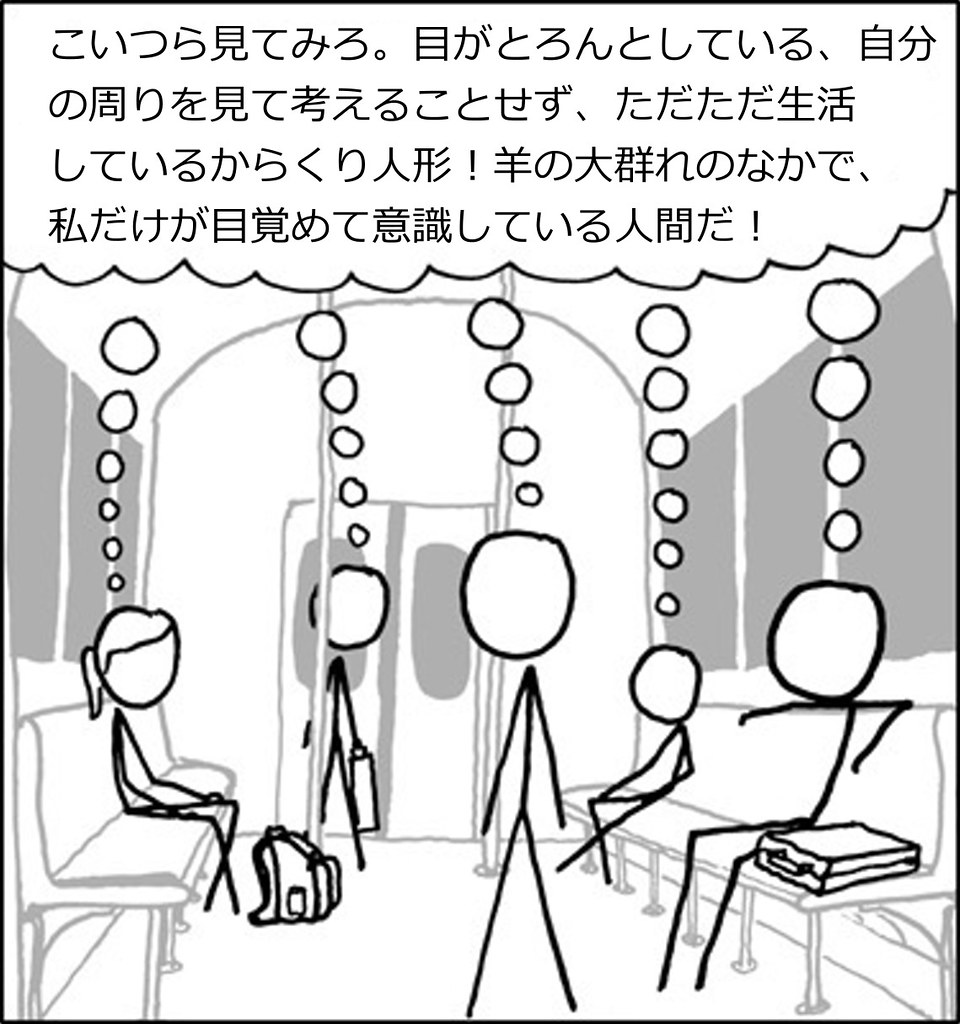
This the above is a Japanese translation of this illustration where everyone on a train thinks that all the others present are sheeple. Research (Leuers = Takemoto & Sonoda, 1999) shows that Westerners do have a false uniqueness bias, whereas Japanese are more likely to believe that they are more normal than they in fact are. Leuers = Takemoto, T. R. S., & Sonoda, N. (1999). Independent self bias. Progress in Asian Social Psychology, 3, 87–104. Retrieved from http://ift.tt/1ScThyE http://flic.kr/p/GmP39M

Selasa, 19 April 2016

Spring Night's Dream


There is a Japanese saying "The proud don't last long, but are like a Spring night's dream." This proverb is often said to be the equivalent of "Pride comes before a fall," but it is more severe. According to the Japanese, the proud do not just fall, but disappear. In my pride, I feel I am really letting the Japanese down. My 'research,' which I tend to present only orally, claims that the Japanese too are very proud. While they don't say so, they see themselves, and present themselves, in a very positive light. Furthermore, many of Japanese including a majority of Japanese psychologists and their political leader seem to have been persuaded that they are lacking in pride and self confidence. To be proud and unaware that one is proud is a dangerous situation to be in, like being under the influence of alcohol unaware that someone has spiked your drink. So perhaps like the Heike, who were defeated just down the road, the Japanese may be in for some very bad news. In my pride and delusions of grandeur I feel I really need to try much harder to make the Japanese aware of their positivity so they do not let it blind them. Oh Japan, please take care. 驕る者久しくあらず(春の夜の夢のごとし)という日本語の格言があります。英語のPride comes before a fallに相当するものだといわれますが、日本の格言の方が厳しいですね。驕るもは「落ちる」のみならず、消えるとまで。 驕る私は日本人の厚恩にぜんぜん答えていないと思います。殆どが口頭発表という形のみで公開されている小生の研究では、日本人も誇り高いと主張しています。そうは言わずとも、日本人は非常に肯定的に自己視し、肯定的な形で視覚的に自己呈示すると思います。更に多くの日本の方、多くの日本の心理学者やその政治的指導者は、日本人には誇りと自信が足りていないと思わさされているようです。 驕りがあって驕りに気づいていないという状況は、ジュースだと思い込んでいる飲み物にアルコールを入れられて知らず知らず酔っている状態のように危ないでしょう。そう考えると、この近くで敗北した平家のように、日本人も悲報が届きそう。驕りと研究についての慢心のなか、目が見えなくならないように日本の方が日本型肯定的さに気づかれるようにもっと努力しなければならないと思っている今日です。 日本、気をつけてくださいm(._.)m http://flic.kr/p/GpvuHR

Selasa, 12 April 2016

Will Jim be Helpful?

Will Jim be Helpful?

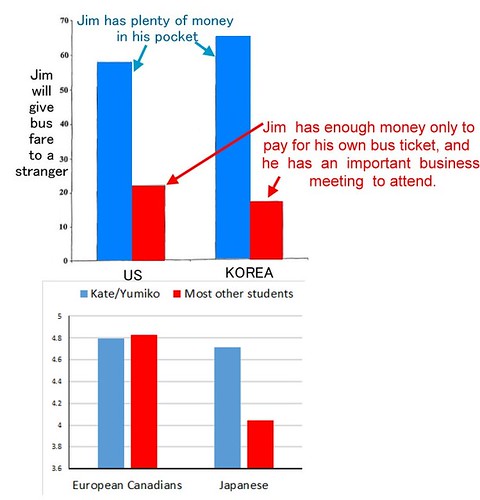
Choi, Nisbett, and Norenzayan (1999) that when Americans and Korean's were asked whether an individual, "Jim", would help a stranger in the situation where Jim either has plenty of money in his pocket, or where Jim has money only enough for his own fare and an important meeting to go to, the Koreans were found to be more influenced by the situation as in the above graph (based upon Choi, Nisbett, & Norenzayan, 1999, fig. 1. p. 52). It is argued that Asians are more contextual basing their decisions, and predictions of other's decisions, upon the context of the action rather than the character of the individual.

The experimental evidence is persuasive, and it fits in with stereotypes of East Asian "collectivists", lacking gumption, blown by the winds of societal, and contextual pressure.

At the same time, there is something wrong with this picture. Firstly I find that Koreans and Japanese are notably helpful, and non violent, to strangers across situations rather than showing behavioural swings, the helpful to mean, as shown in the graph above.

I suspect that there is another reason why the Koreans are being more "context" sensitive and that is that they are given no information about Jim other than his name. If the Koreans were given an equal amount of information regarding Jim, such as "Jim is a suited 25 year old business man working for a provincial bank", say, then the they would have been no more swayed by the context than the Americans because they, like the Japanese, base their decisions upon what they can imagine, animating the visio-imaginable rather than the phoneme "Jim".

In support of this hypothesis in other research it was found that when given a little more information ‘‘Kate (Yumiko in Japanese) age 20, is a student at your university," (Hamamura, Heine, & Takemoto, 2007, p.250) was given to Japanese and Canadian students, it was the Japanese and not the Canadians that gave a more outlier - further from "most other students" - appraisal of ‘Kat/Yumiko's personality (graph above bottom, based on Hamamura, Heine, & Takemoto, table 1). This difference was significant (p<.001). This is because, I believe, in this experiment the subjects were not just given a name, but also some information upon which to imagine the person that they were appraising.

The Japanese mind does not make decisions in words (Kim, 2002), but upon the surface of its mirror (Timothy Roland Scott Leuers = Takemoto & Sonoda, 1998, 2000; T.R.S. Leuers = Takemoto & Sonoda, 1999; T. Leuers = Takemoto & Sonoda, 1999; Takemoto, T., 2002, 2003; T. Takemoto, n.d.; Timothy Takemoto, 2011a, 2011b, 2012a, 2012b, 2014).

Choi, I., Nisbett, R. E., & Norenzayan, A. (1999). Causal attribution across cultures: Variation and universality. Psychological Bulletin, 125(1), 47. Retrieved from citeseerx.ist.psu.edu/viewdoc/download?doi=10.1.1.316.410...
Hamamura, T., Heine, S. J., & Takemoto, T. R. (2007). Why the better-than-average effect is a worse-than-average measure of self-enhancement: An investigation of conflicting findings from studies of East Asian self-evaluations. Motivation and Emotion, 31(4), 247–259. Retrieved from link.springer.com/article/10.1007/s11031-007-9072-y
Heine, S. J., Takemoto, T., Moskalenko, S., Lasaleta, J., & Henrich, J. (2008). Mirrors in the head: Cultural variation in objective self-awareness. Personality and Social Psychology Bulletin, 34(7), 879–887. Retrieved from www2.psych.ubc.ca/~heine/docs/2008Mirrors.pdf
Kim, H. S. (2002). We talk, therefore we think? A cultural analysis of the effect of talking on thinking. Journal of Personality and Social Psychology, 83(4), 828. Retrieved from labs.psych.ucsb.edu/kim/heejung/kim_2002.pdf
Leuers = Takemoto, T. R. S., & Sonoda, N. (1998, October). 心像的自己に関する比較文化的研究(1) Cross Cultural Research on the Specular Self. Oral Presentation口頭発表 presented at the The 62th Annual Convention of the Japanese Psychologiocal Association English日本心理学第64回大会, Tokyo Gakugei Daigaku. Retrieved from nihonbunka.com/docs/shinzoutekijiko1.doc
Leuers = Takemoto, T. R. S., & Sonoda, N. (1999). Independent self bias. Progress in Asian Social Psychology, 3, 87–104. Retrieved from httyp://www.nihonbunka.com/docs/independent_self.rtf
Leuers = Takemoto, T. R. S., & Sonoda, N. (2000, November). 心像的自己に関する比較文化的研究(6) -メディア(言語とイメージ)の違いと日米比較― Cross Cultural Research on the Specular Self: Differences in Media (Language and Image) and comparison between Japan and America. Oral Presentation口頭発表 presented at the The 64th Annual Convention of the Japanese Psychologiocal Association English日本心理学第64回大会, Kyoto University. Retrieved from nihonbunka.com/docs/shinzoutekijiko6.docx
Leuers = Takemoto, T., & Sonoda, N. (1999). The eye of the other and the independent self of the Japanese. In Symposium presentation at the 3rd Conference of the Asian Association of Social Psychology, Taipei, Taiwan. Retrieved from nihonbunka.com/docs/aasp99.htm
Takemoto, T. (2002). 鏡の前の日本人. In 選書メチエ編集部, ニッポンは面白いか (講談社選書メチエ. 講談社.
Takemoto, T. (2003). 言語の文化心理学―心の中のことばと映像(The Cultural Psychology of Language: Language and Image in the Heart). In 武本, ティモシー & 古賀,範理, あなたと私のことばと文化―共生する私たち―. 五絃舎.

Senin, 11 April 2016

Astrologers and macroeconomists


I like to keep track of "econ diss" articles, since that's what this blog was mostly about for its first few years of existence. Most of them leave a lot to be desired. But here's one I really like, in Aeon magazine, by philosophy prof Alan Levinovitz.

Levinovitz likens modern-day macroeconomics to mathematical astrology in the early Chinese empire. And in fact, the parallel sounds pretty accurate. The article is worth reading just to learn about classical Chinese astrology, actually.

But anyway, Levinovitz draws heavily on the econ disses of Paul Romer:

‘I’ve come to the position that there should be a stronger bias against the use of math,’ Romer explained to me. ‘If somebody came and said: “Look, I have this Earth-changing insight about economics, but the only way I can express it is by making use of the quirks of the Latin language”, we’d say go to hell, unless they could convince us it was really essential. The burden of proof is on them.’
 ...and Paul Pfleiderer:
Pfleiderer called attention to the prevalence of ‘chameleons’ – economic models ‘with dubious connections to the real world’...Like Romer, Pfleiderer wants economists to be transparent about this sleight of hand. ‘Modelling,’ he told me, ‘is now elevated to the point where things have validity just because you can come up with a model.’
He also rightly (in my opinion) identifies Robert Lucas as a key figure in the turn away from empiricism in macro:
Lucas’s veneration of mathematics leads him to adopt a method that can only be described as a subversion of empirical science:
"The construction of theoretical models is our way to bring order to the way we think about the world, but the process necessarily involves ignoring some evidence or alternative theories – setting them aside. That can be hard to do – facts are facts – and sometimes my unconscious mind carries out the abstraction for me: I simply fail to see some of the data or some alternative theory."
A lot of what Levinovitz is writing is just a synthesis of things that smart economists have been complaining about in private for decades, and in public since the 2008 crisis. I think econ needs more critics like this, who are willing and able to go talk to the smart dissidents within the econ mainstream, rather than just accepting at face value the arguments of "heterodox" outsiders due to political affinity (as some econ critics sadly do).

Levinovitz, however, leaves out what I think is the most important development: the empirical revolution in econ. This has been most important in micro fields, since data is much more abundant, but it's also starting to influence macro. "Micro-focused macro" - using firm-level or area-level data to test the assumptions of macro models directly, rather than just throwing in a bunch of obviously wrong assumptions and hoping they yield aggregate results you like - is a big deal these days, and getting bigger. Soon, we may even see people insisting in seminars that DSGE models only use assumptions that have been rigorously tested on high-quality micro data! That dream is still far off, but it seems to be getting closer.

I also think Levinovitz should have given a shout-out to the successes of applied micro theory - auction theory, matching theory, discrete choice models, and the rest. He writes:
Unlike engineers and chemists, economists cannot point to concrete objects – cell phones, plastic – to justify the high valuation of their discipline.
But that's actually not right. Econ theory powers lots of useful technology, from Google's ad auctions to kidney transplant allocation systems. Economic engineering isn't a term people use, but it's a real thing, and mathematical econ theories sometimes do an excellent job of describing human behavior in ways that can be consistently applied.

But anyway, Levinovitz' article is very good (and very well-written), and is worth a read. Just remember that econ is a lot more than macro, that it has become much more data-centric, and that it has produced a number of useful engineering applications.

Sabtu, 09 April 2016

101ism in action: minimum wage edition


A while ago I went on a rant about the dangers of "101ism", which is a word I made up for when people use an oversimplified or just plain wrong version of Econ 101 in policy discussions. Well, here I have a perfect example for you. And among the culprits was me.

It started when American Enterprise Institute scholar Mark J. Perry tweeted the following graph about minimum wage:


I was annoyed by the word "actually". My current pet peeve is people not paying attention to empirical evidence - I think if you say "actually", there should be more than just a theory backing you up, especially if evidence is actually available. So I started giving Mark a hard time about ignoring the empirical evidence on the minimum wage question. 

That's when Alex Tabarrok jumped in and defended the cartoon, saying that it's just a basic supply-and-demand model:


But that's not right. This cartoon actually doesn't show the basic D-S model at all. Let's look at it again:


The basic, Econ 101 D-S model is a model of a market for a single homogeneous good. In the case of the labor market, that good is labor. There's one kind of labor, and everyone who does it gets paid the same wage. Since the wage in that model is equal to the marginal revenue product of labor, this means everyone's labor generates the same amount of revenue (this is also obvious just from the assumption that labor is homogeneous; if everyone's doing the exact same work, they can't each be generating different amounts of revenue). A wage floor in the basic D-S model will put some people out of work, and will raise the amount of revenue generated by each person who keeps her job, thus raising wages as well.

In the cartoon, however, different jobs are stated to generate different amounts of revenue. Also, the last panel implies that a wage floor leaves the revenue generated by workers unchanged. So while the cartoon and the D-S model both predict that minimum wage causes job loss, it's only a coincidence - they're not the same model at all. 

The cartoon could be trying to portray a sophisticated model of heterogeneous labor in a highly segmented market. Or, far more likely, it could just be some sloppy political crap made by a cartoonist who doesn't remember his intro econ class very well. Either way, Econ 101 it ain't.

When Alex claimed that the cartoon is an "accurate portrayal" of the D-S model, I waved away his protest, basically saying "Who cares, evidence comes first." But (possibly because I had a nasty virus...excuses, excuses), I failed to notice until this morning that the cartoon is not the D-S model at all! I gave it the benefit of the doubt and assumed Alex was right. But Alex must not have been paying close attention - since he teaches the D-S model in online videos, he obviously does know how that model works.

So the cartoonist, and Mark J. Perry as well, are peddling bad economics. But they managed to momentarily convince both me and Alex that they're just peddling good' ol simple Econ 101. How did they do that?

In my case, it was because I committed the fallacy of the converse. I assumed that because the basic Econ 101 model says minimum wages cause job loss, and the cartoon says the same, the latter must be equal to the former. That's like saying "Horses have legs, I have legs, therefore I must be a horse." I suspect that Alex made the same mistake. And so we both gave a stupid cartoon far more credit than it deserved.

This is 101ism at its worst. It got me too, people. It's a plague, I tell you! A plague!


Updates

This post has stimulated a lot of interesting discussion about what the basic Econ 101 supply-and-demand model actually says (see comments, also Twitter).

One point has been that the definition of "the amount of revenue a job generates" - the language in the cartoon - is not clear. I took it to mean "marginal product of labor", but some people take it to mean "average product of labor". Either way, though, the APL generally changes as total labor consumed changes, so the cartoon still doesn't make sense if we define "revenue generated" as APL.

Alex Tabarrok, in the comments, seems to suggest a model in which one "job" is not equal to one differential unit of undifferentiated labor, but actually represents several units. If this is the case, each job will have a different total revenue benefit to employers, and the MPL of a job can't even be well-defined (since it's a discrete unit rather than a differential). So with these definitions, you can definitely say that "each job generates a different amount of revenue". 

But the point is, no matter how you define a job, or the revenue generated by a job, that amount will in general change for each job under a wage floor. The amount of revenue one person's job generates depends on who else is working. That's what Econ 101 teaches - or ought to teach, anyway. And that's what the cartoon gets wrong. It shows a wage floor eliminating every job whose "revenue generated" is lower than the wage floor before the implementation of the wage floor. Actually, basic Econ 101 D-S teaches that a wage floor eliminates every job whose total revenue benefit to employers (the integral of marginal revenue product over some range represented by the "job") is less than the wage floor (representing the cost of hiring the worker) after the introduction of the wage floor. Since the wage floor changes the quantity of labor consumed, and since the marginal revenue product of labor is in general not constant, those things are not the same. 

And that is why the cartoon is a bad representation of Econ 101. Good Econ 101, in my opinion (and probably in most people's opinions), should teach how marginal benefits and costs change according to the quantity consumed. The cartoon shows them not changing. That's not good Econ 101.

Selasa, 05 April 2016

A new age of econ imperialism is coming


Much of the discussion about econ methods these days revolves around the "credibility revolution", and the broader rise of empirics in general. Despite scattered protests from various quarters of the discipline, there looks to be no stopping the transformation of econ into an empirical, evidence-based field.

But the shift isn't just healthy - it's also a golden opportunity for economists to do what social scientists love best, which is to go on a giant raid and conquer the other social sciences! The new empiricism is the amphibious assault ship that will carry hordes of Econquerors (heh) to the vulnerable shores of sociology. 

The first big econ raid on sociology came from Gary Becker and other theorists in the 70s and 80s, who applied rational choice theory (partial equilibrium optimization, game theory, etc.) to issues like crime and marriage that had traditionally been the domain of sociology. By the turn of the century, economists were brashly trumpeting their dominion over their sister field. This earned the undying animosity of sociologists, of course, since social scientists tend to guard their intellectual "territory" quite jealously.

But the attack on soc-land was ultimately repulsed. Sociologists were basically free to ignore the incursion by A) not learning anything about econ models, and B) not publishing econ models in their journals. That was quite an effective tactic. Since university administrators and other dark overlords of academia (not to mention the general public) also don't understand optimization models, economic imperialists found themselves mostly talking to each other. 

The conquest was also a lot more difficult than economists predicted, since the defenders got an assist from Extant Reality. A lot of the imperialists' models were just flat-out wrong. A spectacular (and spectacularly tragic) example was Gary Becker's prediction that harsh sentencing could substitute for consistent law enforcement. Oops.

And in the end, economists had to pull back their occupying troops to fight battles closer to home. The financial crisis and Great Recession showed that economists didn't really understand the economy, which made a lot of people wonder why they were going off and trying to explain the division of household chores. (Of course, there's a good reason for this; it's a lot easier to test theories about household chores than it is to understand the business cycle...but hey!) By the 2010s, economic imperialism was kind of a joke.

But now the empirical revolution, especially the Credibility Revolution, is giving econ a second chance to conquer the neighbors. The new techniques - regression discontinuity, difference-in-difference, synthetic controls - are mostly pretty easy and quick for any smart person to grasp. The results of these sorts of studies are also usually very easy to interpret, unlike the output of many optimization models. And most importantly, the techniques can be applied to any social science subject.

That means that if empirical economists feel like writing a paper, it's really easy to go pick a soc topic. Want to study education policy? Just pull out your empirical econ toolkit! The relationship between crime and poverty? Go for it! 

The new econ imperialists will succeed where the first wave mostly failed, because they're armed with better weapons. Back then, it was basically a war of theory against theory, and the fights looked like:
Economist: [optimization model no one except economists understands] 
Sociologist: [slew of jargon no one except (possibly) sociologists understands] 
Public: Hmm, let me go with my political priors on thi - Hey, look, CNN is talking about Monica Lewinski! Sorry guys, gotta go.

Now, when empirical economists come with actual evidence, sociologists will be in a bind. See, the public doesn't get theory, but it gets empirical results. "X causes Y" is easy to understand, even for the most distracted of university administrators or Quartz columnists. That means empirical economists will soon be treated as experts on sociological topics.

In order to rebut economists, both in the public sphere and in the court of their own intellectual consciences, they will either need A) empirics of their own, or B) a good understanding of empirics AND the ability to clearly explain their own theories in order to use theory to question economists' interpretations of their results. 

Sociologists will have at least two barriers to doing this. First, many sociologists aren't nearly as proficient at stats and math as economists. That's not a huge problem, because Credibility Revolution techniques are actually not nearly as hard to learn as stuff like structural econometrics or Bayesian time-series methods. So sociology will have to beef up its grad students' quant skills, but it's hardly an insurmountable task.

Second, sociology is much more closed-off than econ, since few sociologists publish working papers. Soc is going to have to become a lot more open if it's going to hold off against the coming econ onslaught, both in the court of public opinion and in the general intellectual world.

Even if sociology does this, it's going to have another problem - many sociology theories will be found to be "not even wrong". As empirical evidence becomes the gold standard for social science arguments, jargon-heavy non-mathematical theories will just be less and less useful. That's probably going to make some soc theorists even angrier than it made econ theorists - at least econ theories, being quantitative, can often be tested with data. 

(Political scientists, meanwhile, will just keep doing what they always do, which is to cheerfully copy techniques from anyone and everyone.)

Anyway, in the end, I expect the new age of econ imperialism to be a good thing, for the world and for social science in general. It's time for the siloes to come down, for the borders between the arbitrary domains to be erased. Econ hordes: Conquer, pillage, burn!!

Senin, 04 April 2016

Doutaku and Doguu: Destroying the internal Other

Doutaku and Doguu: Destroying the Other
Doutak bells are a quite mystery to me.

They are found dating from the Yayoi period when, I believe the previous, indigenous Japanese Joumon ("rope pattern") Japanese culture that had existed in Japan for millennia was invaded by horse mounted invaders from the continent. These bells were probably originally horse-bells, to allow horse mounted warriors to know where their horses are in the dark for instance. They started out being about the size of the bell that Ray is holding in the above photo, but were gradually made in larger and larger sizes.

My guess is that these larger and larger bells were in part to prove regal (or invader) hereditary, "My father or (great great..) grandfather was a horse mounted warrior." And with each passing generation the bells were made in larger sizes, perhaps.

The Japanese themselves have a tendency to believe that there was no "invasion" and that the Joumon people evolved into Yayoi people, and subsequently Kofun people, due to the arrival of "technology" from the continent rather than due to subjugation. The Japanese tend to believe, traditionally at least, imho, that their culture is continuous or contiguous from the year dot. And they may be right.

The genetic record however seems to point to a considerable differences (in height for instance) with at the same time much overlap, so at least there was interbreeding between an indigenous and arriving race. On the other hand, I suppose that genes might also be described as a "technology," and Japanese culture may have survived changes to the gene pool. I think it very likely.

I imagine Yayoi warriors arriving and breeding (no offence intended) with the indigenous Joumon people, and then later a second wave of invaders (related to the first) arriving in the Kofun (ancient burial mound) period. This two wave hypothesis is suggested by some (Korean) historical interpretations of Japanese mythology. After the latter wave vast tombs were created. The creation of vast tombs, all around Japan, makes me think that there was great stratification within society. I imagine that those that were related to the invaders rounded up and forced vast numbers of indigenous and mulatto stock Japanese and had them build tombs the size of the Egyptian pyramids for their new masters. But this is all my imagination. Korean and Western historians tend to present a sort of "Japan was invaded" type of history, whereas, as I say, the Japanese tend to portray their history as one of continuous evolution with changes in society being attributed to the arrival of new technologies such as for rice farming. I guess that the difference in historical outlook is one of degree. The Japanese are, and their culture is, great at maintaining continuity, of which a great deal remains. This post is about the possibility of continuity between doutaku (as held by my son Ray) and dogu (pictured above right).

Returning to the dotaku bells, they have peculiar characteristics. They appear to have been kept, while not in use, buried in the ground, being unearthed at specific occasions. One theory has it that they were buried in order to soak up and be replenished with the spirit of the earth. The bells often have pictorial inscriptions that may be rebuses, punning on that which they represent. They seem to have a lot of water related imagery and a preponderance of images of deer.

Ah yes, I remember now (I make the same observations over and over again): it seems to me that these doutaku bells may be the origin of the temple bells that are used to ring in the new year in Japan in the "joya no kane" (除夜の鐘) ritual, which are even more massive than the largest doutak. They look similar. They are likewise inscribed. These "joya no kane" bells are now associated with Buddhist ritual to purify the ringers of sins, of which there are said to be 108.

The "rope pattern", Joumon culture indigenous Japanese, who existed for millennia, seem to have created first person body view (McDermott, 1996) figurines or dogū (土偶) which have similarities with the Venus figurines found all over the palaeolithic world. These figurines in Japan were often destroyed. I wonder if they were destroyed (and perhaps buried) in an attempt to exorcise their owners from the mother that occupied their, and perhaps all our, minds.

If so then, by a vast leap of conjecture, it might be argued that the practice of making first person body view figurines and then breaking and burying them, may have evolved into the practice of making vast bells and ringing then (at first) burying them.

This conjecture parallels the hypothesis of Lacanian (and Freudian but less explicitly) psychology which has it that the self evolves by first being represented visually as a body view, then narrativally in phonemes.

In each stage the self is paired with an other-of-the-self that witnesses the self representation.

Lacanian psychology seems to lack reference to self-person body views. The visual or "mirror-stage" is purported to be one in which the the mirror self, or third person body image such as represented in mirrors, and the form of other children with whom infants identify, is seen from the perspective of real others and is therefore groupist, and interpersonal, rather than intra-psychic (in the mind).

It is only, according to Lacan and Mead, with the arrival of language that humans internalise an imaginary friend or Other or ear (of the Other). In Lacan and Mead, and Western philosophers in general, ears are argued to be internalisable but eyes are not. They claim that one can speak, whisper and eventually "think" in words to "oneself," or rather that hidden friend, a generalised other, super ego, super addressee. Eyes are always, interpersonal, groupist, social, out there in the world.

Till the discovery of mirror neurons, our paper on Mirrors in the Head, McDermott's first person, Nishida's Mephistopheles in 'active direct vision', and the lyrics of David Bowie ("Your Eyes" in Blackstar) it was not realised that people can create a watcher within their minds.

Western theorists seem to have missed out on autoscopic potential of the mirror neuron, or McDermottian possibility that eyes are just as internalisable.

Until recently I had thought that the "eye of the Other" was internalised in an abstract, ineffable way. Japanese pictorial art is often represented from the perspective of "an eye apart," typically looking down, from the sky such as one can experience when playing Mariokart, Final Fantasy or other third person view Japanese video games (Masuda, et al., in preparation).

At the same time however, it also seems possible to model an eye within the self in a more concrete way, as the the first person view of self, such as may be represented by dogū, and the first person view that we have of their own brow nose and limbs. When I look at myself in the mirror I can see the noses and brow of the person on this side of the mirror. I can hold out my hand and caresses the surface of the mirror. Narcissus is portrayed attempting to scoop up his image from the surface of water, using his this-side-of-the-mirror hands.

In a sense perhaps the phonic equivalent of the nose and brow is the voice. I can narrate myself and when I do, when I call myself names, such as "Tim" or "I," the in that situation, there is likewise a "this side of the mirror" in the voice that expresses these names. Mead, and Derrida, rightly point out that hearing oneself speak (s'entendre parler in Derrida) introduces a believable duality. But I think that Nishida is right to point out (at least I think he is pointing out) that a similarly believable, or en-actable (kouiteki) duality exists in seeing. Since we can see our brow, and our nose(s), and often our hands, we see ourselves see. We do not even need a mirror to do so.

So, aware of the fact that self always presupposes and entails a self loving drama (with [less than/not?] one actor and two personae), in an attempt to rid themselves of their self-loving sin, the Japanese may have moved from destroying images of the self-person view in the act of destroying and burying dogū figurines, to destroying the phoneme in the act of a DONNGG, of a doutaku or joya no kane bell.

One can hear the sound of a bell on the Japanese joya no kane wikipedia page and in this Youtube Video.

Bibliography
McDermott, L. R. (1996). Self-representation in Upper Paleolithic female figurines. Current Anthropology, 37(2), 227–275. websites.rcc.edu/herrera/files/2011/04/PREHISTORIC-Self-R...

I have also argued that Japanese attempted to destroy inner ears (converting them to external ones) by snapping their earrings. The more you love others the less you love yourself, and vice versa.