Kamis, 30 Juni 2016

Some stuff economists tend to leave out


Chris Arnade got a PhD in theoretical physics, became a bond trader, and then became a photographer who documents drug addiction. He frequently writes on Twitter and elsewhere about social problems. Recently, he wrote a tweetstorm (series of threaded tweets) about his interpretation of Trumpism. I think Chris leaves out a lot of the reasons for Trump support - xenophobia, fear of racial conflict, misplaced nostalgia. I also doubt that the drug addicts that Chris spends his life documenting tend to be Trump supporters. But I think Chris makes some really good points when he writes:
Many people have no chance & they know it & reminded of it daily. On TV, on the web. They see what they are missing. And who is winning...The response to this is, we all have Iphones now. Everyone has all this stuff they never had before...Response 1: Maybe when we measure someone by how much stuff they have, those at bottom will never be happy. Because others have far more...Response 2: Maybe trying to get all that stuff is painful. Maybe the monthly payments needed to keep up isn't fun...Response 3: Maybe, crazy as it might sound, having an Iphone, and other things, just isn’t the key to happiness after all...Response 4: Maybe people need meaning beyond economic. Maybe they need to feel included, to have strong bonds to institutions & groups...Maybe the predatory, hyper rational society we have built has stripped institutions of their meaning...Maybe it has all left people, who used to get meaning from them, with very little, other than anger.
I think there's a lot to this. Putting it in econ language: 1) Social preferences are probably very important in reality. 2) Utility functions often contain inputs like inclusion, human connection, and a sense of meaning, for which no markets exist.

Econ rarely deals with these things. When is the last time you heard an economist talk about how minimum wage policy affects people's desire to feel like society cares about them? When is the last time you heard an economist talk about the need to include strong interpersonal relationships in GDP? When is the last time you saw a welfare analysis of tax policy that took inequality preferences into account?

The formal machinery of economics is totally equipped to deal with these things. You can put love in a utility function right alongside consumption, just call utility u(c,L). You can incorporate community stability into an urban model or a model of migration. You can put social trust as an input into a production function. You can give people a utility boost from having a job, and call it the "dignity of work". You can model the alienation of arm's-length market transactions as a transaction cost, and remove this cost for long-term informal contracts. Almost anything, except for some fairly exotic behavioral biases, can be dealt with using the standard tools of utility maximization and cost minimization that every econ student learns in school.

So why do economics classes, papers, and policy recommendations so rarely include any of these things?

Part of it might just be an accident - or maybe two accidents. Non-market goods like love, trust, connectedness, patriotism, social obligation, fairness, dignity, etc. is usually really easy to put into models - too easy, in fact. Assuming the existence of something really important but really simple is not intellectually or mathematically impressive. It might be the most important thing in the world, but it won't help you look smart for a hiring or tenure committee.

And these non-market goods are also very hard to measure empirically. How do you measure them? What economic data is a proxy for social connectedness, inclusion, or dignity? They'll usually wind up as unobservable parameters, meaning that the data used to evaluate the models will not be super-informative. (Sociologists probably know more about how to do this, but they don't even post their working papers or blog very much, so who knows what they're up to?)

Social preferences, on the other hand, can be devilishly hard to model. Some people do do it, in highly specific, stylized settings (see here and here), and some people do study social preferences empirically (see here and here; thanks to the excellent Ivan Werning for these examples). But they're pretty tough to put into policy evaluation models, and probably too tough for most undergrad classes.

So there are some technical and institutional barriers to putting these things in economic models and in econ classes and textbooks. But I suspect there might be cultural barriers as well. Econ began in an age when severe material deprivation was the main problem afflicting humankind (as it still is in many countries). Economists of the 19th and early 20th centuries correctly grasped that rising material prosperity would override almost any other concern for the destitute masses of the world, if that prosperity became available.

But as soon as countries get past the stage of abject deprivation, non-market goods and social preferences probably become a lot more important. By sweeping these things under the rug, economists are probably A) nudging policymakers to ignore crucially important stuff, B) developing a reputation for being out of touch, and C) opening the discipline to allegations of irrelevance from people who want to see econ replaced with other ways of analyzing the world.

Interestingly, I think a lot of the progress in the public discussion of these things has come from conservative-leaning economists, whose free-market bona fides probably give them the political cover to openly discuss things non-market goods like social trust. That's a positive development, but economists on the other side of the ideological spectrum should probably get in on that game. To their credit, left-leaning economists often do discuss inequality aversion, but this is rarely translated into formal models or official policy advice.

Anyway, I think Arnade has a point, and economists should listen - even though I'm not sure what exactly needs to be done.


Senin, 27 Juni 2016

Sooth Pilgrimage


If the comforter watches but does not listen, then there us no objective "third person perspective" (Mori) so language is contextual, situated, out there, and one must travel to where language was uttered to understand it. The farmer who returned from Tokyo to his home town in Hokkaido, upon whom the famous Japanese television series, "From the North Country," (北の国から)is based, said "Receive from nature. Be humble". Japanese tourists, or sooth pilgrims, travel to where sooths were uttered, there receiving it, for that is where the sooth is. The Japanese world is not "inside out", as I have claimed, but has rather no inside nor out. The world is the sensations (Mach). The self is the world and the world is self (Nishida). http://flic.kr/p/JrF7Dt

Senin, 20 Juni 2016

Asian Holisim is Happier: And how happy are you?

Asian Holisim is Happier: And how happy are you?
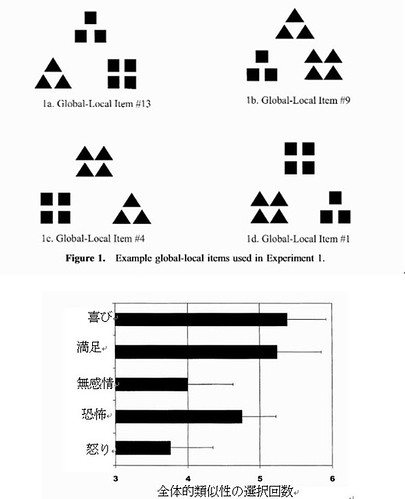
In each of 1a, 1b, 1c and 1d in the above image, which of the two (left or right) figures resembles most the figure above them? This is a test of happiness!

Fredrickson & Branigan(2005)had subjects watch videos of penguins, nature, abstract sticks, a climbers fall, and bullying to promote: pleasure, contentment, the absence of emotion, fear and anger respectively.

Subjects were then shown the four diagrams 1a, 1b, 1c and 1d above which show a single figure above two others and asked which of the two, left or right most resembles the one above. The right hand figure is made up of the same fundamental building block ■ or ▲, whereas the left hand figure is made of the opposite building block but is arranged holistically in the same way as the figure above.

It was found that the more positive emotions resulted in more holistic (left hand) resemblances as per the graph below (with the emotions in the same order as given above). This suggests that those that see the world holistically are happier and those that see it parts, may be in a more negative affective state.

Due to the higher suicide rate in Japan, and naff surveys purporting to guage the well-being of a nation based on one culturally laden question, one is often led to believe that the Japanese are bunch of unhappy people. I think this is very misleading. The higher suicide rate in Japan is due in large part to less negative appraisals of choosing the time and place of ones own death. It is further noted that East Asians in particular and Japanese in general tend to see the world in a more holistic way (Masuda & Nisbett, 2001; McKone et al., 2010). I think that this may be in part because the Japanese are in fact happier.

Fredrickson & Branigan(2005)は、ペンギン・自然・抽象的な模様・登山家の事故とイジメのビデオを使って、喜び・満足・無感情・恐怖と怒りの感情を被験者に持たせ、どれだけ全体的⇔局所的な注意を行っているかを調べた。下記のそれぞれの1a, 1b, 1c, 1dにおいて、上にある形状は下の右か左のどちらに似ているかという質問に対して
全体的局所的
1 a左右
1 b左右
1 c左右
1 d左右
それぞれの4つの設問の下にある2つの形状の右側は、上の物と同じ■か▲かの構成部員からできているから局所に似ているが、左側の形状は構成部員が違っているが全体的には上と同じ三角か四画の配置になっているので全体的に似ている。

その結果

つまり、肯定的感情があるときは全体的な類似性(つまり左側)を選択することが多いです。

Bibliograp;hy
Fredrickson, B. L., & Branigan, C. (2005). Positive emotions broaden the scope of attention and thought‐action repertoires. Cognition and Emotion, 19(3), 313–332. http://doi.org/10.1080/02699930441000238
Masuda, T., & Nisbett, R. E. (2001). Attending holistically versus analytically: comparing the context sensitivity of Japanese and Americans. Journal of Personality and Social Psychology, 81(5), 922. Retrieved from http://psycnet.apa.org/journals/psp/81/5/922/
McKone, E., Aimola Davies, A., Fernando, D., Aalders, R., Leung, H., Wickramariyaratne, T., & Platow, M. J. (2010). Asia has the global advantage: Race and visual attention. Vision Research, 50(16), 1540–1549. http://doi.org/10.1016/j.visres.2010.05.010

Minggu, 19 Juni 2016

Does the Ladder of Life Exist?


The United Nations publishes a world happiness report based upon data from a Gallup survey, ranking countries according to their level of happiness. The Danes game out top. The Japanese were 53rd, one third of the way down the 150 or so countries, which is irregular bearing in mind their high GDP per capital with which "happiness" is shown to correlate.

It transpires however that the Gallup survey does not measure anything I recognise as happiness at all. The actual, and single, question that determines national happiness is as follows.

“Please imagine a ladder, with steps numbered from 0 at the bottom to 10 at the top. The top of the ladder represents the best possible life for you and the bottom of the ladder represents the worst possible life for you. On which step of the ladder would you say you personally feel you stand at this time?” (From the statistical appendix of the report)

(In my Japanese 「0」という一番下の段から、「10」という一番上の段のある梯子を想像してください。一番上の段は、あなたにとって自分の一番よい人生で、一番下の段は自分の一番悪い人生を表しています。今現在、梯子の何番目の段に立っていると感じるといえるでしょうか?)

While the notion of a variety of lives, and the possibility of my being able to live any other life but the one I am living is a little fraught, it is at least imaginable. I might never have left the UK. I might have married someone else, etc.

As the famous song by Chiyoko Shimakura goes, people lead and we all could have lead a variety of lives. Life is varied. And by implication in the song, while life has its ups and downs, it is all good.

The notion on the contrary that these lives could be ranked and arranged in a vertical hierarchy with the "best life" at the top and "the worst life" at the bottom is far more difficult to grasp. It seems to me that certain negatives accompany positives (such as the envy of others with success), and positives with negatives (such as emotion, and humility with suffering).

That this imaginary vertical ranking of lives transpires to correlate - in most instances - with wealth may be because it is in fact encouraging respondents to economically appraise their own lives, ranking it in quantitative terms -- "I've done okay" "I've done well" -- in none other than in dollars and yen. In any event the suggestion that this one question plumbs the depths of national well-being or that it should be used to guide political policy seems to be to be quite absurd, especially in view of the way in which Westerners answer such questions in so unrealistically positive ways. But alas, this and similar measures are being used to inform political policy and the need for public spending. We are not high enough on the ladder. So, do we need to spend more?

The ladder of life does not exist so we should give up trying to climb it.

The above image contains a detail from a still from Chiyoko Shimakura's video for "Jinsei Iroiro" (Lit "Life Variety" or "Life has its Ups and Downs").

Selasa, 14 Juni 2016

The pool player analogy is silly


In a lot of debates about economic methodology, someone will bring up Milton Friedman's "pool player" analogy. The pool player analogy was part of Milton Friedman's rationale for modeling the behavior of economic agents (consumers, firms, etc.) as the optimization of some objective function. Unfortunately, the analogy is A) not that good in the first place, and B) frequently misapplied to make excuses for models that don't match data.

Here's the original analogy:
Consider the problem of predicting the shots made by an expert billiard player. It seems not at all unreasonable that excellent predictions would be yielded by the hypothesis that the billiard player made his shots as if he knew the complicated mathematical formulas that would give the optimum directions of travel, could estimate accurately by eye the angles, etc., describing the location of the balls, could make lightning calculations from the formulas, and could then make the balls travel in the direction indicated by the formulas. Our confidence in this hypothesis is not based on the belief that billiard players, even expert ones, can or do go through the process described; it derives rather from the belief that, unless in some way or other they were capable of reaching essentially the same result, they would not in fact be expert billiard players.  
It is only a short step from these examples to the economic hypothesis that under a wide range of circumstances individual firm behave as if they were seeking rationally to maximize their expected returns (generally if misleadingly called “profits”) 16 and had full knowledge of the data needed to succeed in this attempt; as if, that is, they knew the relevant cost and demand functions, calculated marginal cost and marginal revenue from all actions open to them, and pushed each line of action to the point at which the relevant marginal cost and marginal revenue were equal. Now, of course, businessmen do not actually and literally solve the system of simultaneous equations in terms of which the mathematical economist finds it convenient to express this hypothesis, any more than leaves or billiard players explicitly go through complicated mathematical calculations or falling bodies decide to create a vacuum. The billiard player, if asked how he decides where to hit the ball, may say that he “just figures it out” but then also rubs a rabbit’s foot just to make sure; and the businessman may well say that he prices at average cost, with of course some minor deviations when the market makes it necessary. The one statement is about as helpful as the other, and neither is a relevant test of the associated hypothesis.
Actually, I've always thought that this is kind of a bad analogy, even if it's used the way Friedman intended. Using physics equations to explain pool is either too much work, or not enough.

Suppose the pool player is so perfect that he makes all his shots. In that case, using physics equations to predict what he does is a pointless waste of time and effort. All you need is a map of the pockets. Now you know where the balls go. No equations required! Actually, even that's too much...since in most pool games it doesn't matter which balls go in which pockets, you don't even need a map, you just need to know one fact: he gets them all in. It's a trivial optimization problem.

But if really good pool players made 100% of their shots, there wouldn't be pool tournaments. It would be no fun, because whoever went first would always win. But in fact, there are pool tournaments. So expert pool players do, in fact, miss. They don't quite optimize. So if you want to predict which pool player wins a tournament, or why they miss a shot, you need more than just a simple balls-in-pockets optimization model. And you probably need more than physics - you could use psychology to predict strategic mistakes, biology to predict how arms and hands slightly wobble, and complex physics to predict how small random non-homogeneities in the table and air will cause random deviations from an intended path. 

The point is, if you use an optimization model to represent the behavior of someone who doesn't actually optimize, you're going to get incorrect results.

Of course, the pool player analogy wasn't Friedman's whole argument - the next paragraph is critical:
Confidence in the maximization-of-returns hypothesis is justified by evidence of a very different character. This evidence is in part similar to that adduced on behalf of the billiard-player hypothesis - unless the behavior of businessmen in some way or other approximated behavior consistent with the maximization of returns, it seems unlikely that they would remain in business for long. Let the apparent immediate determinant of business behavior be anything at all - habitual reaction, random chance, or whatnot. Whenever this determinant happens to lead to behavior consistent with rational and informed maximization of returns, the business will prosper and acquire resources with which to expand; whenever it does not, the business will tend to lose resources and can be kept in existence only by the addition of resources from outside. The process of “natural selection” thus helps to validate the hypothesis - or, rather, given natural selection, acceptance of the hypothesis can be based largely on the judgment that it summarizes appropriately the conditions for survival. 
That turns out to just be wrong. There are plenty of theoretical ways that non-profit-maximizing agents can stay around forever. Also, there are always new people and new companies being born and entering the system - there's a sucker born every minute, so as long as they drop out at some finite rate, there's some homeostatic equilibrium with a nonzero amount of suckers present. And finally, this argument obviously doesn't work for consumers, who don't die if they make bad decisions.

So Friedman's analogy was not a great one even on its own terms. Sometimes consumers, firms, and other agents don't perfectly optimize. Sometimes that's important. So you might want to model the ways in which they don't perfectly optimize.

But actually, everything in this post up to now has been a relatively minor point. There's a much bigger reason why the pool player analogy is bad, especially when it comes to macro - it gets chronically misused.

In pool, we know the game, so we know what's being optimized - it's "balls in pockets". But in the economy, we don't know the objective function - even if people optimize, we don't automatically know what they optimize. Studying the economy is more like studying a pool player when you have no idea how pool works.

In economic modeling, people often just assume an objective function for one agent or another, throw that into a larger model, and then look only at some subset of the model's overall implications. But that's throwing away data. For example, many models have consumer preferences that lead to a consumption Euler equation, but the model-makers don't bother to test if the Euler equation correctly describes the real relationship between interest rates and consumption. They don't even care.

If you point this out, they'll often bring up the pool player analogy. "Who cares if the Euler equation matches the data?", they'll say. "All we care about is whether the overall model matches those features of the data that we designed it to match."

This is obviously throwing away a ton of data. And in doing so, it dramatically lowers the empirical bar that a model has to clear. You're essentially tossing a ton of broken, wrong structural assumptions into a model and then calibrating (or estimating) the parameters to match a fairly small set of things, then declaring victory. But because you've got the structure wrong, the model will fail and fail and fail as soon as you take it out of sample, or as soon as you apply it to any data other than the few things it was calibrated to match.

Use broken pieces, and you get a broken machine.

This kind of model-making isn't really like assuming an expert player makes all his shots. It's more like watching an amateur pool player until you he makes three shots in a row, and then concluding he's an expert.

Dani Rodrik, when he talks about these issues, says that unrealistic assumptions are only bad if they're "critical" assumptions - that is, if changing them would change the model substantially. It's OK to have non-critical assumptions that are unrealistic, just like a car will still run fine even if the cup-holder is cracked. That sounds good. In principle I agree. But in practice, how the heck do you know in advance which assumptions are critical? You'd have to go check them all, by introducing alternatives for each and every one (actually every combination of assumptions, since model features tend to interact). No one is actually going to do that. It's a non-starter. 

The real solution, as I see it, is not to put any confidence in models with broken pieces. The dream of having a structural model of the macroeconomy - one that we can trust to be invariant to policy regime changes, one that we can confidently apply to new situations - is a good dream, it's just a long way off. We don't understand most of the structure yet. If you ask me, I think macroeconomists should probably focus their efforts on getting solid, reliable models of each piece of that structure - figure out how consumer behavior really works, figure out how investment costs really work, etc. That's what "macro-focused micro" is really about, I think.

So let's put Friedman's pool player analogy to rest.


Updates

Chris House (who was the first person to ever introduce me to the pool player analogy) has a response to this post. But as far as I can tell, he merely restates Friedman's (flawed) logic without addressing the main points of my post. 

Sabtu, 11 Juni 2016

Econ theory as signaling?


I don't expend much effort dissing macroeconomics these days, but every once in a while it's good to give people a reminder. I wrote a Bloomberg post about how academic macro (or more accurately, mainstream macro theory) has not really helped out the finance industry, the Fed, or coffee house discussions. The reason, as Justin Wolfers recently pointed out, is basically that DSGE models don't work. Brad DeLong then wrote a post riffing on mine, which is excellent and which you should read. A super-fun Twitter discussion then followed, part of which Brad storified for posterity.

But that leaves the question: Assuming Wolfers and DeLong and I aren't just blowing smoke out of our rear ends, and DSGE models really don't work, why do so many macroeconomists spend so much time on them? One obvious hypothesis is that a huge percent of their human capital is already invested in knowing how to do this technique, so they just keep doing what they know how to do, and teaching it to their grad students.

Another hypothesis could be that it's just an equilibrium of a repeated coordination game. Universities pay macroeconomists to do research, but they have absolutely no idea what good macroeconomic research is, so in practice they pay macroeconomists to do whatever other macroeconomists decide is good. Maybe since macro data is very uninformative, no one actually knows what good research looks like, so they all settle on some random thing - DSGE models. This is a kind of Kuhnian explanation.

Another hypothesis is politics - a small conservative old guard thinks that since DSGE is at some level based on RBC, forcing everyone to do DSGE will nudge macro toward anti-interventionist stances on fiscal and monetary policy. And they use their positions of influence at departments, journals, and professional organizations to enforce conformity among the younger, less politicized economists. I don't really buy this hypothesis, but someone usually brings it up.

Yet another hypothesis is that it's just fun for some people to do, or at least to watch other people do, this kind of theory. Paul Romer recently complained that "in the new equilibrium...empirical work is science; theory is entertainment." I'm sure there are people out there for whom this really is the case - I once saw V.V. Chari get very excited that he couldn't use a fixed-point theorem to prove the existence of a solution in one of his models, and had to resort to more exotic methods. Heh. 

But here's another hypothesis: What if it's signaling?

I've been very skeptical of the fad in which everyone invokes signaling to explain social phenomena. I'm also pretty critical of the signaling model of college - yeah, it's probably part of what's going on, but the signal is just too expensive (4+ years of the prime working years of millions of our most talented young people, wasted on signaling?). So I bet it's a smallish piece of the college puzzle.

BUT, when it comes to DSGE, I kind of suspect that signaling could be a bigger piece of what's going on.

That suspicion was probably planted in 2005, before I even went to grad school, by a Japanese economist I knew who had done his PhD at Stanford. He gave me his advice on how to have an econ career: "First, do some hard math thing, like functional analysis. Then everyone will know you're smart, and you can do easy stuff." That's paraphrased only a little (I can't recall his exact wording).

I then watched a number of my grad school classmates go into macroeconomics. Their job market papers all were mainly theory papers, though - in keeping with typical macro practice - they had an empirical section that was usually closely related to the theory. The models all struck me as hopelessly unrealistic and silly, of course, and in private my classmates - the ones I talked to -  agreed that this was the case, and said lots of mean things about DSGE modeling in general, basically saying "This is the game we have to play." Then all of those classmates went on to do much less silly-seeming stuff, usually more focused on empirics, usually for government agencies. Essentially, they followed the advice of that Japanese economist.

Finally, I noticed an interesting data fact. Theory papers are getting much less common in top econ journals, but are still prominent among job market papers. The pattern again looks the same - prove yourself with theory, then do more empirical stuff later on. Of course, this data is for all econ, not just macro, and some percentage is going to just be people in the micro theory field itself. Plus, the thing for job market papers is just one year. So it's far from a slam-dunk case, but it's another piece of evidence that seems to fit the pattern.

But OK, suppose signaling is going on. What's being signaled, why is it valuable, and why is it hard to observe directly? The obvious possibility is that it's signaling intelligence - that the ability to make DSGE models is just an upper-tail IQ test. That's valuable because A) in the long run, people with very high intelligence are going to do good research, and B) intelligence gets much harder to observe in the upper tail. If DSGE is an IQ test, though, the invention of tools like Dynare that make it easier to make DSGE models might push the profession toward a pooling equilibrium, lowering the prestige and/or the salary of macroeconomists.

But it might also be what Bryan Caplan calls "conformity signaling". If macroeconomics research is a coordination game (see above), and if the prevailing research paradigm is not really better than alternatives, then you probably want macroeconomists who are willing to "play the game", as it were. So DSGE might be an expensive way of proving that you're willing to spend a lot of time and effort doing silly stuff that the profession tells you to do.

So there it is: The Signaling Model of Macro Theory Research.


Updates

Of course, all this is predicated on the notion that DSGE models haven't really increased our understanding of the economy. Chris Sims, one of the smartest folks in the business, and a very empirically minded macroeconomist, is a defender of DSGE. And here's another DSGE defense. So again, my premise here could always just be wrong.

Also, there are a lot of DSGE papers I personally like, but they tend to be ones that ingeniously poke holes in other DSGE models. See this discussion in the comments for some of those. Also, a few other examples are here, here, and here.

If you want to know what I think is the actual problem with DSGE models, see my next post

Selasa, 07 Juni 2016

Republic of Science or Empire of Ideology?


The Washington Post has a long story by Jim Tankersley about Charles' Koch's attempt to influence the economics profession with massive donations of money to large numbers of universities. Here are some excerpts:
Koch’s donations have fueled the expansion of a branch of economic research that aligns closely with his personal beliefs of how markets work best: with strong personal freedom and limited government intervention. 
They have seeded research centers, professors and graduate students devoted to the study of free enterprise, who often provide the intellectual foundation for legislation seeking to reduce regulations and taxes... 
From 2012 through 2014 alone, his charitable arm, the Charles Koch Foundation, donated $64 million to university programs. A tax filing from 2013 lists more than 250 schools, departments or programs that received grants from the foundation, in amounts that ranged from a few thousand dollars to more than $10 million at George Mason University in Fairfax, Va. Recipients include obscure liberal arts colleges, flagship state universities and members of the Ivy League.

Some donations flow to research hubs within an institution, such as Mercatus at George Mason and the Ed Snider Center for Enterprise and Markets at the University of Maryland, which ground their research in the belief that economic freedom — and less government intervention — is the key to increased prosperity. Some support faculty positions at schools such as Clemson University and Florida State University, which have long specialized in that same sort of research...
Koch no longer personally reviews those applications — his foundation staff does...Koch, though, has articulated a set of principles to determine who gets his money. He has prized researchers whose values, as he calls them, are rooted in an economic philosophy that aligns with his— the belief that economic and personal freedoms produce the fastest advancements in human well-being.
The Post's article is titled "Inside Charles Koch’s $200 million quest for a 'Republic of Science'". This is a reference to a 1962 article by Michael Polanyi called "The Republic of Science: Its Political and Economic Theory". In that article - which Koch cites as a big influence on his efforts - Polanyi says that research dollars should flow to the scientists whose work is supported by the scientific consensus. Tankersley drily notes:
[Koch's donation effort] raises the question of whether Koch has become, for university researchers, the sort of distorting force that Polanyi warns against.
Why yes. 

Koch is making a sustained, multi-hundred-million dollar effort to push the academic economics profession toward a libertarian ideology. This is a "Republic of Science" to the same degree that North Korea is a "Democratic People's Republic of Korea".

One way to see this is as a defensive reaction against the interventionist turn in economic thinking. On many issues, academic economists are now less pro-free-market than the general public. And the most famous public-facing economists now tend to be left-leaning rather than right-leaning - Hayek and Friedman have given way to Piketty and Krugman. So the Koch donation campaign might be an attempt by libertarians to stem the tide.

Another way is to see it as a defensive reaction against the overall leftward turn of academia. Many social science disciplines - anthropology, urban studies, social psychology, and probably sociology - seem to have been captured by leftist ideology to a greater degree than econ was ever captured by libertarianism, even in the 70s and 80s. Koch might be using his hundreds of millions to try to preserve econ as a bulwark against this leftist capture of social science.

A final interpretation is that Koch is just doing what Koch always does - steadily pushing libertarian thought on the world by whatever means seem most expeditious.

Whatever it is, though, I don't like it. Unlike Koch, and unlike many of the lefty social science types I've been having debates with recently, I don't believe that social science is an inherently ideological enterprise. And I think it sets back our understanding of the world when people try to flood any portion of academia with researchers whom they think will promote a certain set of conclusions.

I don't have much more to say than that, so here's one of my favorite Feynman quotes:
Our responsibility is to do what we can, learn what we can, improve the solutions, and pass them on. It is our responsibility to leave the people of the future a free hand. In the impetuous youth of humanity, we can make grave errors that can stunt our growth for a long time. This we will do if we say we have the answers now, so young and ignorant as we are. If we suppress all discussion, all criticism, proclaiming “This is the answer, my friends; man is saved!” we will doom humanity for a long time to the chains of authority, confined to the limits of our present imagination. It has been done so many times before.
A real "Republic of Science" would focus on an open-minded search for truth, not the enshrinement of one pre-decided dogma.


Updates

I also thought this passage from Tankersley's article was interesting:
None of the largest recipients of Koch dollars appear on a list of the most influential academic economic departments in the United States, as calculated by the research arm of the Federal ­Reserve Bank of St. Louis. Only one professor who works at one of Koch’s most-supported centers cracks a similar list that calculates the top 5 percent of influential economists in the research community 
Koch-funded researchers make a larger impact in the public arena. They frequently testify before Republican-led committees in Congress. Their work often guides lawmakers, particularly conservatives, at the state level in drafting legislation, and they have provided the foundations for judicial opinions that affect the economy on issues such as whether the government should intervene to stop large companies from merging.
It's possible that the Koch doesn't want to influence economic science itself, as much as he wants to sculpt its public-facing component. The end result could be two econ professions - a dispassionate, truth-seeking one occupying the upper levels of the ivory tower, at MIT and Princeton and Stanford, doing hard math things and careful honest data work that slowly trickles out through traditional media channels...and a second econ profession in the lower-ranked schools, doing a slightly fancier version of the kind of political advocacy now done by conservative think tanks. The former would have the best brains and the best understanding of the real world, but the latter would have much more policy influence and impact on the wider intellectual world. This is different from the wholesale yoking of science to ideology that I was envisioning, but it also doesn't seem like a pleasant vision of the future.

Many Koch money recipients have pushed back on Twitter, saying that unions and left-leaning think tanks also fund university research too. Of course, that does worry me too - maybe it's time for a general code of ethics for econ funding. But it worries me a lot more if A) the funding becomes the main source of funding for whole departments, B) it's hundreds of millions of dollars from one single source, C) it's explicitly ideological, and D) it seeks to make hiring decisions along ideological lines instead of simply funding research by existing profs.

There's lots of dirty stuff out there in econ, but the Koch effort just seems so huge and so unapologetically ideological that it's worth singling out. Quantity, as one of Koch's favorite authors once said, has a quality all its own.

A commenter talks about the situation at Western Carolina University. I've mainly been thinking about the science and policy-advocacy aspects of this issue, but education seems important as well.

Senin, 06 Juni 2016

US Doctors are Harder than Salary Men


Or is that more selfish? In surveys of Japanese and US doctors asking whether each would go to work at various levels of fever the results were as given above, with US doctors choosing to skip work less than Japanese salaried men and women. Particularly at the 39.5 degree Celsius, 101 -102.9 (=39.5 degree Celsius) nearly twice as many salarymen choose to skip work as compared to US doctors. This may demonstrate that they are made of sterner stuff, or that they care a little less about infecting their co-workers and clients. Bibliography Truong, K. K., Huang, S. S., Dickey, L., Cao, C., Perret, D., Swaroop, B., ... & Gohil, S. K. (2015, December). 328Do No Harm: Attitudes Among Physicians and Trainees About Working While Ill. In Open Forum Infectious Diseases (Vol. 2, No. suppl 1, pp. S135-S136). Oxford University Press. http://ift.tt/22LfFlM オリスリス(2013) . 体温37.9度は高いか低いか。何度熱が出たら会社を休む?.マイナビスチューデント調べ. http://ift.tt/22LfkQ5 http://flic.kr/p/GZKpGz

Masked Rider's Icon: Eye-soul

Masked Rider's Icon (Eye-soul)

The latest masked rider symbolic transformation item from the 2016 series Masked Rider Ghost (仮面ライダーゴースト) is called an "icon" using the characters for eye and soul (目魂). That the transformation item is some sort of symbol is common to all the transformation items of super sentai (power rangers), ultraman, masked riders, Mirrorman, Mito Kōmon, real members of totemistic tribes such as the Aranda, as well as the symbol collecting Japanese Shinto practitioners. The Japanese traditionally believed they received their soul vectored by a symbol received from shines in the form of shinpu, ofuda,or omamori amulet. Mirrorman, the closest to the Shinto tradition, would transform to his super form thanks to a shrine amulet, while standing in front of a mirror.

That these iconic amulets vector something supernatural from the country of light (Ultraman) is also clear. With this particular symbolic transformation item it is becoming increasing clear that these icons vector an "eye" or perspective such that their wearer or consumer may be transformed into the heroic suit or mask, representing visual appearance. One could only identify with a visual appearance by also internalising another. In the case of masked rider Ghost, these others are heroes such as Isaac Newton, Miyamoto Musashi, and the protagonist's father. Internalising the icon of the father allows the protagonists to internalise the father's eye. The "icon" as "eye soul" pun is Tsuburaya genius.

Another commonality shared by many transformatory symbols, such as Masked Rider Orz Medals, Masked Rider Ghost's Icons, and the Tjurunga or "bull roarers" of the Aranda (I made one) is that they are symbols that make a noise, as if reading themselves. If there were ever a visual symbol that could read itself it would 'prove' that the symbol is not merely formal (arbitrary) but an ontological part of a real world, and perhaps that there is of necessity a third person viewer to read it. Intrinsic icons that combine sound and vision, introduce that gap or distance into the world required for self sight. Icons that can read themselves do indeed therefore contain (or would if such things existed) "eye souls," the eye of the soul, that allow those possessed to transform into the seen.

These symbolic catalysts have the same, but 'Nacalianly transformed,' function as the Lacanian mirror image which is or appears to be a image that sees itself. The Lacanian mirror image, Superman's suit and indeed our own faces, is something that misguides or conceals our whispered identity, but it is also the condition for linguistic self-hood. The catalyst or condition for the linguistic world is that two things are the same. That is the importance of Jackson's red, all the images that Western pilgrims go to see, or the wafer in mass. They prove identity. The catalyst or condition for the visual world is that there is something that is two things, a symbol that reads itself, that can intrinsically be read. The Japanese need to prove an intrinsic distance. Westerners need to prove an intrinsic identity.

Both world views are magical but which is best? Keeping ones symbols on the outside, on ones forehead, or in ones watch or belt, is imho a lot more healthy.

Sabtu, 04 Juni 2016

Do feathers fall as fast as iron balls?


Josh Hendrickson's Twitter account is @RebelEconProf, and his blog is The Everyday Economist. So if both these names are accurate, I can only assume that Josh adheres to Mao's theory of Perpetual Revolution!

That has nothing to do with this post, I just always wanted to say that.

What this post is really about is that Josh wrote a post about my Bloomberg post about Econ 101! So I decided to write a counter-rebuttal post. Hmm.

OK, let's back up. I have two basic criticisms related to Econ 101:

1. I think 101 classes don't include enough empirics.

2. I think 101 models often get misapplied in public discussions, a phenomenon I call "101ism".

Josh is arguing about (1). I think. Mostly. But I think he doesn't always quite get what I'm saying. Therefore, I will do - you guessed it! - a point-by-point response. You know you love em.

Josh:
Noah Smith’s dislike of Econ 101 seems to come from the discussion of the minimum wage. 
Not really, no. That's just one example. It's probably one of the more egregious examples when it comes to the quality of the public discussion, but in terms of 101 models not fitting the data, there are better examples. For example, immigration is a positive labor supply shock, and positive labor supply shocks push down wages, right? Well, no, not in reality. That debate is probably a lot more settled than the minimum wage debate.

Josh:
[Noah's] basic argument is that Econ 101 says that the minimum wage increases unemployment. However, he argues that: 
That’s theory. Reality, it turns out, is very different. In the last two decades, empirical economists have looked at a large number of minimum wage hikes, and concluded that in most cases, the immediate effect on employment is very small. 
This is a bizarre argument in a number of respects. First, Noah seems to move the goal posts. The theory is wrong because the magnitude of these effects are small? The prediction is about direction, not magnitude.
If a theory represents only one tiny piece of reality, should we teach that theory front-and-center, in intro classes, as the main lens through which we are to understand the world?

I say no.

Here's an analogy. Suppose I drop a feather and an iron ball off of the Leaning Tower of Pisa, at the same height. Which one hits the ground first? Correct answer: The iron ball. It's denser than the feather, so it is less slowed down by air resistance. In fact, it's not even close.

Now, Newton's laws (including the classical Law of Gravitation) are a lot more general than air resistance. You need to learn Newton's Laws, just like you need to learn supply-and-demand.

But if you teach Physics 101 kids that Newton's Laws imply that feathers and iron balls fall at the same rate here on Earth, you're going to be embarrassed when some smartypants kid points out that no, they don't actually. And then the kids are going to start thinking physics is quackery.

This is why Physics 101 teachers are careful to emphasize that Newton's Laws only describe motion well when you can neglect air resistance. And then they send the physics kids to a lab, where they can see how and when air resistance matters, by looking at the evidence.

Econ 101 teachers are not always so humble in their presentation of theories, nor do they always defer to the evidence as the ultimate arbiter. And because of this, Econ 101 students are going to grow up, and they're going to read a Nick Hanauer column saying econ is total bullshit, because we keep raising the minimum wage and it hasn't and they're going to think "Everything I learned in Econ 101 was wrong!" Then they're going to turn to alternate sources - ideological movements, wordy literary tomes, etc. - to help them understand the economy.

In fact, this has already happened to a substantial degree.

Anyway.

Josh:
Second, David Neumark and William Wascher’s survey of the literature suggests that there are indeed disemployment effects associated with the minimum wage and that these results are strongest when researchers have examined low-skilled workers.
OK, yeah, the debate surely isn't settled. Not as much as, say, the immigration debate. But meta-analyses show that the estimates of the studies with the largest sample sizes cluster at exactly zero effect. It seems to me that the people saying the short-term effect is quantitatively small haven't yet won, but they're winning.

Josh:
Forgetting the evidence, let’s suppose that Noah’s assertion that the discussion of the minimum wage in Econ 101 is empirically invalid is correct. Even in this case, the idea that Econ 101 is fundamentally flawed is without basis. When I teach students about price controls, I am careful to note the difference between positive and normative statements. For example, many students tend to see price controls as a “bad” thing. When I teach students about price controls, however, I am quick to point out that saying something is “bad” is a normative statement. In other words, “bad” implies that things should be different. What “should be” is normative. The only positive (“what is”) statement that we can make about price controls is that they reduce efficiency. Whether or not this is a good or a bad thing depends on factors that are beyond an Econ 101 course — and I provide some examples of these factors.
Josh seems a bit confused here about what I'm saying. I'm not arguing for the inclusion of normative economics in Econ 101. I'm saying that if you don't teach Econ 101 kids some evidence, you're getting the positive economics wrong.

Josh:
The value of Econ 101 is the very process of thinking through [the] possible effects [of a policy change like the minimum wage]. What effect we actually observe is an empirical question, but it is of secondary importance to teaching students how to logically think through these sorts of examples.
Here's a real difference in philosophy between me and Josh. Josh thinks that teaching kids how to think deeply about the implications of models is Job #1, and everything else is of secondary importance. I think that if people use the wrong model to think about real-life situations, then this kind of deep logical thinking becomes worse than useless. Thinking deeply about bad models just leads to yet more mistaken conclusions about reality. I think Job #1 is to figure out how to use evidence to tell good models from bad.

You can learn how to think deeply through model implications in your second-year classes, after you have a realistic understanding of how to know whether you should do so in real life. Theories are powerful tools, and I think the first lesson for any powerful tool should be how to use it responsibly.

Josh:
If you are a student who only learned the perfectly competitive model in Econ 101, then you should politely ask for a refund. Econ 101 routinely includes the discussion of externalities, public goods, monopoly, oligopoly, etc. All of these topics address issues that the competitive market model is ill-equipped to explain. 
On this point, Josh and I are in total and complete agreement. This is what I mean when I bash "101ism".

Anyway, thanks to Josh for responding, and I look forward to purging him and the other capitalist roaders from our glorious Cultural Revolution talking about this further!

And now, back to my regularly scheduled caffeine-overdosing.

Rabu, 01 Juni 2016

Can social science yield objective knowledge?


I've been having a fairly epic email argument with a lefty* social scientist friend, about whether social science can give us objective knowledge about the world. Apparently, it has become accepted in lefty* social science and humanities circles that the study of human beings is an inherently subjective enterprise, and will never yield the kind of knowledge delivered by physics, chemistry, biology, etc.

There are essentially three arguments for this. Paraphrasing heavily:

1) Social science has policy implications, and so ideological bias will always leak in, affecting both researchers' methodological choices and their interpretations of conclusions.

2) Social phenomena are highly complex, and hence can never be understood in the way natural phenomena can be.

3) Social science = humans studying other humans, and "reflexivity" prevents us from understanding ourselves in the same way we could understand the behavior of ants or atoms.

I think all that each of these arguments highlights an important difficulty of doing social science, but gets the implications wrong.

In fact, in recent decades, a few very successful predictive social science theories have emerged that don't suffer much from any of these problems. My four favorite examples are auction theory, gravity models, matching theory, and random-utility discrete choice models. Each of these is not just very predictive, but very useful to humanity. They power Google auctions, allow people to forecast trade flows, improve organ transplants, let cities predict how many people will use the train, and allow humanity to do many other things.

Keeping these examples in mind, let's go through the (heavily paraphrased) arguments one by one.**


1) First, the presence of ideological bias. Yes, these days few people care about the policy implications of the orbit of Venus, while most people care about the policy implications of minimum wage studies. So these days, people are more likely to be objective about the former than the latter. But it was not always thus! There was a time when scientists were being put under house arrest (or worse) for saying politically incorrect things about the orbits of the planets.

Eventually, the facts won out. Natural scientists who ignored the prevailing ideology were able to predict the motion of the planets better than their rivals, and that basically settled it. There seems no reason, in principle, why a similar process wouldn't happen with social science.

Now, it might happen a lot slower, because really super-predictive social science theories are harder to get than super-predictive physics theories. But predictive success seems to drive out ideology, meaning that social science has a chance of being objective.

Some people think it's a good idea for social science researchers to lay their cards on the table - to admit their ideologies when they report their research results. That sounds like a nice idea, but I suspect it is not even slightly feasible in practice. Imagine an economist saying "From this natural experiment, I find the elasticity of labor supply with respect to minimum wage increases to be -0.1. Also, you should know I'm a lefty type who wants to use policy to help the working class."

Well, how much did the economist let said ideology affect said estimation? Did he underestimate the elasticity because he thinks that reporting a small number will make people more likely to enact minimum wages, which he thinks will help the working class? Did he overestimate the elasticity in a conscious or unconscious attempt to correct for his bias? Did he try to get an unbiased estimate, because he doesn't know whether minimum wage would help or hurt the working class, and he wants to find out?

Who knows??? Not him. Not the reader. So this sounds like a nice idea, but I don't think it would work in practice at all. In practice it would just lead to a lot of confusion, suspicion, and noise.


2) Second, complexity. Well, again, this is a big challenge in natural sciences too! Quantum mechanics and relativity have passed every empirical test, to arbitrary levels of precision. But will these things tell us how a tree grows? Maybe. But if so, that's certainly far in the future. Right now, there are plenty of phenomena too complex for particle physics to understand. That doesn't mean particle physics is incapable of yielding objective knowledge.

To me, the argument that social science phenomena are too complex seems quite a bit like the "irreducible complexity" that creationists use to argue for "intelligent design". Yes, you can always find some phenomenon so complex that existing theories can't (yet) explain it. And as theories get better and better, you can keep on jumping up to even more complex theories, saying  "Oh yeah? Explain that, scientists!". But that just means you keep losing and losing, as scientists get better and better at explaining the world.

I guess you can jump directly to the most complex, hard-to-study phenomena of all - macroeconomics, politics, and history - and camp out there for a good long while, constantly saying "See? Told you so! You haven't explained this stuff yet, and you never will!" And you're probably safe - you'll be in your grave before science explains these hellishly complex, probably-non-ergodic macro-phenomena.

Well, good for you! But in the meantime, the sphere of things that can be explained by science will expand...


3) "Reflexivity". The idea that humans can't study their own behavior. If you manage to make a theory that predicts human behavior, people's behavior will change so that the theory no longer works.

Well that's obviously wrong. Here's a very useful, robust law of human behavior that many humans have rediscovered over the years: if you walk up and threaten random humans with a deadly weapon, they'll probably hand over their money.

Obviously, reflexivity often matters. In economics there are plenty of examples. The Lucas Critique. The disappearance of asset market anomalies. I'm sure there are also tons of examples in other social sciences.

But there are obviously lots of situations in which it probably doesn't come into play very much. Epidemiologists figured out that when everyone washes their hands, disease has more difficulty spreading. So they made rules and public awareness campaigns trying to get people to wash their hands. The rules and campaigns worked, and now disease has a harder time spreading in rich countries. Reflexivity be damned! There are also plenty of examples in econ - the response to taxation, for instance, or the labor market effects of immigration - that have no obvious reflexivity problem.


So while ideology, complexity, and reflexivity are real challenges in social science, they don't seem insurmountable. They don't seem to represent a fundamental difference between social and natural science.

These arguments against objective social science really feel a lot like the "God of the gaps" reasoning that religious thinkers use to argue against the universality of natural science. Every gap in science's current ability to explain the world is presented as a reason to embrace religion - usually the specific religion of the person making the argument.

When it comes to social science, the "natural alternative" for the people making the above arguments isn't God, it's lefty* ideology. Into every gap in our current understanding of social phenomena should flow the conviction that the have-nots are oppressed by the power of the haves. Arguing with lefty* friends in the soft-sociology/anthropology/humanities complex feels a bit like arguing with a Catholic priest about science back in 1700. "You can predict balls rolling down ramps, but can you tell me when the next thunderstorm is going to happen? No you can't! See? Nature is inherently mysterious! Only the Bible will show you the truth!"

Social science is damn hard (and not just for the reasons described above). It'll be many years before predictive social theories get good enough to understand things like recessions, elections, or the rise and fall of great powers. Maybe it'll never happen. But that's not a reason to give in to ideological, desire-based worldviews. We should keep crawling forward toward a better and better objective understanding of the world.


*"Lefty" is not meant as a pejorative here. I just don't have a word for the Marxist-influenced, left-leaning idea/ideology package that has become dominant in the humanities and soft social sciences, along with the methodology of critical theory. It is a very broad, complex, multi-faceted idea/ideology package with no commonly accepted over-arching name, so "lefty" will have to do for now. If you know a better term, let me know.

**Obviously this is a one-sided exercise, since I'm responding to my own summaries/paraphrasing of the opposite side. But that doesn't mean it's a straw man. The concepts and ideas I put forth will be summarized and paraphrased in your own mind, and next time you encounter someone who says something kinda-sorta like the arguments I describe, you can use your internally summarized and paraphrased arguments to think about the filtered, summarized, paraphrased versions of that other person's arguments that appears in your own mind. The purpose here is to present ideas, not to definitively win an argument or settle a point.